Partial agonists, inverse agonists and spare receptors
0.0(0)
 Studied by 0 people
 Call Kai
 Learn
Learn Practice Test
 Spaced Repetition
 Match
Match Flashcards
 Knowt Play
Card Sorting
1/8

Earn XP
Description and Tags
Last updated 6:32 PM on 11/22/22
Name | Mastery | Learn | Test | Matching | Spaced | Call with Kai |
|---|
No analytics yet
Send a link to your students to track their progress
9 Terms
1
New cards
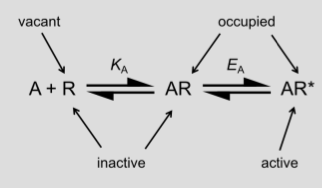
del Castillo-Katz mechanism
2
New cards
full agonist
able to elicit a maximal tissue response
3
New cards
partial agonist
cannot elicit maximal response, no matter that concentration
4
New cards
difference between full and partial agonist action
both cause conformational change, full agonist stabilises
5
New cards
Slow Channel Congenital Myasthenic Syndrome
prolonged endplate currents
6
New cards
constitutively active receptors
activate in the absence of agonist
7
New cards
ligand binding to R and R*
if L only binds to inactive - encourages formation of inactive receptors - inverse agonist/negative antagonist
if L only combines with R*, has reverse reaction - conventional agonist
if L has equal affinity for R and R*, no effect on fraction of receptors in active state - reversible competitive antagonist
if L only combines with R*, has reverse reaction - conventional agonist
if L has equal affinity for R and R*, no effect on fraction of receptors in active state - reversible competitive antagonist
8
New cards
desensitisation of receptor
can isomerise into inactive, desensitised state
G protein coupled receptors can be phosphorylated - can be followed by loss of receptors from cell surface
G protein coupled receptors can be phosphorylated - can be followed by loss of receptors from cell surface
9
New cards
spare receptors
extra to ensure maximal response reached
 Note
Note  Flashcards (101)