Bio Test 3
 Call Kai
 Learn
Learn Practice Test
 Spaced Repetition
 Match
Match Flashcards
 Knowt Play
1/89

There's no tags or description
Looks like no tags are added yet.
Name | Mastery | Learn | Test | Matching | Spaced | Call with Kai |
|---|
No analytics yet
Send a link to your students to track their progress
90 Terms
Homeostasis
maintaining relative constant internal environment
Set Point - Sensor signals the Control Center - Triggers response - Effector (cell) performs response
Parameters in the Body that would be good to regulate
body temperature, blood pH, blood pressure, blood glucose, water balance
Negative Feedback Loop
change in variable triggers response that counteracts that change and maintains homeostasis
Positive Feedback Loop
Change in variable triggers response that amplifies that change.
Endotherms
Regulators
Metabolism, body response, behaviorally
Mammals and birds
Ectotherms
Conformers
MOSTLY through behavior
Amphibians, fish, reptiles, invertebrates
Ectotherm 4 Processes
Radiation - heat transfer from warm object (sun)
Evaporation - vaporization of water from a surface (sweat)
Conduction - heat transfer between two objects by direct contact
Convection - heat transfer through movement of air or liquid (fan)
Endocrine System
signaling molecules travel directly via blood
acts throughout body
slower, long-lasting
Nervous System
electrochemical signaling travels to a specific location affecting neurons, muscle, or gland cells
faster, fleeting
specifically along dedicated routes
Neurotransmitters
Act on other neurons, muscles, or glands
Short distance across a synapse
Neurohormones
Released by neurosecretory cells
travel in the bloodstream
Peptide Hormones
Water soluble
cannot travel through plasma membrane
bind to receptor in membrane of target cell
triggers signal transduction (second messenger, kinases, etc.)
Steroid Hormones (lipids)
Lipid soluble
travel through the plasma membrane into the target cell
bind to the receptors in the cytoplasm or inside nucleus
acts as transcription factor
in blood escorted by carrier protein
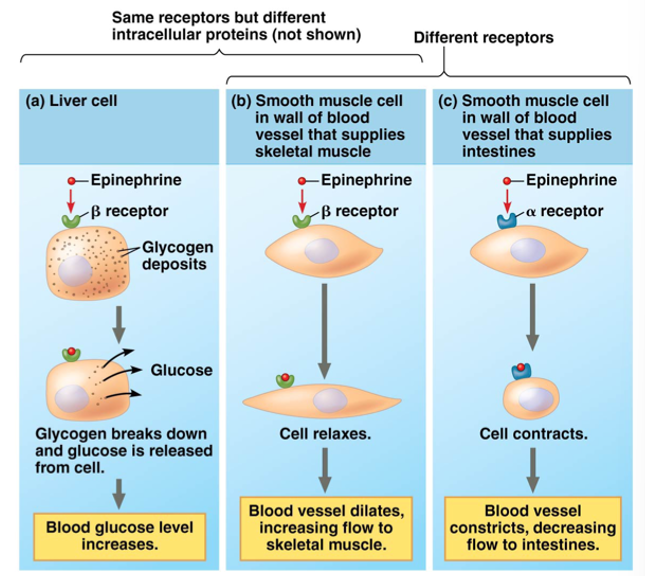
Factors Affecting Hormone Response
Receptor
Relay proteins in the signaling pathway
Glucose Regulation
Controlled by 2 different hormones produced by pancreas
Beta cells make insulin
Alpha cells make glucagon
When blood sugar rises ____ release _____
When glucose goes down, _____ make _____ to break down Liver ______
Beta Cells
Insulin
Alpha Cells
Glucagon
Glycogen
Location of Alpha and Beta Cells
Pancreas as “islets” (small endocrine organs)
Diabetes mellitus
Blood glucose levels too high
Type 1 Diabetes
Loss of insulin-producing beat cells (autoimmune or viral)
Type 2 Diabetes
Cells resist the influence of insulin and do not take up glucose
Pancreas overproduces insulin and becomes
Body eventually stops making insulin
Can be reversed
7th most common cause of death in US
Ingestion
eating or feeding
Digestion
when food is broken down into small molecules (mechanical and chemical)
Absorption (Transport)
Cells take up small molecules (and deliver to body cells)
Elimination
passing of undigested material
Mechanical Digestion
breaks food into smaller pieces, increasing surface area exposes surfaces to chemical digestion.
Chemical Digestion
cleaves large molecules into smaller molecules (protein to amino acids)
Extracellular Digestion + Body Plans
Most have Alimentary canal with compartments continuous with the body
Simple Body Plan: Gastrovascular cavity single opening (take in food OR dispel waste)
Complex Body Plan: Alimentary canal with two separate openings (mouth and anus)
Digestion Overview
Mouth: amylases break down polysaccharides
Stomach: pepsin breaks down proteins
Small intestine: further breakdown ALL molecules
Where does most digestion occur?
the duodenum of the small intestine
Large Intestine Digestive Role
Mechanical Digestion (propulsion, segmental mixing)
No Chemical Digestion
Absorption of ions, water, minerals, vitamins, and small organic molecules produced by bacteria
Small Intestine Digestive Role
Mechanical Digestion (mixing and propulsion)
Chemical Digestion of carbs, lipids, proteins, and nucleic acids.
Absorption of peptides, amino acids, glucose, fructose, lipids, water, minerals, and vitamins
Stomach Digestive Role
Mechanical Digestion (peristaltic mixing and propulsion)
Chemical digestion of proteins
Absorption of lipid-soluble substances, such as aspirin
jejunum and ileum
second and third parts of the small intestine
Huge surface area (absorption) of folds with villi, microvilli
What happens to nutrients immediately after absorption in the small intestine?
Water soluble nutrients enter blood and are carried to liver through the hepatic portal vein
liver filters toxins and drugs
Fatty acids bypass the portal and enter lymphatic system
Why must nutrient rich blood pass through the liver before reaching the heart
Detoxification of harmful substances
allows liver to regulate nutrient distribution
prevents unregulated glucose, amino acids
acts as body’s metabolic gatekeeper
Hypoosmotic
Lower solute concentration in solution, H2O into cell
Hyperosmotic
Higher solute concentration in solution. H2O moves out of cell
Animal Cells in: Hypo, Iso, Hyper
Lysed, normal, shriveled
Plant Cells in: Hypo, Iso, Hyper
Turgid, Flaccid, Plasmolyzed
Osmoconformer
Isoosmotic with its surrounding
Many marine animals
Less energy expended
Osmoregulator
controls internal osmolarity independent of the environment
freshwater animals and mammals
energy intensive
Nitrogenous Waste
Breakdown of proteins and nucleic acids
3 types: ammonia, urea, and uric acid
Ammonia
Nitrogenous waste
High toxicity, requires losing a lot of water to remove it
Aquatic fish
Urea
Nitrogenous waste
Lower toxicity but requires energy to convert ammonia to urea in liver
Amphibians, mammals, humans
Uric Acid
Non-toxic, requires most energy to make, loses least water
Birds, reptiles, insects, land snails
Transport Epithelia
Specialized epithelial cells that move solutes in controlled amounts
Osmoregulation, nitrogenous waste disposal
Complex tubular networks
Large surface area
What are the 4 excretory functions?
Filtration: water, small solutes, sugars, amino acids, nitrogenous waste filtered out of blood by BOWman’s capsule in nephron
Reabsorption: water and useful solutes are returned to blood ACTIVE TRANSPORT
Secretion: Nonessential solutes or waste are secreted out of the blood ACTIVE TRANSPORT
Excretion: Filtrate is released from the body (elimination)
How do complex body plans deal with the issue of large diffusion distance?
Circulatory systems (fluid, interconnecting vessels, and muscular pumps) are dedicated to transporting materials throughout the body
Hemolymph
Open systems like in insects have fluids ejected over certain areas and then sucked back up into the vessels. Those fluids are mixed with the interstitial fluid outside the cells and it is called hemolymph.
Arteries
Carry blood (usually oxygenated) away from the heart
Veins
Carry blood (usually deoxygenated) towards the heart to the lungs to get oxygen and get rid of carbon dioxide
Transpiration
Loss of water vapor from leaves and other aerial parts of the plant (one direction)
often through stomata
water moves high pressure to low pressure
Cohesion-Tension Hypothesis
The way water makes it all the way up the plant: transpiration provides the pull for the ascent and cohesion/adhesion transmits this pull along the entire length of the xylem
Translocation
movement of sugars inside the phloem that requires active transport (multidirectional)
Sensory Neurons
Receptors transmit information set in motion by external stimuli (touch) or internal conditions (blood pressure)
Interneurons
Integration- connect neurons in the brain or simple ganglia
Many dendrites and synaptic terminals
Ganglia
cluster of nerve cell bodies
Motor Neurons
Transmit signals to muscle cells to contract
Can trigger glandular activity
Many dendrites but few synaptic terminals
Long axons
Composition of Central Nervous System
Brain and Spinal Cord for processing and integration with interneurons
Composition of Peripheral Nervous System
Cranial Nerves
Spinal Nerves
Peripheral Nerves
Afferent/sensory neurons transmit information to CNS
Efferent/motor neurons transmit information away from CNS
Dendrites
Branched projections that receive signals
Axons
Long extension that transmit signals, electric signals originating from Axon Hillock
Synapse
junction between sending and receiving cells; chemical signals
Where is electrical signal converted into chemical signal?
the synapse
Autonomic Nervous System
regulates internal body and controls involuntary and automatic behaviors like breathing and heartbeat
comprised of Sympathetic, Parasympathetic and Enteric Divisions
Sympathetic Nervous System
1/3 of Autonomic NS
flight or flight, stimulates body during stress
Parasympathetic Nervous System
1/3 of Autonomic NS
rest and digest, relaxes after the stress has passed
Enteric Nervous System
1/3 of Autonomic NS
controls digestive system and intestinal tract
Motor System
Skeletal Motor Control
Resting Potential
Membrane potential of resting neuron
around -70mV
Sodium Potassium pump goes against the gradient, pumping 3 Na+ out and 2 K+ in
There are more K + ion channels, which helps keep resting potential
What transport mechanism maintains the resting potential (nothing stimulating the neuron)?
Primary active transport in the Sodium Potassium ATPase pump
ATP is used to move ions against the gradient, 3 Sodium Out, 2 Potassium In
What ion channel states exist at resting potential
Na + channels closed (prevents Na+ leakage and accidental firing of action potential)
K + channels closed
Sodium Potassium Pump maintains resting potential (potential energy for the action potential)
What causes depolarization during an action potential
signal occurs and voltage gated Na+ channels open
Na + flows into cell
membrane becomes less negative
threshold reached, action potential fires
What causes repolarization and the undershoot phase?
Na+ channels inactivate
K+ channels open (resets resting potential)
K+ flows out of the cell
Membrane becomes negative again
Continued K+ efflux causes undershoot (hyperpolarization)
Why can’t another action potential occur immediately after one?
Na + channels are inactivated
Membrane resets after refractory period
Undershoot makes the neuron temporarily resistant to firing
Na
What does it mean to reach threshold, why does it cause an action potential to fire
Depolarization means inside of neuron becomes less negative
stimulus opens some sodium channels, letting sodium enter
if enough sodium enters, the membrane reaches a threshold potential difference where the sodium influx triggers even more sodium channels to open, automatically firing an action potential
Myelin Sheath
allow narrow diameters of axons with high speed of action potential.
Vertebrate axons are mainly myelinated, while invertebrate axons are not.
Factors Affecting Conduction Speed
Axon Diameter: large diameter means low internal resistance and faster conduction
Myelination: provides insulation preventing leak of ions and allow for action potentials to jump between Nodes of Ranvier.
Nodes of Ranvier
small, uninsulated gaps in the myelin sheath and have a high concentration of voltage-gated ion channels which allow action potentials to jump (saltatory conduction)
Chemical Synapses
flexible in function
require chemical neurotransmitters
most common
play role in memory and learning
Electrical Synapses
electrical current flows directly from neuron to neuron (gap junction)
faster, instantaneous
rare
Types of Sensory Receptors
Mechanoreceptors: hearing, balance, pressure, touch
Electromagnetic Receptors: electromagnetic energy, light
Thermoreceptors: heat and cold
Pain Receptors: sense extreme pressure/temperature, damaging chemicals
Chemoreceptors: solute concentration, specific molecules
Photoreceptor Cells
Rods: sensitive to light, enables night vision
Cones: provide color vision
Found in Retina
What is the relationship between Loop of Henle length and an animal’s water‑conservation needs?
Species in arid environments evolve longer Loops of Henle, which create a steeper medullary osmotic gradient that enables greater water reabsorption and therefore more concentrated urine to minimize water loss.
Glial Cell
Nourish and support health of neurons
What cells are the myelin sheath comprised of?
Glial Cells: Oligodendrocytes (CNS) and Schwann Cells (PNS)
Microglia
Glial Cells in the central nervous system that function as scavengers, removing dead cells and harmful pathogens
Ependymal Cells
Glial Cell which produces cerebrospinal fluid that cushions the brain and circulates nutrients
Astrocytes
Glial Cells with many functions, maintain chemical composition of fluid that surrounds neurons, replace neurons, provide nutrients to neurons, and form blood-brain barrier
Iris
Controls the amount of light entering the eye

