Unit 3 20th Century-The Cold War
 Call Kai
 Learn
Learn Practice Test
 Spaced Repetition
 Match
Match Flashcards
 Knowt Play
1/34

There's no tags or description
Looks like no tags are added yet.
Name | Mastery | Learn | Test | Matching | Spaced | Call with Kai |
|---|
No analytics yet
Send a link to your students to track their progress
35 Terms
Yalta Conference
-February 4-11th, 1945, Crimean Peninsula, Russia
-Meeting between the Allies: Churchill (GB), FDR (US), Stalin (USSR)
-Meant to outline what would happen in the post WWII world
-Germany was on the ropes and formally surrendered in May
Harry S Truman
33rd President of the US. 1945-1953. Succeded FDR
Winston Churchill
Prime Minister of the UK 1940-1945 during WWII and then again in 1951-1955
Josef Stalin
(1878–1953) was the dictator of the Soviet Union from the mid-1920s until his death, transforming it into a totalitarian industrial and military superpower. He is crucial for leading the USSR to victory in WWII, initiating the Cold War, and enacting policies resulting in millions of deaths through forced collectivization, famine, and political purges
United Nations
-The ultimate “supranational” organization
-Something that FDR wanted (some ideas of the UN contained in the Atlantic Charter) to pursue, much like Wilson and the “League of Nations” after WWI, push for it came at Yalta
-50 nations gathered together in San Francisco in June of 1945, drafting the UN charter
-Charter ratified in October of 1945 by the five permanent security council members
-Today, ever “recognized” country is part of the UN…UN is the ultimate judge of a country’s sovereignty
Postdam Conference
“Big Three”
Confirmed agreements made in Yalta to
Divide Germany into 4 occupation zones
Demilitarize and disarmed German
Denazification of German society
The creation of free institutions
Prosecution of war criminals
Postponed reconstitution of national German government
Agreed to the extent of war reparations
Russia was allowed to take reparations from the Soviet Zone, and also 10% of the industrial equipment of the western zones as reparations. America and Britain could take reparations from their zones if they wished.
Issued the “Potsdam Declaration” threatening Japan with “prompt and utter destruction” if did not surrender (Soviets did not sign the declaration-had yet to declare war)
George F Kennan/Containment
-To hold within something, keep in one place, stop the spread of
-US policy that is adopted in order to prevent the spread of Communism, idea hatched by George Kennan as a result of the Long Telegram
-US realized the the Soviet Union was not going anywhere, but Communism should not be allowed to influence more parts of the world
-Shaped US foreign policy during the Cold War
Iron Curtain
-Theoretical boundary drawn between Communist Eastern Europe and Capitalist Western Europe
-Term first used by Winston Churchill in a speech he gave at a college in Missouri in 1946
-Represents the spheres of influence of the US and USSR in Europe
-At its heart is Germany
Truman Doctrine
-Direct response to instability in Greece and Turkey in 1946 (British had ceased their support for Greece)
-Truman gave a speech to Congress that stated without aid those two countries would fall to Communism at the hands of the Soviets
-The “doctrine” outlined American foreign policy for years to come, contain the “disease” of Communism and don't allow it to spread
Marshall Plan
-Drafted on June 5th, 1947
-Aid package from the US to Western Europe
-Why only Western Europe?
-$13 billion ($130 billion 2016) to help rebuild
-Promote US values and interests
Berlin Airlift
-Control of Germany was at the heart of the Cold War beginnings, establishing an economy and currency with the ultimate “goal” of German independence
-In 1948, US, GB, and France decided to combine their parts into one nation (West Germany)
-Berlin divided as well, but located in Soviet controlled East Germany
-USSR wanted to strike quickly and see if they could take total control of Berlin
NATO
-North Atlantic Treaty Organization
-Created by the North Atlantic Treaty signed in 1949 by: Belgium, Canada, Denmark, France, Iceland, Italy, Luxembourg, Netherlands, Norway, Portugal, United Kingdom, and the United States
-A military alliance that pledged support in case of attack, an attack on one is an attack on all
-First peacetime military alliance the US ever joined
Manhattan Project
Code name of the research project that developed the atomic bomb, Los Alamos, NM (August, 1942)
-Headed by J. Robert Oppenheimer, who expanded and developed the research of nuclear fission and the possibility of the weapon
-The US was fearful Germany may develop the technology first, so they worked extensively on developing the weapon in utter secrecy
Hiroshima & Nagasaki
-August 6th & August 9th, 1945
-129,000-246,000 people killed as a result, mostly civilians
-Cities reduced to nothing, they were important for military industry (Nagasaki chosen based on weather)
-A specially modified B-29 bomber named the “Enola Gay” dropped the first bomb on Hiroshima
-Japan formally surrendered days later
Chiang Kai-shek
Ruled in the southern and eastern china.
Relied heavily on aid from United States.
Struggled with inflation and a failing economy.
Suffered from weak leadership and poor morale
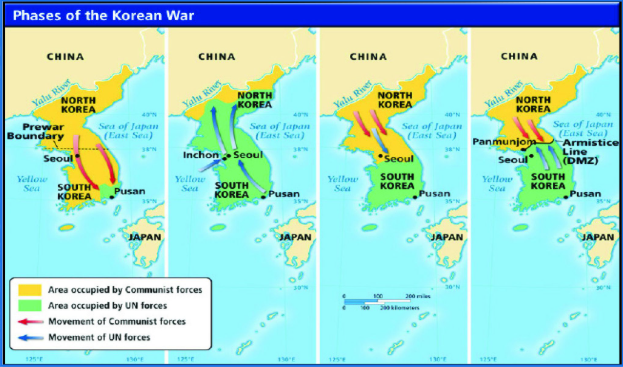
Korean War
-On June 25, 1950, North Korea invaded South Korea
-Truman called for a special session of the UN Security Council to contain communism
-The Security Council Authorized a UN force to defend South Korea (Only US, France, GB)
-The USSR was boycotting the Security Council for the US’s refusal to recognize Communist China (not changed until 1971)
-Congress supported Truman but did not declare war, troops who were occupying Japan were moved to Korea who were not trained or equipt for war
38th Parallel
The 38th parallel north is a circle of latitude north of the Earth's equatorial plane, which famously served as the boundary dividing North and South Korea following World War II in 1945. Originally selected by U.S. planners, it separated Soviet occupation in the north and American occupation in the south, later becoming the boundary between North and South Korea before and after the Korean War.
Mao Tse-tung (Zedong)
Ruled in northern china.
Relied heavily on financial aid from soviet union.
attracted peasants with promises of land reform.
benefited from experienced guerrilla army and a highly motivated leadership.
Douglas MacArthur
American military leader in the Pacific theater during World War II. He was also famed for commanding United Nations forces in the Korean War.
Dwight D. Eisenhower
-Won the Presidency in 1952
-Famous for his role in WWII
-Elected based on the promise that he would continue containment and be tough on Communism
-Military background greatly influenced his presidency
Brinkmanship
-Comparable to the game “chicken,” but involving nukes
-Soviet and US governments had a commitment to look like they were tough on capitalism/communism
-Both sides committed to building up nuclear capabilities
-Escalating threats and promises of retaliation that would have resulted in mutual destruction
New Look
-Eisenhower was more of an economic conservative, yet also was a military man
-Wanted to balance cutting spending & increasing our readiness
-The “New Look” reworked military spending top build up a fleet of planes and ships that could deliver nuclear weapons, while also increasing our supply of nuclear weapons
-More “bang for the buck”
Nikita Khrushchev
-Emerged as the Communist party leader and leader of the Soviet Union after Stalin’s death in 1953
-Committed to being tough on Capitalism, cut spending on traditional military projects in favor of missile programs
-Less oppressive than Stalin, but just as committed to upholding the Cold War
Warsaw Pact
a collective defense treaty and military alliance between the Soviet Union and seven Eastern European communist states—Albania, Bulgaria, Czechoslovakia, East Germany, Hungary, Poland, and Romania. Formed as a direct response to West Germany joining NATO, its primary purpose was to act as a communist counterweight to Western military power while strengthening Soviet control over its satellite states.
Eisenhower Doctrine
a U.S. foreign policy commitment promising military and economic aid to any Middle Eastern nation resisting communist aggression, authorized by President Dwight D. Eisenhower to check Soviet influence in the region. It extended the policy of containment, previously focused on Europe, to the Middle East.
Arms race
each nation trying to build larger and stronger atomic weapons and spending more money on the military
Military Industrial Complex
an informal, powerful alliance between a nation’s military, defense industry, and political leaders, designed to maintain a permanent, large-scale armaments industry.
HUAC/Blacklist
House Un-American Activities Committee, formed in 1938 but increased activities post 1945
-Charged with investigating Communist activities/people in the United States and neutralizing the red threat, using the constitutional authority of Congress to investigate
-Also tasked with locating Soviet spies and investigating their actions in order to lead to arrests
Alger Hiss
-Worked within the State Department in the 1940s
-Accused of being a Soviet spy in 1948 by a former Soviet spy
-HUAC was all over it
-Evidence was a bit sketchy, but jailed due to perjury (lying in the courtroom)
-Legitimized the role of HUAC to the American people
Joseph McCarthy
-Senator from Wisconsin
-Needed something for voters to rally around in order to gain reelection in 1952
-Began making wild accusations of Communist influence in the government in 1950, starting with a speech in West Virginia
-People listened, got scared that he was right and the government was being taken over
-“McCarthyism”
The Rosenbergs
-Young American couple who were accused of passing atomic secrets to the USSR
-Convicted of espionage and sentenced to death, their appeal to President Eisenhower was rejected
-They were executed on June 19th, 1953, leaving behind two children
-First married couple executed in American history
Fullgencio Batista
Batista was a brutal leader who was seen as cozy with the US, thus representative of the “imperialist US”
-At one time was “democratically” elected, but spent most of his time in power as an authoritarian leader
Fidel Castro
Castro was a charismatic, young Cuban lawyer
-He viewed the Batista regime as corrupt and as a US puppet
-Believed the US and other western countries exploited the Latin American people and that Latin Americans should assert their independence
-Organized a coup in 1953
Berlin Wall
built the Berlin Wall starting on August 13, 1961, to stop a massive, destabilizing exodus of citizens escaping to the West. It was built as a concrete "Antifascistischer Schutzwall" (anti-fascist protective wall) to stop the flow of people and solidify Soviet control over East Berlin.
Cuban Missile Crisis
a 13-day standoff in October 1962 between the U.S. and Soviet Union, sparked by the discovery of Soviet nuclear missiles in Cuba. Considered the closest the world came to nuclear war, it was resolved through diplomacy, where the USSR removed the missiles in exchange for a U.S. promise not to invade Cuba.

