Ch 15 ISP 205
 Studied by 0 people
 Call Kai
 Learn
Learn Practice Test
 Spaced Repetition
 Match
Match Flashcards
 Knowt Play
1/15

Earn XP
Description and Tags
The Milky Way Galaxy
Name | Mastery | Learn | Test | Matching | Spaced | Call with Kai |
|---|
No analytics yet
Send a link to your students to track their progress
16 Terms
How did the shape and color of our galaxy arise from the orbital motions and ages of stars?
Disk stars all orbit in the same direction with up and down motion
Bulge and halo stars have random orientations
How does our galaxy recycle gas from dying stars into new stars?
Stars release gas (H+He) into space when they become planetary nebulae/supernovae.
Stellar winds and gravity condense the gas and dust into clouds
Characteristics of Halo stars
Randomly orientation and elliptical orbit. Older with less metal.
Characteristics of disk stars:
Nearly circular orbits in a single plane. Younger with more metal
Why do disk galaxies form more stars?
Cool gas (H) is concentrated and gathered quickly in a thin, rotating disk
Why does the disk have the coldest gas?
Gas cools down after leaving the hotter halo, and is compressed into dense molecular clouds
Why do disk stars bob up and down as they orbit the galaxy?
The gravity of other disk stars pulls them toward the disk.
Why does the Halo have the gas hottest?
Hot gas is always being recycled, heated, and cooled.
Energized by supernova explosions and galactic mergers.
Why would you find an ionization nebula in the disk of a galaxy.
The disk is rich in gas and dust, providing fuel for active star formation.
The best measurements of a central black hole’s mass come from:
The orbits of stars in the galactic center because they are vert
How do astronomers use star orbits to measure central black hole's mass?
Track individual stars orbiting the galactic center over many years.
Apply Kepler's Third Law (Newton’s ver.) to calculate the Black Hole’s mass, which is contained within its orbits
Where are most of the Milky Way's globular clusters found?
In the Halo where they formed very early.
How do we determine the Milky Way's mass outside the Sun's orbit?
Observe the orbital speeds and distances of stars and gas clouds far from the galactic center.
Use Kepler's Laws (Newton's ver.) to relate their motion to the total gravitational pull.
Why would you least expect to find an ionization nebula in the Halo?
The Halo doesn’t have the necessary ingredients
For an ionization nebula (emission nebula) to form:
A giant cloud of gas and dust (a nebula)
Form near a source of high-energy UV light
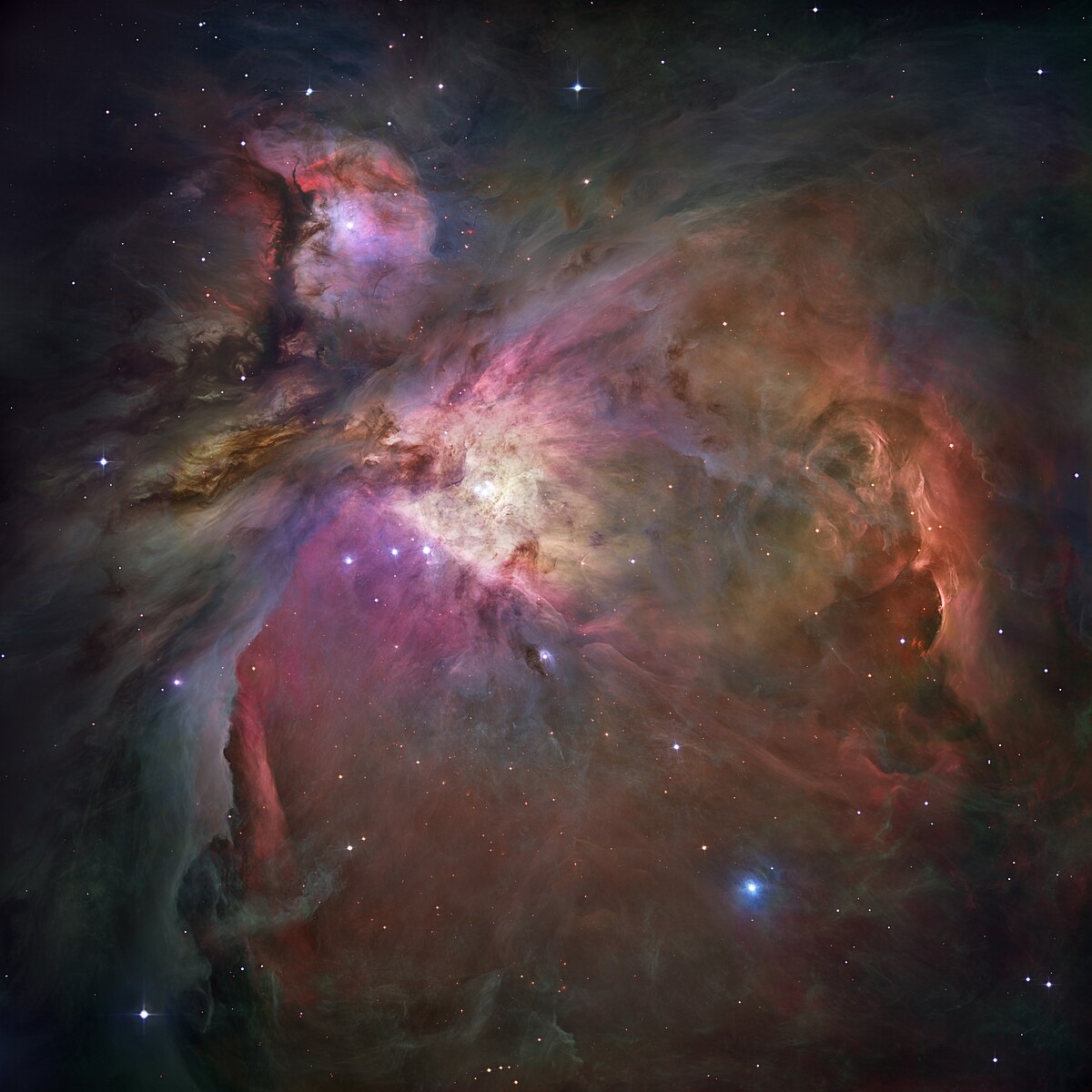
Ionization nebula
a cloud of gas that glows because it is energized by a nearby hot star
 Note
Note  Flashcards (33)