Chapter 12: Biliary Tract and Upper Gastrointestinal System
 Studied by 0 people
 Call Kai
 Learn
Learn Practice Test
 Spaced Repetition
 Match
Match Flashcards
 Knowt Play
1/126

There's no tags or description
Looks like no tags are added yet.
Name | Mastery | Learn | Test | Matching | Spaced | Call with Kai |
|---|
No analytics yet
Send a link to your students to track their progress
127 Terms
The liver is located primarily in the ____ of the abdomen.
A) LLQ
B) RLQ
C) RUQ
D) LUQ
C) RUQ
The liver is divided into ____ major and minor lobes.
A) three
B) four
C) two
D) six
B) four
The liver secretes approximately ____ mL of bile per day.
A) 100 to 250
B) 500 to 700
C) 800 to 1000
D) 1200 to 1500
C) 800 to 1000
The main function of bile is to:
A) break down cholesterol.
B) emulsify fats.
C) begin the digestion of proteins.
D) begin the digestion of complex sugars.
B) emulsify fats.
Which aspect of the gallbladder is located most posterior within the abdomen?
A) Fundus
B) Body
C) Neck
D) Apex
C) Neck
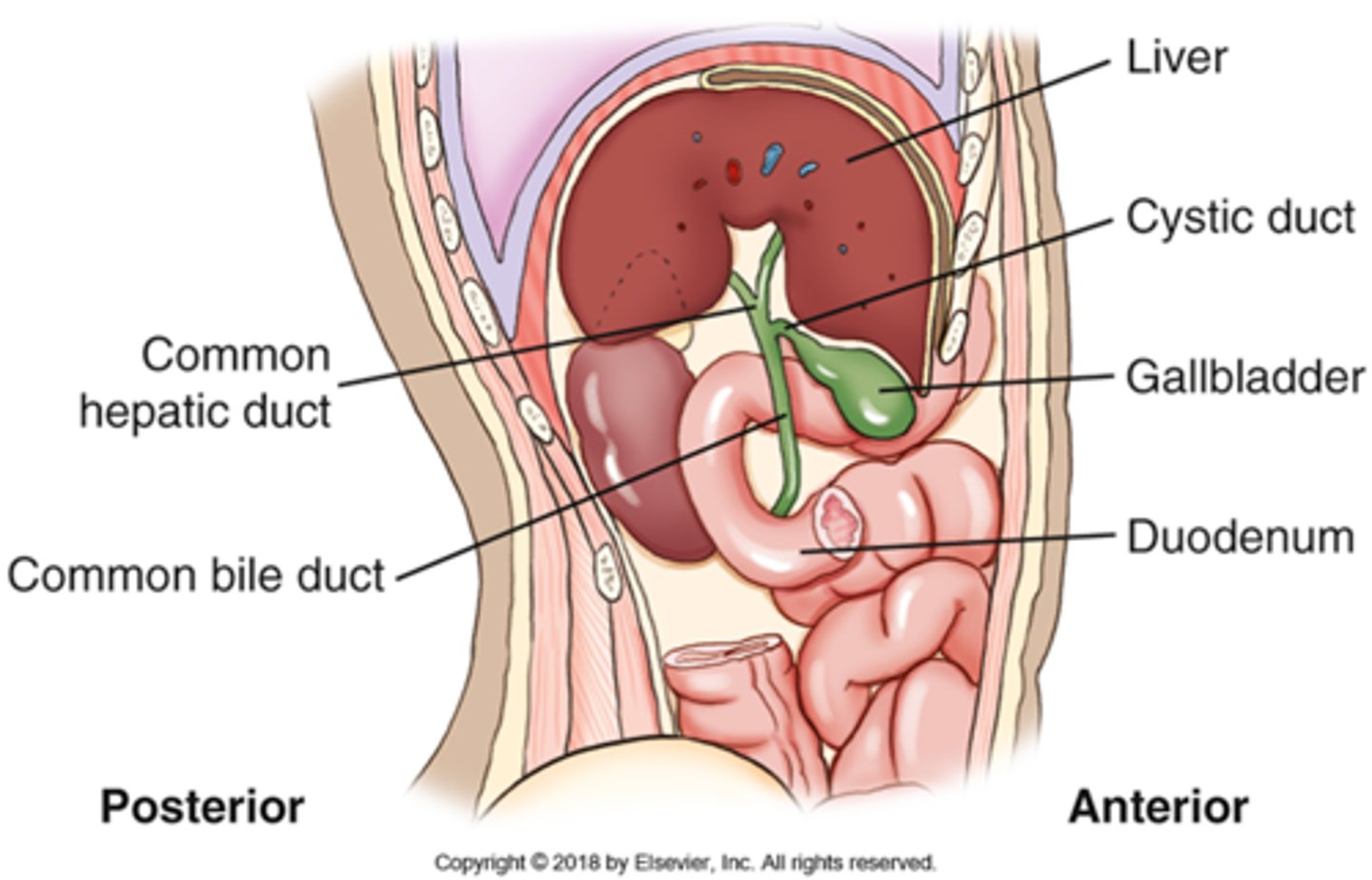
The average adult gallbladder is ____ cm long and ____ cm wide.
A) 7 to 10; 3
B) 4 to 6; 2
C) 12 to 15; 5 to 6
D) 2 to 3; 1
A) 7 to 10; 3
What is the primary purpose of the membranous folds located within the cystic duct?
A) Produces cholecystokinin
B) Prevents gallstones from entering the gallbladder
C) Provides blood supply to the gallbladder
D) Prevents distention or collapse of the cystic duct
D) Prevents distention or collapse of the cystic duct
Where is bile formed?
A) Gallbladder
B) Duodenal mucosa
C) Liver
D) Pancreas
C) Liver
Which of the following functions are performed by the gallbladder?
A) Storage of bile
B) Concentration of bile
C) Contraction and release of bile
D) All of the above
D) All of the above
What is a primary function of cholecystokinin?
A) Serves as an enzyme to break down certain food nutrients
B) Stimulates the production of bile
C) Stimulates the gallbladder to contract
D) Inhibits the formation of gallstones.
C) Stimulates the gallbladder to contract
Where is cholecystokinin produced?
A) Duodenal mucosa
B) Liver
C) Gallbladder
D) Pancreas
A) Duodenal mucosa
What is an older term for the pancreatic duct?
A) Duct of Wirsung
B) Hepatopancreatic duct
C) Duct of Langerhans
D) Ampulla of Vater
A) Duct of Wirsung
What is an older term for the hepatopancreatic sphincter?
A) Duodenal papilla
B) Sphincter of Vater
C) Duodenal sphincter
D) Sphincter of Oddi
D) Sphincter of Oddi
Which aspect of the gallbladder is labeled 1?
A) Neck
B) Fundus
C) Body
D) Apex
B) Fundus
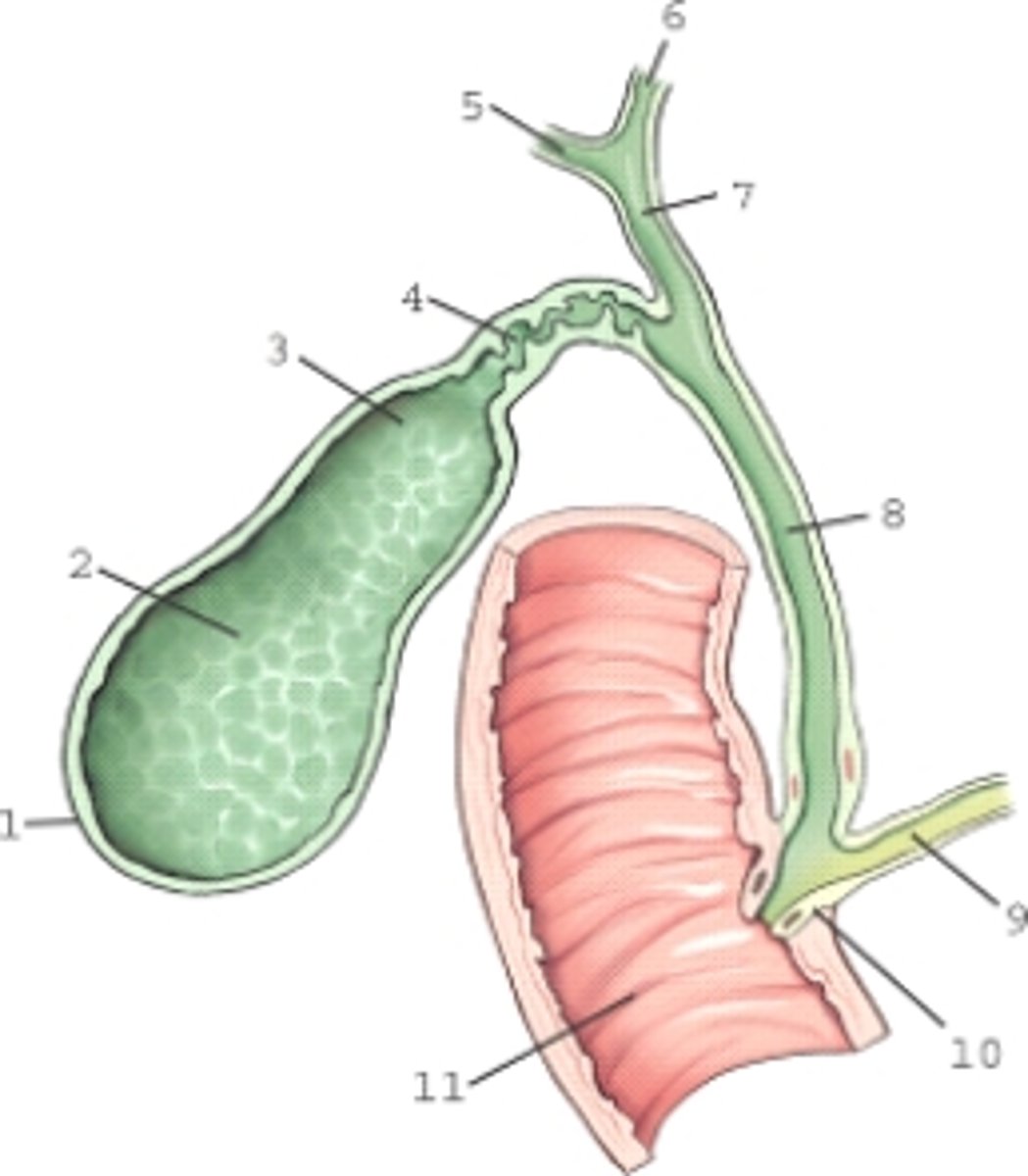
Which biliary structure is labeled 4?
A) Cystic duct
B) Common bile duct
C) Common hepatic duct
D) Right hepatic duct
A) Cystic duct
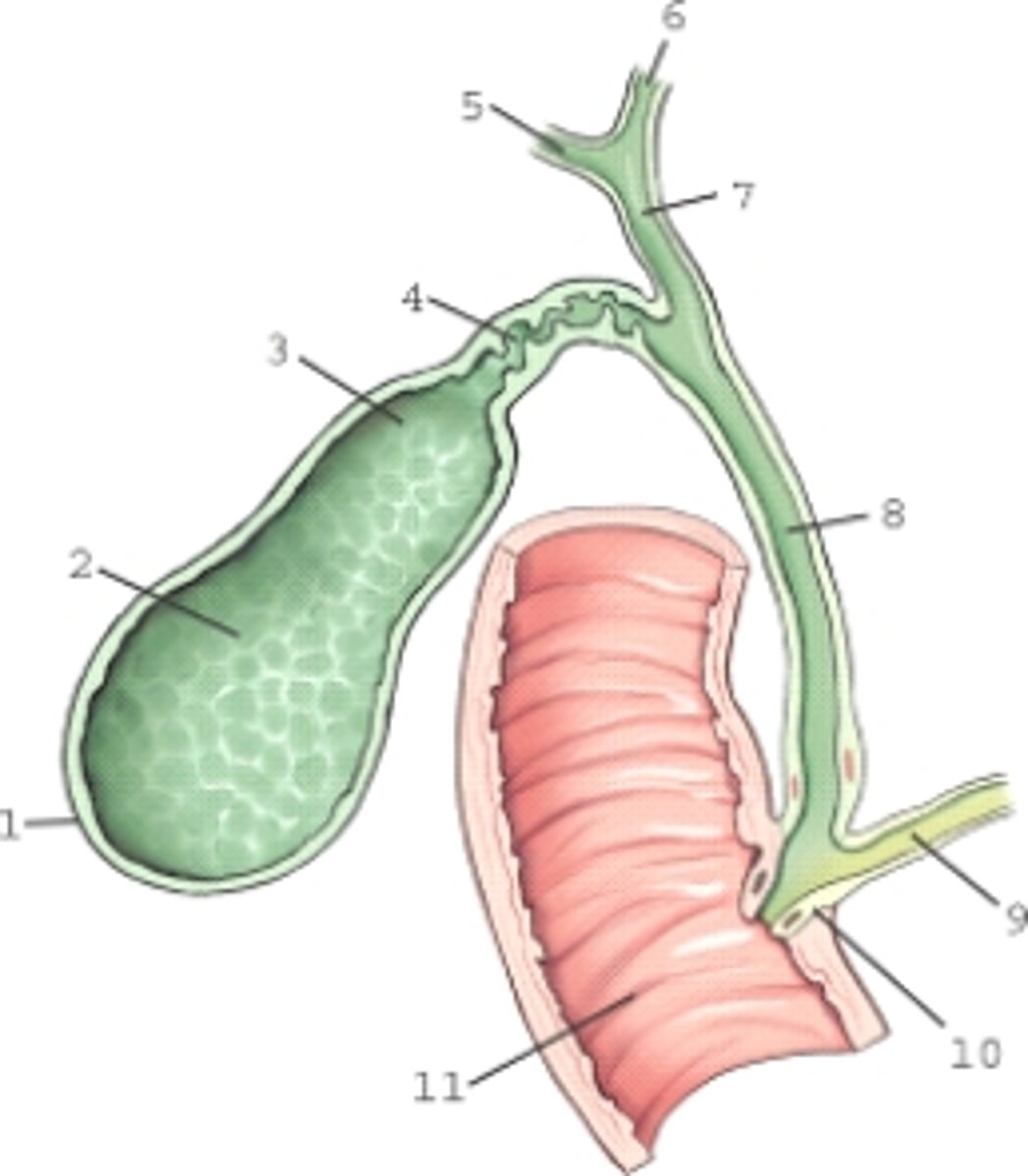
Which structure is labeled 6?
A) Cystic duct
B) Pancreatic duct
C) Right hepatic duct
D) Left hepatic duct
D) Left hepatic duct
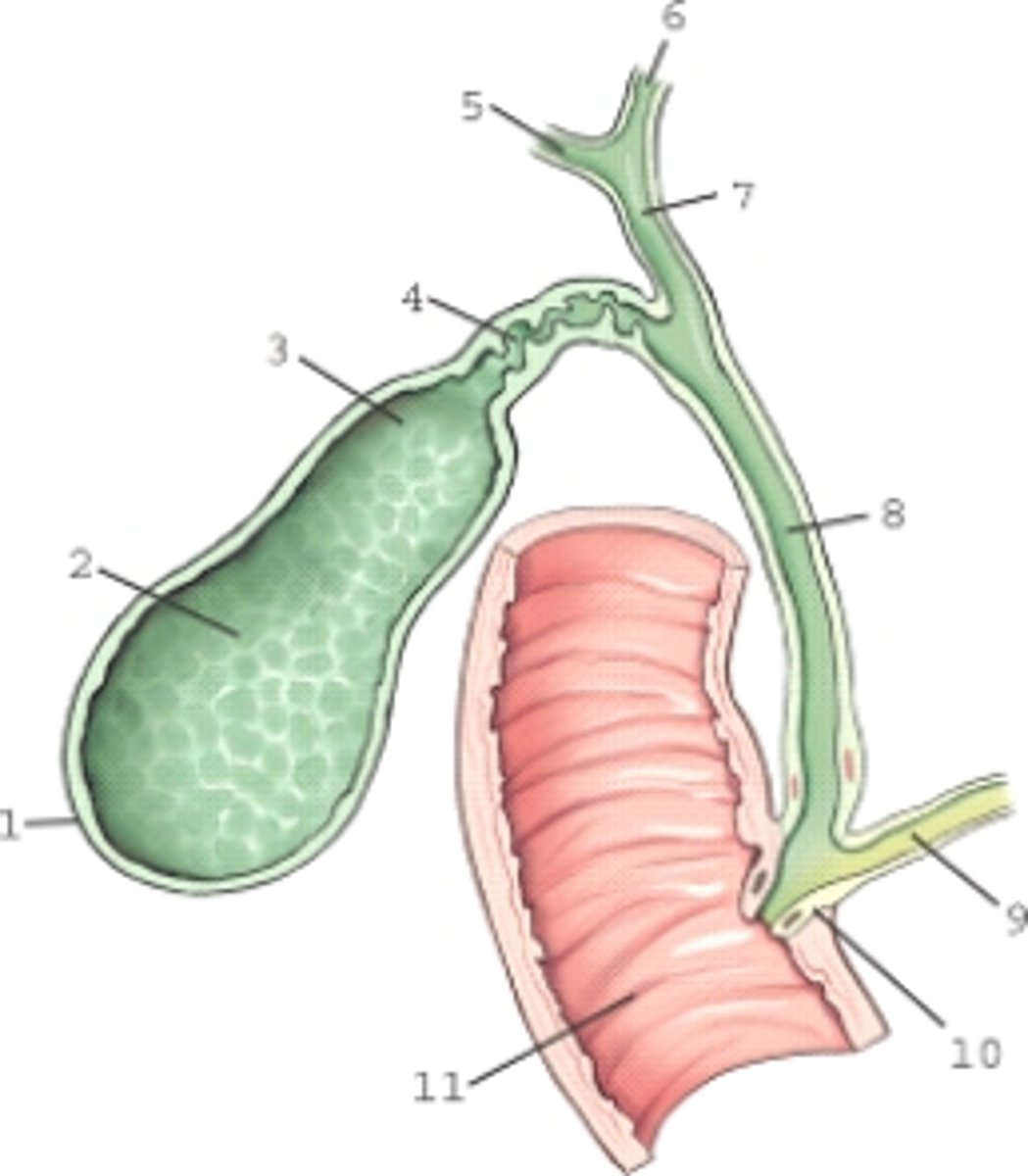
Which structure is labeled 9?
A) Pancreatic duct
B) Common bile duct
C) Cystic duct
D) Common hepatic duct
A) Pancreatic duct
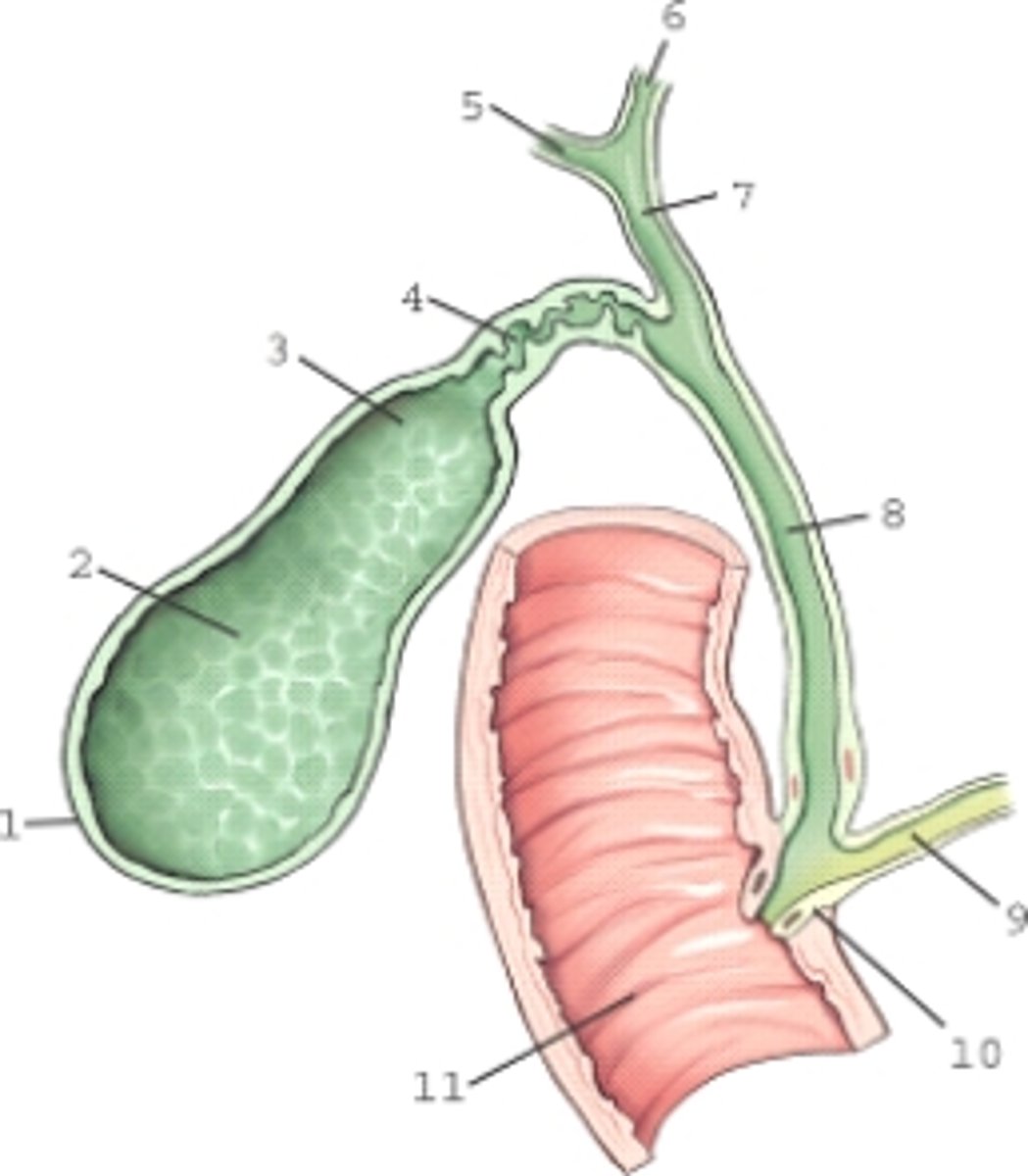
Which region of the biliary system is labeled 10?
A) Duct of Vater
B) Hepatopancreatic ampulla
C) Duct of Wirsung
D) Hepatopancreatic sphincter
D) Hepatopancreatic sphincter
"Chole-" is a prefix for terms pertaining to the:
A) gallbladder.
B) ducts.
C) bile.
D) liver.
C) bile.
Radiographic examination of the biliary ducts only is termed:
A) cholecystography.
B) cholangiography.
C) cholelithiasis.
D) cholecystocholangiography.
B) cholangiography.
Which of the following structures is not considered to be an accessory organ of digestion?
A) Liver
B) Pancreas
C) Salivary glands
D) Kidneys
D) Kidneys
Saliva contains certain enzymes to begin the digestion of:
A) starch.
B) minerals.
C) proteins.
D) lipids.
A) starch
The act of swallowing is termed:
A) mastication.
B) digestion.
C) deglutition.
D) aphasia.
C) deglutition.
Which of the following structures is not one of the salivary glands?
A) Parotid
B) Sublingual
C) Submandibular
D) All of the above are salivary glands.
D) All of the above are salivary glands.
The esophagus is located ____ to the larynx.
A) anterior
B) posterior
C) inferior
D) proximal
B) posterior
The aortic arch and the _____ create a normal indentation seen along the lateral border of the esophagus.
A) pulmonary artery
B) left primary bronchus
C) pulmonary veins
D) superior vena cava
B) left primary bronchus
Which two forces or processes propel food down the esophagus?
A) Peristalsis and gravity
B) Peristalsis and rhythmic segmentation
C) Gravity and deglutition
D) Deglutition and mastication
A) Peristalsis and gravity
The opening between the stomach and esophagus is termed the:
A) cardiac antrum.
B) cardiac notch.
C) esophagogastric junction.
D) esophagocardiac junction.
C) esophagogastric junction.
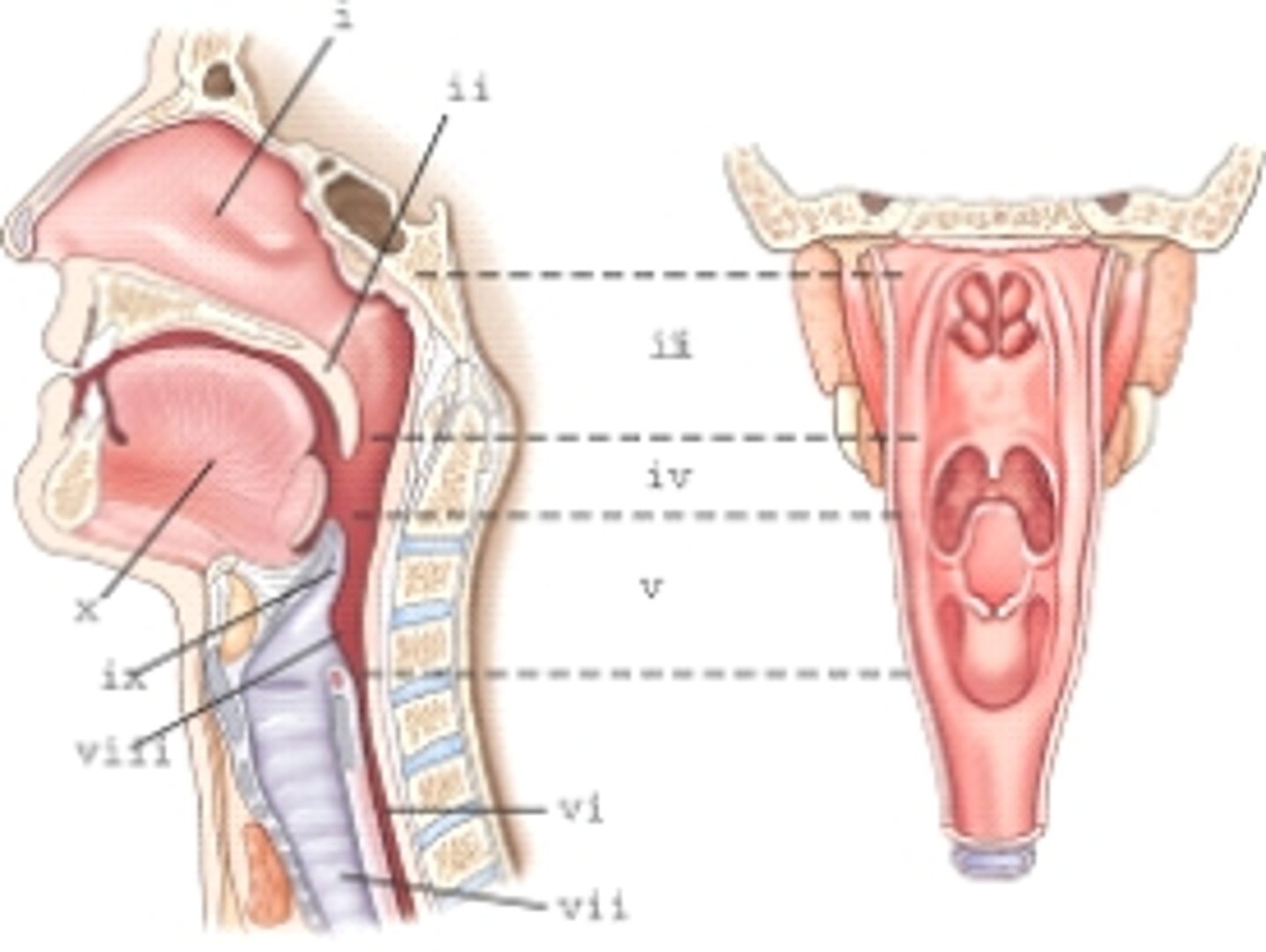
Part ii refers to the:
A) soft palate.
B) tonsils.
C) hard palate.
D) epiglottis.
A) soft palate.
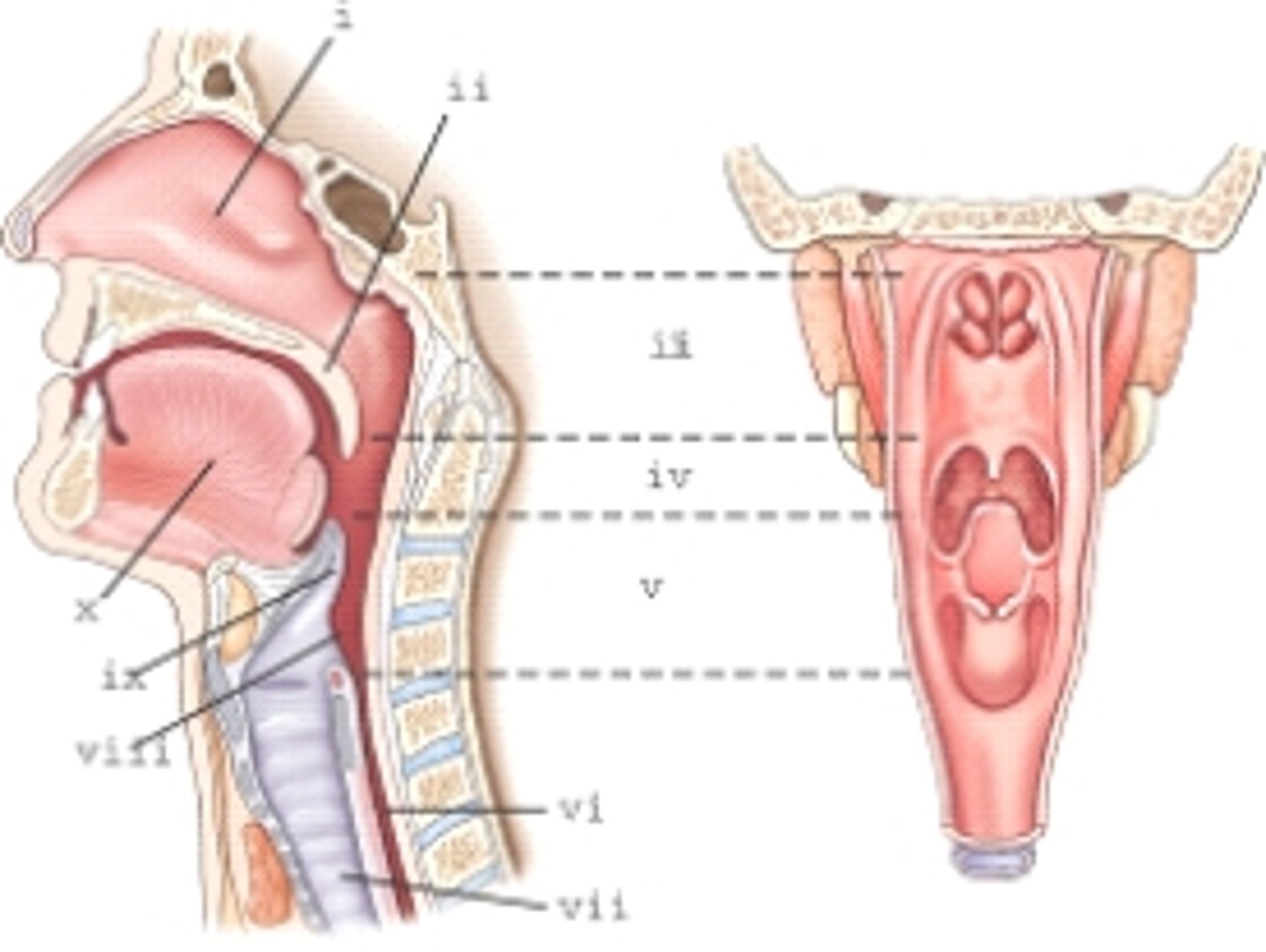
Part iv refers to the:
A) laryngopharynx.
B) nasopharynx.
C) oropharynx.
D) posterior oral cavity.
C) oropharynx.
Part ix refers to the:
A) soft palate.
B) tonsils.
C) uvula.
D) epiglottis.
D) epiglottis.
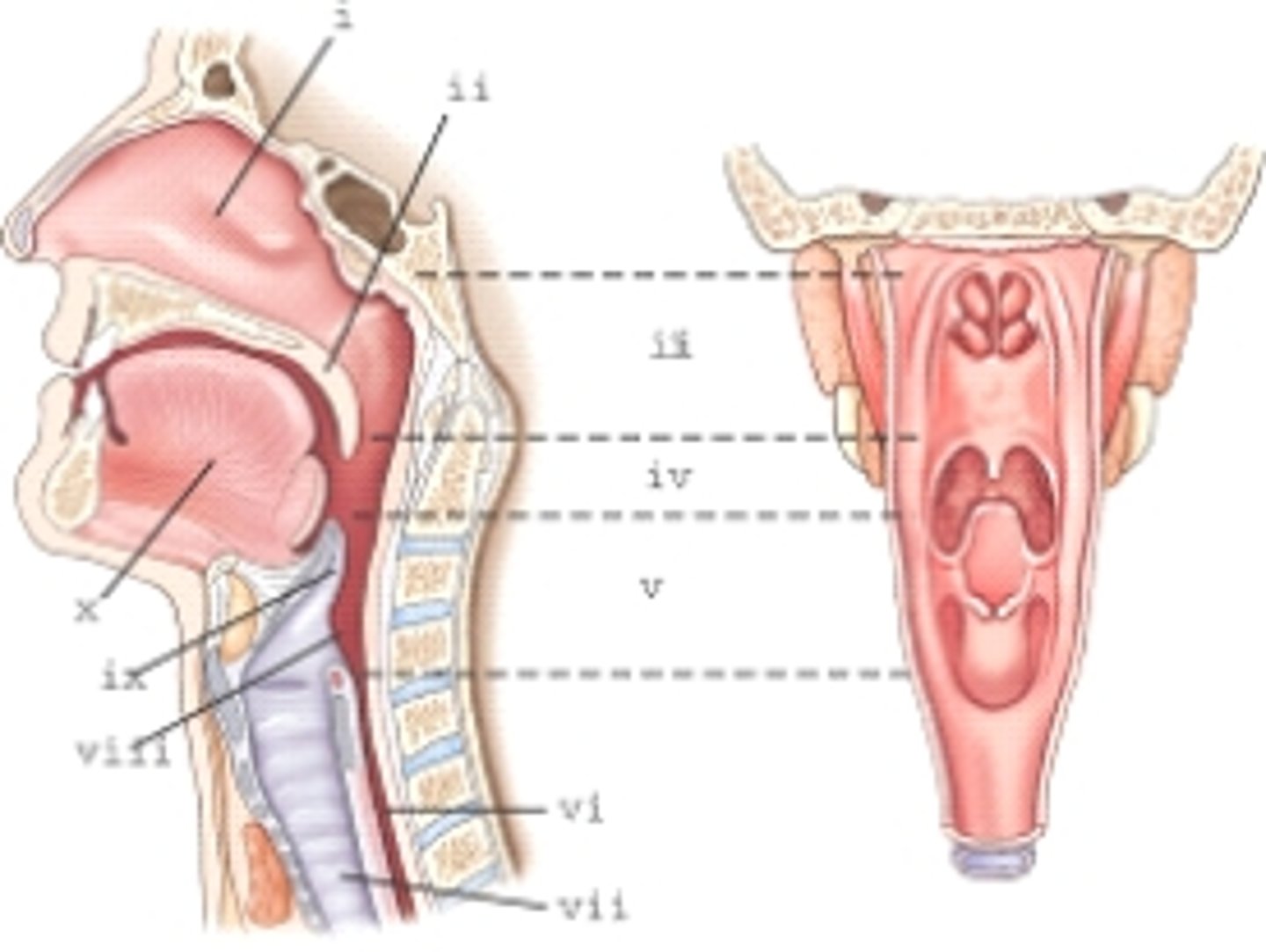
Part iii refers to the:
A) nasopharynx.
B) laryngopharynx.
C) oropharynx.
D) nasal cavity.
A) nasopharynx.
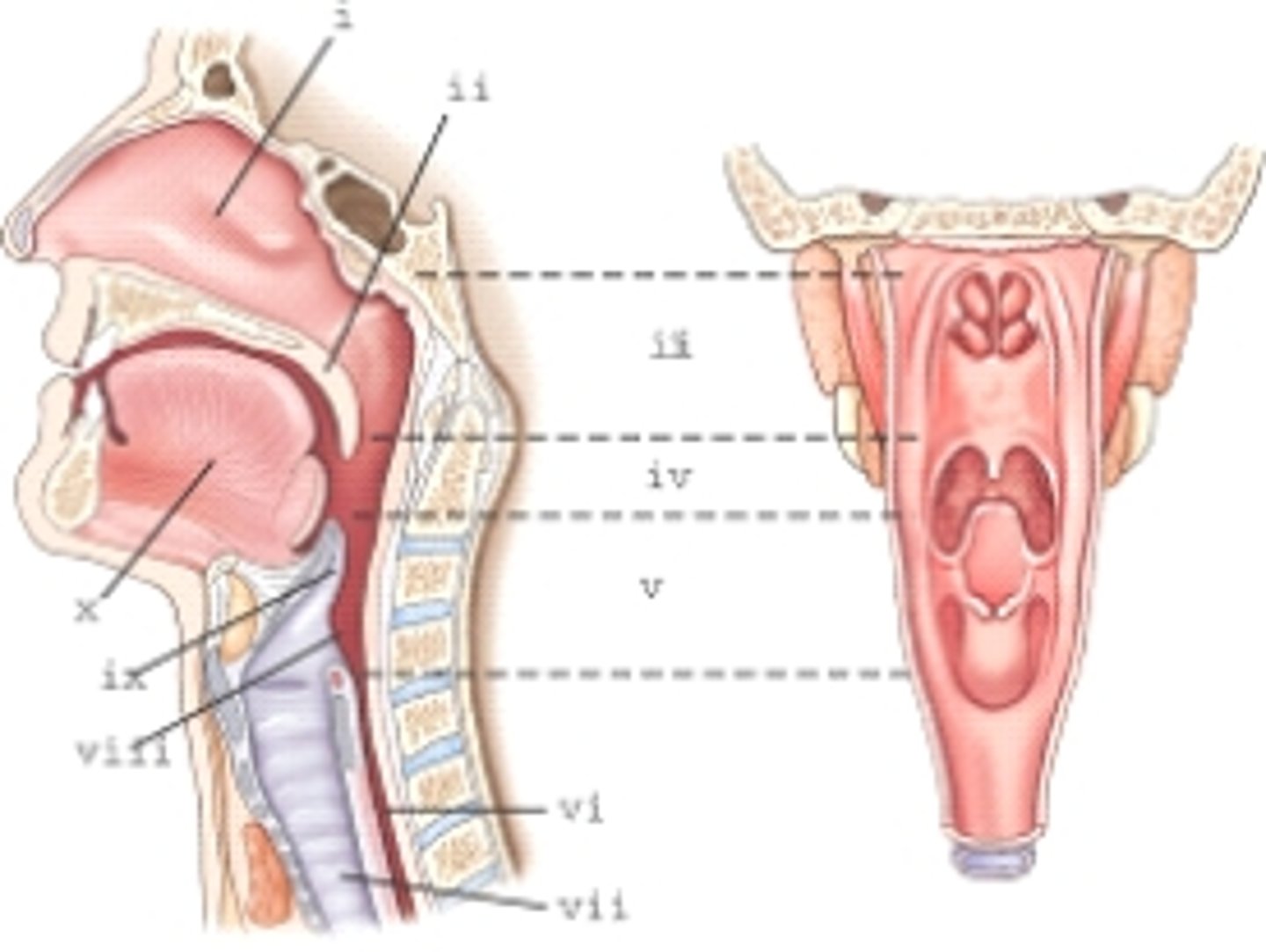
Part vii refers to the:
A) esophagus.
B) trachea.
C) spinal cord.
D) larynx.
B) trachea.
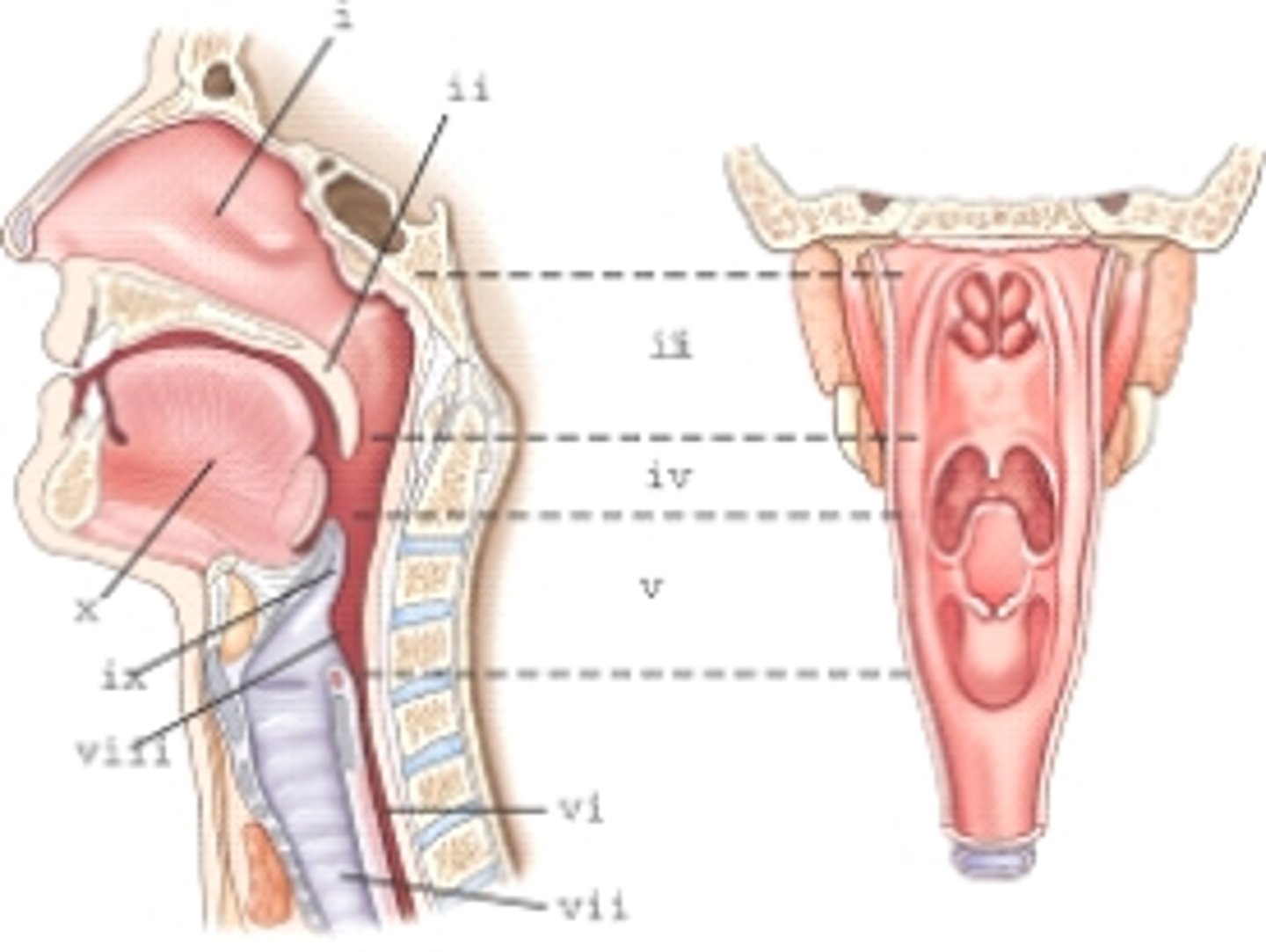
Part i refers to the:
A) nasal sinus.
B) maxillary sinus.
C) nasal cavity
D) upper oral cavity.
C) nasal cavity
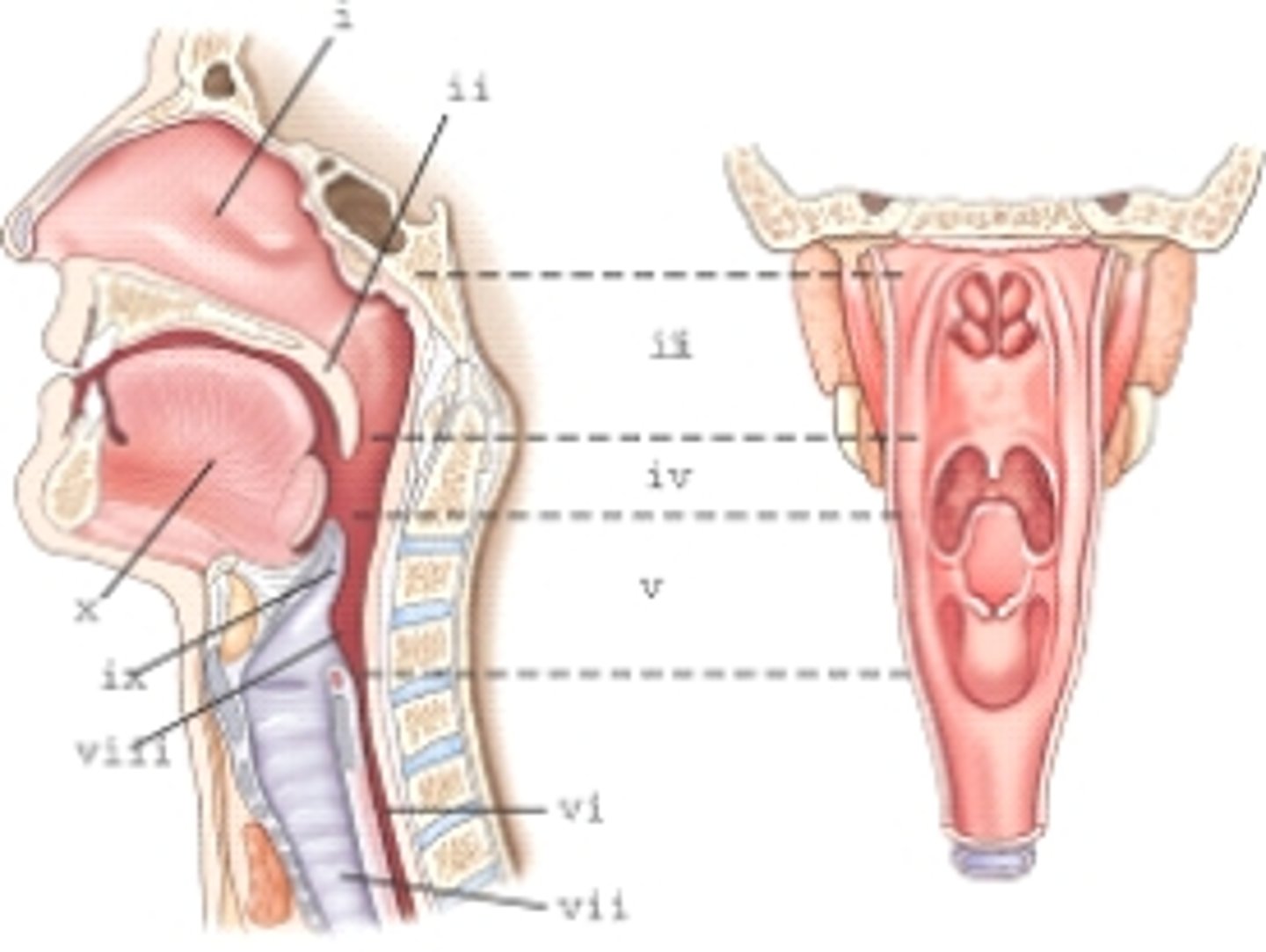
Part v refers to the:
A) nasopharynx.
B) larynx.
C) oropharynx.
D) laryngopharynx.
D) laryngopharynx.
The dilated portion of the distal esophagus is termed the:
A) cardiac antrum
B) cardiac notch.
C) fundus.
D) incisura cardiaca.
cardiac antrum.
Which of the following is not a main subdivision of the stomach?
A) Fundus
B) Cardium
C) Pylorus
D) Body
B) Cardium
Which term describes the outer, lateral border of the stomach?
A) Lesser curvature
B) Incisura angularis
C) Gastric border
D) Greater curvature
D) Greater curvature
What is the term for the longitudinal mucosal folds found within the stomach?
A) Gastric canal
B) Valvulae conniventes
C) Haustra
D) Rugae
D) Rugae
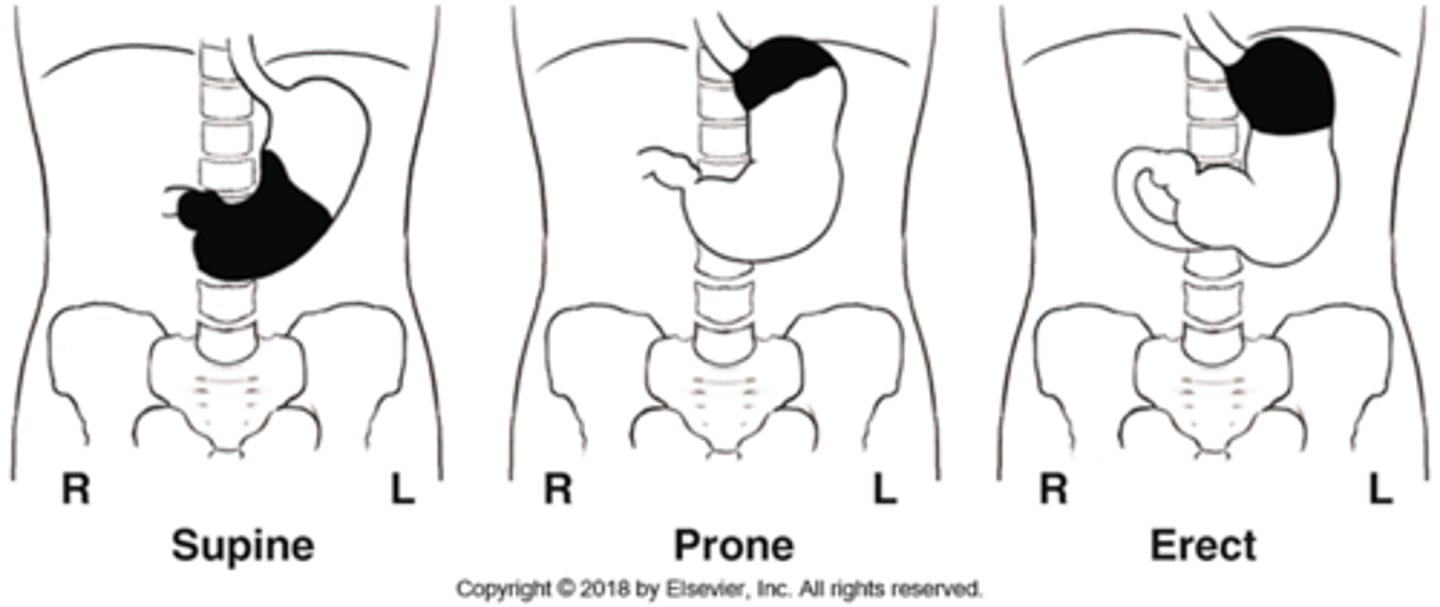
Toward which aspect(s) of the stomach will barium gravitate with the patient in a prone position?
A) Body and pylorus
B) Fundus
C) Cardiac
D) Fundus and body
A) Body and pylorus
Which aspect of the stomach is attached to the duodenum?
A) Fundus
B) Body
C) Pylorus
D) Cardiac
C) Pylorus
Which specific part of the pancreas is adjacent to the C-loop of the duodenum?
A) Tail
B) Body
C) Head
D) Neck
C) Head
Which division of the duodenum contains the duodenal bulb or cap?
A) First (superior)
B) Third (horizontal)
C) Second (descending)
D) Fourth (ascending)
A) First (superior)
What structure indicates the junction between the duodenum and jejunum?
A) Duodenal cap
B) Suspensory muscle of the duodenum
C) Valvulae conniventes
D) C-loop of the duodenum
B) Suspensory muscle of the duodenum
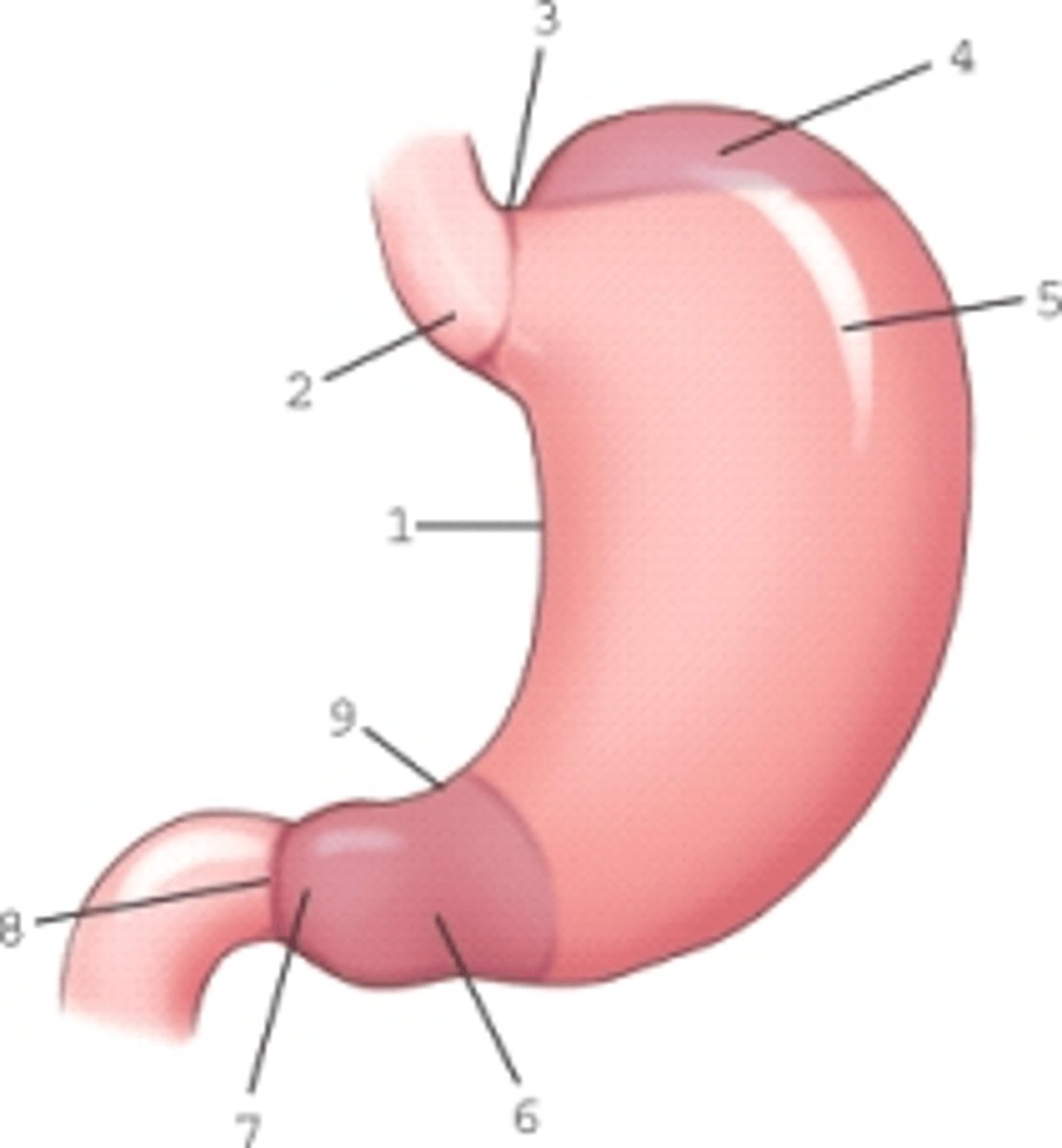
Which part of the stomach is labeled 6?
A) Body
B) Pyloric portion
C) Pyloric antrum
D) Pyloric canal
C) Pyloric antrum
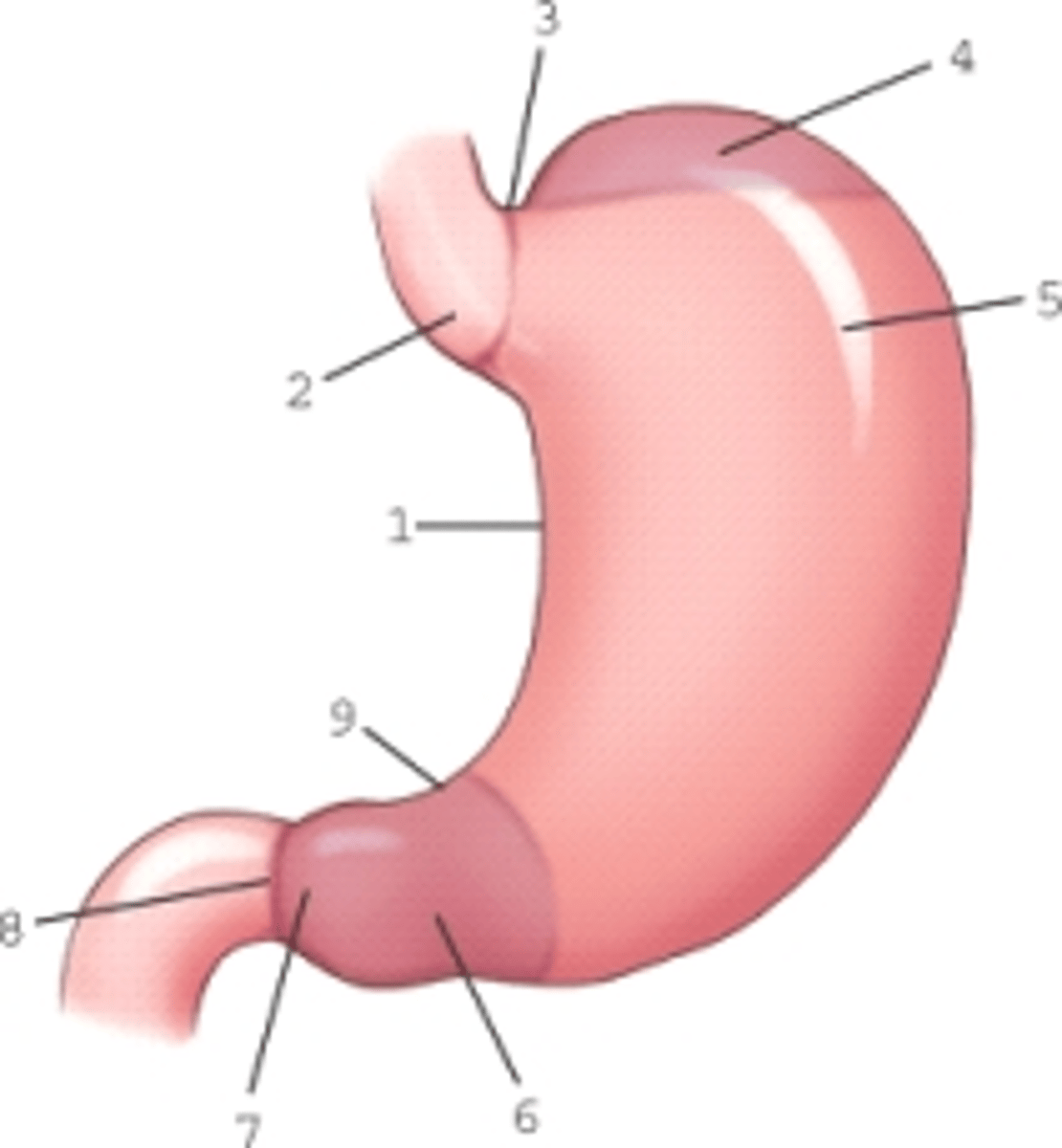
Which part of the stomach is labeled 2?
A) Esophagogastric junction
B) Incisura angularis
C) Incisura cardiaca
D) Cardiac antrum
D) Cardiac antrum
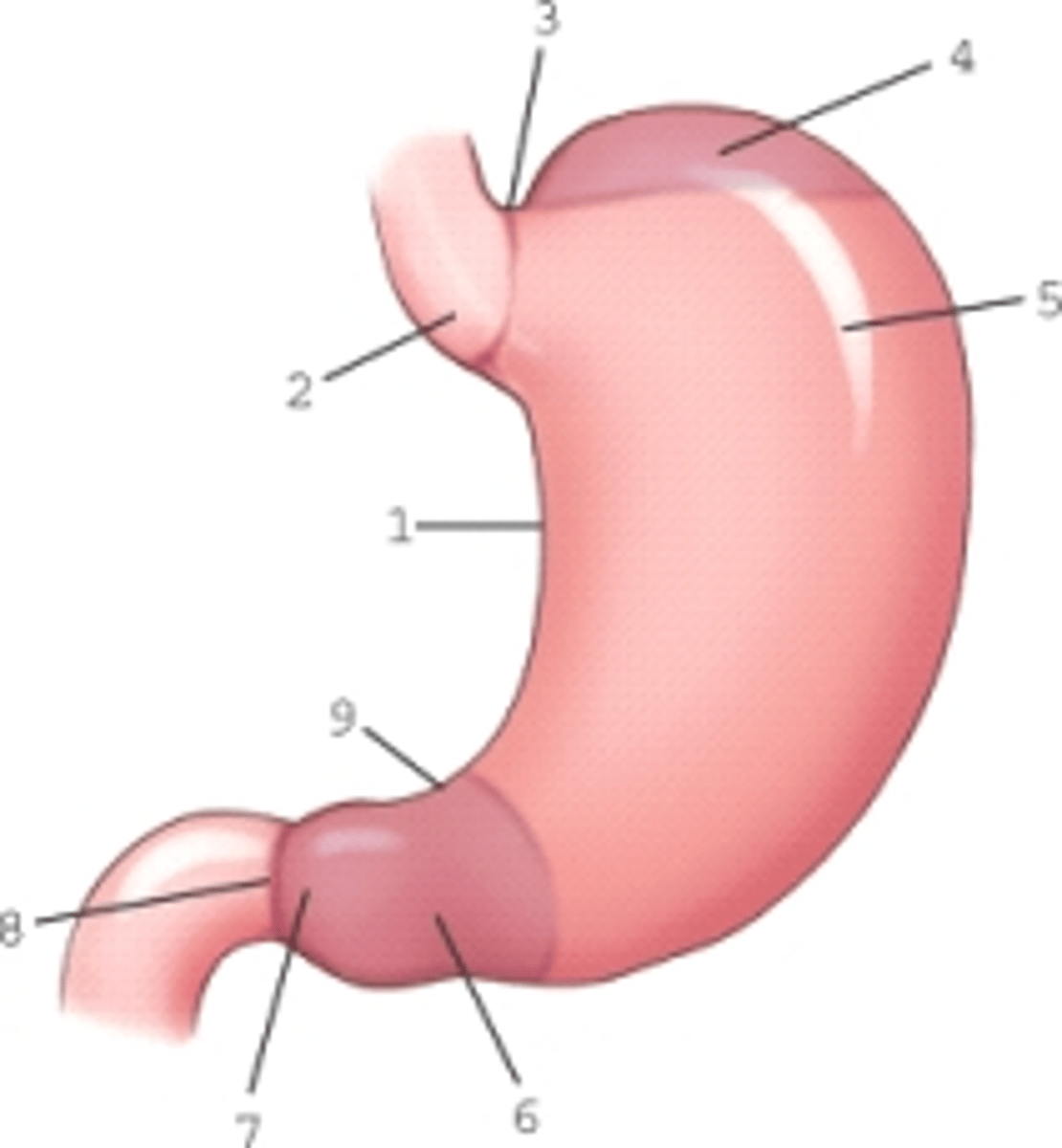
Which part of the stomach is labeled 9?
A) Cardiac notch
B) Angular notch
C) Pyloric orifice
D) Incisura cardiaca
B) Angular notch
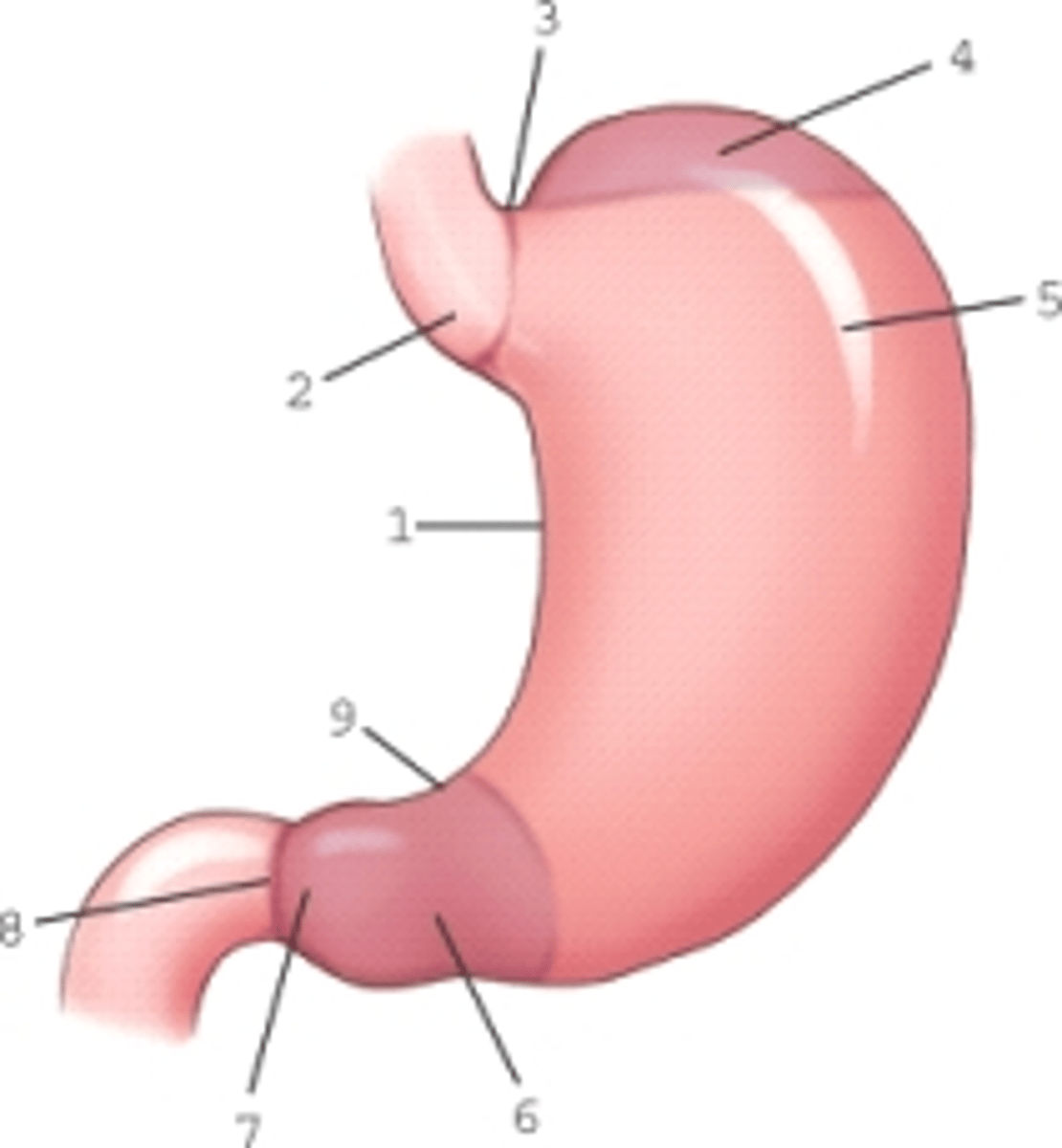
Which part of the stomach is labeled 3?
A) Angular notch
B) Cardiac notch
C) Incisura angularis
D) Esophagogastric junction
B) Cardiac notch
Once food enters the stomach and is mixed with gastric secretions, it is termed:
A) bile.
B) lipids.
C) chyme.
D) biologic catalysts.
C) chyme
Which of the following substances are not digested chemically?
A) Minerals
B) Carbohydrates
C) Proteins
D) Lipids
A) Minerals
Enzymes that aid in chemical digestion are classified as:
A) lipids.
B) biologic catalysts.
C) digestive acids.
D) amino acids.
B) biologic catalysts.
Lipids (fats) are broken down into fatty acids and glycerol as they are digested and absorbed by the:
A) stomach and small bowel.
B) stomach only.
C) small bowel only.
D) None of the above (are not digested).
C) small bowel only.
Which aspect of the gastrointestinal (GI) tract is primarily responsible for the absorption of digestive end products along with water, vitamins, and minerals?
A) Stomach
B) Small intestine
C) Large intestine
D) Pancreas
B) Small intestine
A high and transverse stomach would be found in a(n) ____ patient.
A) hyposthenic
B) asthenic
C) sthenic
D) hypersthenic
D) hypersthenic
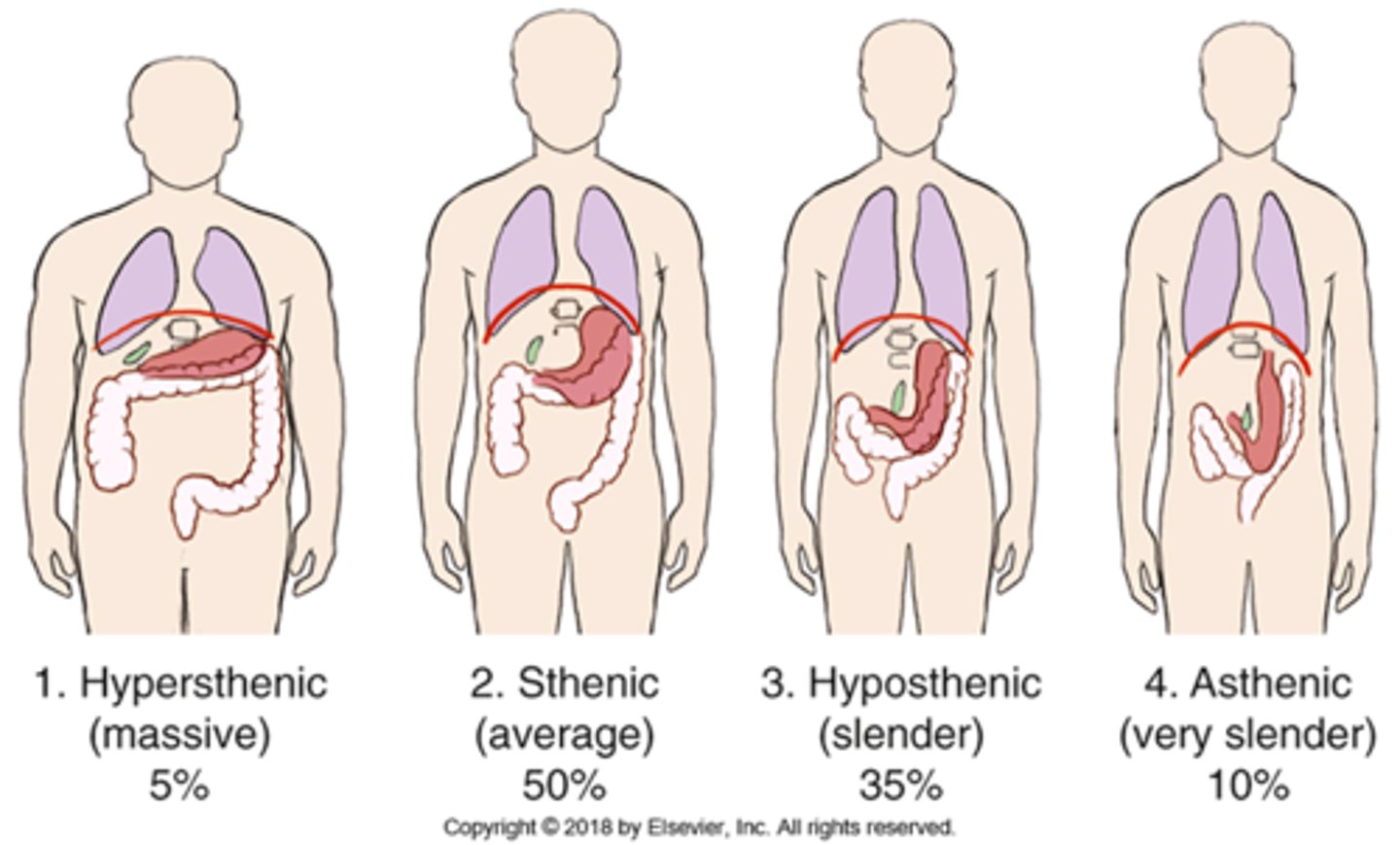
A stomach with the duodenal bulb at the level of L1-2 would be found in a(n) ____ patient.
A) hyposthenic
B) asthenic
C) sthenic
D) hypersthenic
C) sthenic
What is the classification of barium sulfate as a contrast media?
A) Radiopaque
B) Radiolucent
C) Isodense
D) Negative contrast media
A) Radiopaque
What type of solution is formed when barium is mixed with water?
A) Water-soluble solution
B) Isotonic solution
C) Hypotonic solution
D) Colloidal suspension
D) Colloidal suspension
Which of the following statements is true about barium sulfate?
A) It should be discarded if not used within an hour after mixing.
B) The patient may become ill if it is not prepared with sterile water.
C) It rarely produces an allergic reaction.
D) It is soluble in water.
C) It rarely produces an allergic reaction
Which of the following clinical indications would mandate the use of an oral, water-soluble contrast agent?
A) Patient with esophageal reflux
B) Patient with a bezoar
C) Patient with a possible perforated bowel
D) Patient with a possible peptic ulcer
C) Patient with a possible perforated bowel
What type of contrast media is ideal for demonstrating a diverticulum within the stomach?
A) Double-contrast barium/negative contrast agent
B) Single-contrast barium sulfate
C) Water soluble
D) Radiolucent
A) Double-contrast barium/negative contrast agent
Which of the following patient care concerns would prevent the use of an oral, water-soluble contrast medium?
A) The patient has a possible ulcer.
B) The patient is sensitive to iodine.
C) The patient has esophageal reflux.
D) The patient has dysphasia.
B) The patient is sensitive to iodine.
Which of the following is not one of the cardinal principles of radiation protection?
A) Time
B) Distance
C) Intensity
D) Shielding
C) Intensity
Which one of the following cardinal principles of radiation protection is most effective in reducing the dose to the technologist during fluoroscopy?
A) Time
B) Distance
C) Intensity
D) Shielding
B) Distance
Which of the following devices reduces scatter exposure during fluoroscopy from the fluoroscopy tube?
A) Compression paddle
B) Bucky tray
C) Bucky slot shield
D) Lead gloves
C) Bucky slot shield
Protective aprons worn during fluoroscopy must possess at least ____ mm lead equivalency (Pb/Eq.).
A) 0.25
B) 0.5
C) 0.75
D) 1
B) 0.5
Which of the following conditions involves dilated veins in the distal aspect of the esophagus, which in some cases can lead to internal bleeding?
A) Esophageal varices
B) Esophageal reflux
C) Esophageal hypertension
D) Esophageal thrombosis
A) Esophageal varices
A large outpouching of the proximal esophagus above the upper esophageal sphincter is termed:
A) Barrett esophagus.
B) esophageal varices.
C) esophageal reflux.
D) Zenker diverticulum.
D) Zenker diverticulum.
Achalasia is generally defined as:
A) difficulty in swallowing.
B) a common malignancy of the esophagus.
C) motor disorder of the esophagus.
D) large outpouching of the esophagus.
C) motor disorder of the esophagus.
.
Which of the following definitions would describe a bezoar?
A) Inflammation of the gastric lining
B) Outpouching of the stomach wall
C) Mass of undigested material
D) Stomach neoplasm
C) Mass of undigested material
Research suggests that peptic ulcers may be caused by:
A) smoking.
B) bacteria.
C) alcohol.
D) antibiotics.
B) bacteria.
Gastritis is defined as inflammation of the:
A) pancreas.
B) large intestine.
C) small intestine.
D) stomach.
D) stomach.
Which of the following conditions is an example of GERD?
A) Esophageal varices
B) Gastric carcinoma
C) Esophageal reflux
D) Bezoar
C) Esophageal reflux
What is the most common radiographic procedure performed to diagnose GERD?
A) Endoscopy
B) Esophagogram
C) Upper GI series
D) CT
A) Endoscopy
Which of the imaging modalities or procedures is most effective and preferred in diagnosing HPS?
A) Nuclear medicine
B) CT
C) Upper GI series
D) Ultrasound
D) Ultrasound
What is a potential risk associated with the use of water-soluble contrast agents, especially for geriatric patients?
A) Bowel obstruction
B) Cardiac arrest
C) Dehydration
D) Shock
C) Dehydration
When using computed radiography (CR), inadequate kV or mAs will produce a ____ image.
A) dark
B) light
C) blurry
D) mottled
D) mottled
Which of the following technical factors will best enhance a digital image taken during an upper GI series?
A) Collimation
B) Low kV techniques
C) Long SID
D) Use of compensation (wedge) filter
A) Collimation
Patient preparation for an esophagogram includes NPO _____ before the procedure.
A) 4 to 6 hours
B) 30 minutes to 1 hour
C) 4 to 6 hours and no gum chewing or smoking
D) None of the above; patient preparation is not needed as long as an upper GI series is not scheduled to follow.
D) None of the above; patient preparation is not needed as long as an upper GI series is not scheduled to follow.
Most esophagograms begin with the patient:
A) recumbent-supine.
B) erect.
C) recumbent-prone.
D) in a left lateral decubitus position.
B) erect.
Why would a patient undergo Valsalva maneuver during an esophagogram?
A) To demonstrate possible esophageal varices
B) To demonstrate possible esophageal reflux
C) To demonstrate possible esophagitis
D) To demonstrate a possible bezoar
B) To demonstrate possible esophageal reflux
Which of the following procedures will not demonstrate possible esophageal reflux?
A) Toe-touch maneuver
B) Water test
C) Reverse Trendelenburg method
D) Compression technique
C) Reverse Trendelenburg method
Which of the following positions is not normally considered to be part of the esophagogram basic routine?
A) Posteroanterior (PA)
B) Left lateral
C) Right anterior oblique (RAO)
D) Anteroposterior (AP)
D) Anteroposterior (AP)
Patient preparation for an adult upper GI series includes:
A) nothing; no patient preparation is required.
B) NPO 4 hours before the procedure.
C) NPO 8 hours before the procedure.
D) NPO 24 hours before the procedure.
C) NPO 8 hours before the procedure.
Which of the following kV ranges should be used for an upper GI series using barium sulfate (single-contrast study)?
A) 80 to 90 kV
B) 90 to 100 kV
C) 110 to 125 kV
D) 125 to 140 kV
C) 110 to 125 kV
Which of the following imaging modalities is an alternative to an esophagogram for detecting esophageal varices?
A) Sonography
B) CT
C) Nuclear medicine
D) MRI
A) Sonography
Which of the following imaging modalities is ideal for demonstrating signs of Barrett esophagus?
A) Nuclear medicine
B) MRI
C) Sonography
D) CT
A) Nuclear medicine
How much barium is typically given to a 3- to 10-year-old child during an upper GI series?
A) 4 to 6 ounces
B) 14 to 16 ounces
C) 6 to 12 ounces
D) 1 cup
C) 6 to 12 ounces
Gastric emptying studies are performed using:
A) intraesophageal sonography.
B) radionuclides.
C) MRI.
D) CT.
B) radionuclides.
CR centering for an esophagogram should be to the vertebral level of:
A) the sternal angle.
B) T3 or T4.
C) T5 or T6.
D) T7.
C) T5 or T6.
How much obliquity is required for the RAO position for the esophagus?
A) 10° to 15°
B) 20° to 30°
C) 35° to 40°
D) 45° to 60°
C) 35° to 40°
The RAO position of the esophagus is preferred over the left anterior oblique (LAO) because it:
A) is a more comfortable position for the patient.
B) increases the visibility of the esophagus between the vertebrae and heart.
C) reduces thyroid exposure to the patient.
D) is easier for the patient to hold the cup of barium in his or her left hand.
B) increases the visibility of the esophagus between the vertebrae and heart.
What type of breathing instructions should be given to the patient during an esophagogram using a thin barium mixture?
A) Suspended respiration while continuing to swallow
B) Suspended inspiration after the last swallow
C) Shallow breathing and continued swallowing during exposure
D) Exposure immediately after last bolus is swallowed (patient will not be breathing immediately after swallow)
C) Shallow breathing and continued swallowing during exposure
Other than the esophagogram, what imaging modality is performed to diagnose Barrett's esophagus?
A) Computed tomography
B) Nuclear medicine
C) Magnetic resonance
D) Sonography
B) Nuclear medicine
Which of the following upper GI projections and/or positions will best fill the body and pylorus with barium?
A) AP
B) Right lateral
C) Left posterior oblique (LPO)
D) PA
D) PA
Which of the following upper GI projections and/or positions will best demonstrate the pylorus and duodenal bulb in profile during a double-contrast study?
A) AP
B) LAO
C) PA
D) LPO
D) LPO
At what level should the CR and image receptor be centered for the RAO or PA upper GI projection and/or position on a sthenic body type of patient?
A) Lower costal margin
B) L2
C) L3-4
D) iliac crest
B) L2
A radiograph taken during an upper GI series demonstrates poor visibility of the gastric mucosa. The following factors were used: 80 kV, 30 mAs, and 1/40-second exposure time. Barium sulfate was used during the procedure. Which of the following factors needs to be modified during the repeat exposure?
A) Use of detail-speed screens (adjust mAs accordingly)
B) Shortened exposure time (increase mAs accordingly)
C) Use of a water-soluble contrast medium
D) Increased kV (decrease mAs as needed)
D) Increased kV (decrease mAs as needed)
A radiograph taken during an esophagogram using thin barium mixture demonstrates that there is very little contrast media in the esophagus. Which of the following points will improve filling of the esophagus? (The exposure was made on inspiration after the last swallow.)
A) Have the patient drink during the exposure.
B) Have the patient perform the Valsalva maneuver during the exposure.
C) Have the patient perform the Müller maneuver during the exposure.
D) Shorten the exposure time.
A) Have the patient drink during the exposure.
A PA radiograph taken on a hypersthenic patient during an upper GI series reveals that the pylorus and duodenal bulb are superimposed. Which of the following modifications will best eliminate the superimposition between these structures?
A) Roll the patient into a slight RAO position.
B) Angle the CR 35° to 45° cephalad.
C) Place a rolled towel or a filled compression paddle under the patient's abdomen before exposure.
D) Increase the kV.
B) Angle the CR 35° to 45° cephalad.
A patient comes to radiology for an upper GI series. Her clinical history indicates that there may be a tumor posterior to the stomach. Which one of the following projections and/or positions will best demonstrate this condition?
A) RAO
B) PA
C) Right lateral
D) LPO
C) Right lateral
 Note
Note  Flashcards (130)