Astronomy Exam #2
 Call Kai
 Learn
Learn Practice Test
 Spaced Repetition
 Match
Match Flashcards
 Knowt Play
1/130

There's no tags or description
Looks like no tags are added yet.
Name | Mastery | Learn | Test | Matching | Spaced | Call with Kai |
|---|
No analytics yet
Send a link to your students to track their progress
131 Terms
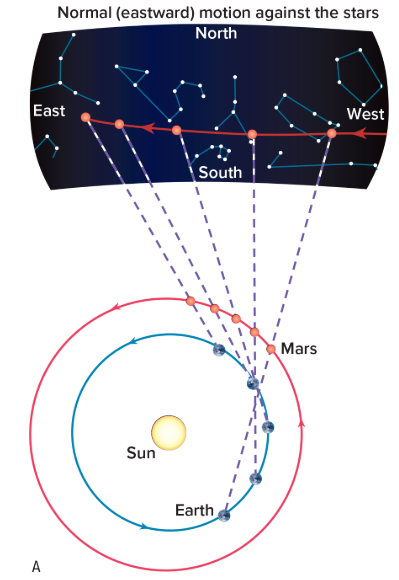
What is the motion of planets?
Retrograde motion and Prograde Motion
Planets move against the background of stars because of a combination of Earth’s and their own orbital motion around the Sun.
Remain on a narrow band on either side of the ecliptic (within the constellations of the zodiac)
Lie nearly in the same plane
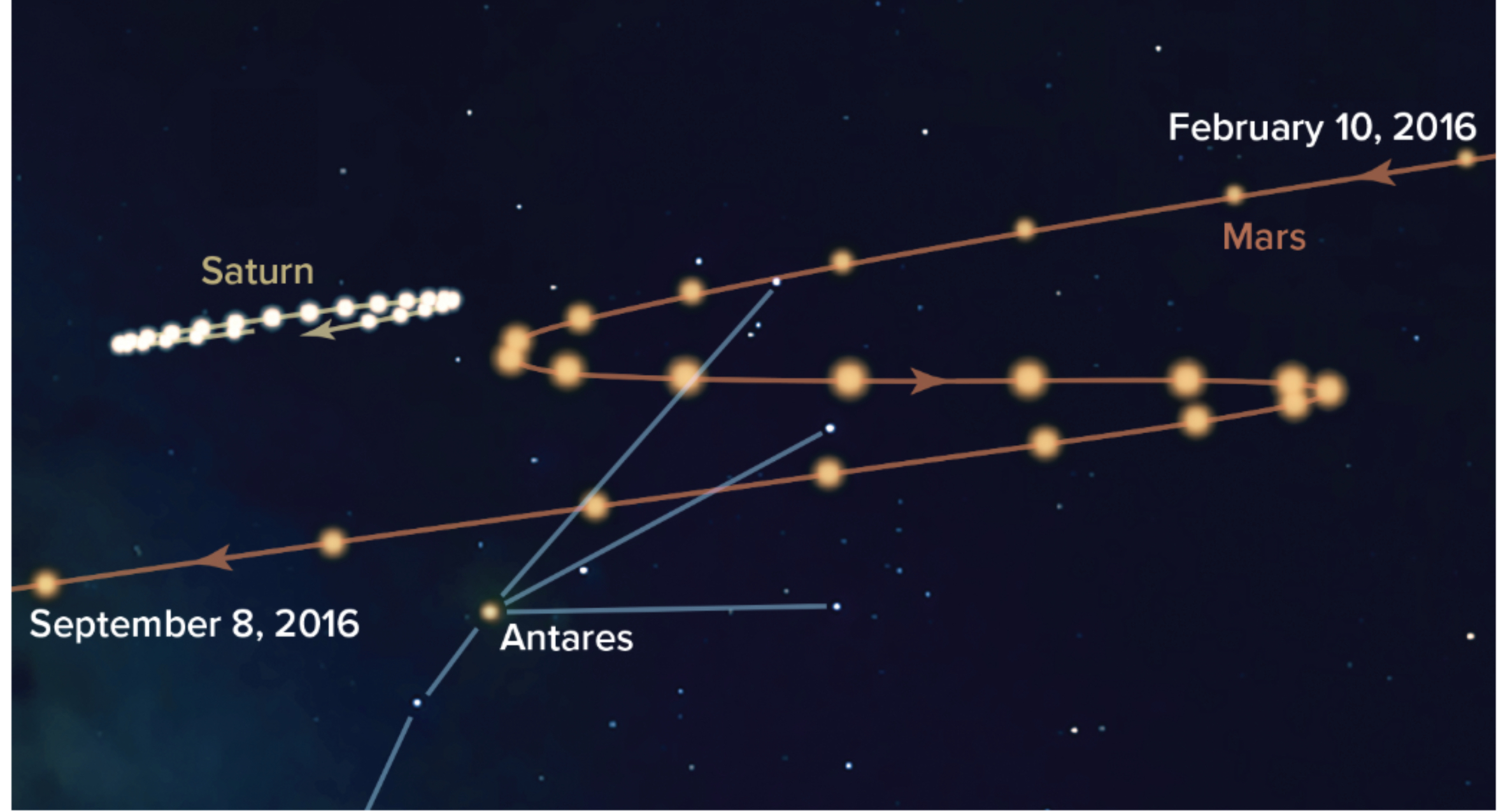
Retrograde Motion (backward)
Reversal; The westward shift of a planet against the background stars. Normally, the planets move west to east across the sky. But occasionally, the planets move from east to west for several weeks, before resuming their normal west-east motion
Appear brighter (larger)
Like a zigzag or loop
Can last from three weeks to up to six months
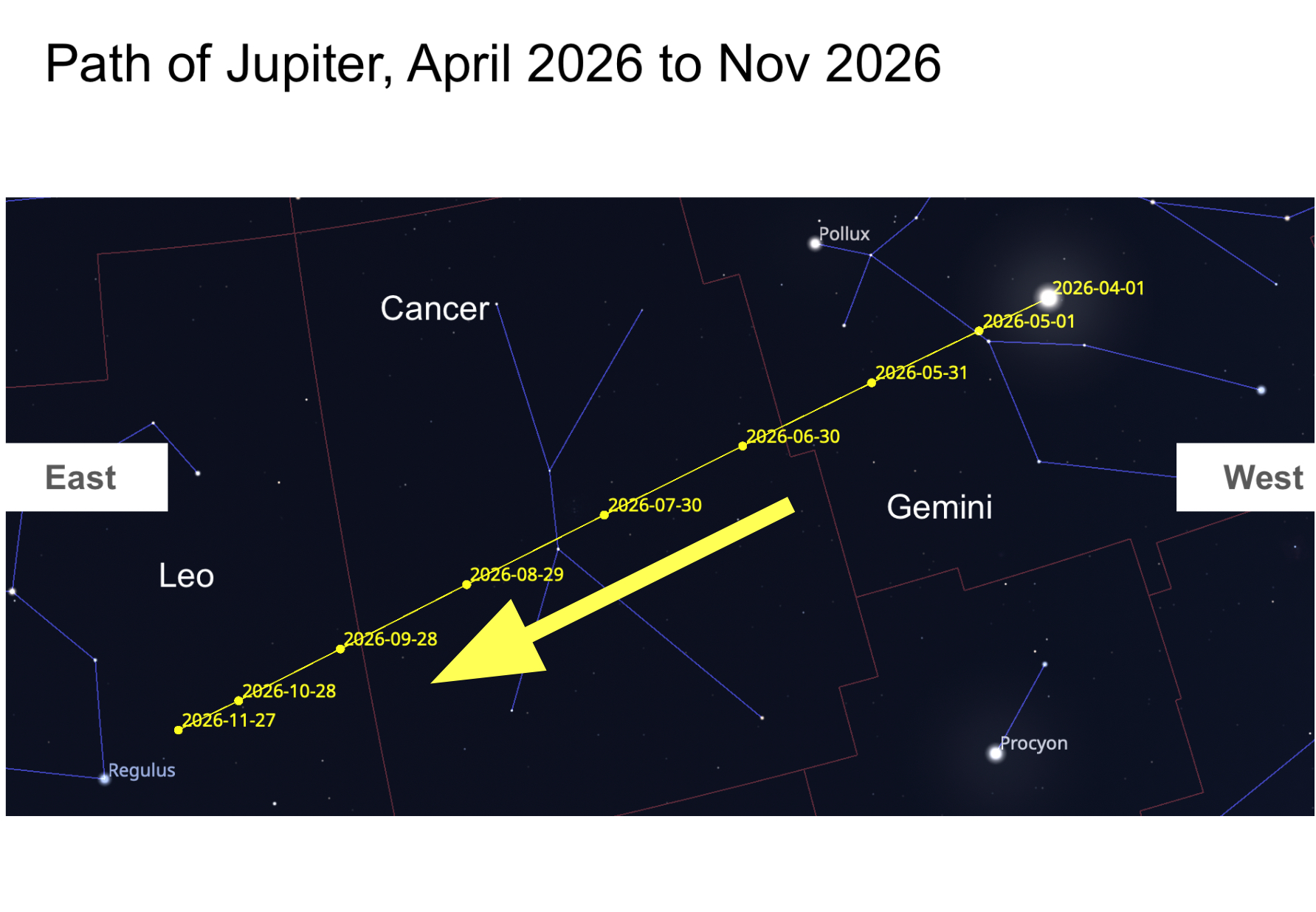
Prograde Motion (forward)
Gradual west-to-east motion is relative to the background stars
(Similar to how the Sun moves along the ecliptic day by day)
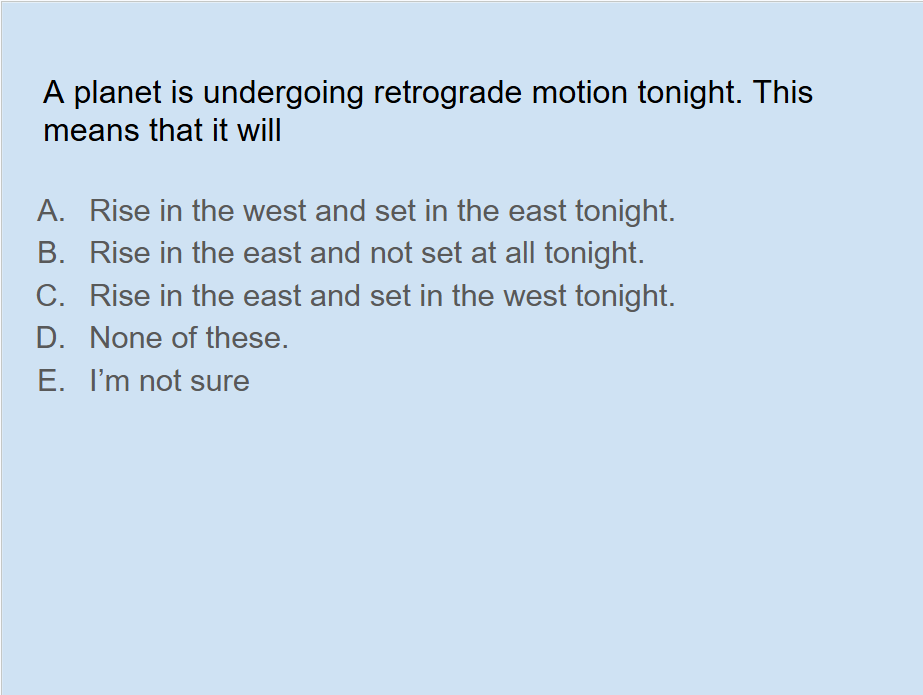
A planet is undergoing retrograde motion tonight. This means it will…?
Rise in the east and set in the west.
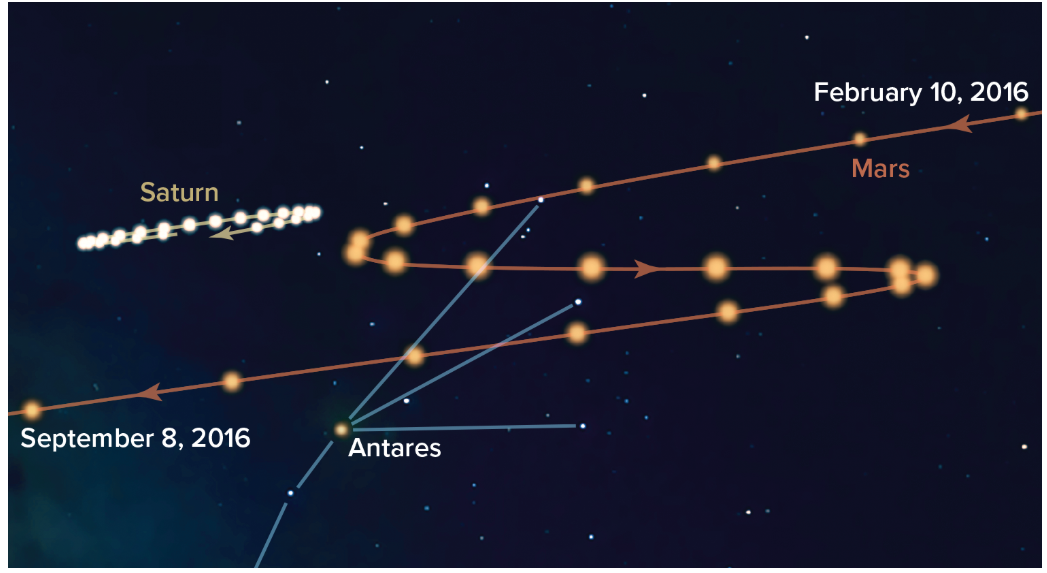
Retrograde Motion of Mars and Saturn
(from diagram) Beginning February 2016, Mars starts on the right, steadily brightens, then changes direction in April; after about two months of travelling backward among the stars, it returns to its original direction, meanwhile fading in brightness
Saturn makes a smaller loop lasting more than four months.
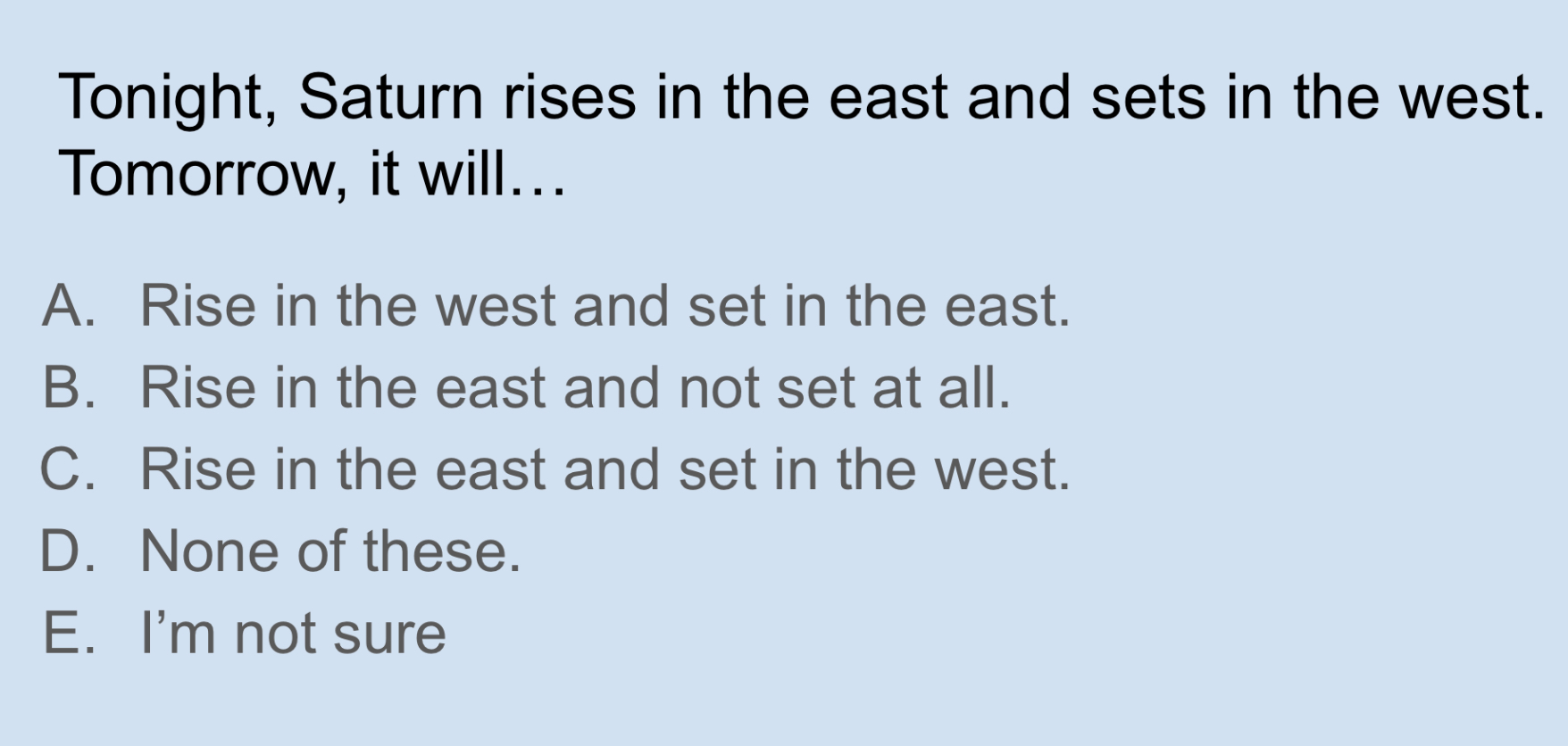
Tonight, Saturn rises in the east and sets in the west. Tomorrow it will…?
Saturn will rise in the east and set in the west.
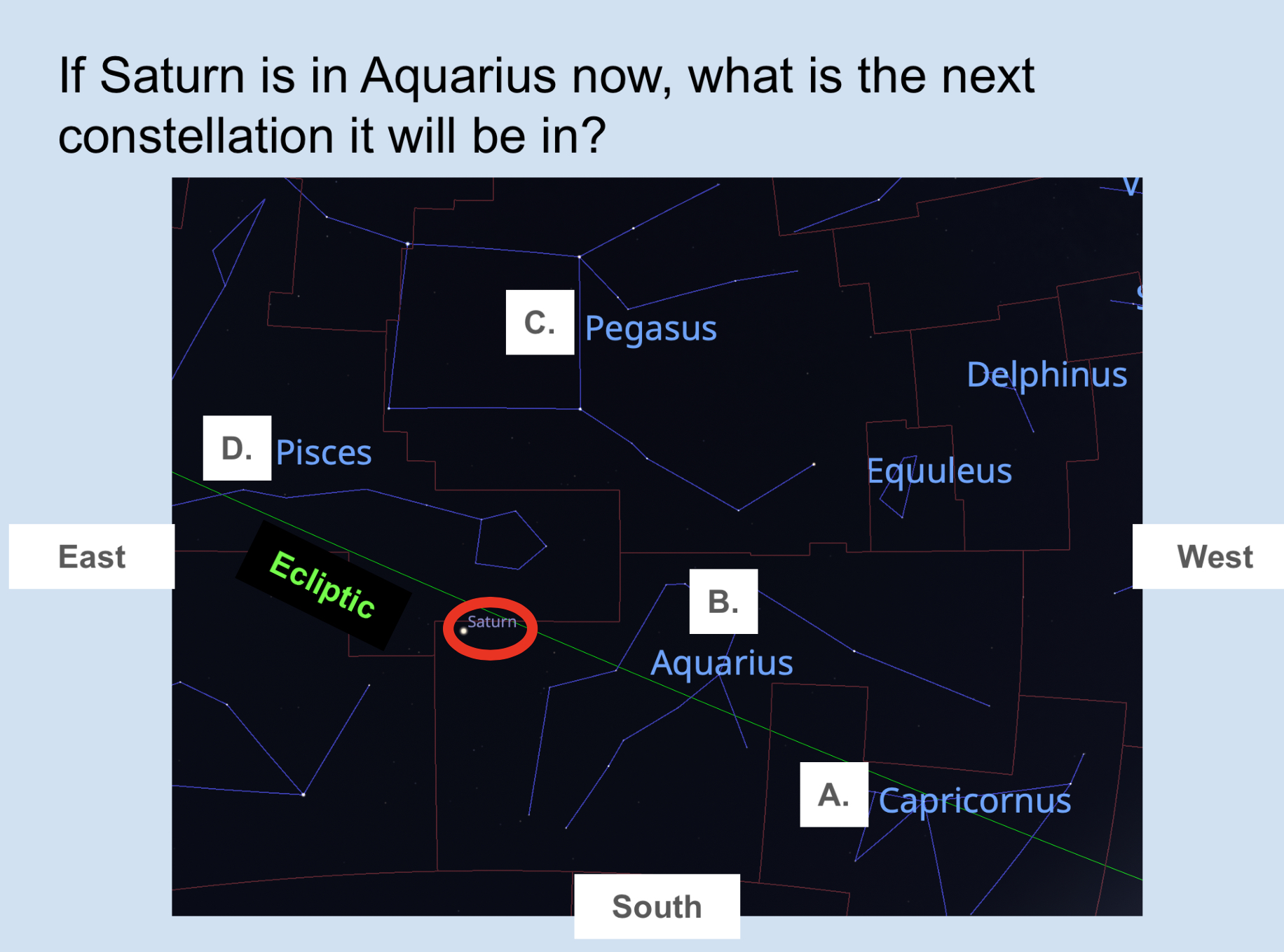
If Saturn is in Aquarius now, what’s the next constellation it will be in?
Pisces
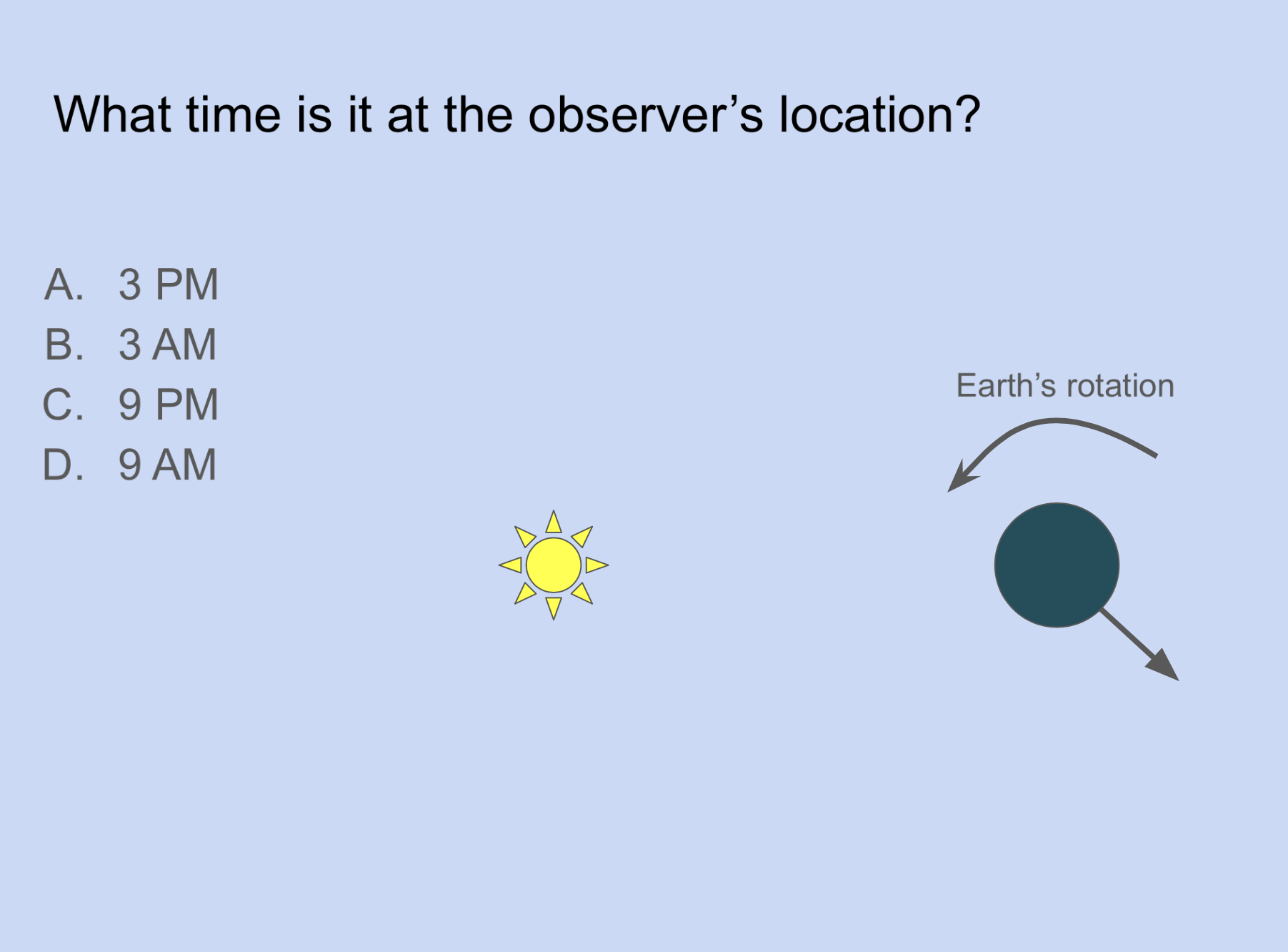
What time is it at the observers location?
9pm
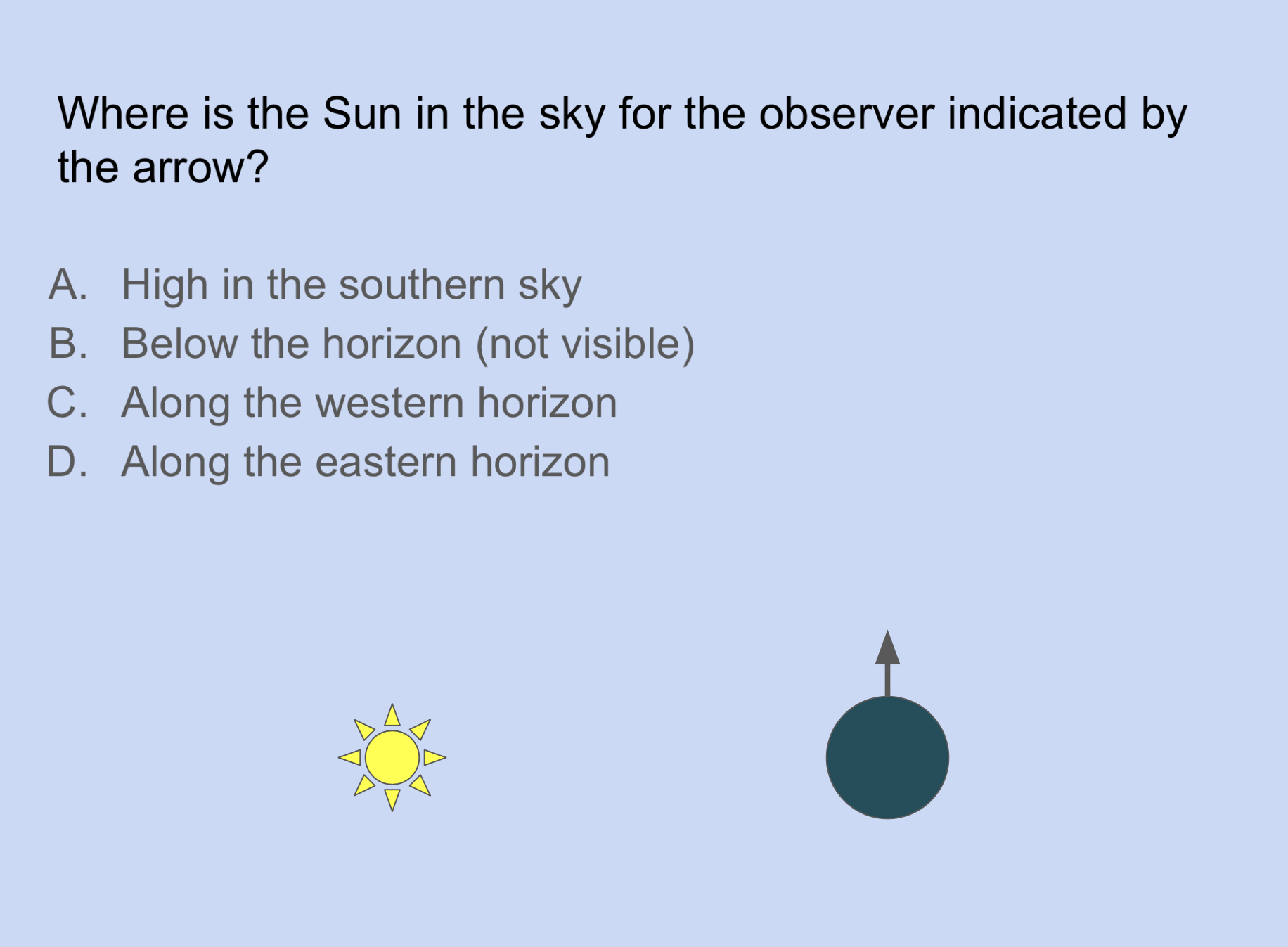
Where is the Sun in the sky for the observer indicated by the arrow?
Along the western horizon
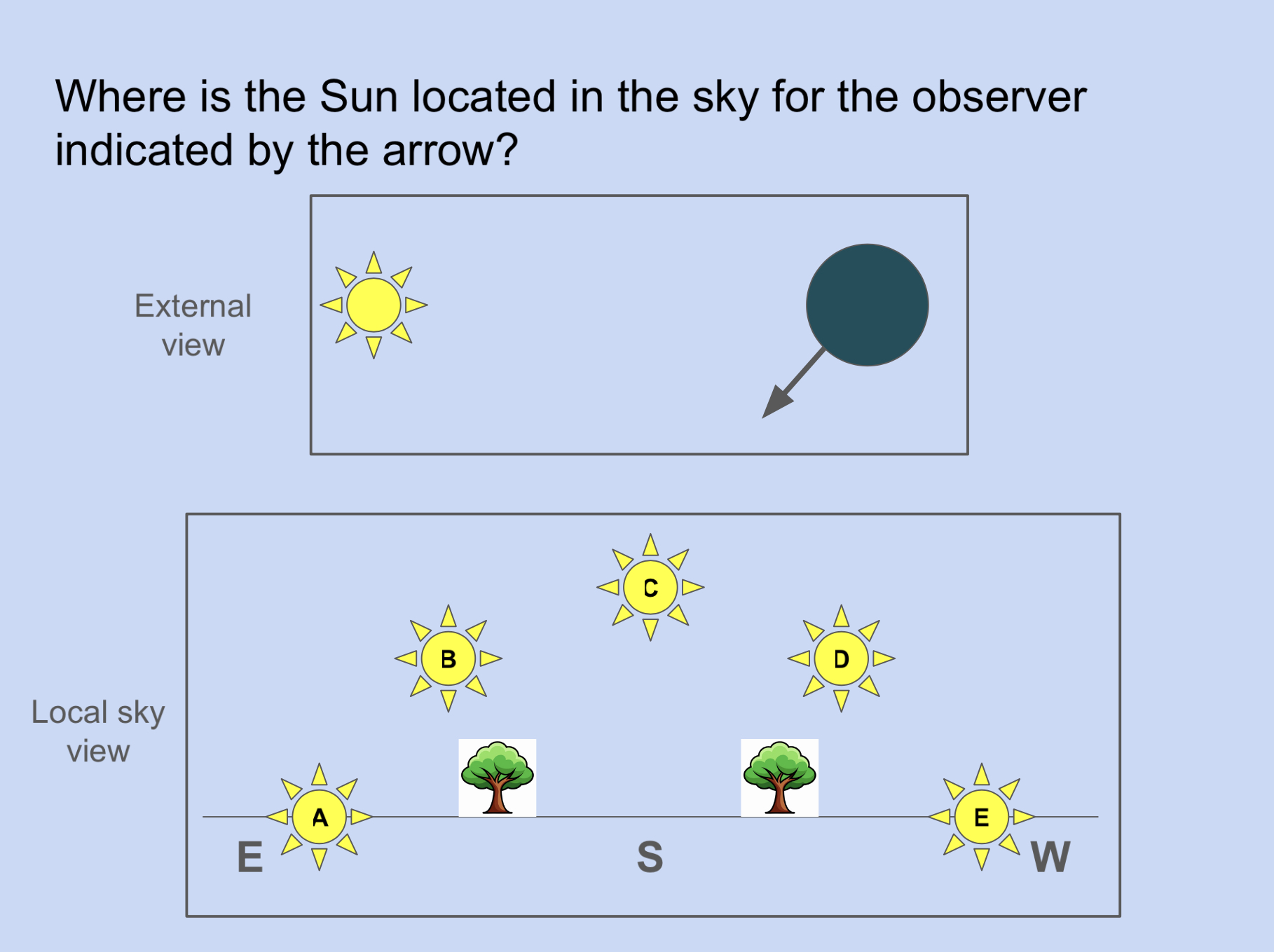
Where is the Sun located in the sky for the observer?
A (southwest, along the eastern horizon)
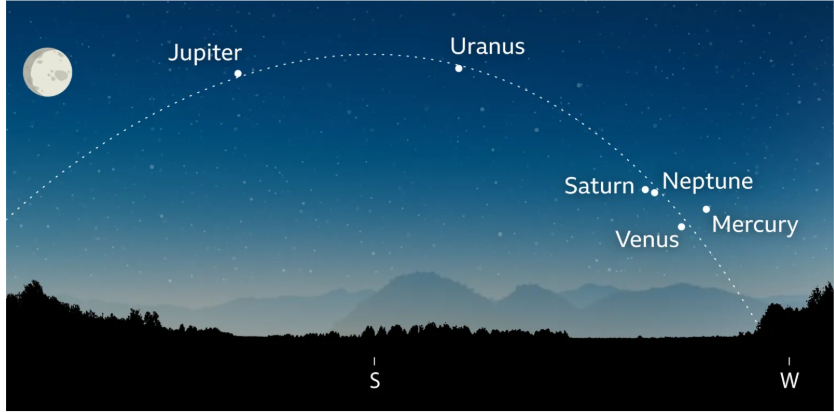
What and where is the ecliptic?
The path of the planets/Sun across the the sky
In the northern hemisphere, it is found in the southern sky
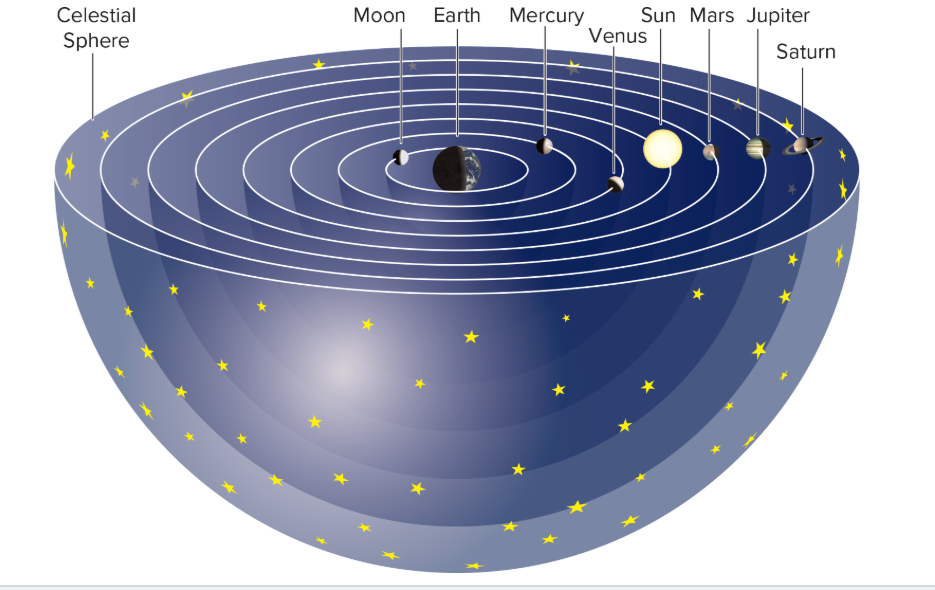
Geocentricism
A hypothesis that held that Earth is at the center of the universe and all other bodies are in orbit around it
Earth is stationary
All the celestial objects are located on spheres that surround the Earth
The spheres rotate around Earth at the correct speeds to match their observed motions in the sky
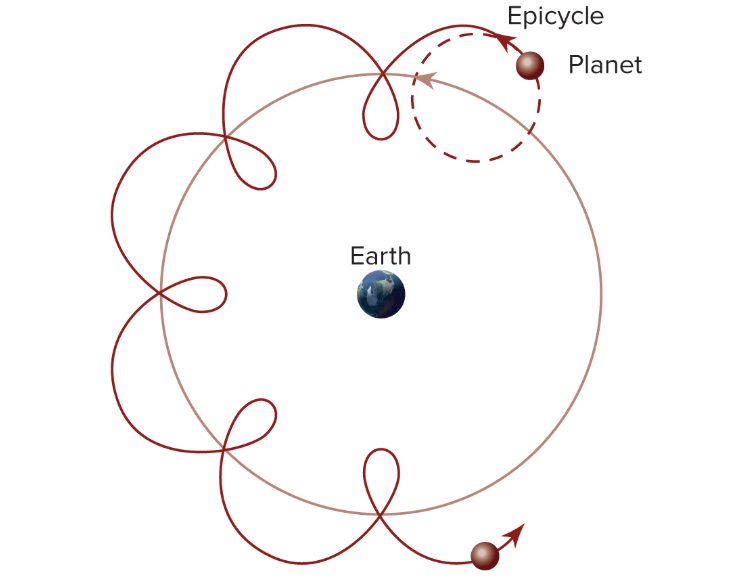
Ptolemy’s Model of Geocentrism
(100-170 AD) Created a model that was modified to include epicycles.
Epicycles were his “explanation” for retrograde motion
Epicycles
A fictitious, small, circular orbit superimposed on another circular orbit. Epicycles were proposed by early astronomers to explain the retrograde motion of the planets and to make fine adjustments to the predictions of planets’ positions
Heliocentrism
A model of the Solar System in which Earth and the other planets orbit the Sun
Developed by Copernicus
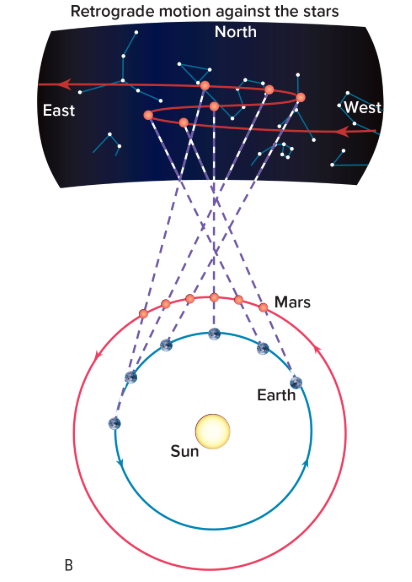
Provides a simple explanation for retrograde motion
Earth moves faster than Mars, so Earth will overtake Mars at some point. From our perspective, Mars appears to move backward across the sky (retrograde motion!) as Earth overtakes Mars
Renaissance scientists considered Copernicus' model more powerful than Ptolemy's because it…?
Could be used to estimate the relative sizes of the orbits of planets
Required fewer special conditions, such as the alignment of Venus's and Mercury's spheres in Ptolemy's model
Copernicus and Heliocentrism
Copernicus’ model explains retrograde motion for inferior and superior planets
Inferior planet = a planet closer to the Sun than the Earth is (Mercury, Venus)
Superior planet = a planet farther from the Sun than the Earth is (Mars-Neptune)
How does the heliocentric model of Copernicus explain the retrograde motion of Mars?
Mars takes longer to complete its orbit than Earth, so when we pass it, it falls behind us and appears to move backwards.
Tycho Brahe’s Influence
Provided enough evidence to overthrow Ptolemy’s model
Designed precision instruments that could measure the sky (resembled giant protractors)
Succeeded in measuring the planet’s positions to about 1 arc minute, or 1/60th of a degree
Discovered that comets are in space, not in the Earth's atmosphere
Observed a supernova and showed it had a fixed position, so it was far beyond the planets
Why did Brahe favor a geocentric model, despite his findings?
He could not measure any stellar parallax
Kepler and Heliocentrism
Developed a new heliocentric model
Using Brahe’s data, proved that Mars moved not in a circular orbit, but on an ellipse
Created 3 laws of planetary motion: shape, speed, and orbital period/distance
These laws apply to any object orbiting the Sun (or another star)
Ellipse
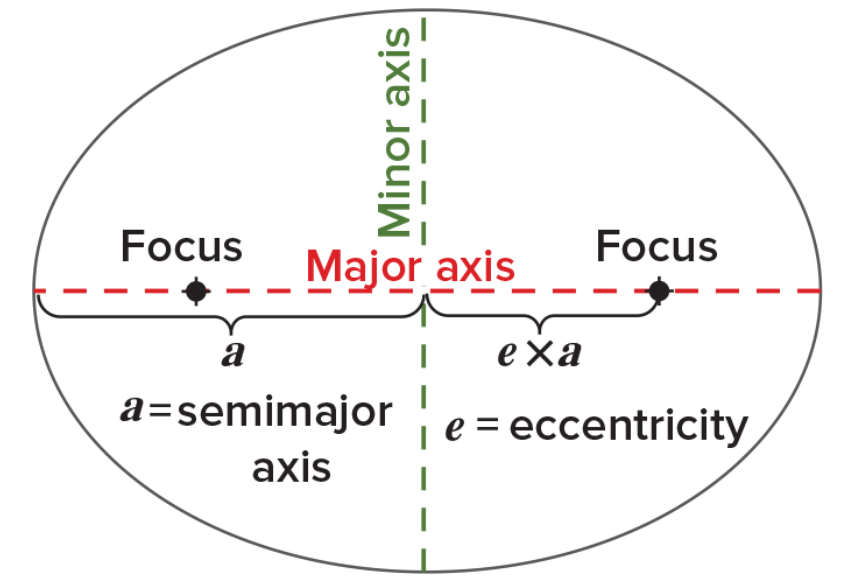
A geometric figure related to a circle but elongated along one axis.
The shape can be described by its long and short dimensions, aka its minor and major axis
Has two foci
How are elliptical orbits and circular orbits different from one another?
In a circular orbit, the distance to the focus is always the same value; it changes at different points in an elliptical orbit
Eccentricity
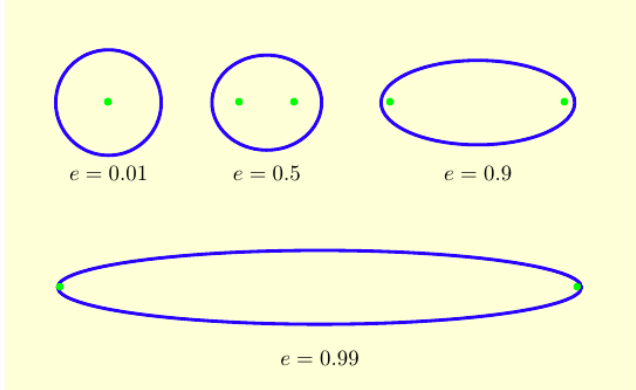
How round or “stretched out” an orbital ellipse is. A circular orbit has zero, while extremely elongated orbits have close to one
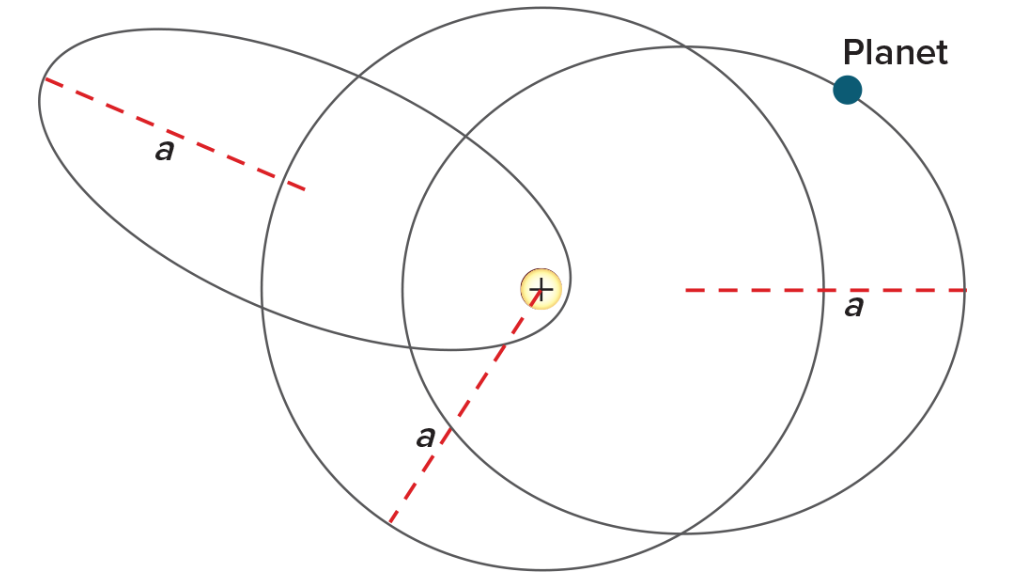
Semimajor Axis
Half the long dimension of an ellipse
(Measured in AU)
If the period of a planet is 8 years, what is the radius (semimajor axis) of its orbit?
4 AU
a³ = p² = (8)2 = 64.
So a = ∛64
= ∛4×4×4 = 4.
(It is 4 AU)
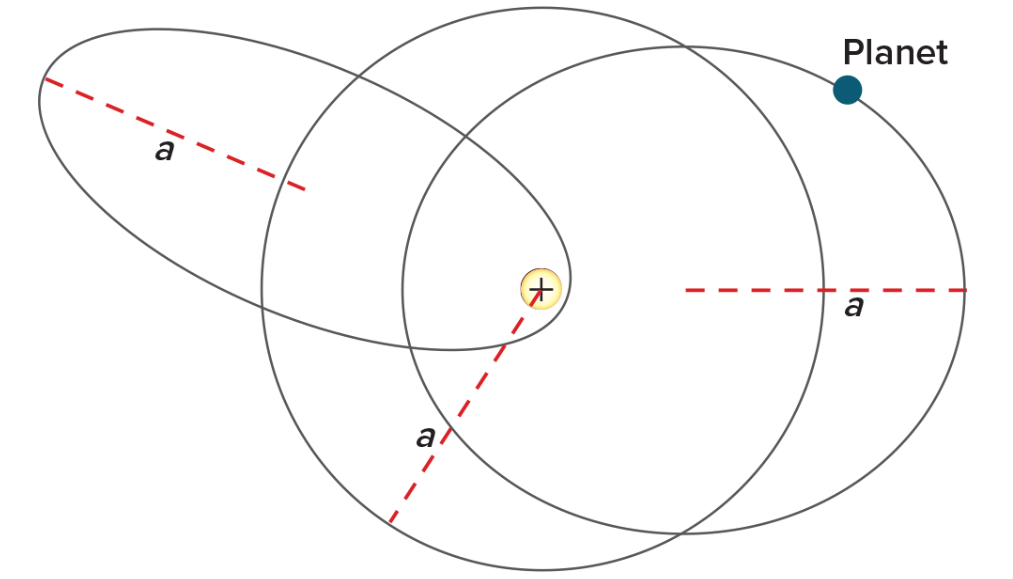
Which properties are different for the three elliptical orbits shown?
Each orbit has a different semi-minor axis.
Each orbit shares the Sun at one focus, but the distance to the second focus is different for each orbit.
Each orbit has a different eccentricity.
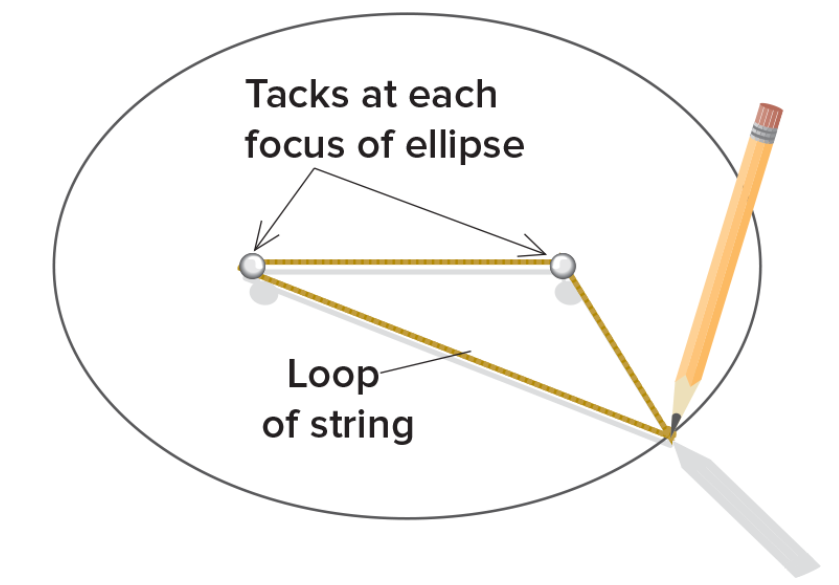
Focus Points
One of two points within an ellipse used to generate the elliptical shape.
(The Sun lies at the focus of each planet’s elliptical orbit)
What is an orbital period?
How long it takes for a planet to complete one orbit around the Sun
(Measured in years)
Kepler's laws are mathematical results based directly on planetary data. Although they predict the positions of planets well, they only explain how, not why, the planets move (they do not involve gravity). These kinds of data-based formulas are called what...?
Empirical results
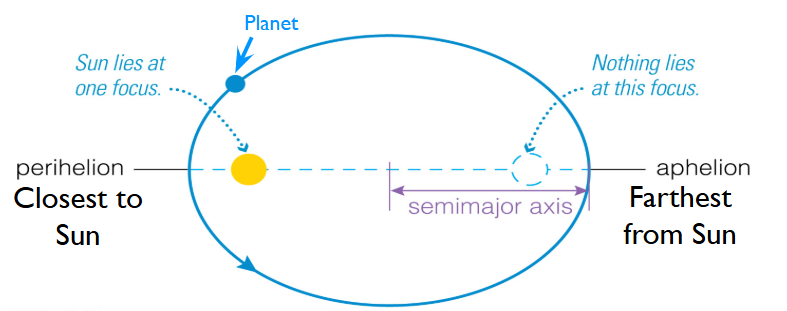
Kepler’s 1st Law
Orbits are ellipses with the Sun at one focus
3 orbits of same a, but different eccentricities e=0, 0.5, 0.9
Because actual orbits are very close to circular, the semimajor axis is essentially the same thing as the orbital distance of the planet
Two hypothetical planets, Alpha and Beta, orbit the Sun. Both orbits have the same semimajor axis, but their eccentricities are different. Nevertheless, both planets have the same orbital period.
True
(the only way a planet’s orbital period would change would be because of a different semimajor axis, but this is not the case)
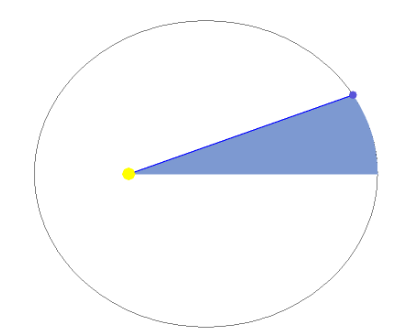
Kepler’s 2nd Law
As a planet moves around its orbit, it sweeps out equal areas in equal times
Each wedge has the same area because the planet travels for the same length of time
When a planet is closer (perihelion) to the Sun…
It moves faster in its orbit
When a planet is farther way (aphelion) to the Sun…
It moves slower in its orbit
In a solar system very similar to ours, an Earth-like planet orbits a star just like the Sun. This planet has an orbital period two-thirds that of Earth's. How will its average distance from the star be different?
It will orbit closer to its star than we do from the Sun
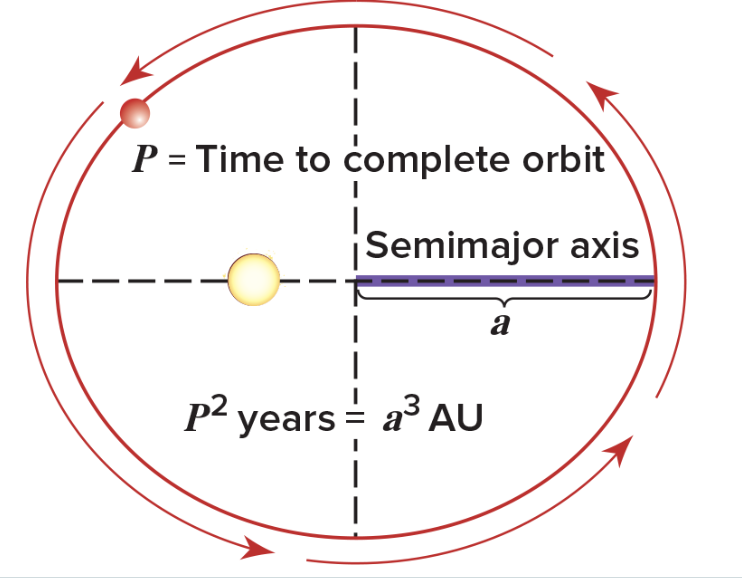
Kepler’s 3rd Law
A planet on a larger orbit takes a longer time to orbit the Sun\
The time to complete one orbit is related to the orbit’s size: P2 = a3
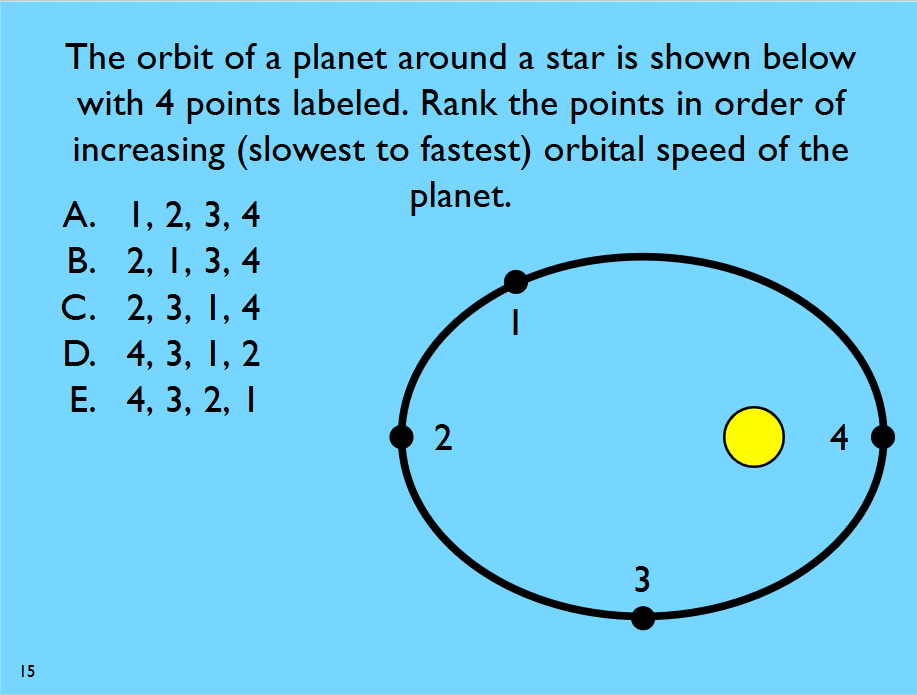
2, 1 ,3, 4
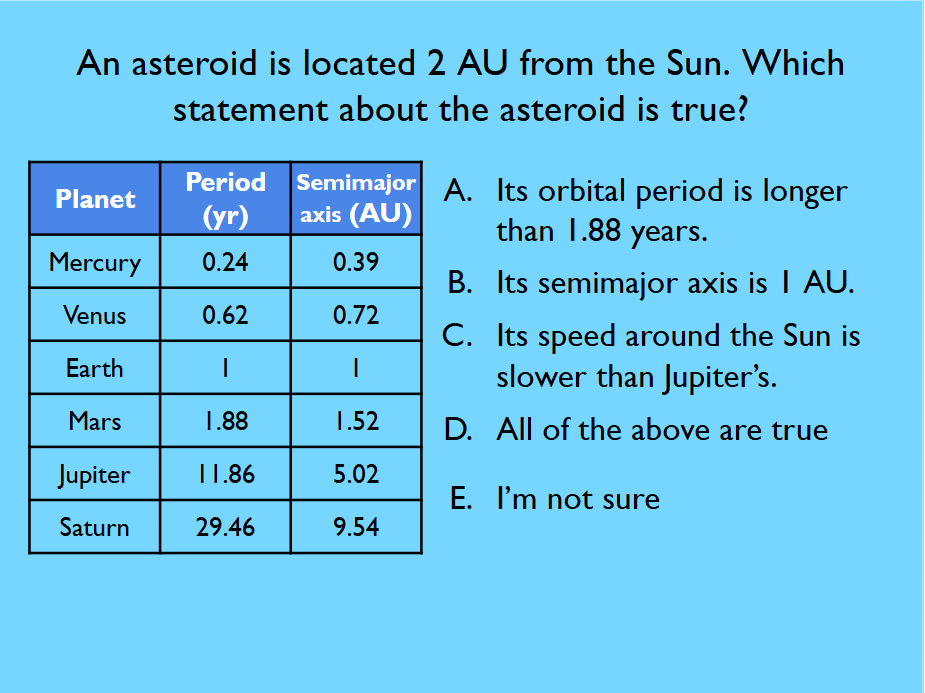
It’s orbital period is longer than 1.88 years
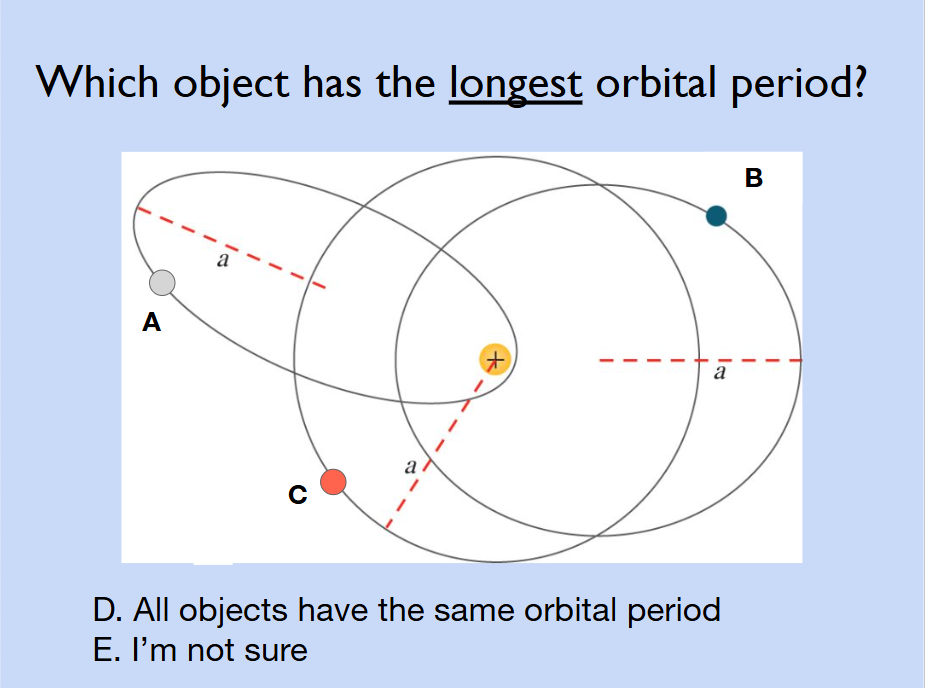
All objects have the same orbital period
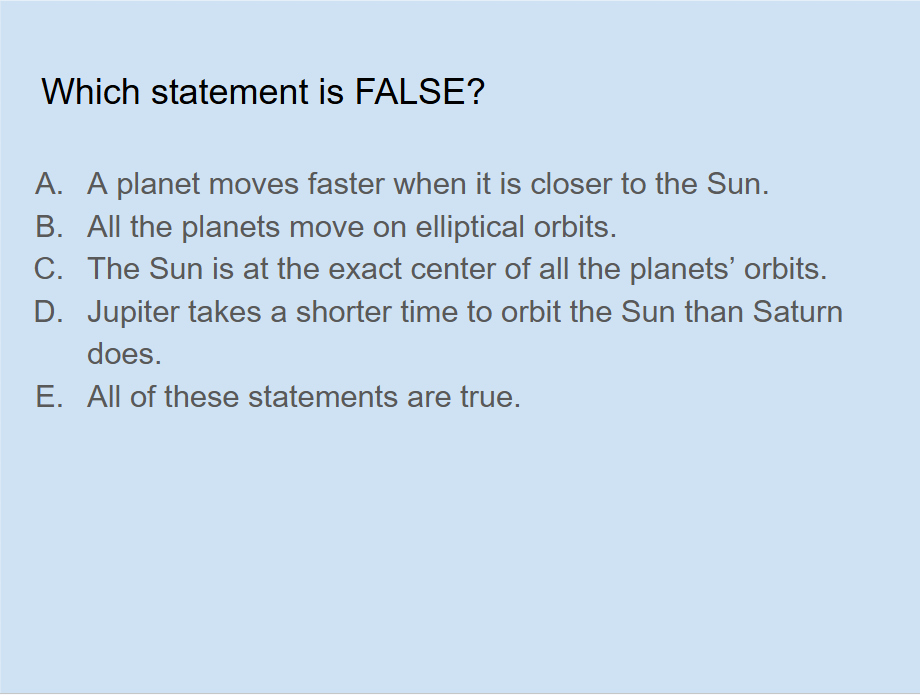
The Sun is at the exact center of all the planet’s orbits
Galieo’s Observations
With his telescope, he discovered:
“Imperfections” on the Moon (craters, mountains, valleys)
“Imperfections” on the Sun (sunspots)
Moons orbiting Jupiter (not the Earth!)
Venus going through phases
Why did the Catholic Church put Galileo on trial?
His support of a heliocentric model was contrary to Church teachings
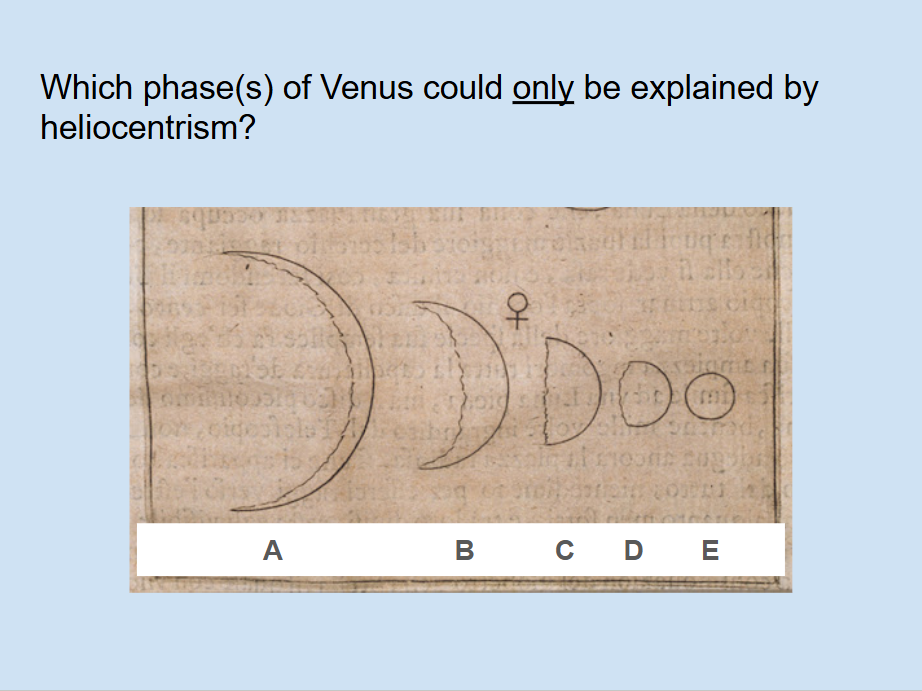
Which phase(s) of Venus could only be explained by heliocentrism?
D (gibbous phase) and E (full phase)
Velocity
The satellite is moving in a circular orbit at constant speed. Therefore, it is NOT accelerating
False
Which object, Earth or satellite, exerts the larger gravitational force on the other?
Both exert the same gravitational force
If the satellite orbited twice as far away from the center of the Earth, the gravitational force it feels will be…?
4 times weaker
The satellite has a mass of 500 kg when on the surface of the Earth. What is its mass in orbit around the Earth?
500kg
(Mass does not change)
Acceleration
Newton’s 1st Law of Motion
Newton’s 2nd Law of Motion
Newton’s 2nd Law of Motion
Newton’s Law of Gravity
Mass vs. Weight
What is a revolution?
A planet’s single trip around the Sun
What is a rotation?
The completion of one full spin of the planet around its own axis
The Earth’s rotation axis is not perpendicular to its orbit around the sun, rather it is…?
Tipped 25.3 degrees from the vertical line
What is the rotation axis?
The imaginary line going through the Earth from the North Pole to the South Pole; this is what is tipped and determines the seasons
How does the Earth’s tilt cause the seasons?
-Maintains the same tilt and direction as it orbits the sun
—Axis remains fixed in space; keeps the same orientation during one complete orbit
-Affects how directly Sunlight hits the Earth’s surface
—Basically how much heat the Earth gets concentrated in one area year-round
-Determines longer and shorter days depending on the Sun’s path
—Longer paths = longer days, shorter paths = shorter days
What defines the start of the seasons?
The Sun’s location on the ecliptic
Earth’s tilt is responsible for…?
The North Pole experiences daylight for six months. The Sun appears to move north and south on the celestial sphere (changes declination) over a year.
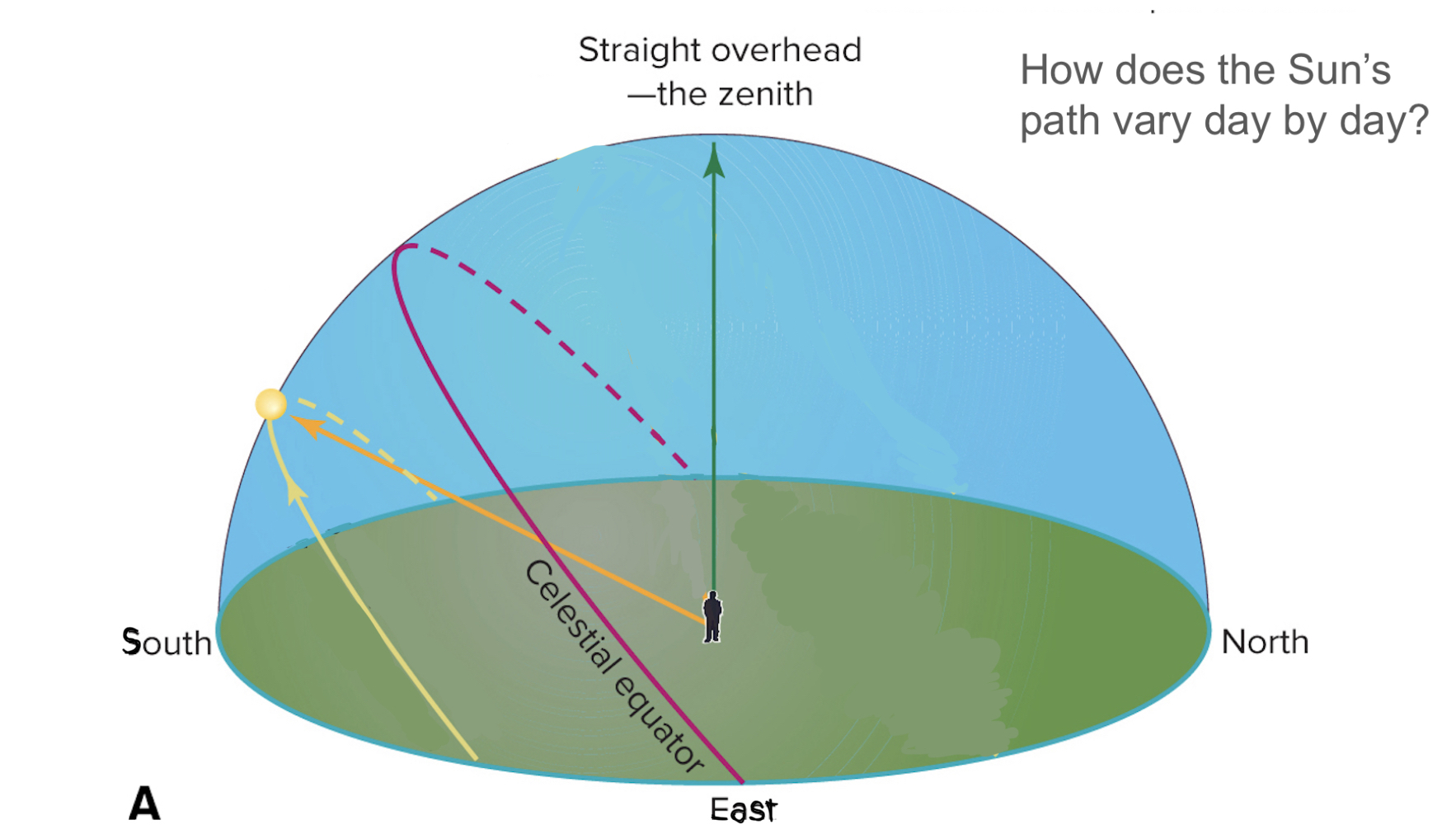
Sun in the Winter (lower in the sky) over a year
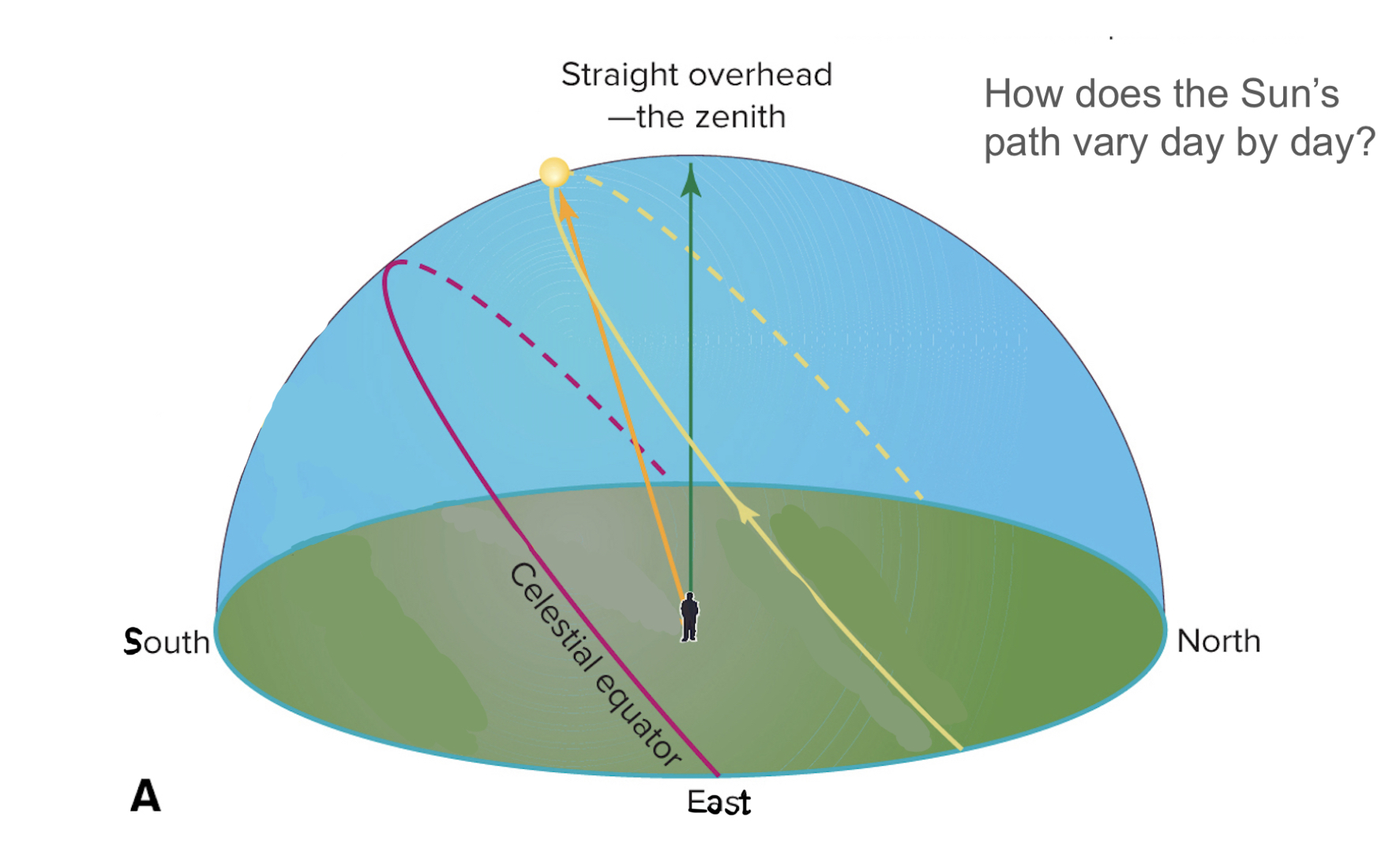
Sun in the Summer (high in the sky) over a year
What is a solstice?
Occurs when the Sun reaches its farthest point north or south on the celestial sphere and has the longest or shortest nights
What is an equinox?
A day when there of 12hrs of daytime and 12hrs of night; when the Sun is crossing the Celestial Equator
Summer (solstice)
June 21st
Winter (solstice)
December 21st
Autumn (fall equinox)
September 22nd
Spring (vernal equinox)
March 20th
Lag of the Seasons
Six week delay period because of oceans ability to absorb and release heat
Hottest period of the year occurs six weeks after the summer solstice
Coldest period of the year occurs six weeks after shortest period of the year
What is the changing location of the Sun on the celestial sphere over a year?
The Sun’s altitude varies throughout the year
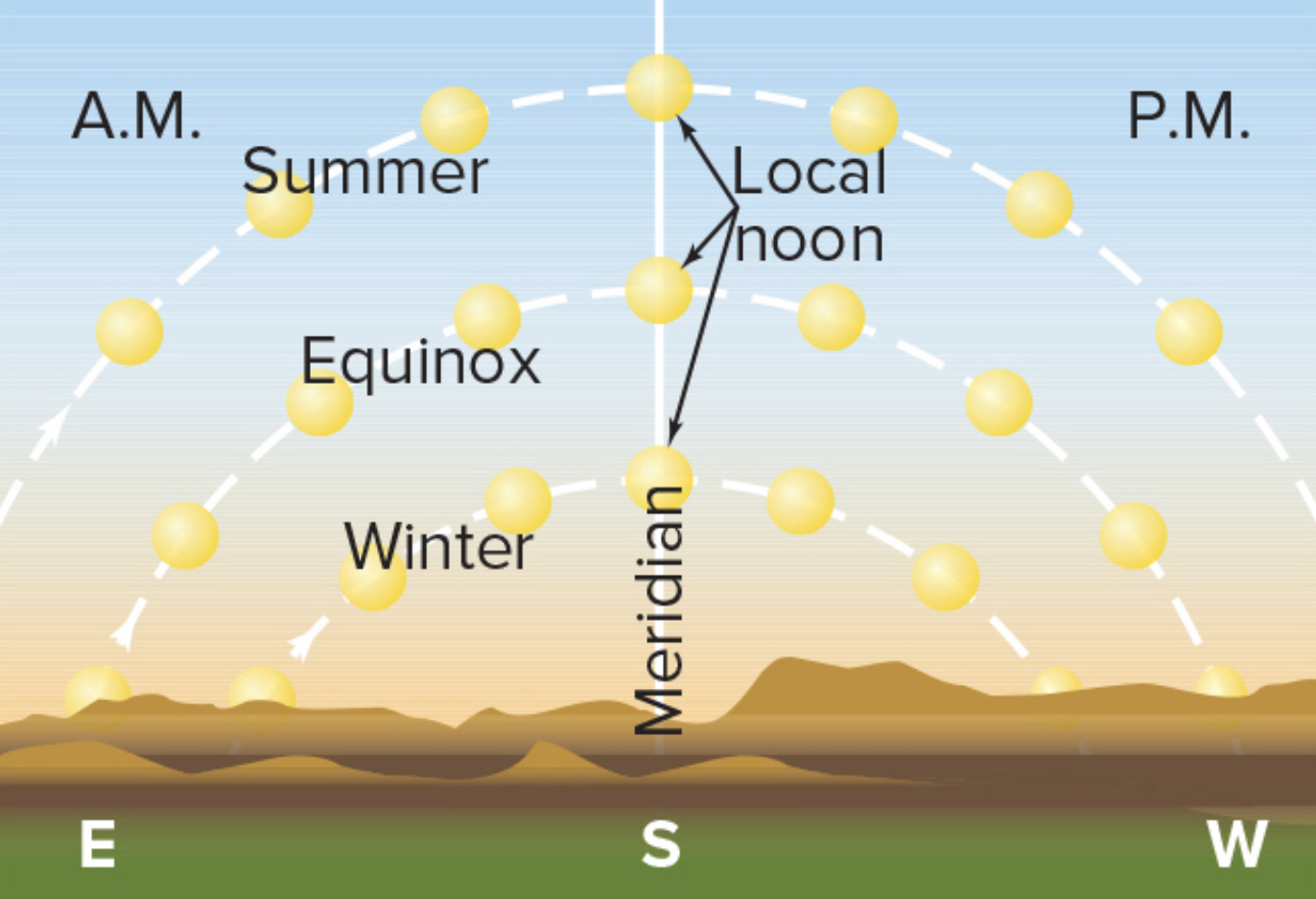
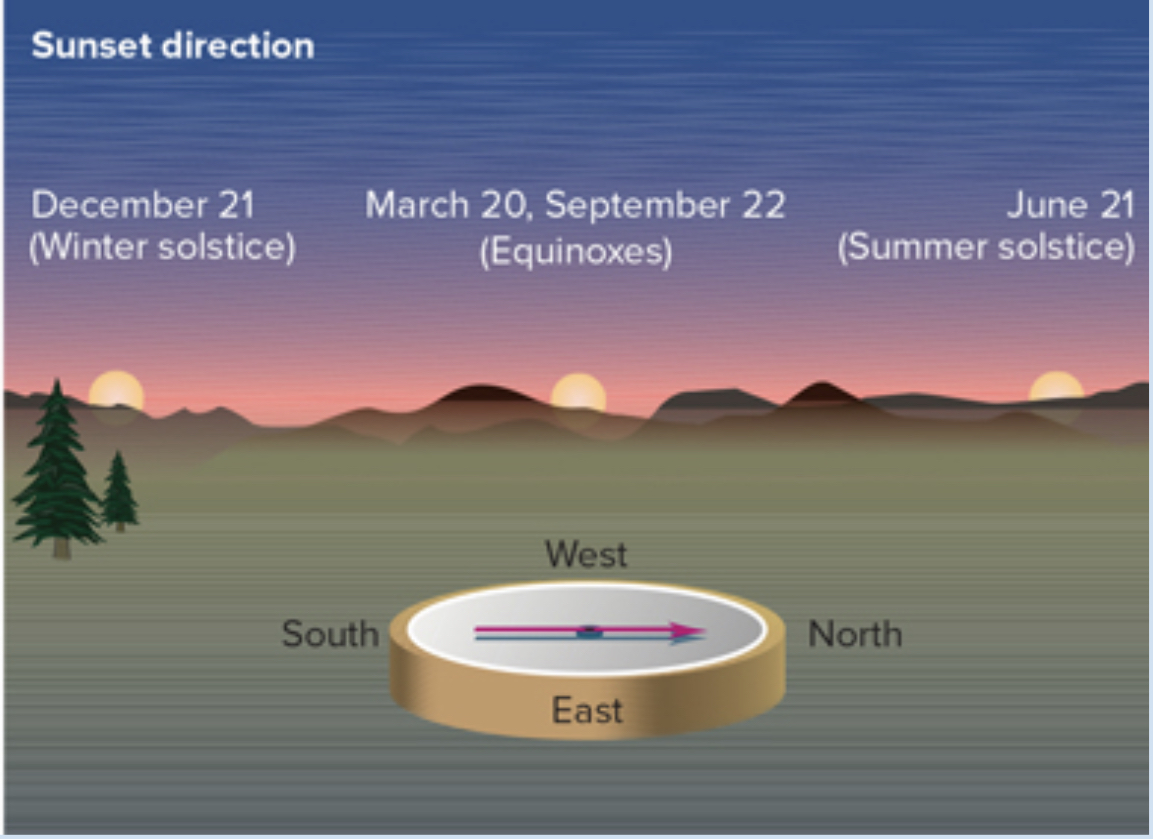
What is the path of a typical Sunrise/Sunset among the seasons?
Starting from December 21st, Sun moves northward, passes through the equinox up to its highest point on June 21st. Then reverses direction.
Where would the sun set on November 1st?
Southwest
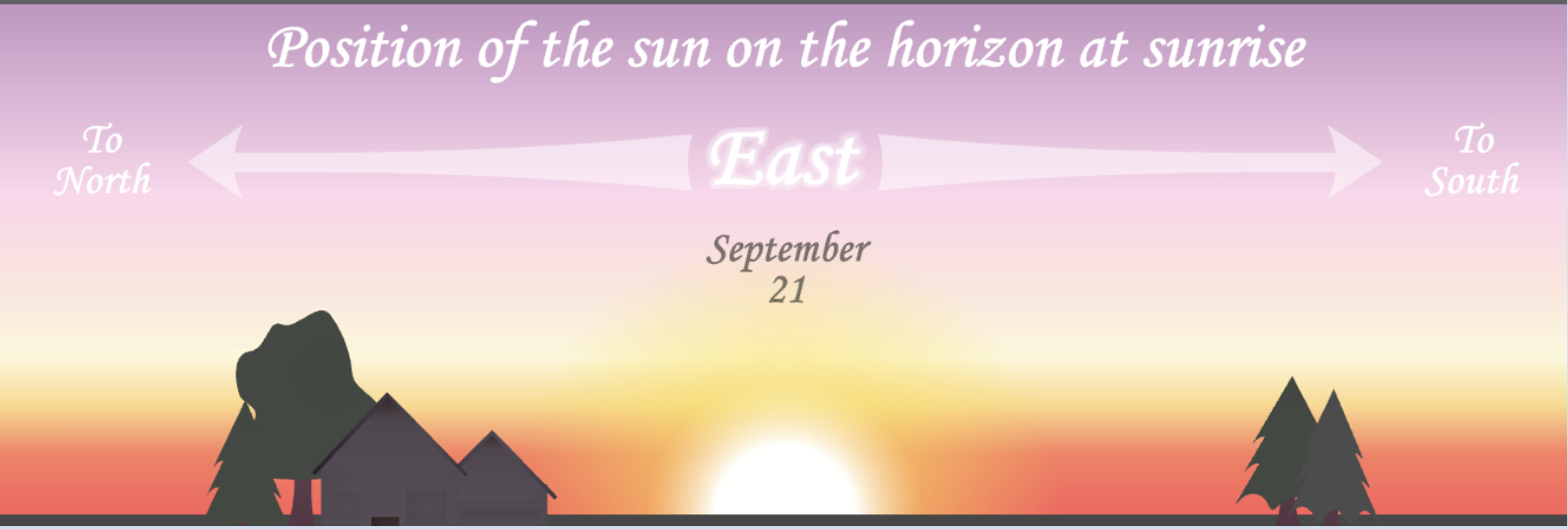
Where would the sun rise on December 1st?
Southeast
In summer, the Sun is higher in the sky because…?
The Earth is tilted toward the Sun
In winter, the Sun is higher in the sky because…?
The Earth is tilted away from the Sun
Direct sunlight hits the surface because of…?
The Earth’s tilt
Effects of Direct Sunlight from the Earth’s tilt
Amount of heating depends on how spread the light is
-Light hitting at an angle is more spread out
Energy is more “concentrated” in a smaller area, so the Earth is heated up more
Energy is less “concentrated” over a larger area, so the Earth is heated up less
Hemisphere tilted toward the Sun (Northern Hemisphere)
Altitude of the Sun at Noon - higher
Directness of Sunlight - More direct
Length of the day - longer
Hemisphere tilted away from the Sun (Southern Hemisphere)
Altitude of the Sun at Noon - lower
Directness of Sunlight - less direct
Length of the day - shorter
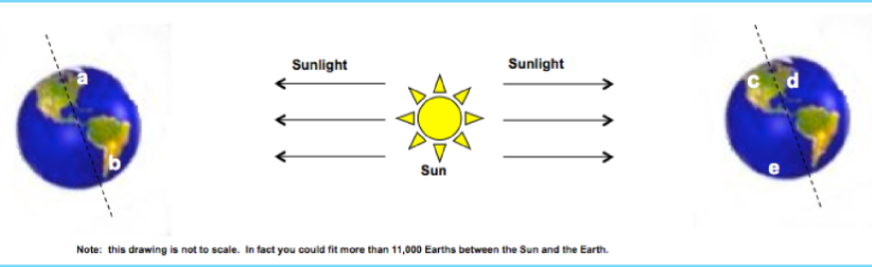
Which season is location “b” experiencing?
Summer
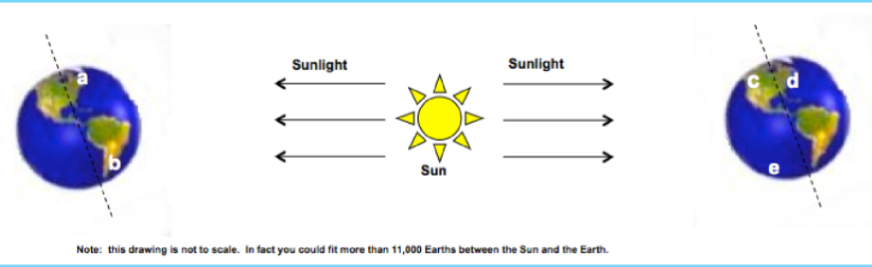
Which season is location “d” experiencing?
Summer
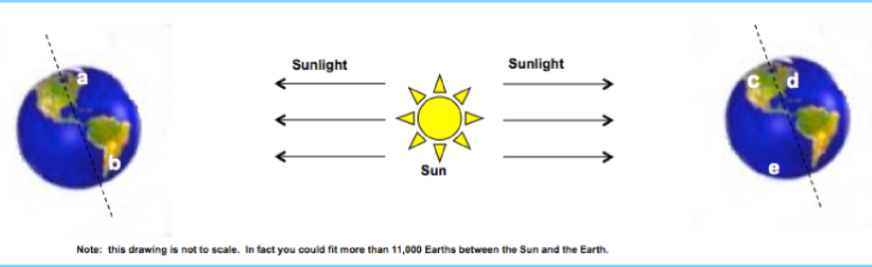
Which season is location “a” experiencing?
Winter
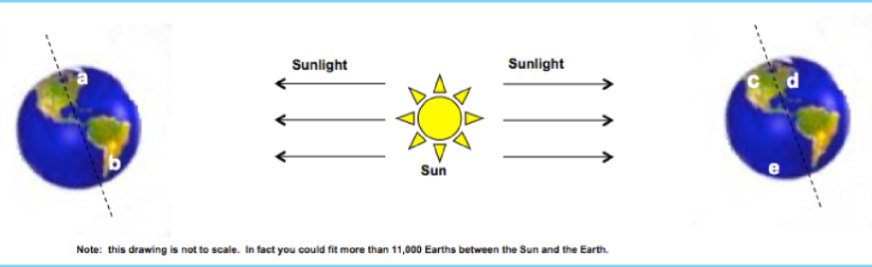
Which season is location “e” experiencing?
Winter
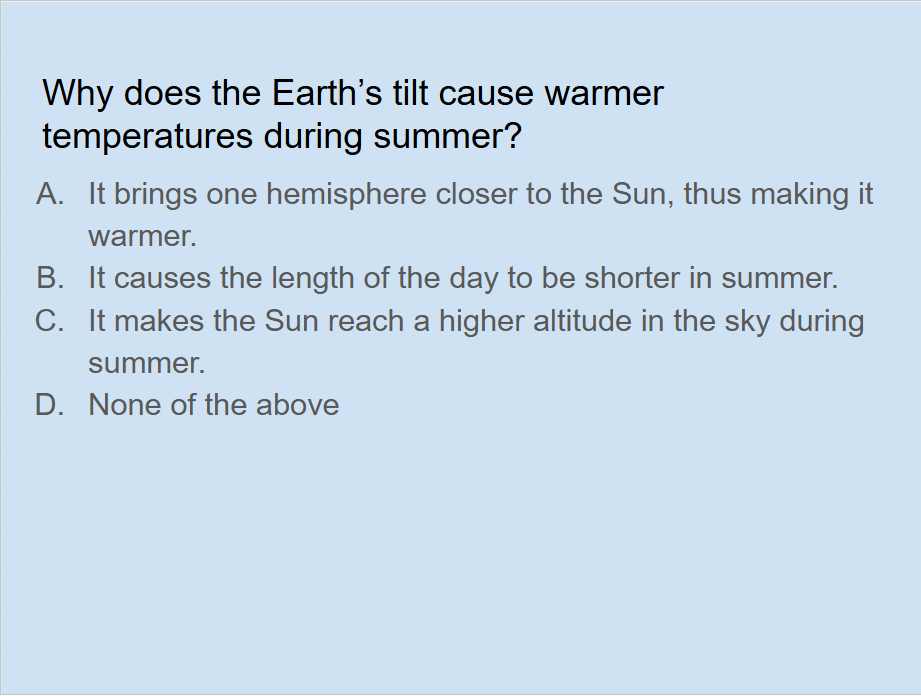
It makes the sun reach a higher altitude in the sky during summer
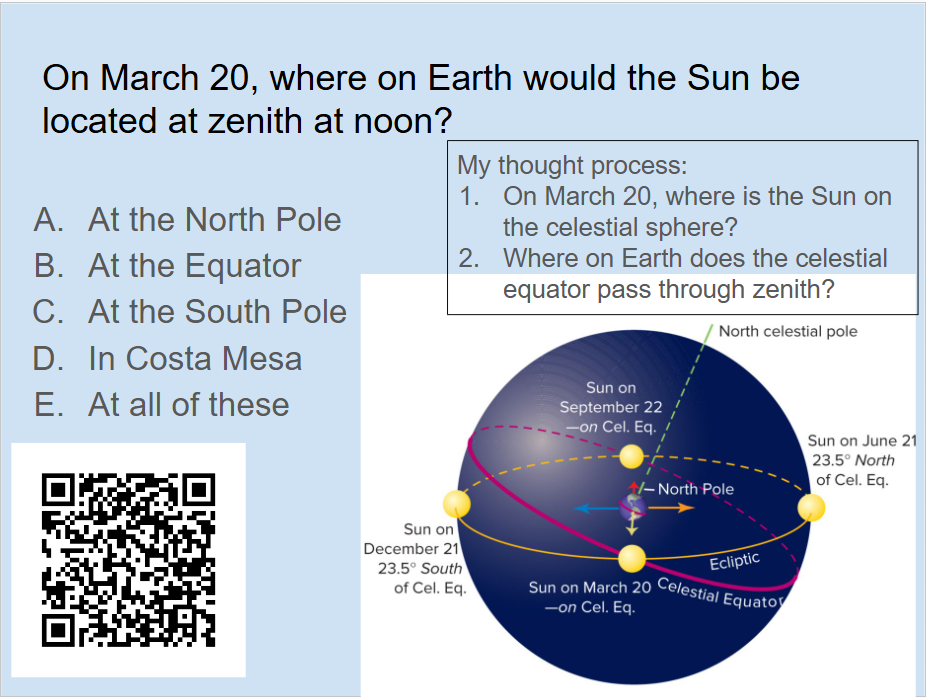
At the Equator
The Annual Path of the Sun in Costa Mesa
The sun follows a seasonal arc across the southern sky, rising in the east and setting in the west. The path is highest and longest in summer (sun reaches elevation), offering long days. In winter, the path is much lower and shorter ( elevation), leading to shorter, cooler days.
Summer Solstice (June): The sun rises at its northernmost point (Northeast), arches high, and sets at its northernmost point (Northwest).
Equinoxes (March/Sept): The sun rises due East and sets due West.
Winter Solstice (Dec): The sun rises at its southernmost point (Southeast), stays low in the southern sky, and sets at its southernmost point (Southwest)
On which date would the Sun rise furthest northeast in Costa Mesa?
June 21st
On which date(s) would the Sun set due west in Costa Mesa?
September 22nd
March 20th
The Sun reaches zenith at noon on the summer solstice in Costa Mesa
False; only reaches about 80° altitude
The Annual Path of the Sun at the Equator
At the equator, the Sun rises straight from the horizon, but reaches the zenith only at the equinoxes.
The Sun only reaches the zenith twice a year at the tropical regions
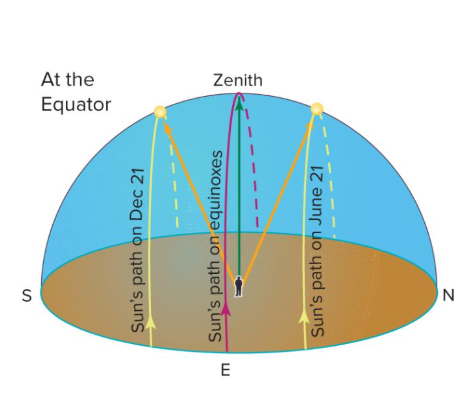
Tropical Regions
Between latitudes 23.5° S and 23.5° N, the Sun passes straight overhead on two days during the year as the Sun moves north and south; the twilight period is shorter than at other latitudes
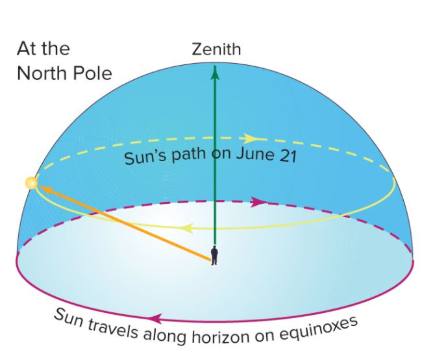
The Annual Path of the Sun at the North Pole
The Sun never sets for six months, but gradually spirals up from the horizon from the vernal equinox to the summer solstice, then spirals down the horizon at the autumnal equinox before it disappears for six months.
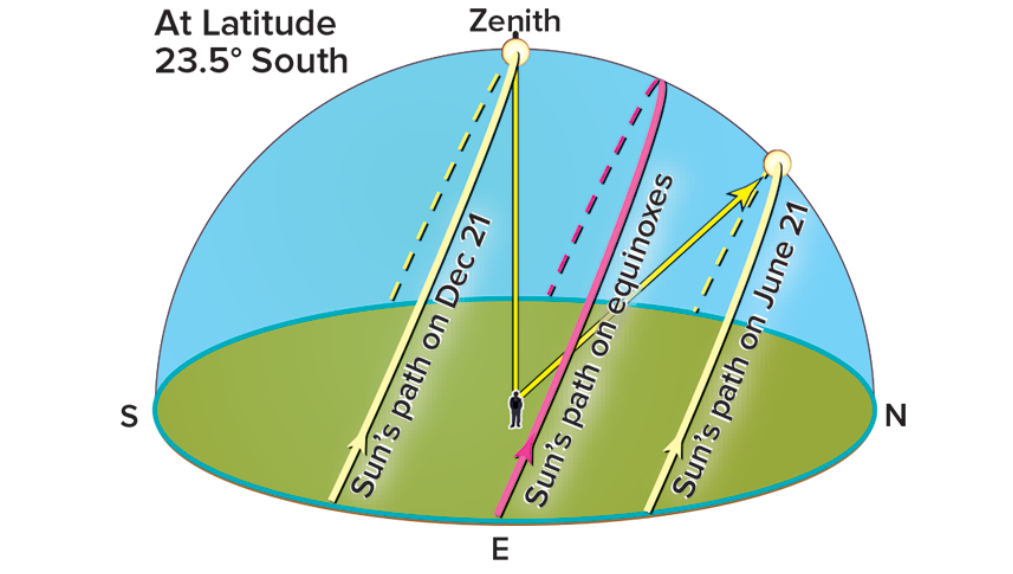
The Annual Path of the Sun at the South Pole
At 23° South, the Sun reaches the zenith only at noon on December 21st (the start of summer in the Southern Hemisphere)
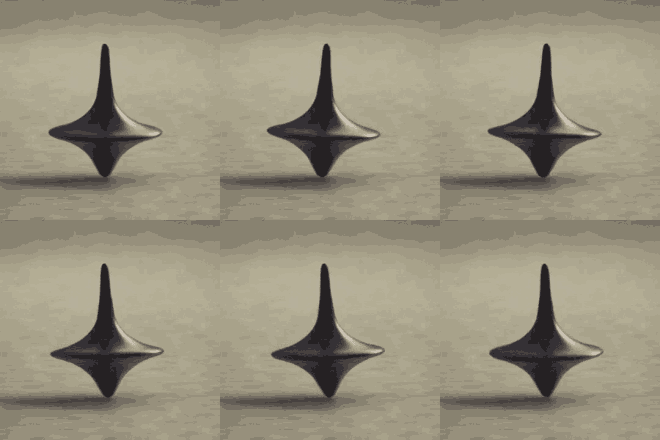
What is a precession?
Over time, the Sun appears in different constellations on the equinoxes. It takes thousands of years, but _______ shifts the position of the ecliptic on the celestial sphere, moving the Sun's position at equinoxes and solstices
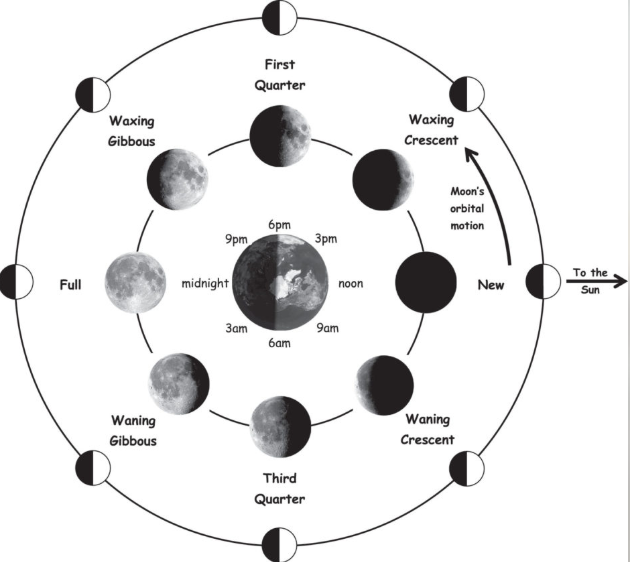
Why does the moon exhibit phases?
The sunlit portion we can see changes as the moon orbits the Earth
The light from the phases of the moon comes from…?
Sunlight reflected by the Moon
Are moon phases also caused by Earth’s shadow?
NO! Moon phases are not caused by Earth’s shadow. The moon can only enter Earth’s shadow when it is opposite the Sun, and therefore full.
What is the moon’s timeline and path?
A month; rises in the East and sets in the West, however, like the Sun, shifts position across the background stars from West to East; counterclockwise motion

