Nutrition and Animal Digestive System
 Call Kai
 Learn
Learn Practice Test
 Spaced Repetition
 Match
Match Flashcards
 Knowt Play
1/50

There's no tags or description
Looks like no tags are added yet.
Name | Mastery | Learn | Test | Matching | Spaced | Call with Kai |
|---|
No analytics yet
Send a link to your students to track their progress
51 Terms
Nutrient
any substance taken in by an organism that is needed for survival, growth, development, tissue repair, or reproduction
Nutrition
process of consuming and using food and nutrients
4 steps of food processing in animals
ingestion
digestion
absorption
egestion
Dietary categories
basic similarities in organ system function lead to similarities in nutritional requirements
different animal physiologies can have different nutritional demands
carnivores
omnivores
herbivores
Organic nutrient purposes
to provide energy - for synthesis of ATP
to make new molecules - larger molecules are taken apart and rebuilt to provide ATP in a way that the body can digest
4 major organic nutrients in animals
carbohydrates - energy source
proteins - provides A.A. for protein production
lipids - major component of cell membranes
nucleic acids - provide sugars, based and phosphates used to make DNA/RNA/ATP
4 essential nutrient groups
essential amino acids
essential fatty acid
vitamins
minerals
Essential amino acids
9 A.A. used in human bodies
20 A.A. total
aminos are useful for producing proteins
not stores and cannot be metabolically synthesized
Essential fatty acids
certain unsaturated fatty acids that cannot be synthesized by animal cells
unsaturated found in plants
obtain them from fish
Unsaturated fatty acids – contain double bonds, lacking hydrogen --> kinked and bent --> bad packing --> typically remain as liquids (oils)
Saturated fatty acids – fully bonded hydrocarbon chain --> long, flat chains -> good for packing --> solid form (butters)
Fatty acid – carboxylic acid and hydrocarbon chain
Advantages of Omega 3
source of energy
reduce inflammation, cancer, clotting
High and low density lipoproteins - flow in body to help fuel physiological processes
Excess of bad will clog arteries, calcifying circulatory system, leading to heart attacks, low blood pressure, etc
Omega 3's act as good cholesterols, containing proteins, that go and find excess deposists and break them down
2 types of digestion
internal
external
Intracellular
Simple animals - vertebrates
Single celled organisms
Sponges, amoeba
Use phagocytosis to absorb nutrients (engulfs)
Cannot store food
Excretes by expulsion
Inefficient mechanism for vertebrates
Extracellular
Occurs in cavity
Protects interior of cells from hydrolytic enzymes
One opening in the extrance and exit
Food enters
Food is digested
Food is absorbed – slows down – maximizes the food essential nutrient extraction
More efficient and better support to a metabolically active organism
Food is excreted
Vertebrate Digestive System
GI track – cannal
Single elongated tube, food comes in, is processed, and excreted through secondary opening
Starts in mouth , pharynx, eso, stom, intes, anus
Accessory structures that help in digestion
Help in breakdown and absorption
Tongue, teeth, salivary glands – external – help in the physical aspect of digestion
Liver, gallbladder, pancrease – internal – release chemicals to help aid in the chemical process
3 methods of absorption
simple diffusion —> natural movement of high concentration to low concentration
facilitated diffusion —> plasma membrane has structures and proteins that facilities movement from high to low concentration
active transport —> against concentration gradient, ATP useage, binding substrate and uses a conformational change to move the molecule across the plasma membrane
3 regions of the alimentary canal
anterior end
middle portion
posterior part
Anterior end
functions primarily in ingestion
mouth, pharynx, esophagus
Middle portion
functions in storage and initial digestion
1+ more food storage or digestive organs
upper part of small intestine and associated organs
posterior part
lower part of intestine and large intestine
undigested material defected through opening (anus or cloaca)
Structure of the GI Tract
Epithelial cells line the GI tract
Functions:
Secrete enzymes and mucus
Release hormones into blood
Absorb/transport nutrients
Gland ducts:
Pass through epithelium
Release acid, enzymes, water, ions into lumen
Tight junctions:
Prevent substances from passing between cells
Ensure controlled absorption
Surrounding support:
Smooth muscle (movement)
Neurons (control)
Connective tissue + blood vessels
Neural activation:
Triggered by sight/smell of food and food in tract
Controls secretion and motility
Structure of GI tract
Epithelial cells have tight junctions --> no space between neighboring cells --> inhibits movement of substances between these cells
- body is regulating what enters blood stream
Smooth cells --> flexible --> involuntary --> provides contraction and release (peracellsis) --> forces food through elementary canal
Mouth
Presence of food stimulates salivary glands to produce saliva
Saliva contains:
Water
Proteins
Mucus
Antibacterial agents
Functions of saliva:
Moistens and lubricates food (helps swallowing)
Dissolves food for taste
Kills bacteria
Begins carbohydrate digestion (via salivary amylase)
Pharynx and esophagus
Acts as a pathway to storage organs
Does not participate in digestion or absorption
Swallowing:
Starts voluntarily in the pharynx
Continues involuntarily in the esophagus
Peristalsis:
Rhythmic smooth muscle contractions
Moves food through the digestive tract
The Crop
in some cases, food moves down the animal esophagus to the crop
it is a storage organ that is a dilation of the lower esophagus
purpose of storing and softening food with little or no digestion
sizes varies off diet
regurgitated material for offspring comes from the crop
Stomach
C-shaped organ located on the left side of the abdominal cavity
food enters the cardioesophageal sphincter from esophagus
empties into small intestine at pyloric valve
functions of the stomach
temporary storage tank for food
digestion site
chemical breakdown of proteins using enzymes and acid
chyme delivered to duodenum of S.I.
composition of the stomach
gastric glands with gastric pits of the sub-mucosa of the stomach
cells produce bicarbonate-rich alkaline mucus, balancing pH
chief and parietal cells
Chief cells
produces protein-digesting enzymes
pepsinogen = activates pepsin to start chemical digestion of proteins
parietal cells
produce hydrochloric acid (HCl)
stomach specialization in birds
proventriculus - The part of the stomach that releases acid and enzymes to start digestion.
gizzard - A strong, muscular part that grinds food into small pieces, often using swallowed sand or small stones.
Stomach specialization in ruminants
Cellulose: A main part of plant cell walls that humans can’t digest, so it passes through the body.
Ruminants (herbivores like cows): Can digest cellulose because microorganisms in their gut break it down into simple sugars they can absorb.
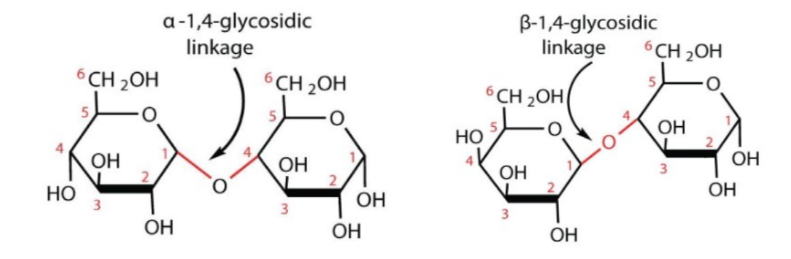
Glycosidic bonds
monosaccharides are joined to others or to alcohols and amines by glycosidic bonds
produced by dehydration reactions
Ruminants
Have a stomach with multiple chambers to help digest plant material.
Rumen & reticulum
Contain microbes that break down cellulose.
Omasum
Absorbs water and nutrients from partially digested food (cud).
Cud
Food that is brought back up, chewed again, and swallowed.
Abomasum
The “true stomach” that uses acid and enzymes to continue digestion.
Small Intestine
Where most digestion and absorption of nutrients and water happens.
Enzymes - Break food into small molecules (like sugars and amino acids).
Absorption - Nutrients pass through intestinal cells into the blood.
Also absorbed - Vitamins, minerals, and water.
Surface Area Specializations
Small intestine lining: Has folds, villi, and microvilli to increase surface area.
Villi: Finger-like projections that stick into the intestine.
Microvilli: Tiny projections on cells that form a “brush border.”
Purpose: Greatly increases surface area (about 600×) to absorb more nutrients.
Absorption by villi
centre of each villus has capillaries and a lymphatic vessel called a lacteal
most fat particles are too bulky for capillaries, and enter larger, wider lacteal instead
empty into circulatory system
Accessory organs
pancreas
liver
gallbladder
Pancreas
secretes digestive enzymes and fluid rich in bicarbonate ions, which neutralizes acidity of chyme as it enters the small intestine
Liver
produces bile
contains bicarbonate, cholesterol, phospholipids, organic waste, amphipathic bile salts
bile is crucial for fat digestion and emulsification
Gallbladder
stores bile and secretes it during a meal
Larger intestine
Large intestine: Includes cecum, colon, rectum, and anus.
Function: Stores waste, absorbs water and salts.
Bacteria: Live here and produce vitamins and gas.
Appendix: Attached to the cecum.
Site of digestion; carbohydrates
Carbs eaten: Mostly complex carbs (like starch); some simple sugars too.
Digestion: Starts in mouth, mostly happens in small intestine (amylase breaks them down).
Breakdown: Disaccharides → monosaccharides.
Absorption: Simple sugars enter the blood through the intestine.
Digestion of lactose
Lactose: Sugar in milk, broken down by lactase.
Infants: Produce lactase; most adults don’t.
Most people: Can’t fully digest lactose after childhood.
Some populations: Evolved to keep producing lactase → can digest milk (lactose tolerant).
Proteins
Proteins: Broken down in stomach (pepsin) and small intestine (trypsin).
Pancreas: Releases inactive enzymes that are activated in the small intestine.
Final breakdown: Into amino acids by enzymes on the intestine surface.
Absorption: Amino acids enter the blood.
Lipids
Fats (lipids): Mostly eaten as triglycerides.
Digestion: Happens in small intestine by lipase (from pancreas).
Breakdown: Into fatty acids and monoglycerides.
Emulsification: Breaks fat into tiny droplets to help digestion.
Absorption: Enter lymph system (too large for direct blood entry).
Formation of micelles and chylomicrons
Micelles: Bile salts group fats into tiny, soluble clusters to help them be absorbed.
Absorption: Lipids slowly enter intestinal cells.
Inside cells: Re-formed into triglycerides.
Chylomicrons: Fat droplets packaged with proteins.
Transport: Released into lymph, then eventually enter the blood.
Vitamins, minerals and water
do not require digestion - absorbed completely
water-soluble vitamins absorbed by diffusion or active transport in SI
fat-solube vitamins follow pathway for lipid absorption
small water amounts absorbed in stomach but mostly in SI

