Virology Exam 3
0.0(0)
 Studied by 1 person
 Call Kai
 Learn
Learn Practice Test
 Spaced Repetition
 Match
Match Flashcards
 Knowt Play
Card Sorting
1/187

Earn XP
Description and Tags
Last updated 4:46 PM on 5/7/23
Name | Mastery | Learn | Test | Matching | Spaced | Call with Kai |
|---|
No analytics yet
Send a link to your students to track their progress
188 Terms
1
New cards
1983
first major breakthrough against the disease
2
New cards
Francoise Barre-Sinoussi and Luc Montagnier
Pasteur Instutute researches that isolated the retrovirus
3
New cards
Robert Gallo
described the retrovirus that he named the third of the human T-lymphotropic viruses, HTLV-III
4
New cards
1985
blood test for HIV developed
5
New cards
1987
first antiretroviral drug, aidovudine (AZT)
6
New cards
1994
Highly-active antiretroviral therapy (HAART)
7
New cards
HIV family name
Retroviridae
8
New cards
Group M
main/major
* worldwide pandemic
* worldwide pandemic
9
New cards
Group O
outlier
* less than 1% of HIV-1 infections, restricted to Cameroon, Gabon, and neighboring countries
* less than 1% of HIV-1 infections, restricted to Cameroon, Gabon, and neighboring countries
10
New cards
Group N
non-M, non-O
* rare: fewer than 20 cases ever documented
* rare: fewer than 20 cases ever documented
11
New cards
Group P
newest group
* only 2 cases documented, both from Cameroon
* only 2 cases documented, both from Cameroon
12
New cards
HIV-1 groups
* group M
* group O
* group N
* group P
* group O
* group N
* group P
13
New cards
HIV-2 groups
* 8 distinct groups, A-I
* Groups A and B are most prevalent
* Groups C-I are rare
* No HIV-s subtypes exist
* Groups A and B are most prevalent
* Groups C-I are rare
* No HIV-s subtypes exist
14
New cards
HIV is transmitted primarily 3 ways:
1. sexual contact that exposes a mucosal epithelium to semen, vaginal secretions, rectal secretions, or blood that contains the virus
2. from infected mother to child- transplacentally
1. through blood and blood products- injectable drug use, improperly sterilized needles or medical equipment, and through accidental exposure
15
New cards
T or F: mosquitoes have never been shown to transmit HIV
False
16
New cards
most common route of HIV infection worldwide
heterosexual transmission
17
New cards
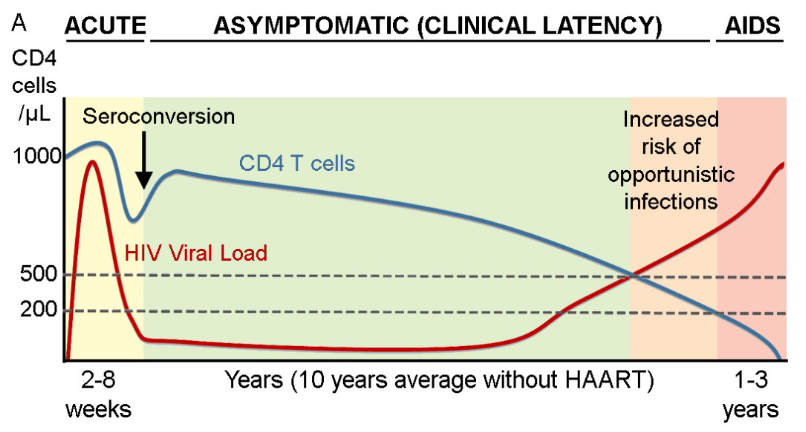
the clinical course of HIV infection is divided into 3 stages:
1. acute
2. asymptomatic (clinical latency)
3. aids
18
New cards
Stage 1: Acute stage
* within 2-4 weeks after infection
* \
> 50% of HIV-infected individuals develop severe flu-like symptoms: fever, swollen lymph nodes, sore throat, arthralgia(joint pain), myalgia (muscle pain), headache, fatigue, weight loss, sometimes a rash
* viral loads reach very high levels
* person seroconverts (produces antibodies against the virus) as symptoms resolve
* lasts 2-8 weeks
* \
> 50% of HIV-infected individuals develop severe flu-like symptoms: fever, swollen lymph nodes, sore throat, arthralgia(joint pain), myalgia (muscle pain), headache, fatigue, weight loss, sometimes a rash
* viral loads reach very high levels
* person seroconverts (produces antibodies against the virus) as symptoms resolve
* lasts 2-8 weeks
19
New cards
stage 2: Asymptomatic phase (clinical latency stage)
* symptoms are absent or limited
* HIV slowly replicates, causing gradual depletion of CD4 cells
* lasts an average of 10 years without antiretroviral therapy
* HIV slowly replicates, causing gradual depletion of CD4 cells
* lasts an average of 10 years without antiretroviral therapy
20
New cards
rapid progressors
* take 2-3 years to progress through this stage (10-15%)
21
New cards
long-term nonprogressors (LTNPs)
* maintain normal CD4 T cell counts and low HIV titers without ART (5%)
* a subset known as elite controllers even maintain undetectable viral loads
* a subset known as elite controllers even maintain undetectable viral loads
22
New cards
elite controllers
* maintain undetectable viral loads
23
New cards
opportunistic infections
* that infections caused by pathogens that are normally cleared by the immune system but cause disease when an individual’s immune system becomes impaired
24
New cards
stage 3: acquired immune deficiency syndrome (AIDS)
* a person is classified as progressed to AIDS when he/she develops one or more opportunistic infections or has a CD4 T cell count below 200 cells/µL of blood
* person diagnosed with AIDS lives around 3 years or 1 year if an opportunistic infection is acquired
* person diagnosed with AIDS lives around 3 years or 1 year if an opportunistic infection is acquired
25
New cards
Other AIDS disease complications
* kidney disease, due to:
* the infection of kidney cells by HIV
* immune complexes, antigen-antibody complexes that become lodged in the kidneys
* a side effect of antiretroviral drugs
* Neurological manifestations
* cognitive issues
* HIV- associated dementia
* Encephalitis- inflammation of the brain
* meningitis- inflammation of the meninges
* the infection of kidney cells by HIV
* immune complexes, antigen-antibody complexes that become lodged in the kidneys
* a side effect of antiretroviral drugs
* Neurological manifestations
* cognitive issues
* HIV- associated dementia
* Encephalitis- inflammation of the brain
* meningitis- inflammation of the meninges
26
New cards
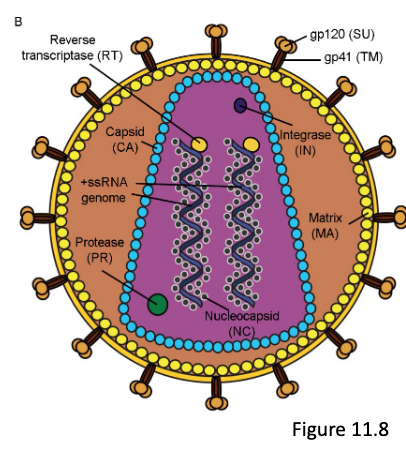
molecular virology of HIV
* HIV is an enveloped retrovirus possessing a cone- or bullet-shaped capsid
27
New cards
molecular virology of HIV:
* capsid built from a single protein:
* two complete copies of the:
* capsid built from a single protein:
* two complete copies of the:
* the capsid protein (CA)
* +ssRNA genome
* +ssRNA genome
28
New cards
Molecular virology of HIV:
* within the core:
* within the core:
* Nucleocapsid protein (NC) that coats the viral RNA
* 3 enzymes:
* reverse transcriptase
* integrase
* protease
* Vpr- an accessory protein that is involved in the transport of cDNA into the nucleus
* 3 enzymes:
* reverse transcriptase
* integrase
* protease
* Vpr- an accessory protein that is involved in the transport of cDNA into the nucleus
29
New cards
Molecular virology of HIV:
* the envelope surrounds the core to create a virion
* the envelope surrounds the core to create a virion
* matrix protein- attaches to the inner surface of the envelope
* trimers of the envelope glycoproteins are found on the surface
* consist of gp120 (surface subunit) and gp41 (transmembrane subunit)
* gp120 and gp41 are cleaved from gp160 during replication but remain non-covalently associated with each other
* trimers of the envelope glycoproteins are found on the surface
* consist of gp120 (surface subunit) and gp41 (transmembrane subunit)
* gp120 and gp41 are cleaved from gp160 during replication but remain non-covalently associated with each other
30
New cards
why haven’t any candidate HIV vaccines been successful?
* traditional methods (live attenuated or inactivated virus vaccines) have not been effective
* HIV is a human virus that does not infect typical animal models-testing for safety and efficacy is a challenge
* HIV mutates quickly due to low fidelity of the RT
* # of HIV subtypes make is unreasonable to create a “universal vaccine” against them all
* gp120 is highly glycosylated, preventing antibodies from easily interacting with it
* HIV is a human virus that does not infect typical animal models-testing for safety and efficacy is a challenge
* HIV mutates quickly due to low fidelity of the RT
* # of HIV subtypes make is unreasonable to create a “universal vaccine” against them all
* gp120 is highly glycosylated, preventing antibodies from easily interacting with it
31
New cards
“prime-boost” strategy
* “prime” vaccine- recombinant vector vaccine using canarypox to deliver and express HIV Gag, Pol, and Env peptides
* last 2 injections included the “boost” vaccine, containing the gp120 protein
* last 2 injections included the “boost” vaccine, containing the gp120 protein
32
New cards
Broadly neutralizing antibodies (bNAbs)
* neutralize a range of HIV isolates have been observed in rare HIV+ individuals
* requires some to have been infected for years
* antibodies have mutations that allow the antibody to pass
* through glycans to interact with conserved regions of gp120
* numerous nNAbs have been identified
\
* requires some to have been infected for years
* antibodies have mutations that allow the antibody to pass
* through glycans to interact with conserved regions of gp120
* numerous nNAbs have been identified
\
33
New cards
Influenza family name
* Orthomyxoviridae
34
New cards
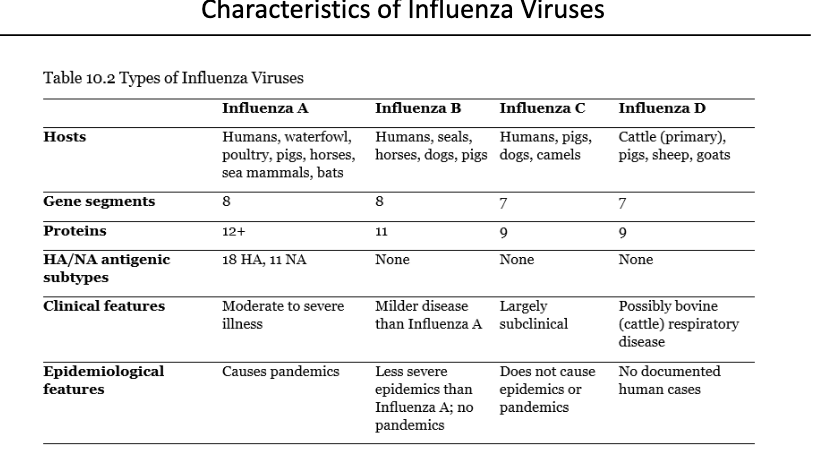
characteristics of influenza viruses
35
New cards
Influenza A viruses accounts for…
\~ 2/3 of human infections each year
36
New cards
subtypes of influenza A
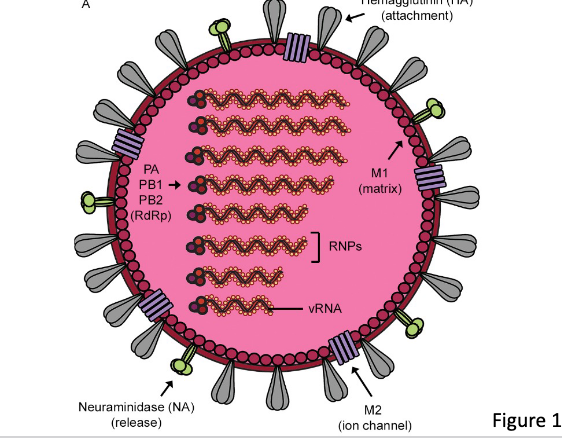
* codetermined by the identity of its 2 envelope glycoproteins:
* hemagglutinin (HA or H)
* neuraminidase (NA or N)
* hemagglutinin (HA or H)
* neuraminidase (NA or N)
37
New cards
How many different HA subtypes exist?
* 18 (H1-H18)
\
\
38
New cards
How many different NA subtypes exist?
* 11 (N1-N11)
39
New cards
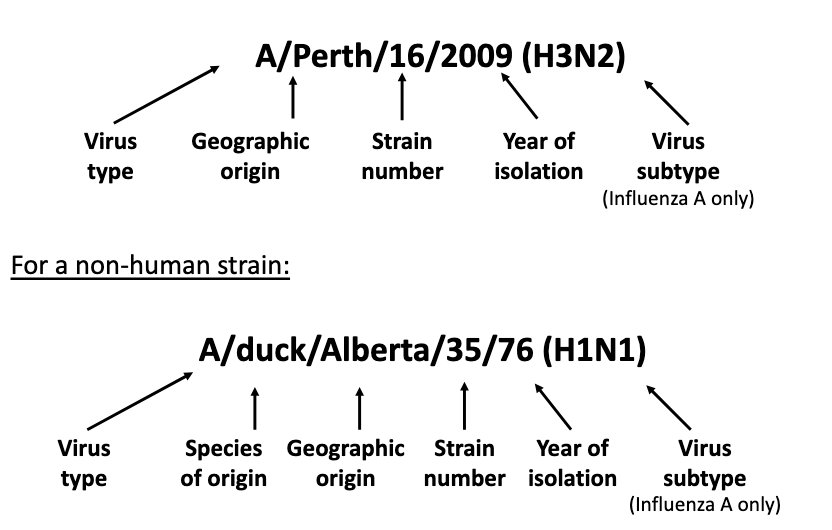
Internationally accepted convention of naming Influenza viruses
* the antigenic virus type (A, B, or C)
* the species of origin, only indicated if not a human strain
* the geographic site where it was first located
* the strain number
* the year of isolation
* the HA and NA virus subtype, in parentheses
\
* the species of origin, only indicated if not a human strain
* the geographic site where it was first located
* the strain number
* the year of isolation
* the HA and NA virus subtype, in parentheses
\
40
New cards
What type of virus is Influenza?
* respiratory
* transmitted in droplets that are generated when a person coughs or sneezes
* droplets are inhaled by a susceptible person less than 3 ft away into the respiratory tract, where the virus comes into contact with cells that bear its cell surface receptor
* transmitted in droplets that are generated when a person coughs or sneezes
* droplets are inhaled by a susceptible person less than 3 ft away into the respiratory tract, where the virus comes into contact with cells that bear its cell surface receptor
41
New cards
incubation period of influenza?
* 1-4 days (average:2)
42
New cards
symptoms of influenza
* abrupt onset fever
* myalgia
* generalized malaise
* fatigue
* headache
* sore throat
* rhinorrha (runny nose)
* dry cough
* myalgia
* generalized malaise
* fatigue
* headache
* sore throat
* rhinorrha (runny nose)
* dry cough
43
New cards
How long do symptoms of Influenza last?
* 3-5 days
44
New cards
shedding Influenza virus
* occurs from the day before symptoms appear to 5 days after they begin
* children can shed the virus for longer than 10 days
* viremia is uncommon
* children can shed the virus for longer than 10 days
* viremia is uncommon
45
New cards
complications of infection
* influenza A is associated with 4 times more hospitalizations than influenza B, which mostly affects children
* case fatality rate is \~ 7%
* \~ 10% of people experience myocarditis, inflammation of the heart
* case fatality rate is \~ 7%
* \~ 10% of people experience myocarditis, inflammation of the heart
46
New cards
molecular virology of influenza virions:
* are enveloped
* contain a helical -ssRNA genome
* are pleomorphic (of varying shape)
* elongated upon initial infection, but more spherical after being propagated in cell culture
* contain a segmented genome
* influenza A and B have 8 segments
* influenza C and D have 7 segments
* contain a helical -ssRNA genome
* are pleomorphic (of varying shape)
* elongated upon initial infection, but more spherical after being propagated in cell culture
* contain a segmented genome
* influenza A and B have 8 segments
* influenza C and D have 7 segments
47
New cards
the 3 influenza proteins that form the RdRp and are the largest influenza proteins
1. PB2
2. PB1
1. PA
48
New cards
Molecular virology of influenza C:
* has one less genome segment than influenza A or B because it does not have separate HA and NA proteins
* envelope glycoprotein hemagglutinin-esterase-fusion (HEF) possess both HA and NA activity
* envelope glycoprotein hemagglutinin-esterase-fusion (HEF) possess both HA and NA activity
49
New cards
Molecular virology of influenza virus: M1
* the matrix protein
* found immediately beneath the viral envelope
* involved in the transport of new RNPs out of the nucleus
* plays a role in the budding of the virion from the plasma membrane
* most abundant protein in the influenza virion
\
* found immediately beneath the viral envelope
* involved in the transport of new RNPs out of the nucleus
* plays a role in the budding of the virion from the plasma membrane
* most abundant protein in the influenza virion
\
50
New cards
Molecular virology of influenza virus: M2
* a transmembrane protein that acts as an ion channel, involved in fusion of the viral envelope with the endosomal membrane
51
New cards
Molecular virology of influenza virus: NS1
* interferes with the host’s production of type 1 interferon and inhibits PKR
52
New cards
Molecular virology of influenza virus: NS2
* known as the nuclear export protein (NEP)
* exports newly-formed RNPs from the cell nucleus
* exports newly-formed RNPs from the cell nucleus
53
New cards
Influenza is internalized via _________
endocytosis
54
New cards
Generally ____________, but non-clathrin and non-caveolin pathways have also been described. \n
clathrin-mediated endocytosis
55
New cards
Unlike other RNA viruses, influenza viruses replicate within the ________.
nucleus
56
New cards
Because the influenza RdRp is error-prone, mutations occurs in the \n _________ during genome replication
vRNA
57
New cards
Since mutations occurs in the vRNA during genome replication, it may result in_______
* Some result in silent mutations
* Some result in missense mutations that change the amino acid sequence
* Some result in missense mutations that change the amino acid sequence
58
New cards
Single-nucleotide point mutations lead to _______, the constant \n acquisition of small changes in the influenza genome that result in the creation of new strains (NOT subtypes)
genetic drift
Other info:
* Mutations in HA and NA may result in an antigen that is no longer recognized by previous antibodies
Other info:
* Mutations in HA and NA may result in an antigen that is no longer recognized by previous antibodies
59
New cards
_________ with mutations have a selective advantages because they \n are not neutralized, so they will continue infecting and replicating
Escape mutants
60
New cards
___________ is the basis for seasonal influenza epidemics: the strain \n circulating one year may mutate into a strain that is not recognized by previous antibodies
Antigenic drift
Other info:
* Basis for changing the strains in the yearly influenza vaccine
Other info:
* Basis for changing the strains in the yearly influenza vaccine
61
New cards
Antigenic shift occurs through ________,__ creating a new _______.
reassortment; subtype
62
New cards
Antigenic shift concerns
• Because the influenza genome is segmented, if a cell is simultaneously infected with two different subtypes of influenza, the newly-replicated vRNA segments could mix within assembling virions \n • This is a major concern to humankind, because only four influenza A subtypes have ever circulated, so the entire population has no immunity to the many subtypes that circulate in other animal reservoirs \n • Wild aquatic birds transmit avian influenza to poultry, pigs, horses, and sea mammals \n • Co-infection of one of these with an avian and human virus could lead to reassortment
63
New cards
In the _______, four major pandemics caused by antigenic shifts \n struck the world.
20th century
64
New cards
1918 Antigenic Shifts
1\. The pandemic of 1918 is the single greatest infectious disease outbreak in history, killing 20-50 million people worldwide in the course of months \n • May have begun at a U.S. Army base at Camp Funston (now Fort Riley), Kansas, in March of 1918 Figure 10.9 National Museum of Health and Medicine \n • Hundreds of soldiers were sick and 48 died from pneumonia \n • Different flu because the healthy were becoming sick, as well, not just children and the elderly \n • Virus spread to Europe with the troops of WWI
65
New cards
Press in Spain covered the outbreak first in Europe → _________
**“Spanish flu”**
66
New cards
The spread of influenza
• September 1918: soldiers began dying at Camp Devins (near Boston), and the flu spread to civilians, who also began dying of pneumonia \n \n • Moved down the eastern seaboard to New York City and Philadelphia \n • High fever, delirium, severe headache, cough, myalgia; death occurred from bacterial pneumonia or fluid in the lungs \n • Heliotrope cyanosis \n • Case fatality was 2.5% \n • Hundreds of people died every day \n • In NYC, nearly 900 people died in one day alone \n • In Philadelphia, 11,000 people died in the month of October \n • Spread South and West
67
New cards
Overall, the pandemic killed ________ people in the US (more than all wars of the century combined) and 20-50 million people worldwide
675,000
68
New cards
_________ recreated the 1918 influenza virus by artificially inserting vRNA sequences into cells to generate functional virions
Reverse genetics
69
New cards
Results of reverse genetics
• Infection of monkeys and mice indicated the 1918 HA and NA genes are more virulent than typical flus \n • The 1918 influenza, particularly the HA protein, induced a “cytokine storm” of inflammatory cytokines that caused tissue damage, hemorrhaging, and massive infiltration of immune cells to the lungs \n • 1918 NS1 gene downregulated the type 1 IFN response by the host
\n __Result__: a virus of increased virulence to which the human population had no immunity that inhibited the anti-viral immune response while \n overstimulating immune cells that cause damage
\n __Result__: a virus of increased virulence to which the human population had no immunity that inhibited the anti-viral immune response while \n overstimulating immune cells that cause damage
70
New cards
Reasons for why 1918 pandemic ended
After a pandemic influenza circulates through the population, it becomes unable to maintain initial transmission rates and its pandemic potential because of an newly-immune population \n →Becomes a seasonal influenza that continues undergoing antigenic drift
71
New cards
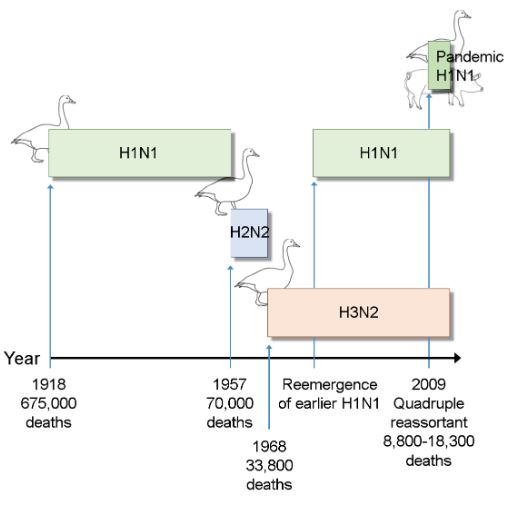
Look at image
• 1957 \n H1N1 → H2N2 \n “Asian influenza”
\n • 1968 \n H2N2 → H3N2 \n “Hong Kong influenza”
\n • 1977 \n H1N1 mysteriously \n reemerged \n “Russian influenza” \n Circulated alongside H3N2
\n • 2008-2009 \n Quadruple-reassortant \n H1N1
\n • 1968 \n H2N2 → H3N2 \n “Hong Kong influenza”
\n • 1977 \n H1N1 mysteriously \n reemerged \n “Russian influenza” \n Circulated alongside H3N2
\n • 2008-2009 \n Quadruple-reassortant \n H1N1
72
New cards
Influenza viruses of many different HA and NA subtypes circulate in \n wild bird populations, particularly _______,__ where the disease is \n ________: widespread in an animal population.
waterfowl; epizootic
73
New cards
Strains that have been circulated
H1N1, H1N2, H3N2
74
New cards
Possibility exists that more human pandemics could occur through direct infection of humans with a mutated ___________ or ____________
avian influenza; through reassortment
75
New cards
However in the past 20 years, we have observed that __________ viruses can be directly transmitted to humans and cause severe respiratory syndromes, pneumonia, and death
highly pathogenic avian influenza (HPAI)
76
New cards
Tropism of avian influenzas for ________ is a contributing factor for why the virus is so virulent in humans.
deeper in the lung
77
New cards
Over 600 cases of ______ since 2003; 60% of those infected have died.
H5N1
Other info:
• Primarily direct bird-to-human transmission \n • Virus continues to circulation throughout the world in both wild birds and poultry populations \n • Can also infect pigs, dogs, ferrets, housecats, and wild cats
Other info:
• Primarily direct bird-to-human transmission \n • Virus continues to circulation throughout the world in both wild birds and poultry populations \n • Can also infect pigs, dogs, ferrets, housecats, and wild cats
78
New cards
_________ is inflammation of the liver
Hepatitis
Other info:
• Caused by excessive alcohol consumption, drugs, toxins, metabolic disorders \n • Several viruses are also a major cause of hepatitis
Other info:
• Caused by excessive alcohol consumption, drugs, toxins, metabolic disorders \n • Several viruses are also a major cause of hepatitis
79
New cards
Major Hepatitis Viruses:
• Hepatitis A virus (HAV) \n • Hepatitis B virus (HBV) \n • Hepatitis C virus (HCV) \n • Hepatitis D virus (HDV) \n • Hepatitis E virus (HEV)
80
New cards
Hepatitis __*___*__*and hepatitis* ______cause 80% of global cases of liver cancer
B; C
81
New cards
Hepatitis viruses are Classified ________ based upon the similar clinical condition they cause, although they are all found in different viral families and possess different molecular properties
together
82
New cards
Acute infection:
1\. Incubation period of 1-3 months, depending upon the virus.
2\. Prodromal period (non-specific symptoms) \n • Malaise \n • Loss of appetite \n • Nausea \n • Vomiting \n • Low-grade fever \n • Occasionally, myalgia and arthralgia
\n 3. Illness period (specific symptoms) begins 3-10 days later \n • Abdominal pain in liver area \n • Dark but clear urine \n • Jaundice due to build up of bilirubin in the blood \n • Gray-colored stools \n • Increased serum aspartate transaminase (AST) and alanine transaminase (ALT) \n • Symptoms peak within 1-2 weeks \n • Jaundice fades during convalescence period \n Clinical Course of Hepatitis Virus Infections \n
2\. Prodromal period (non-specific symptoms) \n • Malaise \n • Loss of appetite \n • Nausea \n • Vomiting \n • Low-grade fever \n • Occasionally, myalgia and arthralgia
\n 3. Illness period (specific symptoms) begins 3-10 days later \n • Abdominal pain in liver area \n • Dark but clear urine \n • Jaundice due to build up of bilirubin in the blood \n • Gray-colored stools \n • Increased serum aspartate transaminase (AST) and alanine transaminase (ALT) \n • Symptoms peak within 1-2 weeks \n • Jaundice fades during convalescence period \n Clinical Course of Hepatitis Virus Infections \n
83
New cards
_______ that are cleared from the host provide ________ immunity.
Acute infections; lifelong
84
New cards
________,__ ______do not generally lead to chronic infections
HAV; HEV
85
New cards
What are some hepatitis virus infections that cause chronic infections in which the virus continues replicating within the liver, causing damage?
\-HBV \n • >90% of infants \n • 25-50% of children between 1-5 years of age \n • 6-10% of older children and adults
\n -HCV \n • 70% of those infected
\n -HDV \n •
\n -HCV \n • 70% of those infected
\n -HDV \n •
86
New cards
Because each hepatitis virus is a ______ virus, they exhibit _______ \n modes of transmission and portals of entry
distinct; differing
87
New cards
Hepatitis D virus is a defective virus, unable to replicate without _____.
HBV
Other info:
no approved serological test that are approved by the FDA, for HEV.
Other info:
no approved serological test that are approved by the FDA, for HEV.
88
New cards
Hepatitis A Virus
• Transmitted through fecal-oral route \n • Drinking contaminated drinking water \n • Eating shellfish from sewage-contaminated water \n • Consuming raw or undercooked foods that have come in contact with virus \n • Non-enveloped \n • Can survive for prolonged periods at low pH, in fresh water, in \n seawater, and in freezing to moderate temperatures \n • Humans are the only known reservoir
89
New cards
After ingestion, the virus is absorbed by the gastrointestinal tract \n and travels via the hepatic portal vein to the liver, where it infects \n and replicates within _______.
hepatocytes
90
New cards
Be familiar for hepatitis A virus
\
• After 10-12 days (2 weeks before symptoms appear), virus is \\n present in bloodstream and in feces \\n • Most transmissible at this point, although it is shed for up to 3 weeks after symptoms appear \\n • Children can shed virus for up to 6 months following infection \\n • Incubation period is 28 days (range: 15-50 days) \\n • Jaundice occurs 70% of the time in older children and adults \\n • 70% of infections are asymptomatic in children
• After 10-12 days (2 weeks before symptoms appear), virus is \\n present in bloodstream and in feces \\n • Most transmissible at this point, although it is shed for up to 3 weeks after symptoms appear \\n • Children can shed virus for up to 6 months following infection \\n • Incubation period is 28 days (range: 15-50 days) \\n • Jaundice occurs 70% of the time in older children and adults \\n • 70% of infections are asymptomatic in children
91
New cards
After HAV, _____ is the second most common cause of acute viral \n hepatitis.
HBV
92
New cards
familiar with HBV
• HBV is transmitted through blood, semen, vaginal fluid, and other \n bodily fluids \n • Highest concentrations of virus are found in blood \n • Percutaneous transmission (through the skin) can occur through sharing of contaminated needles during injection-drug use, unsafe reuse of needles or medical devices in health care settings, or accidental needle pricks with infected human blood \n • Sexual and perinatal transmission are the most common routes of \n transmission \n • In endemic areas, perinatal transmission -- primarily during birth -- is the most important factor in maintaining high HBV prevalence \n • HBV virions can remain infectious for 7+ days at room temperature \n • Humans are the only known natural host of HBV
93
New cards
Additional info of HBV
• Chronic infection varies with age: \n • >90% of infants \n • 25-50% of children between 1-5 years of age \n • 6-10% of older children and adults \n • Chronic infection can lead to chronic liver disease, cirrhosis, or liver \n failure \n • Up to 50% of the cases of hepatocellular carcinoma (HCC) are \n attributable to HBV
94
New cards
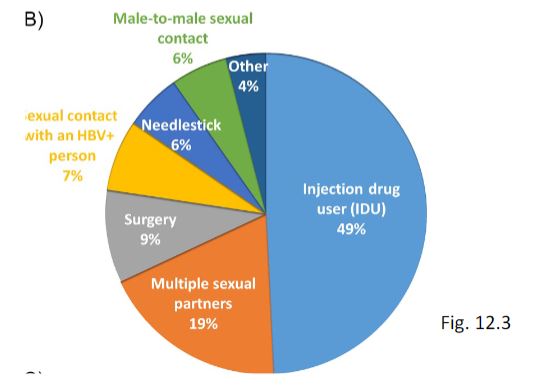
Prevalence geography
• Prevalence is low in U.S., Western Europe, and Australia \n • Still, 1.6 million people are chronically infected in the U.S. \n • 3,000 new acute cases reported each year (more likely 19,000-20,000) \n • Infection in U.S. associated with certain high-risk behaviors:
95
New cards
Hepatitis C virus
• is almost exclusively associated with exposure to contaminated \n blood \n • Most frequently transmitted through sharing of contaminated needles or \n paraphernalia by injection-drug users \n • People that received blood transfusions or organ transplants before 1992 \n (when the blood supply began being screened for HCV) are also at risk \n • Less frequent modes: \n • Sexual contact \n • Perinatal transmission \n • HCV only naturally infects humans
96
New cards
Incubation of HCV
• Incubation period is 45 days (range: 14-180 days) \n • 80% of people are asymptomatic
\n • 70% of people infected develop persistent infections \n • Most common symptom of chronic infection is fatigue \n • Chronic infection can progress to chronic liver disease, cirrhosis (10-25% of \n those with chronic infection), and death from HCC or cirrhosis (20% of those \n developing cirrhosis)
\n • 70% of people infected develop persistent infections \n • Most common symptom of chronic infection is fatigue \n • Chronic infection can progress to chronic liver disease, cirrhosis (10-25% of \n those with chronic infection), and death from HCC or cirrhosis (20% of those \n developing cirrhosis)
97
New cards
HCV treatment
• No vaccine exists for HCV \n • Over 14,000 people die each year of HCV-related liver diseases \n • HCV is the #1 cause of liver transplants \n • Half of those with chronic HCV infection are not aware of it
\
\-New direct acting antiviral (DAA) medications are effective: \n • Composed of two or three compounds that include protease inhibitors and/or nucleoside analogs that inhibit HCV polymerase \n • Current drug combinations result in >95% sustained viral response: viral load is undetectable after treatment is stopped.
\
\-New direct acting antiviral (DAA) medications are effective: \n • Composed of two or three compounds that include protease inhibitors and/or nucleoside analogs that inhibit HCV polymerase \n • Current drug combinations result in >95% sustained viral response: viral load is undetectable after treatment is stopped.
98
New cards
Hepatitis D virus
• Hepatitis D virus (HDV) is also known as “hepatitis delta virus”. \n • HDV is a defective virus: it is unable to replicate on its own. \n • HDV requires a helper virus -- in this case, HBV -- that contributes HBsAg that HDV uses for virion assembly \n • Infection with HDV and HBV can occur through: \n • __Coinfection__: HDV and HBV are contracted at the same time \n • Incubation period of 90 days \n • __Superinfection__: HBV+ individual becomes later infected with HDV \n • Incubation period is 14-56 days \n • HDV is transmitted through contact with infectious blood or \n contaminated injection devices \n • HDV infection can be acute or chronic; if HBV is cleared from the \n host, then HDV is unable to replicate
99
New cards
HDV treatment
• Geographical prevalence of HDV mirrors that of HBV \n • Worldwide, 15-20 million people are infected with HDV \n • 5% of those infected with HBV \n • Chronic coinfection with HBV and HDV leads to more severe liver \n disease than HBV infection alone \n • NRTIs used to treat HBV do not prevent HDV replication, since HDV \n does not possess a RT \n • Vaccination against HBV protects against HDV infection
100
New cards
Hepatitis E Virus
• __Like HAV, HEV is transmitted through the fecal-oral route__ \n • HEV is the #1 cause of waterborne jaundice outbreaks, primarily \n transmitted by fecal contamination of drinking water \n • Due to poor sanitation or inadequate sewage treatment \n • Shellfish can also concentrate the virus if living in waters polluted with sewage \n • HEV is unique among hepatitis viruses because some genotypes \n infect animals \n • HEV-1 through HEV-4 and HEV-7 infect humans \n • HEV-1 and HEV-2 infect only humans (fecal-oral transmission) \n • HEV-3 and HEV-4 infect humans and animals \n • Pigs (main reservoir), boars, deer, and rabbits \n • Can be transmitted through zoonotic transmission or through \n consumption of inadequately cooked meat from these animals \n • High titers of virus in liver and intestines (and sausages using them \n • HEV is relatively resistant to heat; foods must be cooked completely
 Note
Note  Flashcards (45)