How to perform an ECG
 Studied by 0 people
 Call Kai
 Learn
Learn Practice Test
 Spaced Repetition
 Match
Match Flashcards
 Knowt Play
1/20

There's no tags or description
Looks like no tags are added yet.
Name | Mastery | Learn | Test | Matching | Spaced | Call with Kai |
|---|
No analytics yet
Send a link to your students to track their progress
21 Terms
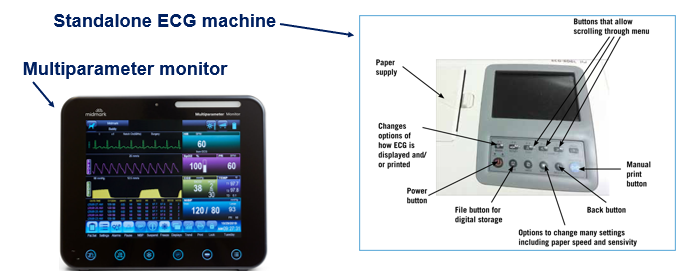
Major components of an ECG machine include ..
Power button
Display screen - to view the ECG trace
Paper supply and speed - to print out the ECG (25mm/s is recommended for most patient but 50mm/s should be used for higher heart rates to spread out the complexes as this is faster
Automatic/manual settings - to choose how to display the ECG (on screen or printed)
Patient Preparation - Calm and relaxed
Avoid false readings, increase in heartrate if they’re stressed
Patient Preparation - Quiet environment
Allow them to be calm and relaxed as possible
Avoid high traffic areas, e.g. prep room
Patient Preparation - Assess heart rate and rhythm prior to beginning the ECG
Indication as to if you placed the ECG correctly
To gain a baseline
Heart rate and rhythm before placing the ECG
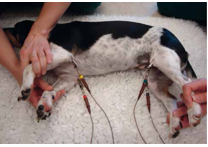
Patient Preparation - Positioned in right lateral recumbency
Least amount of stress on the heart due to where it is positioned
In some circumstances this is impossible - standing, left lateral
If not in Right lateral let the vet know what position the patient was in - if any abnormalities are noticed, this could be why
Patient Preparation - Lay on an electrically insulated surface (rubber matting plus a thick bed)
Patient grip
So we’re only measuring the patients electrical activity
Not picking up any other other, e.g. phone
Patient Preparation - Limbs perpendicular to the body and parallel, limbs not in contact
Legs could get tangled in the leads
Could get artifacts
Patient Preparation - Patient must remain as still as possible
Prevent increase in heartrate
Any artifact could occur
Electrical interference
Patient Preparation - Alter positioning technique for dyspnoeic and uncooperative patients
Standing up or sitting down - dyspnoea patients
Patient Preparation - Consider the effect of anaesthetic and sedative drugs
Effect of opioids on heart rate and rhythm, avoid drugs if possible
Electrodes
Required to connect the ECG leads to the patient
Crocodile clips and self-adhesive electrodes most used
Electrodes - Record the electrical activity generated by the heart ..
Body fluids and tissues are good conductors of electricity, and this can be detected via electrodes
Crocodile clips - Advantages
Good electrical connection
Less risk of disconnection
Moderna clips more conformable
Reusable
Crocodile clips - Disadvantages
Bite can be painful
Uncomfortable
May result in skin necrosis in cases of prolonged use
Unadvised if left on for more than 5-10 minutes as it pinches the skin
Self-adhesive Electrodes - Advantages
Relatively comfortable
Non-invasive (placed in footpads)
Can be used for longer-term monitoring
Self-adhesive Electrodes - Disadvantages
Disposable = £££
Some patients do not like to have their feet touched
To ensure good electrical conductance ..
70& isopropyl alcohol (surgical spirit), or conductive gel (ECG, KY jelly, ultrasound gel) should be applied to the electrodes
When using crocodile clips, position them over ..
Bony prominences - muscle contracts, bone doesn't - can get muscle artifacts
Spirit VS Conductive gel
Spirit - Evaporates, flammable (but cheap!)
Conductive gel - Less evaporation, may require hair clipping
Why might conductive gel be better for cats compared to surgical spirit?
They do not often tolerate the strong alcohol odour
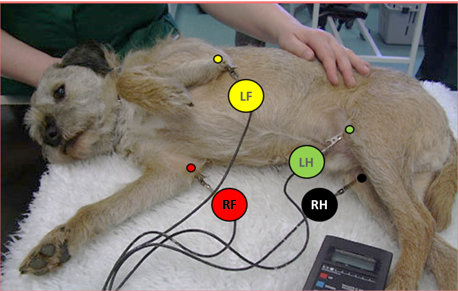
Once the electrodes have been placed ..
They must not be touching any other part of the patient of the handler - do not position the leads over the patient
 Note
Note  Flashcards (50)