Nurs 307 (exam 2): ears

0.0(0)
studied byStudied by 0 people
call kaiCall Kai
learnLearn
examPractice Test
spaced repetitionSpaced Repetition
heart puzzleMatch
flashcardsFlashcards
GameKnowt Play
Card Sorting

1/99

encourage image

There's no tags or description

Looks like no tags are added yet.

Last updated 11:49 AM on 3/24/25
Name
Mastery
Learn
Test
Matching
Spaced
Call with Kai

No analytics yet

Send a link to your students to track their progress

100 Terms

1
New cards

External ear is called

auricle or pinna

2
New cards

Shape serves to funnel sound waves into its opening which is called the ______ ______ _______

external auditory canal

3
New cards

The auditor canal is line with glands that secrete ________

ceruman

4
New cards

t/f cerumen is suppose to be there

true

5
New cards

(external ear): inner _____ ______ consists of ______ covered by thin sensitive skin

two thirds

bone

6
New cards

Lymphatic drainage of ______ ______ flows to parotid, mastoid, and superficial cervical nodes

external ear

7
New cards

Tympanic Membrane is also called eardrum and separates ______ and ______ ear

external

middle

8
New cards

(Tympanic Membrane) is a _______ membrane with a pearly _______ color

translucent

gray

9
New cards

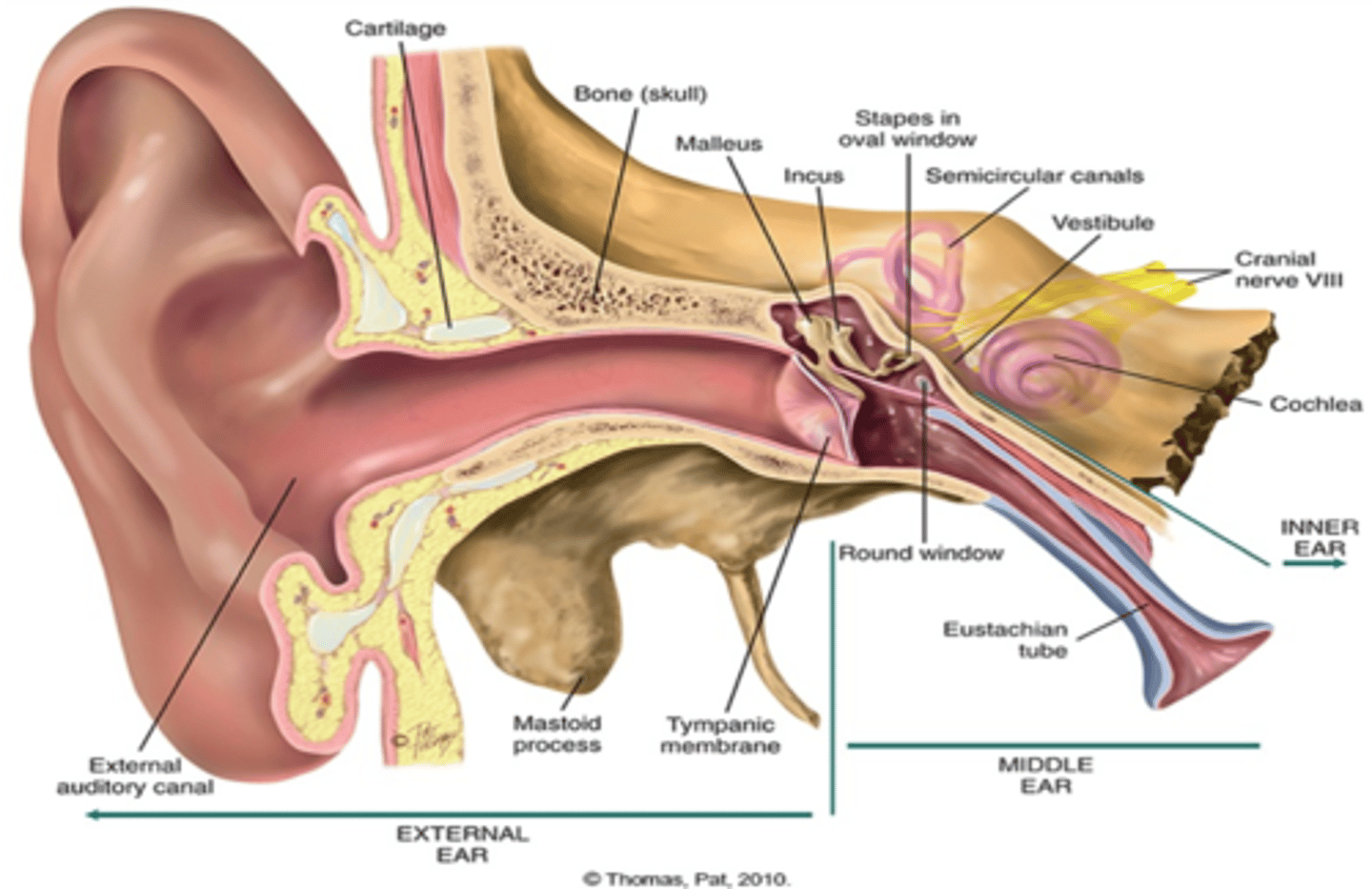
know anatomy of ear

knowt flashcard image
10
New cards

(Middle Ear): to the outer ear and inner ear __________ tube

Eustachian tube

11
New cards

Eustachian tube connects _____ ____ with the ________ and allows passage of AIR

middle ear

nasopharynx

12
New cards

First function of the middle ear:

Conducts ______ vibrations from the OUTER EAR to central _______ apparatus in the inner ear

- sound

- hearing apparatus

13
New cards

Second function of the middle ear:

Protects inner ear by reducing _______ of loud sounds

amplitude

14
New cards

Third function of the middle ear:

Eustachian tube allows _________ of _____ ______ on each side of the TM so the it does not rupture

- equalization

- air pressure

15
New cards

Inner ear contains the ______ ________, which holds ______ organs for ____ and hearing

bony labyrinth

sensory

equilibrium

16
New cards

________ and the semicircular canals within the bony labyrinth compose the ______ ________

vestibule

vestibular appratus

17
New cards

although the inner ear is not accessible to direct examination, its function can be ______

assessed

18
New cards

(hearing)

the auditory system can be divided into three levels:

-

-

-

peripheral

brainstem

cerebral cortex

19
New cards

at PERIPHERAL level, ear transmit ______ and CONVERTS its vibrations into _____ ______, which can be analyzed by the BRAIN

- sound

- electrical impulses

20
New cards

Amplitude: is _______

loudness

21
New cards

Frequency: _______ or NUMBER of cycles per second

pitch

22
New cards

sound waves produce vibrations on _____ _____

TM

23
New cards

Numerous ______ along basilar membrane are receptor ____ CELLS of organ of Cortisones, the sensory organ of HEARING

fibers

hair cells

24
New cards

As hair cells ______, they mediate VIBRATIONS into _____ _____, which are conducted by auditory operation of CN ______ to brainstem

- bend

- electric impulses

- VIII

25
New cards

function at brain stem level is _____ interaction

binaural

26
New cards

Brainstem locates direction of a _____ in space, as well as identifying the _____

sound

sound

27
New cards

CN VIIII (acoustic) from each ear sends SIGNALS to both sides of brainstem, which are sensitive to differences in ______ and _____ of messages from two ears, depending on way HEAD is turned

intensity

timing

28
New cards

The function of the CORTEX is to ________ meaning of the ______ and begin appropriate response

interpret

sound

29
New cards

normal pathway of hearing is _______ ________ . it is the most efficient

air conduction

30
New cards

which pathway of sounds is most efficient?

air conduction

31
New cards

what is the alternate pathway of sound?

bone conduction

32
New cards

_____ of the _____ vibrate and are transmitted directly to inner ear and to CN _____

bones

skull

VIII (acoustic)

33
New cards

presbycusis

age related hearing loss

34
New cards

Conductive hearing loss: partial loss because a person is able to hear if ____ amplitude is ______ enough to reach normal elements in inner ear

sound amplitude

increased

35
New cards

sensorineural hearing loss: increase in ______ may not enable a person to understand ______

amplitude

words

36
New cards

________ holds the sensory organ for equilibrium and hearing)

labyrinth

37
New cards

_______ in inner ear constantly feeds information to the brain about body's position in space

labyrinth

38
New cards

How many semicircular canals are there?

three

39
New cards

If the labyrinth ever becomes inflamed, it feeds the wrong information to the brain, creating a staggering gait and a strong, spinning, whirling sensation called _________.

vertigo

40
New cards

in aging persons, _____ lining ear canal become coarse and stiff

cilia

41
New cards

the coarse and stiff cilia may cause cerumen to accumulate and oxidize, which greatly ________ hearing

reduces

42
New cards

cerumen is _____ because of atrophy of apocrine glands

drier `

43
New cards

true or false: impacted cerumen with hearing loss is not reversible

false

44
New cards

______: type of hearing loss that occurs with aging, even if people living in quiet enviroment

presbycusis

45
New cards

presbycusis onset usually occurs in _____s and slowly progresses

50

46
New cards

with Presbycusis, first notice a ____-___ tone loss

high frequency

47
New cards

ringing, roaring, buzzing in ears without external source

tinnitus

48
New cards

tinnitus occurs with which type of hearing loss?

sensorineural hearing loss

49
New cards

_____ - the room is spinning

vertigo

50
New cards

vertigo- room spinning is (_____ vertigo); environment is spinning around you

objective

51
New cards

vertigo - you're spinning (_____ vertigo

subjective

52
New cards

______ not steady, feels like you are losing your balance

dizzy

53
New cards

(indication of possible hearing loss):

_____ _____ or watching your ___ and __ rather than your eyes

lip reading

face

lips

54
New cards

(indication of possible hearing loss):

_____ or straining ______ to hear

frowning

forward

55
New cards

(indication of possible hearing loss):

posturing of head to catch sounds with better ____

ear

56
New cards

(indication of possible hearing loss):

_________ questions; frequently ask you to repeat questions

misunderstands

57
New cards

_____ or shows _____ reflex when you raise your voice

irritable

startle

58
New cards

(indication of possible hearing loss):

the person's speech sounds garbled, _____ sounds distorted

vowel

59
New cards

(indication of possible hearing loss):

inappropriately _____ voice

loud

60
New cards

(indication of possible hearing loss):____ , ____ tone of voice

flat

monotonus

61
New cards

(external noise questions):

Any loud noises at ______ or on the ___?

home

job

62
New cards

(external noise questions):

Are you hearing other noises such as _____ _____, loud persistent _____, or ____ in military or while HUNTING

-heavy machinery

-music

-gunshots

63
New cards

(coping strategies with external noise questions):

do you take any steps to ____ your ears, such as _____ or ______

protect

headphones

earplugs

64
New cards

inspect external ear:

- SIZE and SHAPE of auricle, ___ and ___ on head

position

alignment

65
New cards

inspect external ear:

check ____ and ____ for tenderness

auricle

tragus

66
New cards

inspect external ear:

ears are _____ size bilaterally with no swelling or thickening

equal

67
New cards

inspect external ear:

ears of unusual size and shape may be a ______ familial trait with no clinical significance

normal

68
New cards

Pinna and Tragus should feel ____ and movement should produce no pain

firm

69
New cards

palpating _____ ____ should also produce no pain

mastoid process

70
New cards

normal tympanic membrane should be: ____ and ____ with a ____-____ color

shiny

translucent

pearl-grey

71
New cards

_____ - _____ light reflex prominent in anteroinferior quadrant, a reflection of the otoscope light

cone-shaped

72
New cards

tympanic membrane with some adults may show scarring, which is a dense ____ patch on the TM, a sequence of repeated ear infections

white

73
New cards

screening for hearing acuity begins during ____; how well a person hears during conversational speech

-history

-how well a person hears during conversational speech

74
New cards

if a person answers yes to hearing difficulty, perform _____ testing or refer for _____ testing

audiometric

75
New cards

if a person answers no, screen using _____ ___ ___

whispered voice test

76
New cards

what is a passing score for Whispered Voice Test?

correct repetition of 4 of 6 number/letters

77
New cards

the whispered voice test is use to detect ______-____ /_____ frequency loss

high-tone

high

78
New cards

this test is to asses ability of vestibular apparatus in inner ear to help maintain standing balance

Romberg sign

79
New cards

(infants and young children):

top of the pinna should match an imaginary line extending from corner of ______ to the _______

eye

occiput

80
New cards

(testing hearing acuity for infants and childeren):

Newborn: _____ (_____)reflex, acoustic blink reflex

startle (Moro)

81
New cards

(behavioral manifestation of hearing loss infants and young children):

child is ______ in casual conversation

inattentive

82
New cards

(behavioral manifestation of hearing loss infants and young children):

____ _____ strained or puzzled

facial. expression

83
New cards

(behavioral manifestation of hearing loss infants and young children):

frequently asks to have statements ______

repeated

84
New cards

(behavioral manifestation of hearing loss infants and young children):

confuses words that _____ ______

sound alike

85
New cards

(behavioral manifestation of hearing loss infants and young children):

has accompanying ____ problem

speech

86
New cards

(behavioral manifestation of hearing loss infants and young children):

appears shy and with drawn and lives in his or her _____ world

own

87
New cards

(behavioral manifestation of hearing loss infants and young children):

frequently complains of _____

earaches

88
New cards

(behavioral manifestation of hearing loss infants and young children):

hears better at times when environment is more ____

conducive

89
New cards

(Aging adults):

high-tone frequency loss apparent for those affected with ____

presbycusis

90
New cards

(Aging adults):

difficulty hearing _____ during conversation.

consonants

91
New cards

(Aging adults):

difficulty hearing _____ words in voice tests

whispered

92
New cards

_______ ______ (swimmer's ear). this abnormal finding of external ear

Otitis externa

93
New cards

lumps and lesions on external ear could be a sign of _____

Carcinoma

94
New cards

abnormal finding in ear canal_____ ____

excessive cerumen

95
New cards

abnormal findings of the TM:

-

-

acute otitis media

perforation

96
New cards

(aging adults):

Gradual sensorineural loss caused by ____ _____ in inner ear or auditory nerve

nerve degeneration

97
New cards

(aging adults):

ability to localize _____ is impaired also

sound

98
New cards

(aging adults):

hearing loss is accentuated when unfavorable ______ noise is present

background

99
New cards

(TM):

Inspect TM and entire circumference of _______ for perforations

annulus

100
New cards

(TM)

Normal TM is ______

intact

Explore top notes

Imperialism Rise in Nationalism • During the French and Industrial Revolution, nationalism continued to inspire nations to increase their political and economic power. • Nationalism became the ideal force in the political, economic, and cultural life in the world, becoming the first universal ideology-organizing all people into a nation state. Nationalism Defined • The strong belief that the interest of a particular nation-state is of primary importance. o Nation-State – a state where the vast majority shares the same culture and is conscious of it. It is an ideal in which cultural boundaries match up with political ones. • As an ideology, it is based on the idea that the individual’s loyalty and devotion to the nation-state surpass other individual/group interests. • Exalting one nation’s belief above all others and placing primary emphasis on promotion of its culture and interests, excluding the interests of others. Changing the World through a Nationalistic Vision • The French Revolution significantly changed the political world and how countries govern. • The Industrial Revolution significantly changed the economic world. • The Age of Imperialism (1870-1914) dramatically changed the political, economic, and social world. What is Imperialism? • Imperialism- The policy of extending the rule of authority of an empire or nation over foreign countries, or of acquiring and holding colonies and dependencies. Power and influence are done through diplomacy or military force. Reasons for Imperialism • There are 5 main motives for empires to seek to expand their rule over other countries or territories: 1. Exploratory • Imperial nations wanted to explore territory unknown to them. • The main purpose for this exploration of new lands was for resource acquisition, medical or scientific research. o Charles Darwin • Other reasons: o Cartography (map making) o Adventure 2. Ethnocentric • Europeans acted on the concept of ethnocentrism o Ethnocentrism- the belief that one race or nation is superior to others. • Ethnocentrism developed out of Charles Darwin’s “survival of the fittest” theory. Philosophers used the theory to explain why there were superior races and inferior races. o This became known as Social Darwinism. • Most imperial nations believed that their cultural values or beliefs were superior to other nations or groups. • Believed imperial conquest would bring successful culture to inferior people. 3. Religious • Imperial expansion promoted a religious movement of people setting out to convert new members of conquered territories. • With the belief that Christianity was superior, missionaries believed it was their duty to spread Christianity to the world. • Christian missionaries established churches, and in doing so, they spread Western culture values as well. • Typically, missionaries spread the imperial nation's language through education and religious interactions. 4. Political • Patriotism and Nationalism helped spur our imperial growth, thus creating competition against other supremacies. • It was a matter of national pride, respect, and security. • Furthermore, European rivalry spurred nations for imperial conquest. Since land equaled power, the more land a country could acquire the more prestige they could wield across the globe. • Empires wanted strategic territory to ensure access for their navies and armies around the world. • The empire believed they must expand, thus they needed to be defended. 5. Economic • With the Industrial Revolution taking place during the same time, governments and private companies contributed to find ways to maximize profits. • Imperialized countries provided European factories and markets with natural resources (old and new) to manufacture products. • Trading posts were strategically placed around imperialized countries to maximize and increase profits. o Such places as the Suez Canal in Egypt which was controlled by the British provided strategic choke hold over many European powers. o Imperial powers competed over the best potential locations for resources, markets, and trade. History of Imperialism • Ancient Imperialism 600 BCE-500 CE o Roman Empire, Ancient China, Greek Empire, Persian Empire, Babylonian Empire. • Middle Age Imperialism (Age of Colonialism-1400-1800s) o Great Britain, Spain, Portugal, France, Netherlands (Dutch), Russia. • Age of Imperialism 1870-1914 o Great Britain, Spain, Portugal, France, Germany, Belgium, Italy, Japan, United States, Ottoman Empire, Russia. • Current Imperialism...? o U.S. Military intervention (i.e. Middle East) o Russia’s Invasion of Ukraine. Imperialism Colonialism • Refers to political or economic control, either legally or illegally. • Refers to where one nation assumes control over the other. • Creating an empire, expanding into neighboring regions and expanding the dominance far outside its borders. • Where a country conquers and rules over other regions for exploiting resources from the conquered country for the conqueror's benefit. • Foreign government controls/governs a territory without significant settlement. • Foreign government controls/governs the territory from within the land being colonized. • Little to no new settlement established on fresh territory. • Movement to settle to fresh territory. Age of Colonialism WHEN? • Started around the late 1400s and ended around the late 1700s/early 1800s. WHY? • Primary Reason: European countries, wished to find a direct trade route to Asia (China & India) and the East Indies. o Quicker and relatively more effective than land routes over Asia. • Secondary Reason: Empire expansion (land power) WHO? • Countries involved: Great Britain, France, Spain, the Dutch & Portugal. • Individuals’ knowns as Mercantilists believed that maintaining imperialized territory and colonizing the region could serve as a source of wealth, while personal motives by rulers, explorers, and missionaries could therefore promote their own agenda. o This agenda being “Glory, God and Gold”. Mercantilism • Mercantilism was a popular and main economic system for many European nations during the 16th to 18th centuries. • The main goal was to increase a nation’s wealth by promoting government rule of a nation’s economy for the purpose of enhancing state power at the expense of rival national power. • It was the economic counterpart of political absolutism. Why did mercantilists want colonies? • Mercantilists believed that a country must have an excess of exports over imports. • By colonizing territory, it provided the nation with indispensable wealth of precious raw materials. • Therefore, the claimed territory served as a market and supplier of raw materials for the mother country. Which, in time, provided an excess of exports for the nation and thus created wealth. o Development of Trading Companies to support this economic system. Hudson Bay Company – (1670). Controlled primarily North America. o Dutch East Indie Trading Company (1682) o East Indian Trading Company (1600) o Royal African Trade Company (1672) WHERE? • European nations begun to colonize the America, India and the East Indies to create a direct trade route. • Great Britain was the leading power in India, Australia and North America, South Africa. • Spain colonized central and South America. • French held Louisiana, coastal land of Africa and French Guinea. • The Dutch built an empire in the East Indies. • The Portuguese was able to take control of present-day Brazil and the southern tip of South America and Japan. Age of Colonialism • As countries started to imperialize these regions, eventually the concept of colonization took hold: • This is what makes the Age of Colonialism extremely different! End of Colonialism • By 1800, colonialism became less popular • Why? o Revolutions (Spain, France & American) o The Napoleonic Wars o Struggle for nationalism and democracy. o Exhausted all money and energy to supervise their colonies. Waiting to wake again • Imperialism would stay quiet for close to 50 years before Great Britain and France’s economies revitalized. • The outbreak of the Industrial Revolution only encouraged and revitalized European nations to begin their conquest for new territory and resources. Age of Imperialism THE SCRAMBLE FOR AFRICA 1870-1914 Conditions Prior to Imperialism of Africa  European interest in exploiting Africa was minimal.  Their economic interests & profit in Africa primarily came through coastal trade that took place during the 1500-1700s.  The slave trade became the main source of European profit.  Furthermore, disease, political instability, lack of transportation and unpredictable climate all discouraged Europeans from seeking territory. Slave Trade & the Trans-Atlantic Slave Voyages  Forced labor was not uncommon during the 13-17th Centuries. Africans and Europeans had been trading goods and people across the Mediteranea for centuries.  This all changed from 1526 to 1867, as a new system of slavery was introduced that became highly “commercialized, racialized and inherited”  By 1690, the America and West Indies saw approximately 30,000 African people shipped from Africa. A century later, that number grew to 85,000 people per year.  By 1867, approximately 12.5 million people (about twice the population of Arizona) left Africa in a slave ship. What Changed? 1. End of the Slave Trade- Left a need for trade between Europe and Africa. 2. Innovation in technology- The steam engine and iron hulled boats allowed Europe 3. Discovery of new raw materials- Explorers located vast raw materials and resources and this only spurred imperialism with Europe in the wake of the Industrial Revolution. 4. Politics- Unification of Germany and Italy left little room to expand in Europe. Germany and Italy both needed raw materials to “catch up” with Britain and France so they looked to Africa. The Scramble for Africa  The scramble started in 1870.  Although some coastal land had previously been acquired before 1870, the need for territory quickly accelerated as European countries looked t get deeper into Africa.  Within 20 years, nearly all continents were placed under imperialistic rule. Who was Involved?  Great Britain  France  Germany  Italy  Portugal  Belgium  Spain (kind) Violent Affairs  Violence broke out multiple times when European nations looked to claim the same territory.  Germ Chancellor. Otto van Bismarck. Attempted to avert the possibility of violence against the European powers.  In 1884, Bismarck organized a conference in Berlin for the European nations. The Berlin Conference (1884-85)  The conference looked to set ground rules for future annexation of African territory by European Nations.  Annexation is the forcible acquisition and assertion of legal title over one state’s territory by another state, usually following military occupation of the territory.  From a distant perspective, it looked like it would reduce tensions among European nations and avert war.  At the heart of the meeting, these European countries negotiated their claims to African territory, made it official and then mapped their regions.  Furthermore, the leaders agreed to allow free trade among imperialized territory and some homework for negotiating future European claims in Africa was established. Further Path  After the conference, european powers continued to expand their claims in Africa so that by 1900. 90% of the African territory had been claimed. A Turn towards Colonization?  Upon the imperialization of African territory, European nations and little interest in African land unless it produced economic wealth.  Therefore, European governments put little effort and expertise into these imperialized regions.  In most cases, this emat a form of indirect rule. Thus, governing the natin without sufficient settlement and government from within the mother country. Some Exceptions  There were some exemptions through in Africa as colonization was a necessary for some regions i n Africa.  Some regions where diamonds and gold were present. Government looked to protectorate the regions and establish rule and settlement in the regions.  Protectorates: A state controlled and protected by another state for defense against aggression and other law violations. Would  Some examples include South Africa, Botswana, Zimbabwe and Congo. Conclusion  Although it may appear that the Berlin Conference averted war amid the African Scramble, imperialism eventually brought the world into worldwide conflict.  With the continued desire to create an empire by European nations. World War 1 would break out which can be linked to this quest at imperialism.
Updated 490d ago
note Note
Imperialism Rise in Nationalism • During the French and Industrial Revolution, nationalism continued to inspire nations to increase their political and economic power. • Nationalism became the ideal force in the political, economic, and cultural life in the world, becoming the first universal ideology-organizing all people into a nation state. Nationalism Defined • The strong belief that the interest of a particular nation-state is of primary importance. o Nation-State – a state where the vast majority shares the same culture and is conscious of it. It is an ideal in which cultural boundaries match up with political ones. • As an ideology, it is based on the idea that the individual’s loyalty and devotion to the nation-state surpass other individual/group interests. • Exalting one nation’s belief above all others and placing primary emphasis on promotion of its culture and interests, excluding the interests of others. Changing the World through a Nationalistic Vision • The French Revolution significantly changed the political world and how countries govern. • The Industrial Revolution significantly changed the economic world. • The Age of Imperialism (1870-1914) dramatically changed the political, economic, and social world. What is Imperialism? • Imperialism- The policy of extending the rule of authority of an empire or nation over foreign countries, or of acquiring and holding colonies and dependencies. Power and influence are done through diplomacy or military force. Reasons for Imperialism • There are 5 main motives for empires to seek to expand their rule over other countries or territories: 1. Exploratory • Imperial nations wanted to explore territory unknown to them. • The main purpose for this exploration of new lands was for resource acquisition, medical or scientific research. o Charles Darwin • Other reasons: o Cartography (map making) o Adventure 2. Ethnocentric • Europeans acted on the concept of ethnocentrism o Ethnocentrism- the belief that one race or nation is superior to others. • Ethnocentrism developed out of Charles Darwin’s “survival of the fittest” theory. Philosophers used the theory to explain why there were superior races and inferior races. o This became known as Social Darwinism. • Most imperial nations believed that their cultural values or beliefs were superior to other nations or groups. • Believed imperial conquest would bring successful culture to inferior people. 3. Religious • Imperial expansion promoted a religious movement of people setting out to convert new members of conquered territories. • With the belief that Christianity was superior, missionaries believed it was their duty to spread Christianity to the world. • Christian missionaries established churches, and in doing so, they spread Western culture values as well. • Typically, missionaries spread the imperial nation's language through education and religious interactions. 4. Political • Patriotism and Nationalism helped spur our imperial growth, thus creating competition against other supremacies. • It was a matter of national pride, respect, and security. • Furthermore, European rivalry spurred nations for imperial conquest. Since land equaled power, the more land a country could acquire the more prestige they could wield across the globe. • Empires wanted strategic territory to ensure access for their navies and armies around the world. • The empire believed they must expand, thus they needed to be defended. 5. Economic • With the Industrial Revolution taking place during the same time, governments and private companies contributed to find ways to maximize profits. • Imperialized countries provided European factories and markets with natural resources (old and new) to manufacture products. • Trading posts were strategically placed around imperialized countries to maximize and increase profits. o Such places as the Suez Canal in Egypt which was controlled by the British provided strategic choke hold over many European powers. o Imperial powers competed over the best potential locations for resources, markets, and trade. History of Imperialism • Ancient Imperialism 600 BCE-500 CE o Roman Empire, Ancient China, Greek Empire, Persian Empire, Babylonian Empire. • Middle Age Imperialism (Age of Colonialism-1400-1800s) o Great Britain, Spain, Portugal, France, Netherlands (Dutch), Russia. • Age of Imperialism 1870-1914 o Great Britain, Spain, Portugal, France, Germany, Belgium, Italy, Japan, United States, Ottoman Empire, Russia. • Current Imperialism...? o U.S. Military intervention (i.e. Middle East) o Russia’s Invasion of Ukraine. Imperialism Colonialism • Refers to political or economic control, either legally or illegally. • Refers to where one nation assumes control over the other. • Creating an empire, expanding into neighboring regions and expanding the dominance far outside its borders. • Where a country conquers and rules over other regions for exploiting resources from the conquered country for the conqueror's benefit. • Foreign government controls/governs a territory without significant settlement. • Foreign government controls/governs the territory from within the land being colonized. • Little to no new settlement established on fresh territory. • Movement to settle to fresh territory. Age of Colonialism WHEN? • Started around the late 1400s and ended around the late 1700s/early 1800s. WHY? • Primary Reason: European countries, wished to find a direct trade route to Asia (China & India) and the East Indies. o Quicker and relatively more effective than land routes over Asia. • Secondary Reason: Empire expansion (land power) WHO? • Countries involved: Great Britain, France, Spain, the Dutch & Portugal. • Individuals’ knowns as Mercantilists believed that maintaining imperialized territory and colonizing the region could serve as a source of wealth, while personal motives by rulers, explorers, and missionaries could therefore promote their own agenda. o This agenda being “Glory, God and Gold”. Mercantilism • Mercantilism was a popular and main economic system for many European nations during the 16th to 18th centuries. • The main goal was to increase a nation’s wealth by promoting government rule of a nation’s economy for the purpose of enhancing state power at the expense of rival national power. • It was the economic counterpart of political absolutism. Why did mercantilists want colonies? • Mercantilists believed that a country must have an excess of exports over imports. • By colonizing territory, it provided the nation with indispensable wealth of precious raw materials. • Therefore, the claimed territory served as a market and supplier of raw materials for the mother country. Which, in time, provided an excess of exports for the nation and thus created wealth. o Development of Trading Companies to support this economic system. Hudson Bay Company – (1670). Controlled primarily North America. o Dutch East Indie Trading Company (1682) o East Indian Trading Company (1600) o Royal African Trade Company (1672) WHERE? • European nations begun to colonize the America, India and the East Indies to create a direct trade route. • Great Britain was the leading power in India, Australia and North America, South Africa. • Spain colonized central and South America. • French held Louisiana, coastal land of Africa and French Guinea. • The Dutch built an empire in the East Indies. • The Portuguese was able to take control of present-day Brazil and the southern tip of South America and Japan. Age of Colonialism • As countries started to imperialize these regions, eventually the concept of colonization took hold: • This is what makes the Age of Colonialism extremely different! End of Colonialism • By 1800, colonialism became less popular • Why? o Revolutions (Spain, France & American) o The Napoleonic Wars o Struggle for nationalism and democracy. o Exhausted all money and energy to supervise their colonies. Waiting to wake again • Imperialism would stay quiet for close to 50 years before Great Britain and France’s economies revitalized. • The outbreak of the Industrial Revolution only encouraged and revitalized European nations to begin their conquest for new territory and resources. Age of Imperialism THE SCRAMBLE FOR AFRICA 1870-1914 Conditions Prior to Imperialism of Africa  European interest in exploiting Africa was minimal.  Their economic interests & profit in Africa primarily came through coastal trade that took place during the 1500-1700s.  The slave trade became the main source of European profit.  Furthermore, disease, political instability, lack of transportation and unpredictable climate all discouraged Europeans from seeking territory. Slave Trade & the Trans-Atlantic Slave Voyages  Forced labor was not uncommon during the 13-17th Centuries. Africans and Europeans had been trading goods and people across the Mediteranea for centuries.  This all changed from 1526 to 1867, as a new system of slavery was introduced that became highly “commercialized, racialized and inherited”  By 1690, the America and West Indies saw approximately 30,000 African people shipped from Africa. A century later, that number grew to 85,000 people per year.  By 1867, approximately 12.5 million people (about twice the population of Arizona) left Africa in a slave ship. What Changed? 1. End of the Slave Trade- Left a need for trade between Europe and Africa. 2. Innovation in technology- The steam engine and iron hulled boats allowed Europe 3. Discovery of new raw materials- Explorers located vast raw materials and resources and this only spurred imperialism with Europe in the wake of the Industrial Revolution. 4. Politics- Unification of Germany and Italy left little room to expand in Europe. Germany and Italy both needed raw materials to “catch up” with Britain and France so they looked to Africa. The Scramble for Africa  The scramble started in 1870.  Although some coastal land had previously been acquired before 1870, the need for territory quickly accelerated as European countries looked t get deeper into Africa.  Within 20 years, nearly all continents were placed under imperialistic rule. Who was Involved?  Great Britain  France  Germany  Italy  Portugal  Belgium  Spain (kind) Violent Affairs  Violence broke out multiple times when European nations looked to claim the same territory.  Germ Chancellor. Otto van Bismarck. Attempted to avert the possibility of violence against the European powers.  In 1884, Bismarck organized a conference in Berlin for the European nations. The Berlin Conference (1884-85)  The conference looked to set ground rules for future annexation of African territory by European Nations.  Annexation is the forcible acquisition and assertion of legal title over one state’s territory by another state, usually following military occupation of the territory.  From a distant perspective, it looked like it would reduce tensions among European nations and avert war.  At the heart of the meeting, these European countries negotiated their claims to African territory, made it official and then mapped their regions.  Furthermore, the leaders agreed to allow free trade among imperialized territory and some homework for negotiating future European claims in Africa was established. Further Path  After the conference, european powers continued to expand their claims in Africa so that by 1900. 90% of the African territory had been claimed. A Turn towards Colonization?  Upon the imperialization of African territory, European nations and little interest in African land unless it produced economic wealth.  Therefore, European governments put little effort and expertise into these imperialized regions.  In most cases, this emat a form of indirect rule. Thus, governing the natin without sufficient settlement and government from within the mother country. Some Exceptions  There were some exemptions through in Africa as colonization was a necessary for some regions i n Africa.  Some regions where diamonds and gold were present. Government looked to protectorate the regions and establish rule and settlement in the regions.  Protectorates: A state controlled and protected by another state for defense against aggression and other law violations. Would  Some examples include South Africa, Botswana, Zimbabwe and Congo. Conclusion  Although it may appear that the Berlin Conference averted war amid the African Scramble, imperialism eventually brought the world into worldwide conflict.  With the continued desire to create an empire by European nations. World War 1 would break out which can be linked to this quest at imperialism.
Updated 490d ago
note Note

Explore top flashcards

Unit 5: Genetics
Updated 375d ago
flashcards Flashcards (29)
La familia
Updated 784d ago
flashcards Flashcards (38)
CMS III Final: EM
Updated 255d ago
flashcards Flashcards (212)
2b: Cell structure
Updated 1171d ago
flashcards Flashcards (30)
deelsteppen
Updated 1065d ago
flashcards Flashcards (87)
PSYC 14
Updated 148d ago
flashcards Flashcards (64)
Unit 5: Genetics
Updated 375d ago
flashcards Flashcards (29)
La familia
Updated 784d ago
flashcards Flashcards (38)
CMS III Final: EM
Updated 255d ago
flashcards Flashcards (212)
2b: Cell structure
Updated 1171d ago
flashcards Flashcards (30)
deelsteppen
Updated 1065d ago
flashcards Flashcards (87)
PSYC 14
Updated 148d ago
flashcards Flashcards (64)