Soils Final Exam
 Studied by 4 people
 Call Kai
 Learn
Learn Practice Test
 Spaced Repetition
 Match
Match Flashcards
 Knowt Play
1/111

Earn XP
Description and Tags
Ch. 10,3 & 12
Name | Mastery | Learn | Test | Matching | Spaced | Call with Kai |
|---|
No analytics yet
Send a link to your students to track their progress
112 Terms
What are the three environmental characteristics that can cause soils to become salt- or sodium-affected?
Soil forming factors, human activities, and climatic conditions.
Define total dissolved solids (TDS).
The mass of salts per volume of water.
What does electrical conductivity (EC) measure?
The amount of electrical current conducted through a solution of salts in water.
How is exchangeable sodium percentage (ESP) calculated?
ESP is the ratio of sodium to other exchangeable cations in the soil.
What is the relationship between salinity, sodium status, and soil pH for saline, sodic, and saline-sodic soils?
Saline soils have low pH and high EC; sodic soils have high pH and low EC; saline-sodic soils have high soluble salts and high sodium.
How can soils be identified as normal, saline, sodic, or saline-sodic?
Based on laboratory data including EC, pH, and ESP.
What effect does excess sodium in solution have on clay and organic matter?
It can disperse clay and organic matter, negatively affecting soil physical properties.
List two negative impacts of salt-affected soils.
Reduced agricultural productivity and soil degradation.
How is irrigation used to reclaim salt-affected soils?
By adding water to leach out salts, but saline soils must be managed differently than saline-sodic or sodic soils.
What role does gypsum play in reclaiming sodium-affected soils?
Gypsum helps to displace sodium and improve soil structure.
What percentage of land area is classified as salt-affected soils?
7% of total land area and 23% of cultivated agricultural land.
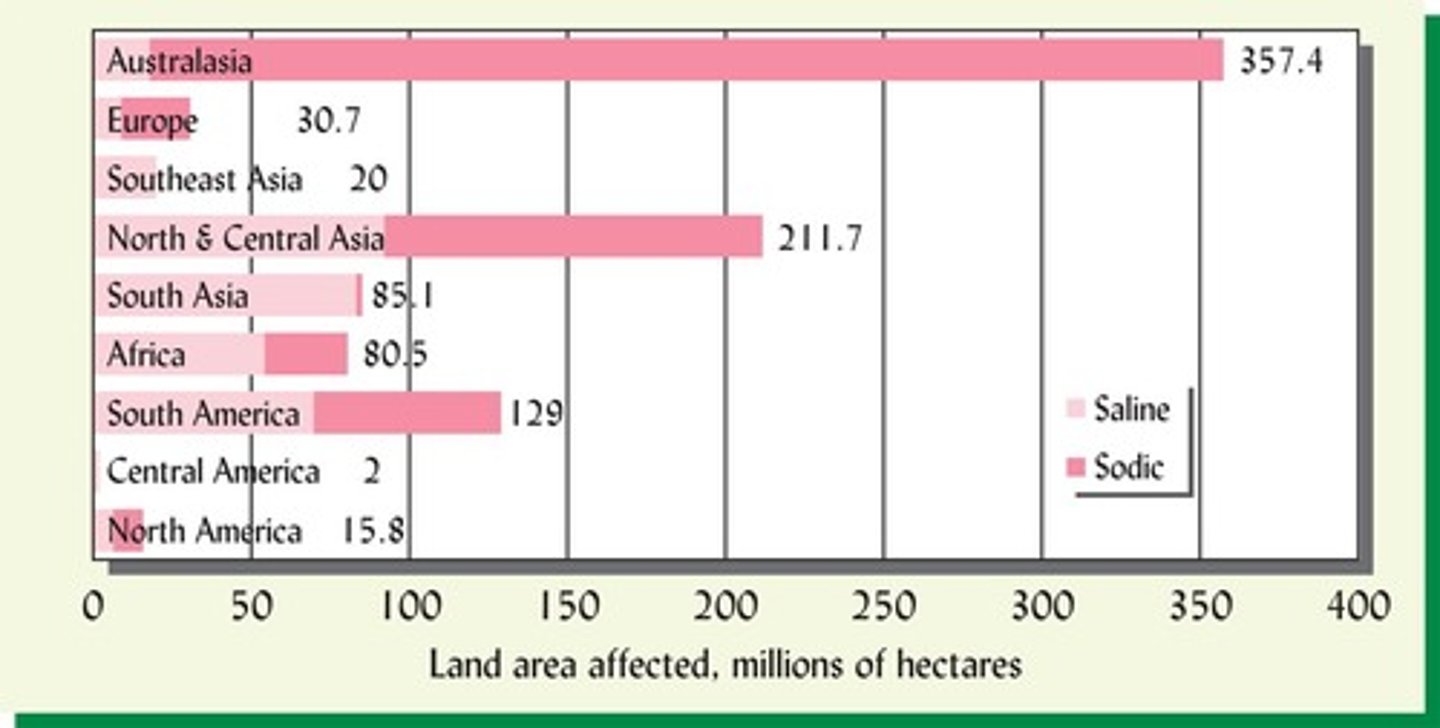
What causes salts to accumulate in arid and semi-arid areas?
Low rainfall and lack of leaching.
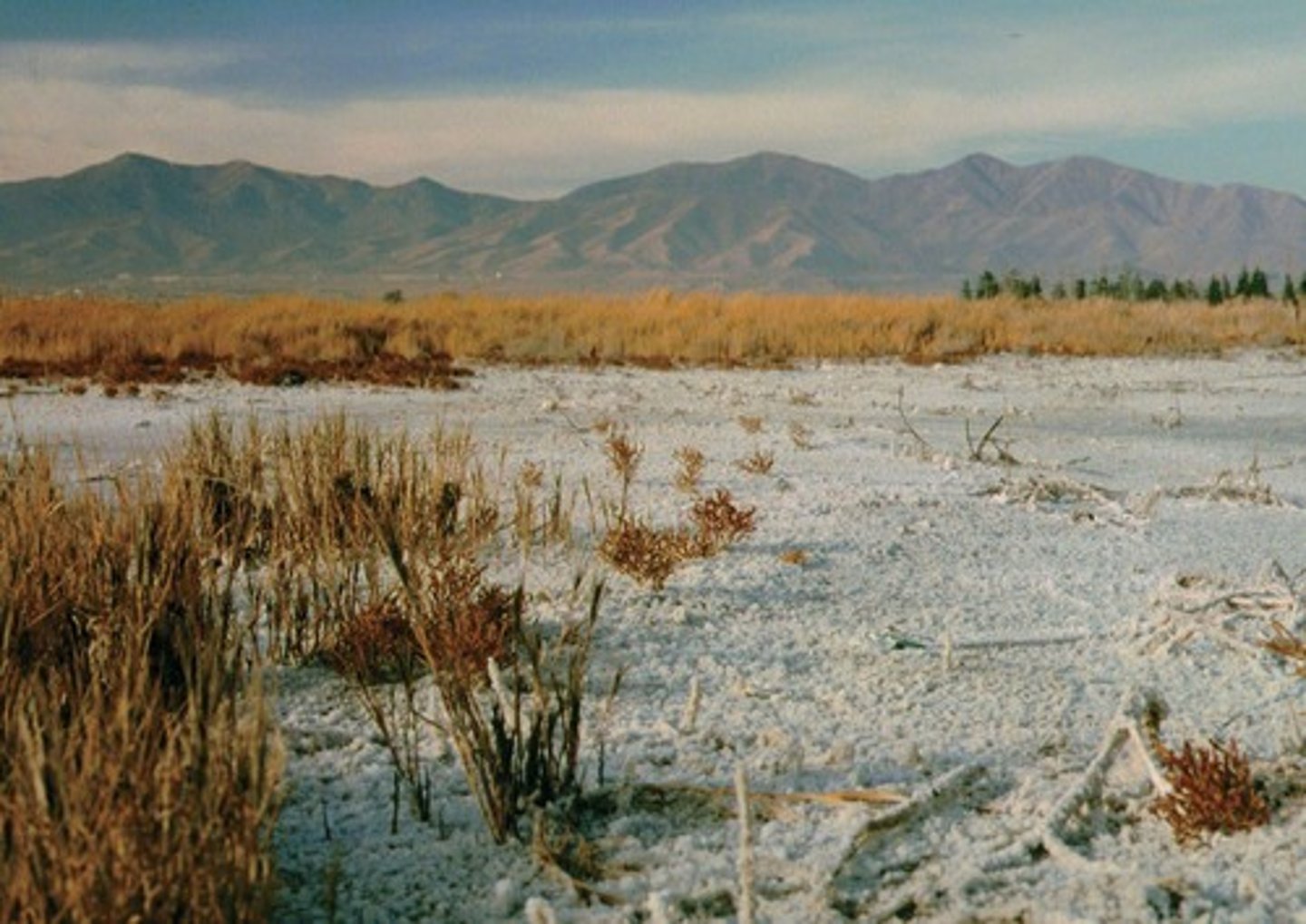
What is salinization?
The process where salts accumulate in soil due to irrigation and insufficient drainage.
What is the sodium adsorption ratio (SAR)?
The ratio of sodium to calcium and magnesium in the soil solution, used to characterize irrigation water.
What are the characteristics of saline soils?
EC > 4 dS/m, pH < 8.5, and ESP < 15.
What defines sodic soils?
EC < 4 dS/m, pH > 8.5, and ESP > 15.
What is the physical effect of high sodium in soil?
It causes dispersion of soil colloids, degrading soil structure.
What are the osmotic effects of soluble salts in soil?
They lower osmotic water potential, making it difficult for roots to absorb water.
What are specific ion effects in plants due to salinity?
Plants may experience toxicity from Na+, Cl−, and HCO3− ions.
What are the symptoms of plants affected by salt-affected soils?
Stunted growth, leaf burn, and premature leaf drop.
What is the impact of high salt concentration on soil colloids?
It can cause flocculation of colloids, improving soil structure.
How does the presence of carbonates affect soil pH?
Carbonates increase pH, while neutral salts can lower it.
What is the significance of the cation type (Na+ vs. Ca2+) in soil alkalinity?
Na+ can lead to higher pH levels compared to Ca2+ due to its higher solubility.
What is the common ion effect in soil chemistry?
The addition of an ion already involved in an equilibrium reaction shifts the equilibrium.
What are the nutrient problems associated with dry region soils?
Low levels of Zn, Fe, Mn, and P, especially at pH > 7.
What is the role of leaching in managing saline soils?
Leaching helps to remove excess salts from the soil profile.
What is salt balance in soil management?
Matching salt input and removal to maintain soil health.
What is the impact of low-salt water on saline-sodic soil?
It exacerbates sodicity.
Why is drainage water quality important?
It must remove water to prevent salt buildup and often contains more salts than applied.
What toxic elements can be found in drainage water?
Molybdenum (Mo), Arsenic (As), Boron (B), and Selenium (Se).
What is the primary method for reclaiming saline soils?
Effective drainage and high-quality water to leach salts.

How can Na+ be removed from saline-sodic soils?
By adding gypsum (CaSO4) or sulfur to replace Na+.
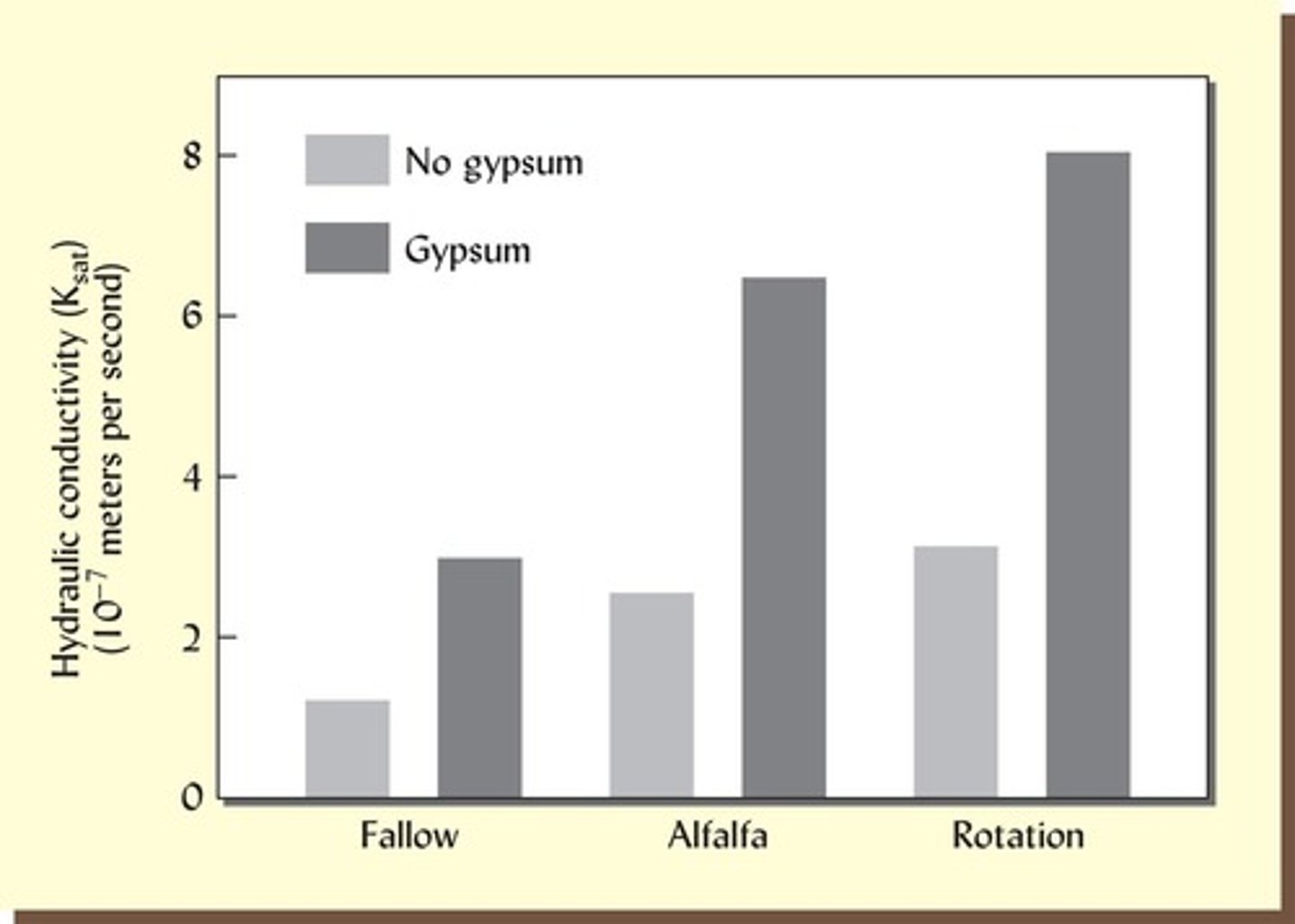
What role do deep-rooted plants play in soil reclamation?
They enhance the effects of reclamation through improved drainage and aeration.
What is a 'pedon' in soil classification?
The smallest sampling unit that displays the full range of properties characteristic of a particular soil.
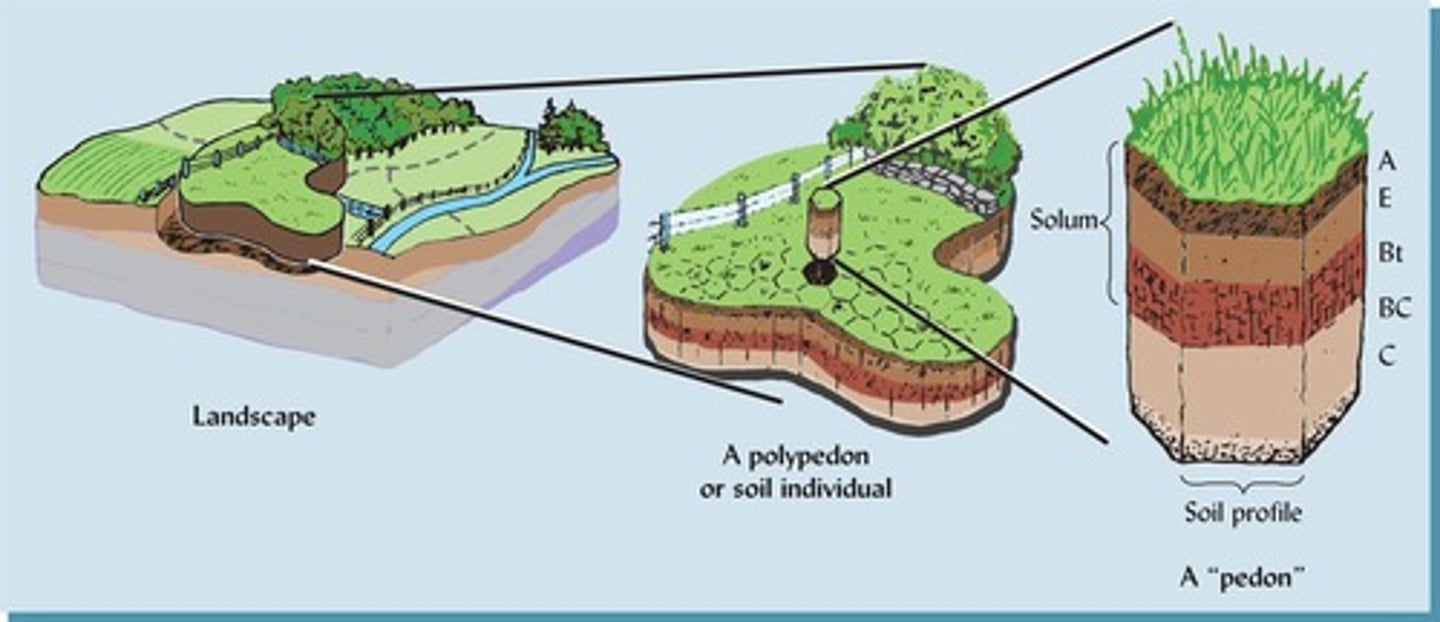
What are diagnostic soil horizons?
Layers with specific characteristics that help classify the soil.
What is the difference between genetic and diagnostic horizons?
Genetic horizons indicate the direction of pedogenesis, while diagnostic horizons indicate the magnitude of pedogenesis.
What are the five most common diagnostic surface epipedons?
Mollic, Umbric, Ochric, Melanic, and Histic.
What is the characteristic of a Mollic epipedon?
A thick, dark-colored horizon with high organic matter and base saturation.
What defines an Umbric epipedon?
Similar to Mollic but with lower base saturation.
What is an Ochric epipedon?
A horizon that is too thin, light-colored, or low in organic matter to be classified as Mollic or Umbric.
What is a Melanic epipedon?
A thick, black horizon with high organic matter, commonly found in volcanic ash soils.
What is a Histic epipedon?
An organic horizon of peat/muck overlying a mineral soil.
What are the soil moisture regimes classified in soil taxonomy?
Aquic, Udic, Perudic, Ustic, Xeric, Aridic, and Torric.
What does the term 'Aquic' refer to in soil moisture regimes?
Soils that are saturated and anoxic.
What is the significance of the 'Frigid' soil temperature regime?
Soils that are cooler than +8°C but warmer in summer.
What are the six hierarchical categories of soil classification?
Order, suborder, great group, subgroup, family, and series.
What is the primary purpose of soil classification?
To understand, manage, and create a universal language for soils.
What is the role of precipitation and temperature in soil orders?
They influence the development and distribution of different soil orders.
What is the relationship between soil orders and climate?
Some orders are directly influenced by climate, such as Gelisols and Aridisols.
What is the importance of monitoring EC and SAR in irrigation water?
To maintain salt balance and prevent soil degradation.
How does organic matter affect soil properties?
It improves soil physical properties and enhances water retention.
What are the characteristics of the twelve soil orders?
Each order has unique properties related to weathering, moisture, and temperature regimes.
What is the significance of diagnostic horizons in soil classification?
They help determine where to place a soil in the classification system.
What are Vertisols characterized by?
Shrink-swell behavior of clays during dry/wet cycles.
What is the dominant soil-forming process in Mollisols?
Accumulation of organic matter from dense root systems.
What defines Gelisols?
Presence of a permafrost layer that remains frozen for at least 2 consecutive years.
What are Entisols?
Recent soils with little to no profile development, very diverse due to various formation modes.
What distinguishes Inceptisols from Entisols?
Inceptisols show the inception of profile development but lack mature horizons.
What are Andisols formed from?
Volcanic ash and cinders, and are not highly weathered.
What are Histosols primarily formed from?
Accumulation of organic material, typically in wetland environments.
What are Aridisols?
Dry desert soils with little moisture for plant growth, allowing soluble materials to accumulate.
What is a key characteristic of Alfisols?
Moderately weathered soils with clay accumulation in a diagnostic argillic horizon.
How do Ultisols differ from Alfisols?
Ultisols are highly leached, more weathered, and often more acidic than Alfisols.
What is the defining feature of Spodosols?
Acidic, intensely leached soils with a spodic horizon forming beneath acidic forest vegetation.
What are Oxisols known for?
Being the most highly weathered soils found in humid, tropical climates with low natural fertility.
What is the significance of the term 'suborder' in soil taxonomy?
It indicates moisture regime, temperature regime, or other characteristics of the soil.
What does the 'Great Group' indicate in soil classification?
It is a subdivision of the suborder that indicates diagnostic epipedons or subhorizons.
What is the most specific taxonomic unit in soil classification?
Soil series, defined by a specific range of soil properties.
What does the term 'intergrade' refer to in soil taxonomy?
A subgroup name indicating overlap with other orders, suborders, or great groups.
What is the role of families in soil taxonomy?
They provide identifying information about physical and chemical properties, particle size, and mineralogical classes.
What does 'smectitic' refer to in soil classification?
It describes a mineralogical class of clay that is highly active in cation exchange capacity.
What is a typical characteristic of the Dickson series?
Fine-silty, siliceous, semiactive, thermic Glossic Fragiudults.
What does 'Typic' indicate in soil series names?
It signifies that the soil is typical of the great group without distinguishing features.
What is the significance of the term 'extragrade' in soil taxonomy?
It indicates special characteristics of a subgroup that are not related to other orders or groups.
What are the two main components of a soil taxonomic name?
The last full word indicates the order, suborder, and great group; the next-to-last capitalized words indicate the subgroup.
What is the primary reason Gelisols are rarely used for agriculture?
The presence of permafrost limits their usability for farming.
What is a common feature of Mollisols that makes them suitable for agriculture?
Their dark, fertile nature due to organic matter accumulation.
What does the term 'slickensides' refer to in Vertisols?
A feature resulting from the shrink-swell behavior of clays.
What is the typical soil color of Ultisols, and what causes it?
Commonly red or yellow due to iron oxides.
What is the typical moisture regime indicated by the suborder 'Aquoll'?
Aquic moisture regime, indicating wet conditions.
What is soil organic matter (SOM)?
The organic fraction of soil that includes plant, animal, and microbial residues in various stages of decomposition, biomass of soil microorganisms, and substances produced by plant roots.
What is the primary source of SOM in ecosystems?
Plant residues.
What is the secondary source of SOM?
Animal products and wastes.
What does SOM commonly consist of?
Sugars, starches, simple proteins, crude protein, hemicellulose, cellulose, fats, waxes, lignins, and phenolic compounds.
What is decomposition in the context of soil organic matter?
The breakdown of large organic molecules into smaller, simpler components.
What are the five major steps of decomposition?
1. Mechanical shredding, 2. Oxidation of plant C compounds, 3. Release and mineralization/immobilization of nutrients, 4. Synthesis of new C compounds by microbes, 5. Protection of original plant compounds from decay.
How does anaerobic decomposition compare to aerobic decomposition?
Anaerobic decomposition is less efficient and tends to accumulate partially decomposed organic matter.
What are two physical factors that affect the rate of residue decomposition?
Incorporation into soil and particle size; smaller particles decompose faster.
What is the significance of the Carbon/Nitrogen (C/N) ratio in organic residues?
It determines the rate of decay; low-N residues decompose slowly, while high-N residues decompose rapidly.
What is nitrate depression?
A period during which microbes must supplement nitrogen from soil to decompose high C/N residues.
What are the two pools of soil organic matter?
Active SOM (easily decomposed) and Passive SOM (not readily accessible).
What factors influence the amount of SOM in soil?
Climate, native vegetation, soil texture, and drainage.
How does climate affect SOM levels?
In warmer climates, plant growth is less than decomposition, while in cooler climates, plant growth exceeds decomposition, leading to SOM accumulation.
What is the impact of tillage on SOM?
Tillage can reduce soil disturbance and allow for SOM buildup.
What are the five general guidelines for managing SOM?
1. Continually supply plant residues, 2. Maximize perennial vegetation, 3. Recognize no ideal SOM amount, 4. Ensure adequate nitrogen, 5. Minimize tillage.
What role does SOM play in soil properties?
It affects nutrient holding capacity, water holding capacity, aggregate formation, and structural stability.
What is the relationship between SOM and plant growth?
SOM provides nutrients for plants and can release allelochemicals that inhibit other plants or microbes.
How does soil texture affect SOM accumulation?
Fine-textured soils tend to accumulate more organic matter than coarse-textured soils.
What is the effect of soil management on active and passive SOM pools?
Active SOM pools are most quickly affected by changes in land management.
What is the importance of microbial activity in SOM formation?
Microbial activity influences the breakdown of organic matter and nutrient cycling.
 Note
Note  Flashcards (63)