Science of Language - Midterm 2
 Call Kai
 Learn
Learn Practice Test
 Spaced Repetition
 Match
Match Flashcards
 Knowt Play
1/114

There's no tags or description
Looks like no tags are added yet.
Name | Mastery | Learn | Test | Matching | Spaced | Call with Kai |
|---|
No analytics yet
Send a link to your students to track their progress
115 Terms
Phonetics vs. Phonology
Phonetics:
- Physical, acoustic, & auditory properties of sounds
- Details about sounds
EX: aspirated vs un-aspirated /p/
Phonology:
- Sound systems, patterns, & rules within a language
- Abstract groupings of sounds into classes
EX: minimal pairs
Categories in Phonetics
- Articulation: how we produce sounds
- Acoustics: the nature of the sound signals that are produced
- Perception: the cognitive processing of acoustics that gives rise to percepts
Components of Speech System
- Respiratory system
- Phonatory system (laryngeal system)
- Articulatory system (supralaryngeal system)
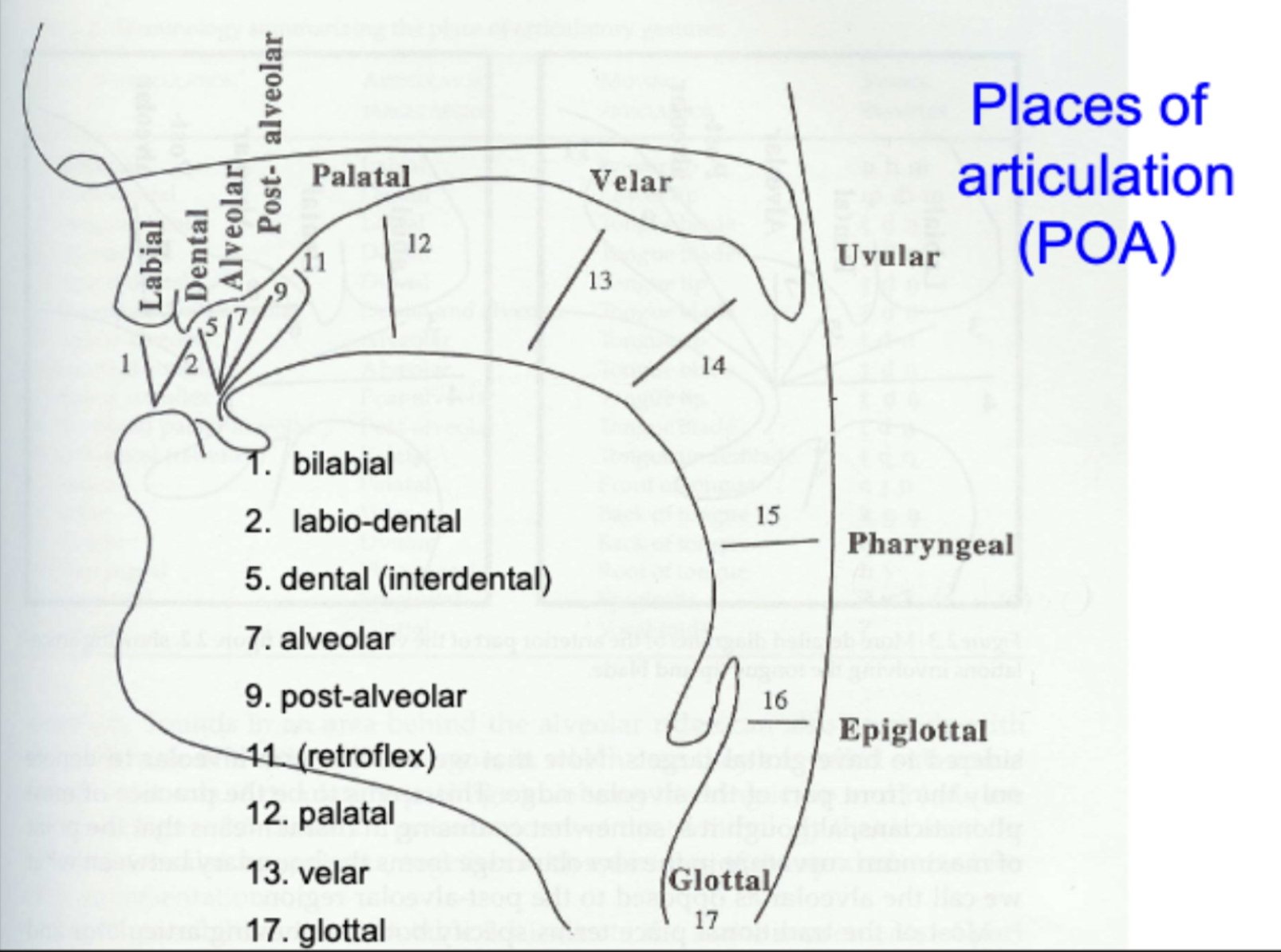
Passive vs. Active Articulators
Passive: Stationary surfaces. Upper lip, upper teeth, alveolar ridge, hard palate, soft palate (velum), and uvula.
Active: Move to create a constriction. Primarily the lower lip, various parts of the tongue (tip, blade, back), and the glottis.
Allophones
Letters or combinations of letters that make the same sound (e.g., f and ph to write /f/ sound)
Digraph
Two letters to represent a single sound (e.g., oo, ea, ch, th)
Trigraph
Three letters represent one sound (e.g., tch, eau)
θ
- voiceless interdental fricative
- "th"
-> mouth
ð
- voiced interdental fricative
- voiced "th"
-> this
ʃ
- voiceless alveopalatal fricative
- "sh"
-> shoes
ʒ
- voiced alveopalatal fricative
- voiced "sh"
- measure
tʃ
- voiceless alveopalatal affricate
- "ch"
-> cheese
dʒ
- voiced alveopalatal affricate
- “𝐣”
-> gym
ɹ
- voiced retroflex rhotic liquid
- standard "r"
-> run
(also written as r)
ŋ
- voiced velar nasal stop
- "ng"
-> wing
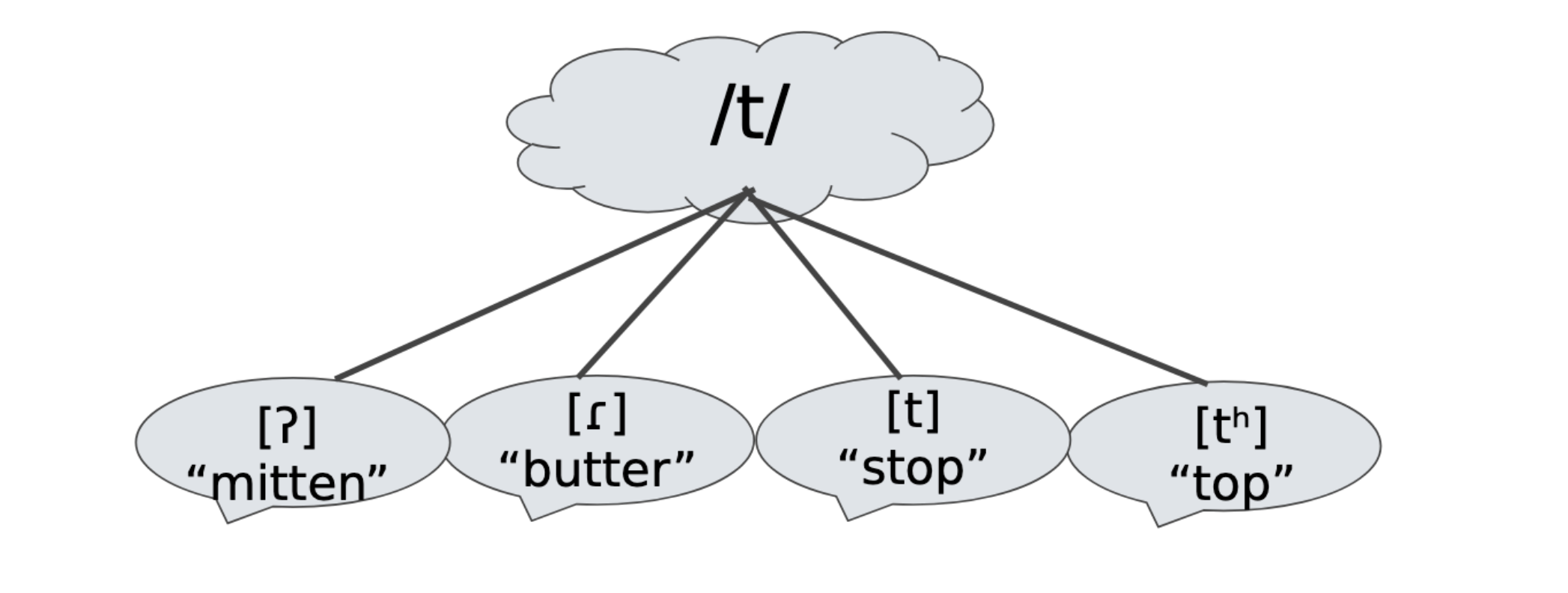
ʔ
- voiceless glottal stop
- "ih"
-> mitten, Britain
(typically replaces /t/; typically before 'n' or in middle/end of word)
p
- voiceless bilabial (oral) stop
- "p"
-> pea
b
- voiced bilabial (oral) stop
- "b"
-> bad
t
- voiceless alveolar (oral) stop
- "t"
-> type
d
- voiced alveolar (oral) stop
- "d"
-> dog
k
- voiceless velar (oral) stop
- "k"
-> kite
g
- voiced velar (oral) stop
- "g"
-> go
m
- voiced bilabial nasal stop
- "m"
-> mom
n
- voiced alveolar nasal stop
- "n"
-> not
f
- voiceless labiodental fricative
- "f"
-> fight
v
- voiced labiodental fricative
- "v"
- vet
s
- primarily voiceless alveolar fricative
- "s"
-> sing
(can be voiced in plurals like "dogs")
z
- voiced alveolar fricative
- "z"
-> zoo
h
- primarily voiceless glottal fricative
- "h"
-> hot
(can be voiced when between vowels like in "behind")
w
- voiced velar glide
- "w"
-> win
𝐣
- voiced palatal glide
- "y"
-> you
l
- voiced alveolar (lateral) liquid
- "l"
-> lord
i
- high front tense vowel
- unrounded
- "ee"
-> baby
ɪ
- high front lax vowel
- unrounded
- "ih"
-> big
e
- higher-mid front tense vowel
- unrounded
- "ay"
-> bait
ɛ
- lower-mid front lax vowel
- unrounded
- "ehh"
-> bet
æ
- low front lax vowel
- unrounded
- "ahh"
-> apple
u
- high back tense vowel
- rounded
- "oo"
-> boot
ʊ
- high back lax vowel
- rounded
- "ooh"
-> book
ə
- mid central lax vowel
- unrounded
- "uh"
-> above
o
- higher mid back tense vowel
- rounded
- "oh"
-> boat
ʌ
- lower mid central lax vowel
- unrounded
- "uhh"
-> but
ɔ
- low-mid back tense vowel
- rounded
- "ough"
-> bought
a
- low back tense vowel
- unrounded
- "aah"
-> father
/aɪ/
- diphthong
- "ai"
-> light
/aʊ/
- diphthong
- "ow"
-> town
/ɔɪ/
- diphthong
- "oi"
-> coin
/oʊ/
- diphthong
- "oh"
-> slow
/eɪ/
- diphthong
- "ay"
-> play
Notes on IPA Symbols
- Letter 'c' transcribed as /k/ or /s/
- Letter 'q' transcribed as /k/ (/kw/ for 'qu')
- Letter 'y' transcribed as /𝐣/
- Use only a single consonant when transcribing a word written with double consonants (happy transcribed as /hæpɪ/)
- Letter 'x' transcribed as /ks/
Three Components of Consonants
- Place of articulation (what parts are involved)
- Manner of articulation (how they're involved)
- Voicing (vocal folds)
Bilabial
- Produced with both lips touching
- /p/, /b/, /m/
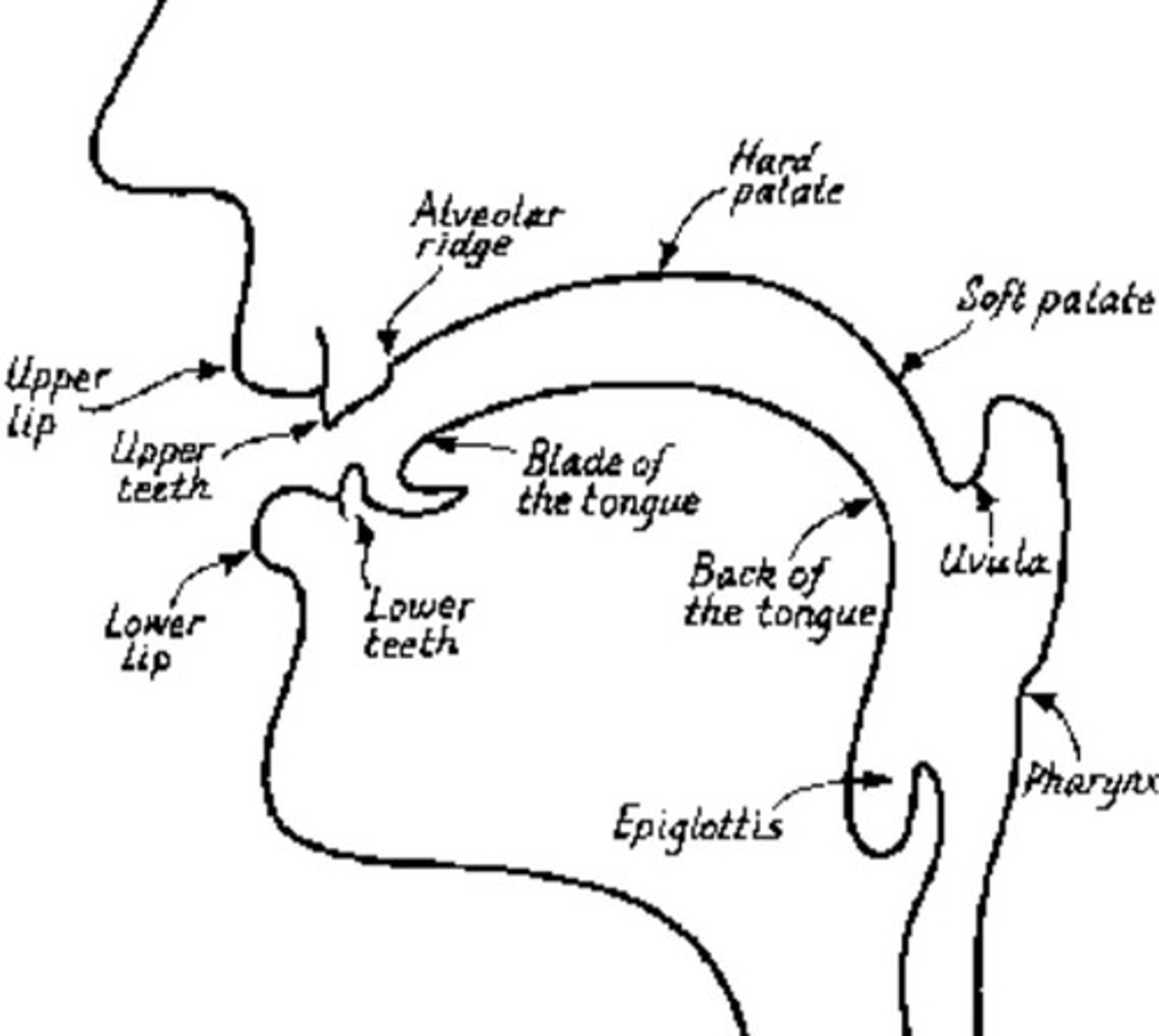
Labio-dental
- Lips and teeth
- /f/, /v/
Interdental
- Tongue between teeth
- /θ/, /ð/
Alveolar
- At alveolar ridge
- /t/, /d/, /n/, /s/, /z/, /l/
Alveo-palatal (Post-alveolar)
- Between alveolar ridge and palatal area
- /ʃ/, /ʒ/, /tʃ/, /dʒ/
Retroflex
- Bottom of tongue flips up and gets close to palatal area
- /ɻ/
Palatal
- Tongue against hard palate
- /𝐣/
Velar
- Tongue very close to soft palate (velum)
- /k/, /g/, /ŋ/, /w/
Glottal
- Obstructing airflow at glottis (space between vocal cords)
- /h/, /ʔ/
Grouping of POA
1) Labial: bilabial and labio-dental
2) Coronal: alveolar, alveopalatal, palatal
3) Dorsal/Velar: velar
Obstruents (Manner of Articulation)
(Plosive) Stops:
- complete closure of the articulators and obstruction of airflow
- voiceless: /p/, /t/, /k/
- voiced: /b/, /d/, /g/
Fricatives:
- two articulators are close; airstream partially obstructed and airflow
- voiceless: /f/, /θ/, /s/, /ʃ/, /h/
- voiced: /v/, /ð/, /z/, /ʒ/
Affricates:
- begin as a stop and immediately release into a fricative
- voiceless: /tʃ/
- voiced: /dʒ/
Sonorant Consonants (Manner of Articulation)
Nasal Stops:
- completely block airflow through mouth with lips or tongue while lowering the soft palate to allow air to escape freely through the nose (/m/, /n/, /ŋ/)
Approximants:
- one articulator close to another but vocal tract not narrowed to such an extent that turbulent airflow produced
- Glides: act like consonants but are produced with a smooth, vowel-like, open vocal tract, quickly transitioning into a following vowel (/w/ like "win"; /𝐣/ like "yes")
- Liquids: smooth, continuous airflow, resembling water flowing in a river
-> Rhotic Liquids: involve the tongue moving backwards ([ɻ])
-> Lateral Liquids: direct air around the sides of the tongue ([l])
(sonorants don't differ in voicing)
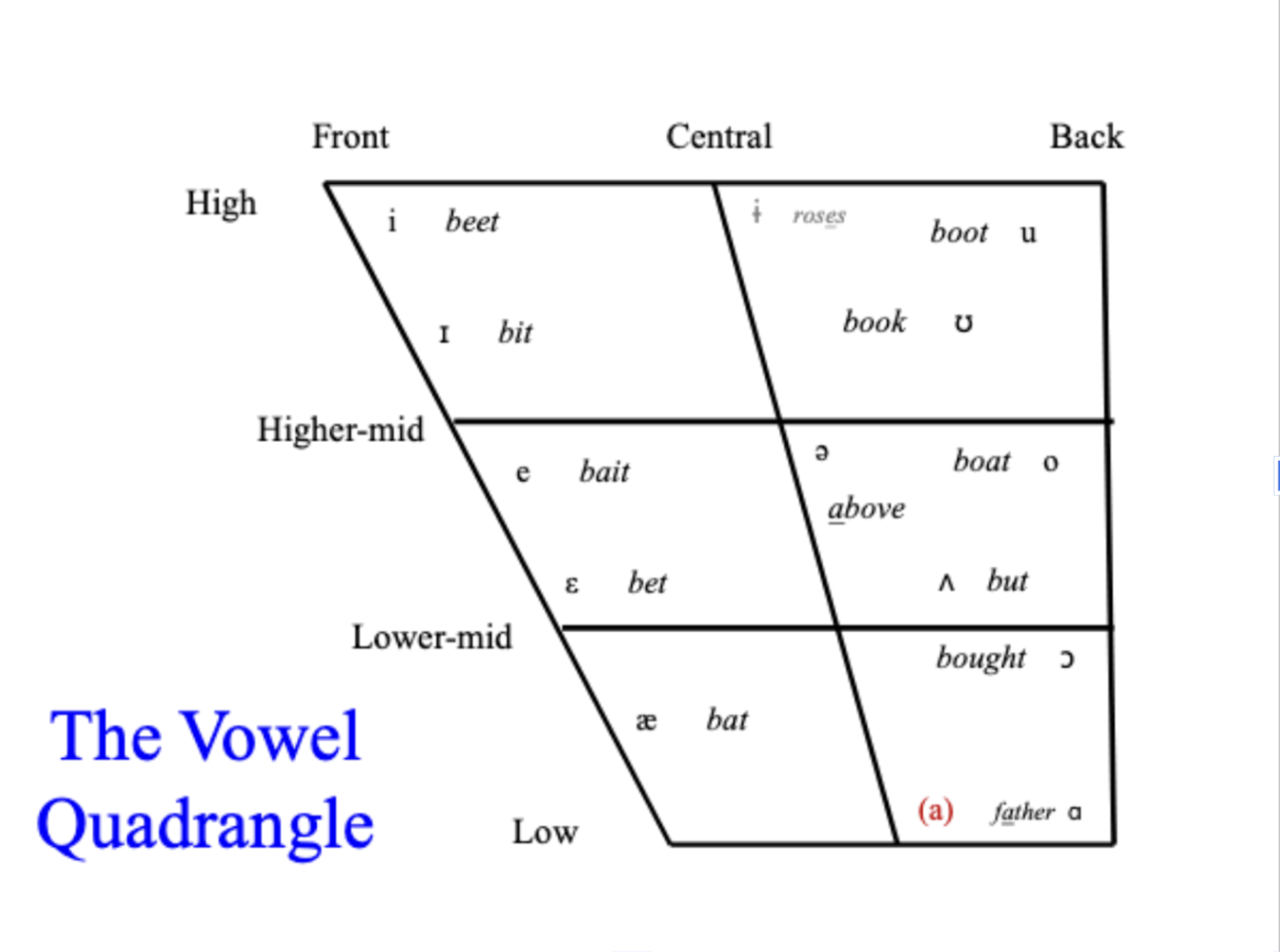
How are vowels described?
- High: tongue is close to the roof of the mouth, jaw is relatively closed
- Low: tongue is low in the mouth, jaw is dropped
- Front: tongue positioned in the front of the mouth, behind the teeth
- Back: tongue positioned towards the rear of the oral cavity, near the soft palate
- Tense: produced with more muscular tension and usually longer in duration
- Lax: produced with less muscular tension
- Rounded: protruding, circular lips
- Unrounded: keep lips relaxed or stretched
Diphthongs
Single syllables containing two distinct vowel sounds that glide together seamlessly
Transcriptions
- Phonemic/Broad: doesn't show much phonetic detail
- Phonetic/Narrow: shows phonetic details by using a wide variety of symbols and often diacritics
Phonemes vs. Allophones
- Phonemes signal a contrast in meaning b/w two words
- Allophones don't indicate a contrast in meaning → they're variations of the same phoneme
Minimal Pairs
- Changing from one phoneme to another causes a change in meaning (i.e., tip and dip)
-> If the sounds are different but do not make a meaningful contrast, they are allophones of the same phoneme (i.e., "pop" with aspirated /p/ at end and pop with unreleased /p/ at end)
Contrastive Distribution
Phonemes → Two or more sounds (phones) appear in the same phonetic environment and cause a change in meaning when substituted for one another [/p/ and /k/ in "pill" and "kill"] → Batman and Superman
Complementary Distribution
Allophones → Two or more distinct sounds (allophones) never occur in the same phonological or grammatical environment [aspirated /p/ vs. unaspirated /p/ in "pop"] → Clark Kent and Superman
Relationship Between Minimal Pairs and Phonemes:
A minimal pair proves that those two sounds are distinct phonemes in a language
Distinctive Features
A broader grouping; a way to talk about the similarities and differences between sounds
Natural Classes
Sounds are grouped into natural classes based on shared distinctive features (e.g. vowel vs. consonant)
Specific Distinctive Features
• ± [consonantal] (vowels vs. consonants)
• ± [sonorant] (+: vowels, glides, liquids, nasals)
• ± [continuant] (+: fricatives, sonorants [except
nasals!])
• ± [nasal]
• ± [syllabic] (vowels are [+syllabic], glides are not)
• Vowels: (± [high, low, back, round, tense])
• Place: (± [labial, coronal, dorsal])
• Voicing: (± voice)
Continuants vs. Sonorants
- Similar to each other -> can hold that sound definitively
- Continuant: air flow continuous through mouth
- Sonorant: continuous vocal fold vibration + clear resonant sound
Syllables
- A syllable is a unit of sound made up of phonemes, organized as: (Onset) - Nucleus - (Coda).
- The nucleus (usually a vowel) is required
- Onset and coda are optional
- Common structures: CV, CVC, CCV, V, VCC
Cat: Onset 'C' (c), Nucleus 'V' (a), Coda 'C' (t).
Tree: Onset 'CC' (tr), Nucleus 'V' (ee), no coda.
I: No onset, Nucleus 'V' (I), no coda.
Phonological Rules
X -> Y/ A ___ B
("x becomes y in the context of ___" )
Syntax in Linguistic Theory
- Phonology: How sounds combine into syllables and words
- Morphology: How morphemes combine into words
- Syntax: How words combine into sentences
Grammaticality Judgements
- Phonology: Is this a possible word in English? (wug, blick, *bnick)
- Morphology: Is this a possible word in English? (tassable, wuggied, *wuggedify)
- Syntax: Is this a possible sentence in English? (The boy found the ball, *The boy found quickly)
Count vs. Mass Nouns
Count:
- have plural forms (bean, beans)
- cannot stand alone in singular (*bean is healthy)
- occur with "too many" (too many beans)
Mass:
- don't have plural forms (rice, *rices)
- can stand alone (rice is delicious)
- occur with "too much" (too much rice)
Noun Phrase (NP)
A phrase formed by a noun and all its modifiers and determiners (EX: "the big red ball," "the tall girl")
Verb Phrase (VP)
A group of words that includes a main verb plus all the accompanying helping verbs (EX: "is eating," "should have gone")
Prepositional Phrase (PP)
A group of words consisting of a preposition, its object, and any words that modify the object (EX: "under the bed," "with a gold spoon")
Constituency Tests
Determine whether a sequence of words forms a syntactic constituent (Substitution, Question asking, Clefting, and Conjunction)
Substitution
- NP: she, it, he, they (EX: "Mary moved the table into the kitchen" → "She moved the table into the kitchen" ; "Mary" substituted with "she")
- VP: do/did, do so/did so (EX: "Mary moved the table into the kitchen" → "Mary moved the table into the kitchen but in order to do so, she needed Sue's help" ; "moved the table into the kitchen" substituted with "do so")
- PP: here, there (EX: "Mary moved the table into the kitchen" → "Mary moved the table there" ; "the table into the kitchen" substituted with "there")
Question Asking
"Mary moved the table into the kitchen"
Who? → Mary (NP)
What did she move? → The table (NP)
Where? → Into the kitchen (PP)
Into where? → The kitchen (NP)
She did what? → Moved the table into the kitchen (VP)
Clefting
! NP And PP Only
It was X that Y, where X is a PP or an NP
"Mary moved the table into the kitchen"
- It was into the kitchen that Mary moved the table
- It was Mary that moved the table into the kitchen
Conjunction
Only phrases of the same type may be conjoined
- The old man AND Mary moved the table into the kitchen (NP and NP)
- Mary gulped AND moved the table into the kitchen (VP and VP)
Subject (Role of NP)
- The "doer" of the sentence
- Often the first NP of sentence
- Subject-verb agreement ("The student is happy" → "The students are happy")
- Nominative pronouns ("The student is happy" → "She is happy")
Direct Object [DO] (Role of NP)
- "Reciever" of action
- Often right after verb
- Passive Test ("Some mysterious person pushed Humpty-Dumpty" → "Humpty-Dumpty was pushed by some mysterious person")
Indirect Object [IO] (Role of NP)
- "Recipient" of DO
- IO inversion ("I gave a present to Lucy" → "I gave Lucy a present")
Object of a Preposition (Role of NP)
- After a preposition (but not the IO)
- EX: "I walked the dog to the park," "We sat in the movie theater"
Subject Complement (Role of NP)
- Tells us more about the subject
- Occurs after the copular verb (to be)
- EX: "Lucy is a teacher," "Karen won't be Megan's best friend"
Object Complement
- Tells us more about the object
- Often the second NP after the verb
- EX: "The people elected Barack Obama president of the USA," "Dorothy called the lion a traitor"
Personal Pronouns
- Nominative (subjects): I, you, she, he, it, we, you, they
- Accusative/objective (DO, IO, Obj of Prep): me, you, her, him, it, us, you, them
- (Genitive: my, your, her, his, its, our, your, their)
Reflexive Pronouns
- Used when the subject and the object in a sentence refer to the same person (myself, yourself, himself, herself, itself, ourselves, yourselves, themselves)
-> Snow White saw herself in the mirror
-> Snow White saw her in the mirror
* (her cannot be Snow White)
Demonstrative pronouns
- Replace NPs
- Show distance from the speaker
- Reflect numbers
-> I like this dress = I like this
Relative Pronouns
- Used in a relative clause (a sentence inside another sentence)
- When an NP is repeated in a relative clause, we find a relative pronoun in its place.
-> I know the woman WHO won a prize = I know the woman. The woman won a prize
Types of Verbs
- Transitive: direct object(s) only (like, borrow)
- Intransitive: no object attached to the verb; can have obj of preposition but no DO or IO (sleep, laugh)
- Ditransitive: two kinds of objects (give) [IO inversion ("I gave a present to Lucy" → "I gave Lucy a present")]
- Linking: followed by an adjective, describes the subject (feel, to be)
Adjectives
- Modify nouns (yellow sweater)
- Can often get -er and -est (for comparisons)
- Can be modified by adverbs -> called 'intensifiers' (very, awfully)

