Lecture 17: Cellular Respiration and Earth's Climate
 Call Kai
 Learn
Learn Practice Test
 Spaced Repetition
 Match
Match Flashcards
 Knowt Play
1/24

There's no tags or description
Looks like no tags are added yet.
Name | Mastery | Learn | Test | Matching | Spaced | Call with Kai |
|---|
No analytics yet
Send a link to your students to track their progress
25 Terms
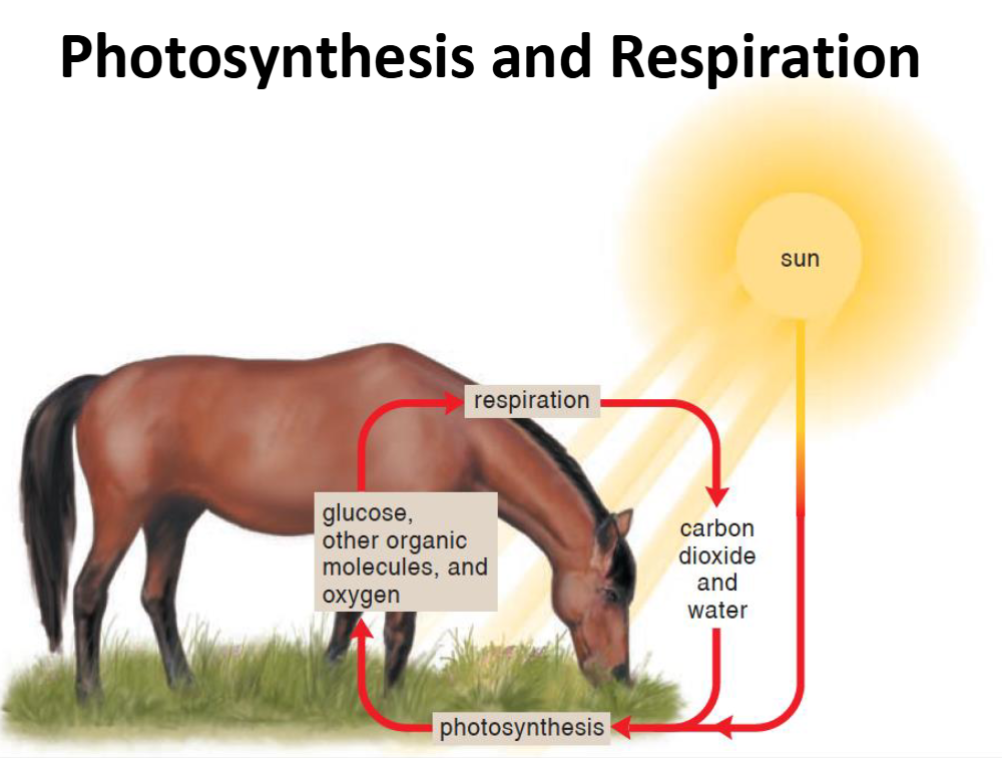
Cellular Respiration
releases the energy from glucose molecules broken down to the individual carbon dioxide molecules
photosynthesis in reverse
Aerobic Respiration: The opposite of photosynthesis

Aerobic Respiration occurs in which two parts of the cell?
Cytoplasm: This is where the first stage, Glycolysis, takes place.
Mitochondria: This is the site for the remaining stages of respiration
What are the electronic carriers and their function?
NADH and FADH2, they transport electrons for use in chemical reactions
Overview of Cellular Respiration
Glycolysis
Citric Acid Cycle
Electron Transport System
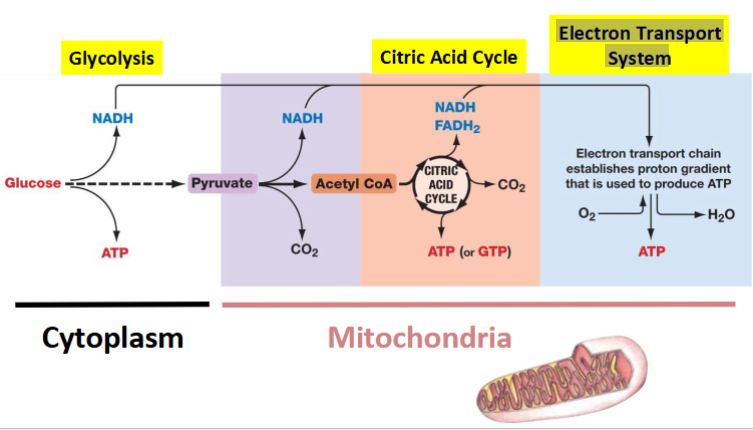
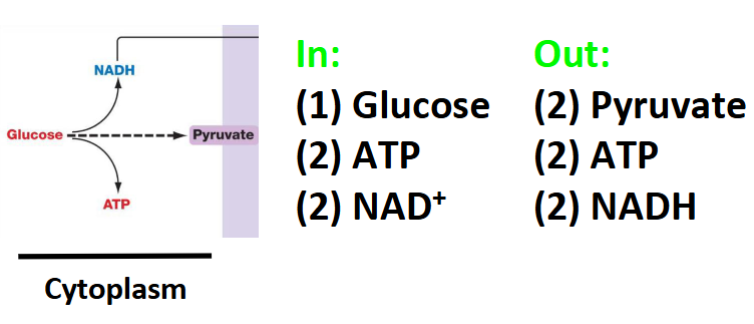
Step One: Glycolysis (Happens in Cytoplasm)
splits the glucose into 2 pyruvate molecules, gains a small amount of ATP, the electrons are transferred from NAD+ , forming NADH
Mitochondria
Is the site of cellular respiration reactions, similar to the structure of chloroplasts (inner folded membrane), contains proteins and enzymes
Function: Converts the pyruvate into ATP
2. Citric Acid (Krebs) Cycle
• Breaking pyruvate down, stripping it of electrons and protons (H+), and releasing carbon dioxide (CO2)
Net gain of 2 ATP (not a lot)
Citric Acid (Krebs) Cycle
In: 2 Pyruvate, 2 ADP, 6 NAD+, 6FAD
Out: 2 ATP, 6 NADH, 6 FADH2, CO2
3. Electron Transport System
• Establishes a proton (H+) gradient that is used to
produce ATP using ATP Synthase
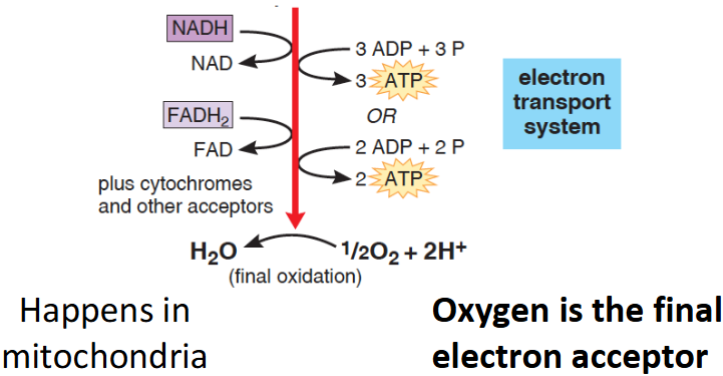
In Electron Transport System
It happens in mitochondria.
Which step in cellular respiration harnesses the most ATP from glucose?
Electron Transport System Step gains a net of 38 ATP (lots)
Oxygen is the final electron acceptor
• Oxygen ”pulls” electrons through the Electron Transport System
• Without oxygen present, the electron transport system stops
functioning -> no proton gradient -> no more big ATP payoff!!!
Fermentation
Occurs when oxygen isn’t available in cells (anaerobic respiration)
Alcohol fermentation
Happens in yeast (Ethanol), this is plants, fungi, bacteria
Lactic acid fermentation
Occurs in humans (lactate) Animals, Bacteria
Greenhouse gases
are atmospheric gases that absorb in infrared radiation
this is water vapor, CO2, ozone, methane, nitrous oxide
Greenhouse effect
Long-wave infrared energy (heat) is re-radiated back to the Earth’s surface by the atmosphere, warming it up earth avg temp is 59 farenheit
When and why did CO2 levels start to spike?
Happened in 1880, caused by human activites of burning fossil fuels
When did temperatures start rising?
1900
Balanced budger of CO2
Natural fluxes of CO2 are mostly balanced,
Anthropogenic fluxes leave behind a net accumulation
Solutions to greenhouse gases
1. Increase photosynthesis
2. Decrease rate of deforestation
3. Increase rate of biomass accumulation
Why the fuss about CO2 emissions?
• CO2 is much more abundant in the atmosphere
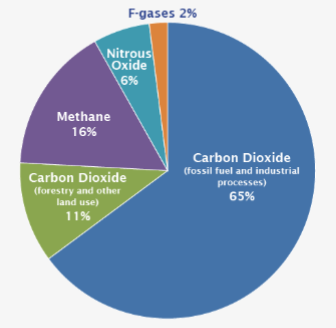
Which greenhouse gas has the most heat-trapping ability (relative to CO2)?
Methane

