Ch. 8 Efficient Market Hypothesis
 Call Kai
 Learn
Learn Practice Test
 Spaced Repetition
 Match
Match Flashcards
 Knowt Play
1/28

There's no tags or description
Looks like no tags are added yet.
Name | Mastery | Learn | Test | Matching | Spaced | Call with Kai |
|---|
No analytics yet
Send a link to your students to track their progress
29 Terms
Random Walk
•Notion that stock price changes are random
pattern on the market where if people were rational there will always be patterns, but because scientists didn’t find any patterns this means it was a “random” generation
Efficient Markey Hypothesis (EMH)
•Prices of securities fully reflect available information
Cumulative Abnormal Returns before Takeover
target company of a takeover
becomes buyout target if the company isn’t doing well
prices will go up due to 3 assumptions
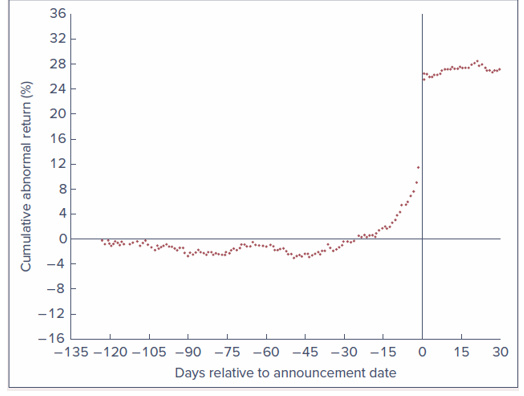
3 takeover assumptions
immediate day of affect (people react quickly to the market)
when prices rise (increase), the price stays put (indicates initial reaction is fast and accurate)
price before the announcement goes up = insider trading, assumption that people have a leverage over public info
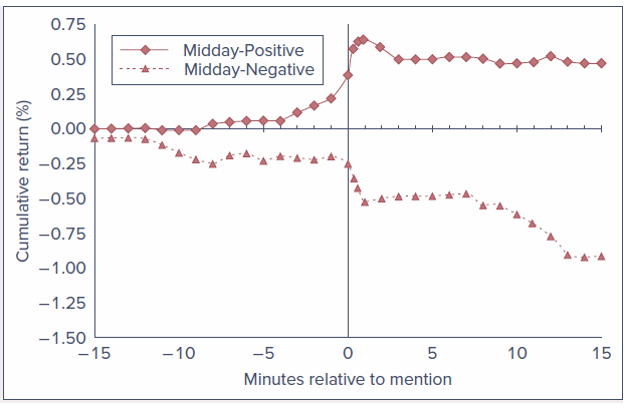
ties into image
Stock Price Reaction
news announcements will come with recommendations
positive reports = quick reaction, there will be slight overreaction
negative reports = drifts initial reaction and will have slight underreaction
market reacts relatively quickly on the daily level of news
Competition as source of efficiency
•Investor competition should imply stock prices reflect available information
•Investors exploit available profit opportunities
•Competitive advantage can verge on insider trading
assumption that more people will passively invest when market is efficient, causing market to become less efficient, then balance out as people will start to actively invest
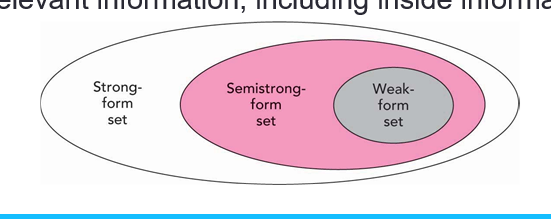
Weak-form EMH
Stock prices already reflect all information contained in history of trading
least efficient
prices already reflected in the historical data
means no advantage
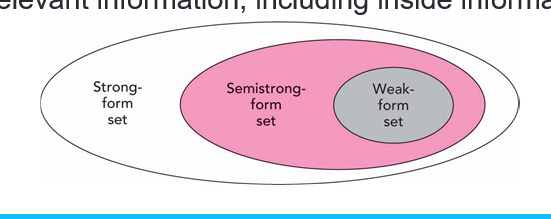
Semistrong-form EMH
Stock prices already reflect all public information
trading data is available to the public
the market is relatively efficient
often means you cannot get a lead on investing
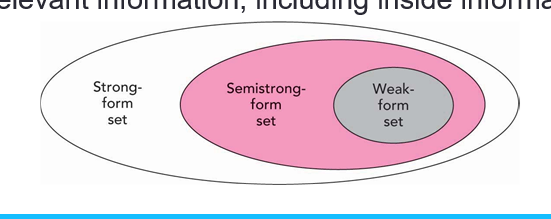
Strong-form EMH
Stock prices already reflect all relevant information, including inside information
market price = private + public information'
Technical Analysis
Research on recurrent/predictable price patterns and on proxies for buy/sell pressure in market
•Resistance Level
Unlikely for stock/index to rise above
•Support Level
Unlikely for stock/index to fall below: stock won’t drop below the lowest stock price recorded
uses historical prices and data
not commonly taught in school
gain an advantage is hard when only using historical data
Fundamental Analysis
•Research on determinants of stock value:
•Earnings, dividend prospects, future interest rate expectations and firm risk
•Assumes stock price equal to discounted value of expected future cash flow
uses financial statements and other public information
commonly taught in school
Passive investment strategy (vs active)
•Buying well-diversified portfolio without attempting to find mispriced securities
Index fund
•Mutual fund which holds shares in proportion to market index representation
Portfolio Management in Efficient Market
•Active management assumes market inefficiency
•Passive management consistent with semistrong efficiency
•Even if the market is efficient, a role exists for portfolio management: Diversification; Tax considerations; Risk profile of investor
•Inefficient market pricing leads to inefficient resource allocation
skipped over
Market Efficiency Issues
Magnitude issue: Efficiency is relative, not binary
•Selection bias issue
•Investors who find successful investment schemes are less inclined to share findings
•Observable outcomes preselected in favor of failed attempts’
•Lucky event issue: Lucky investments receive disproportionate attention
Weak Form Efficiency Tests
• Patterns in Stock Returns
•Returns over short horizons
•Momentum effect: Tendency of poorly- or well-performing stocks to continue abnormal performance in following periods
stocks perform in the short term, reversal effect in the long term
if price goes up in short term, then it’s likely to drop in long term
•Returns over long horizons
•Reversal effect: Tendency of poorly- or well-performing stocks to experience reversals in following periods
Tests indicate if market is efficient, may not be useful though due to transaction costs
Broad Market Performance
Predictors
•1988—Fama and French: Return on aggregate stock market tends to be higher when dividend yield is high
•1988—Campbell and Shiller: Earnings yield can predict market returns
•1986—Keim and Stambaugh: Bond market data (spread between yields) can predict market returns
skimmed in class
Semistrong Form efficiency tests
•Anomalies
•Patterns of returns contradicting EMH
•P/E effect: lower ratio = more valuable stock, firm w/ lower P/E = paying less for equal or better earnings
•Portfolios of low P/E stocks exhibit higher average risk-adjusted returns than high P/E stocks
looking at public data patterns
patterns = anomalies
Semistrong Tests: Market Anomalies
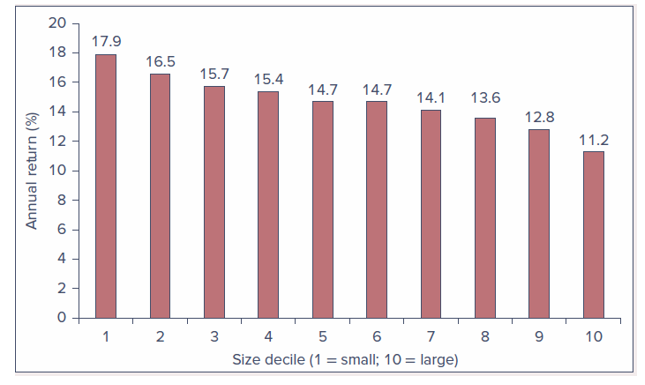
•Small-firm effect
•Stocks of small firms can earn abnormal returns, primarily in January
higher return due to more risk
tied to fama french rule 3
•Neglected-firm effect
•Stock of little-known firms can generate abnormal returns
also may have advantage similar to small firm affect
•Book-to-market effect
•Shares of high book-to-market firms can generate abnormal returns
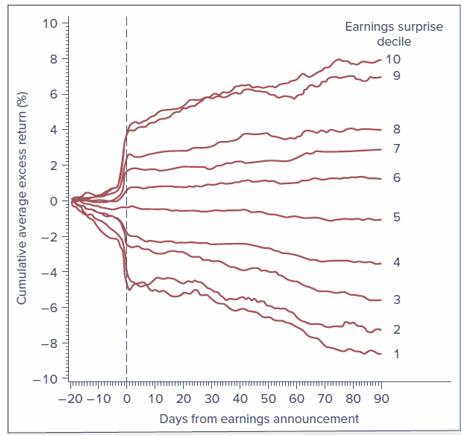
•Post-earnings announcement price drift
•Sluggish response of stock price to firm’s earnings announcement
•Abnormal return on announcement day, momentum continues past market price
continuation of anomaly tests
Abnormal Returns after Earnings Announcements
graph suggests people are still not rational and the market may be inefficient
the earnings aren’t accurate, takes about 3 months to catch up
Strong Form Efficiency Tests
•Inside Information
•The ability of insiders to trade profitability in their own stock has been documented in studies by Jaffe, Seyhun, Givoly, and Palmon
•SEC requires all insiders to register their trading activity
•Trades become public information
Predictors of Stock Returns
•Volatility
•Accruals and earnings quality
•Growth
•Profitability
•Q-factor - the ratio of the present value of an investment to it’s cost (Tobin’s q)
skipped in class
Interpreting Anomalies
•Risk premiums or inefficiencies?
•Fama and French: Market phenomena can be explained as manifestations of risk premiums
•Lakonishok, Shleifer, and Vishny: Market phenomena are evidence of inefficient markets
•Anomalies or data mining?
•Some anomalies have not shown staying power after being reported
•Small-firm effect
•Book-to-market effect: high book value, increase market
bubbles and market efficiency
•Speculative bubbles can raise prices above intrinsic value
•Even if prices are inaccurate, it can be difficult to take advantage of them
skipped in class
Stock Market Analysis
•Analysts are overly positive about firm prospects
•Womack: Positive changes associated with 5% increase, negative with 11% decrease
•Jegadeesh, Kim, Kristie, and Lee: Level of consensus is inconsistent predictor of future performance
•Barber, Lehavy, McNichols, and Trueman: Firms with most-favorable recommendations outperform firms with least-favorable recommendations; Recommendations may lead to investing strategies that are too expensive to exploit
analysts should have a hard time beating the market
alpha
the return on top of the risk premium
excess return on firm risk taken
mutual funds tend to have some of this type of return
Mutual Fund Managers
•Today’s conventional model: Fama-French factors plus momentum factor
•Wermers: Funds show positive gross alphas; negative net alphas after controlling for fees, risk
•Carhart: Minor persistence in relative performance across managers, largely due to expense/transaction costs
skipped in class
•Berk and Green: Skilled managers with abnormal performance will attract new funds until additional cost, complexity drives alphas to zero
hedge fund exclusive, doesn’t grow as much as possible due to it hurting return by requiring more diversification or transaction costs
alpha goes down as fund size goes up
Chen, Ferson, and Peters: On average, bond mutual funds outperform passive bond indexes in gross returns, underperform once fees subtracted
•Kosowski, Timmerman, Wermers, and White: Stock-pricing ability of minority of managers sufficient to cover costs; performance persists over time
•Samuelson: Records of most managers show no easy strategies for success
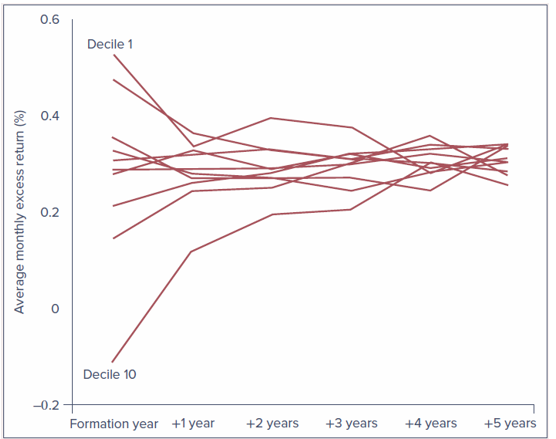
Persistence of Mutual Fund Performance
Shows the Decile formation year
over time performance
evidence of skew? no, not much evidence that good performers stay good over time
hard to stay persistent in trading
Are Markets Efficient?
•Enough that only differentially superior information will earn money
•Professional manger’s margin of superiority likely too slight for statistical significance
basically yes, to an extent

