chapter 54 - behavioural ecology
 Call Kai
 Learn
Learn Practice Test
 Spaced Repetition
 Match
Match Flashcards
 Knowt Play
1/44

There's no tags or description
Looks like no tags are added yet.
Name | Mastery | Learn | Test | Matching | Spaced | Call with Kai |
|---|
No analytics yet
Send a link to your students to track their progress
45 Terms
Optimal diet model
preys are ranked by benefit per unit of undling time
Top ranked prey are never rejected but lower ranked preys can
Ex. Oystercatcher may reject large mussels because they take too long to open. Medium sized mussels are more profitable because easier to open
Central place foraging
Many animals travel from a central place (nest or den) to catch prey
Prediction of central place foraging theory
States that longer travel times are other worthwhile if you can bring back larger, valuable prey
Ex. Ospreys flying further to forage ring back larger fish to nest
When to forage?
Many animals have foraging schedules to avoid predators
Ex. Deer, mice and kangaroo rats will forage at night to avoid daytime dinural predators like coyotes and foxes
some predators like owls take advantage of nocturnal foraging prey
Types of mating behaviours
Seeking/attracting mates, choosing among potential mates, competing for mates and caring for offsprings
2 types of mating systems
Monogamous - one male one female, usually ave similar external morphologies
Ex. Western gulls
Polygamous - one individual of one sex with several individuals of other sex, usually sexually dimorphic and have different external morphologies
3 types of polygamous mating systems
Polyandry - one female mate, multiple male
ex. Phalaropes and angler fish
Polygyny - one male, multiple female
ex. Elephant seals, elk
Polygynandrous - both have multiple partners
Ex. Red winged blackbirds
Most common form of mating
Mating is promiscuous, with no strong pair bonds or lasting relationships
but varies species to species
Expensive offspring favours….
Favours monogamy
its favoured when offspring need parental care and cant care for themselves
Males benefit by staying with their partner
Ex. Altricial birds
Cheap offspring
Where Young’s can feed themselves and males have less benefits by staying with their partner
they can maximize reproductive success by searching for additional mates
Ex. Precocial birds like Ducks and pheasants
What is the second factor affecting mating systems and parental care
Certainty of paternity
2 ways males can increase their reproductive success
Helping female raise offsprings
Searching for other females
he gains no evolutionary benefits if another male is the genetic parent of the offspring
Which species is certainty of paternity more common in
when fertilization is external for species
Ex. Fish, amphibians, aquatic invertebrates, giant water bug and plain fin midshipman
its not common in species with internal dertilization
Midshipman fish in certainty of paternity care
Males sing to attract females to their nest under a rock. Males guard eggs until they hatch but they dont feed while protecting the kids
2 types of midshipman males
Type 1 - are larger and more vocal when they sing to attract females
Type 2 - smaller, sneakier
2 types of sexual selection
Intersexual - member of one sex choose mate based on desirable traits
Ex. Peacocks and peahen
Intrasexual - members same sex compete for opposite sex
Ex. Male elephant seals
Female choice
Type of intersexual competition
Females can drive sexual selection by choosing males with specific behaviours or features
Ex. Stalking eyed flies females choose males with long eye stalks which correlates to health and vitality
Male competition
Intrasexual selection
Can reduce variation among males as it favors evolution of weaponry and large body size
May involve agonistic behaviour, a ritualized contest that determines which competition gains access to a resource
Intrasexual competition in pacific salmon (dog salmon) and hooknose in chinook salmon
Chum salmon (dog salmon) develop a canine teeth when spawning and hop nose male dont feed on spawning grounds, their cabin teeth are for fighting other males
Genetic basis of behavioural variation
Can be linked to variation in a single gene but most behaviours are governed by many genes (polygenic)
Genetic basis of behaviour in personality
Humans of the big 5 personality traits (Extraversion, agreeableness, openness, conscientiousness and neuroticism) show high degrees of heritability
Mating system in prairie voles vs meadow voles
Prairie voles are monogamous and meadow voles are polygynous
difference in male behavior is in the receptor for a neuropeptide hormone vasopressin
Vasopressin and oxytocin
Are neuropeptideds that play a key role in social attatchment and affiliation including parental care and pair bonding
How do variations on a gene effect behaviour example
Differences at a single locus have large effects on behaviour
Ex. Male prairie voles pair bond with mates while male meadow voles dont
What determines which behavioural patttern develops
Level of a specific receptor for a neurotransmitter
Variation in prey selection in garter snakes
Natural diet of garter snakes vary by population
coastal → banana slugs
Inland → rarely eat banana slugs
This shows that diet differences are genetic Since the two populations differ in ability to detect and respond to specific Oder molecules produced by banana slugs
Importance of monoamine oxidase gene
it codes for enzyme that breaks down neurotransmitters norepinephrine and dopamine
a single point mutation can disable the gene on the X chromosomes causing males to be cognitively impaired and prone to violence and sexual offences
Gene affects flight or fight responses
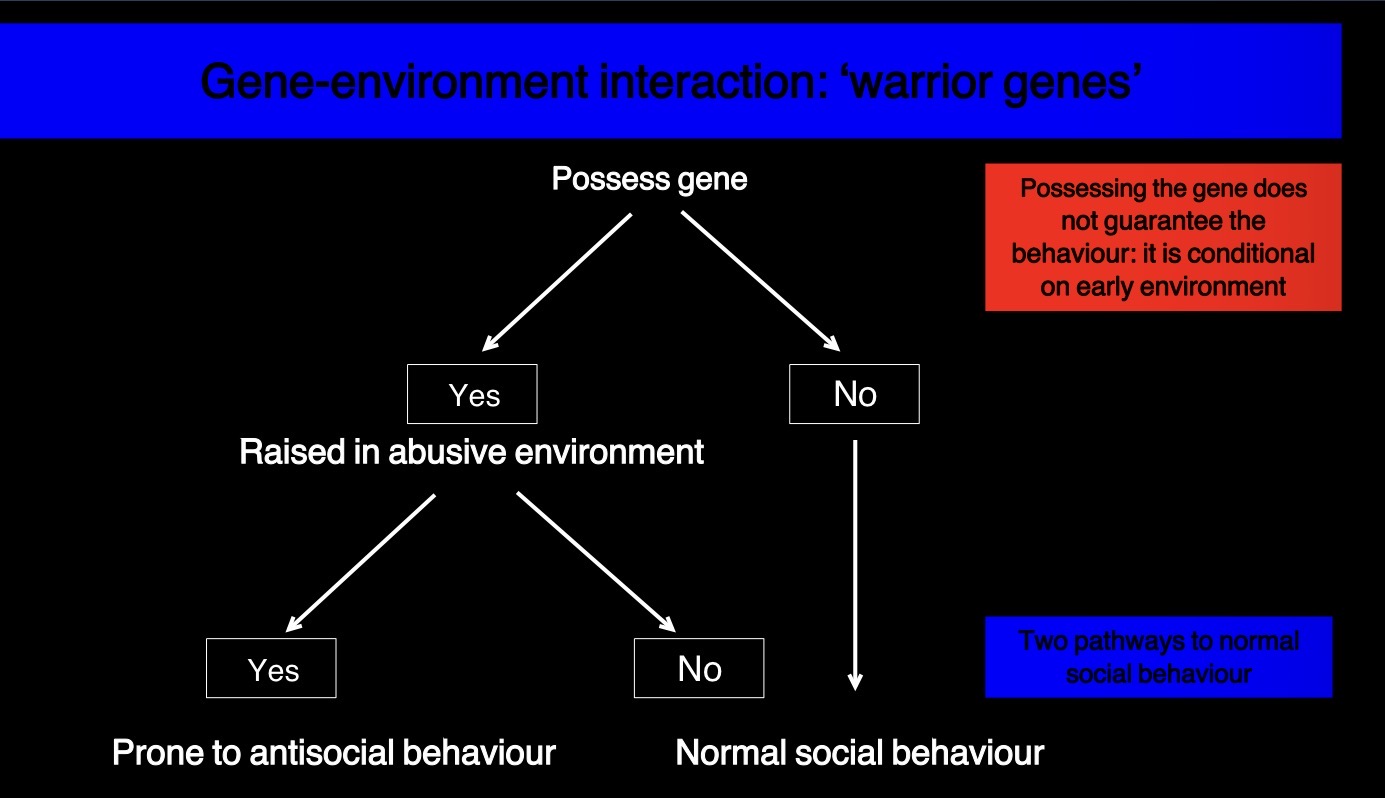
Warrior gene
Slow acting variant of monoamine oxidase that results in individuals more prone to aggression and anti social behaviours
Warrior genes on environmental conditions
The effect of the warrior genes is conditional in early environment, thus having the mutation does not guarantee the behaviour
those raised in abusive environments show more anti social behaviours than those in nurturing environments
How have twin studies helps with research in nature vs nurture with behaviour
Showed how strong genetics are in behaviour
monozygotic twins show greater similarity than dizygotic twins
Altruism
Behaviour of organisms where they reduce their individual fitness but increase fitness of others
Ex. Under threat from predators, an individual Beldings ground squirrel will make an alarm call to warm others, despite making its presence more known to the predator
Kin selection
Proposed by Hamilton where animals help close relatives to increase its genetic representation in the next generation rather than direct offsprings
its the natural selection that favours altruistic behavior by enhancing reproductive success of relatives
Inclusive fitness
Total effect an individual has on proliferating its genes by producing offsprings and helping close relatives produce offspring
helps explain altruistic behavior
Ex. Workers in ants, bees and wasps dont reproduce, they assist close relatives to raise offsprings
Concept of relatedness
Why the average relatedness of full siblings is ½
theres a 50% chance youll share an identical copy of a gene received from one of your parents
3 key variables in an altruistic act (Hamiltons rule)
Benefit to the recipient ; B
Cost to the altruist ; C
Coefficient of relatedness (fraction of genes that on average are shared) ; r
Hamiltons rule
rB > C
shows when natural selection favors altruism
Kin selection - natural selection that favours this kind of altruism behaviour by enhancing reproductive success of relatives
Inclusive fitness in beldings ground squirrels
Female belding ground squirrels are more likely to call alarm in the presence of a predator than males
alarm calling attracts predators (dangerous)
But in a group, most females are closely related to each other and males are less related to each other since males tend to leave home
the kin selection benefit for calling is greater for females than males
Inclusive fitness
Non reproductive individuals increase their inclusive fitness by helping reproductive queen and kinds (close relatives) to pass their genes to the next generation
Ex. Naked mole rats
Human behaviour
Results from interactions between genes and the environment
our social and cultural institutions may provide the only feature in which there is no continuum between humans and other animals
2 examples of adaptive human behaviours
Humans have a language instinct
we acquire language automatically during an early critical period that lasts into puberty
Tongue pushing in new borns
in their first months of life, infants push out solid objects from their mouth, this behaviour is adaptive because the digestive system isnt ready for solid foods
Why do women gain weight during pregnancy
lactation is energetically expensive
Mothers add weight during pregnancy to pay for the cost of lactations
Thus Mothers of twins gain more weight than mothers of singles
Incest avoidance
Children reared together in the first 30 months off life usually show no sexual interest in one another
Is an adaptive human behaviour to avoid harmful effects of interbreeding since everyone carry’s at least 2 recessive lethal genes
What behaviour is influenced by genes
in almost all behaviours but no behavior is 100% heritable, theres still some environmental influence
Ex. Alzheimer’s, aggression, intelligence, etc
Parent offspring conflict
Offspring should be more selfish than parents desire
Parents and offspring have shared but not identical genetic interests
Example of parent offspring conflict in humans
Human pregnancy
preeclampsia (high blood pressure) and gestational diabetes are both due to embryonic genes manipulating mother to increase food supply to the fetus
Both involve imprinted genes (dads fault)

