CPT Section 3

0.0(0)
studied byStudied by 0 people
call kaiCall Kai
learnLearn
examPractice Test
spaced repetitionSpaced Repetition
heart puzzleMatch
flashcardsFlashcards
GameKnowt Play
Card Sorting

1/246

encourage image

There's no tags or description

Looks like no tags are added yet.

Last updated 9:46 PM on 10/19/23
Name
Mastery
Learn
Test
Matching
Spaced
Call with Kai

No analytics yet

Send a link to your students to track their progress

247 Terms
1
New cards
Define the human movement system (HMS).
muscular, skeletal, and nervous systems
2
New cards
Define kinetic chain.
how muscles, bones, joints, and nerves are linked together (chain) to form movement (kinetic)
3
New cards
Define the nervous system.
a network of nerves that transmits information within the human body
4
New cards
What are some functions of the nervous system?
providing sensory information, stimulating movement, keeping heart and organs functioning
5
New cards
Define neuron.
specialized cell that is the functional unit of the nervous system
6
New cards
What are the three parts of a neuron?
axon, cell body, and dendrites
7
New cards
What is an axon?
cylindrical projection that transmits nervous impulses to other neurons
8
New cards
What is the function of an axon?
provides communication from the brain and spinal cord to other parts of the body
9
New cards
What is the function of a dendrite?
gathers information and transmits it back to the neuron
10
New cards
What are the four primary electrolytes needed for the nervous system?
potassium, sodium, magnesium, water
11
New cards
What is the purpose of the neuron’s cell body?
contains nucleus and organelles
12
New cards
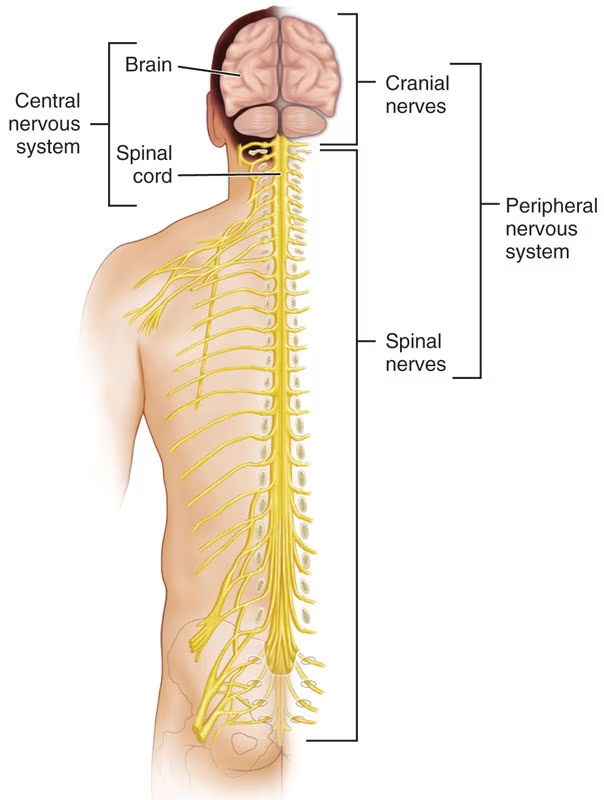
What is the central nervous system (CNS) made of and what is its function?
brain and spinal cord; coordinates activity of all parts of the body
13
New cards
What is the peripheral nervous system (PNS) made of and what is its function?
nerves; helps CNS receive sensory input, translate information, and send a response to the rest of the body
14
New cards
What is the afferent pathway?
sensory pathway that relays information from the body to the CNS
15
New cards
What is the efferent pathway?
relays information from the CNS to the rest of the body
16
New cards
What are interneurons?
neurons located within spinal cord and brain that transmit impulses between afferent and efferent neurons
17
New cards
What are mechanoreceptors?
respond to touch and pressure (mechanical forces)
18
New cards
What is the somatic nervous system?
allows you to move and control muscles throughout your body
19
New cards
What is the autonomic nervous system?
controls the involuntary processes of the body
20
New cards
What is the sympathetic nervous system?
“fight or flight”
21
New cards
What is the parasympathetic system?
“rest and digest”
22
New cards
Define sensory function.
the ability of the nervous system to sense change in the internal or external environment
23
New cards
Define proprioception.
the body’s ability to sense its general orientation and position of all its parts
24
New cards
Define integrative function.
the ability of the CNS to interpret sensory information and allow for the proper response
25
New cards
Define motor function.
the body’s response to integrated sensory information (via the efferent pathway)
26
New cards
What are some examples of mechanoreceptors?
muscle spindles, Golgi tendon organs, and joint receptors
27
New cards
What are muscle spindles?
sensory receptors within muscles that are used to detect change in muscle length and rate of length change
28
New cards
What is the stretch reflex?
muscle spindle response that prevents overstretching and muscle damage
29
New cards
What is the Golgi tendon organ?
sensory receptors located at the muscle fiber/tendon insertion; senses tension placed on the muscle
30
New cards
What is a joint receptor?
injury prevention; signal extreme joint positions and inhibit muscular response if too much stress is placed on the joint
31
New cards
Define neuroplasticity.
the concept that the brain is always changing and growing
32
New cards
Define neurocircuitry.
the interconnections of neurons in the brain and spinal cord
33
New cards
What are the three stages of motor skill development?
cognitive, associative, and autonomous
34
New cards
Define the cognitive stage of motor development.
stage 1: learning the skill; goals of skill are understood and skill is performed inconsistently
35
New cards
Define the associative stage of motor development.
stage 2: beginning to understand the skill; skill is performed with less error
36
New cards
Define the autonomous stage of motor development.
stage 3: skill is mastered; skill is performed consistently with no error
37
New cards
What is the function of the skeletal system?
provides support and protects internal organs
38
New cards
Define joint.
where two bones meet; where movement occurs because of muscle contraction
39
New cards
What makes up the axial skeleton?
skull, rib cage, and vertebral column (80 bones)
40
New cards
What makes up the appendicular skeleton?
arms and legs (126 bones)
41
New cards
What is the function of bones?
act as levers for movement (muscles pull on bones, bones produce movement), provide support (posture)
42
New cards
Define remodeling (bones).
process that consists of resorption and formation of the bone structure
43
New cards
What is the function of an osteoclast?
break down and remove old bone tissue
44
New cards
What is the function of an osteoblast?
form and lay down new bone tissue
45
New cards
What is Wolff’s law?
bones adapt and change due to stress placed on them
46
New cards
Define long bones.
long, cylindrical shaft with irregular or widened ends (humerus, femur)
47
New cards
Define short bones.
similar in length and width and appear cubical in shape (carpals, tarsals)
48
New cards
Define flat bones.
thin, protective surfaces that provide broad surfaces for muscles to attach (scapulae, sternum, ribs)
49
New cards
Define irregular bones.
unique shape and function from all other bone types (vertebrae, sacrum)
50
New cards
Define sesamoid bones.
small, often round bones embedded in a joint capsule or found where a tendon passes over a joint (patella)
51
New cards
Define bone depressions.
flattened or indented portions of the bone; aka fossa
52
New cards
Define sulcus.
a groove in a bone that allows soft tissue to pass through
53
New cards
Define bone process.
projections protruding from the bone where tendons and ligaments attach (aka condyle, epicondyle, tubercle, trochanter)
54
New cards
Where are condyles located?
inner and outer portions at the bottom of the femur and top of the tibia (knee joint)
55
New cards
Where are the epicondyles located?
inner and outer portions of the humerus (elbow joint)
56
New cards
Where are the tubercles located?
top of the humerus at the shoulder joint (attachments for shoulder musculature)
57
New cards
Where are the trochanters located?
top of the femur (attachments for hip musculature)
58
New cards
What is the cervical spine?
C1-C7; provide support and motion for the head
59
New cards
What is the thoracic spine?
T1-T12; is an anchor for the ribs (each vertebra attaches to a rib)
60
New cards
What is the lumbar spine?
L1-L5; support most of the body’s weight and attach to many back muscles
61
New cards
How many bones are in the sacrum?
5
62
New cards
How many bones are in the coccyx?
3-5
63
New cards
What is the function of the intervertebral discs?
shock absorption, allow spine to move
64
New cards
What are the three major spine curvatures?
concave cervical curve (rounded inward), convex thoracic curve (rounded outward), concave lumbar curve (rounded inward)
65
New cards
Define osteokinematics.
the description of bone movement (flexion and extension)
66
New cards
Define arthrokinematics.
the description of joint movement (roll, slide or glide, and spin)
67
New cards
What is a rolling joint movement?
one joint rolls across the surface of another (like a tire on the street)
68
New cards
What is a sliding joint movement?
one joint surface slides across another (like a skidding tire)
69
New cards
What is a spinning joint movement?
one joint surface rotates on another (like twisting a lid off a jar)
70
New cards
What is a gliding joint?
move back and forth or side to side
71
New cards
What is a condyloid joint?
made of an egg-shaped bone that fits into a similarly shaped cavity; move front to back and side to side
72
New cards
Define synovial joint.
a joint with a fluid-filled joint capsule
73
New cards
Define nonaxial.
a gliding joint that moves in only one plane, either back and forth or side to side
74
New cards
What is a hinge joint?
uniaxial; allows movement in one direction
75
New cards
What is a saddle joint?
one bone looks like a saddle while the other sits in it like a rider; two-directional movement
76
New cards
Define nonsynovial joints.
joints with no joint capsule, fibrous connective tissue, or cartilage (ex. skull sutures)
77
New cards

Define ligament.

fibrous tissues that connect bone to bone and provide static and dynamic stability & sensory input to the nervous system that aids proprioception

78
New cards

Define collagen.

protein found in connective tissue, muscles, and skin that provides strength and structure; most abundant protein in human body

79
New cards

Define elastin.

protein that provides elasticity to skin, tendons, ligaments, and other structures

80
New cards

Define growth plate.

specialized cartilage disc located in epiphysis that is responsible for bone length growth

81
New cards

What factors affect peak bone mass?

environmental, dietary, hormonal, lifestyle, physical activity, genetic influences

82
New cards

What are the functions of the skeletal system?

contract and produce movement, support skeletal system, and produce heat

83
New cards

Define fascia.

first layer of connective tissue in bone; surrounds skeletal muscles & connects them to other muscles

84
New cards

Define epimysium.

layer of fascia that directly surrounds an entire muscle; “deep fascia”

85
New cards

Define fascicles.

largest bundles of muscle fibers

86
New cards

Define perimysium.

connective tissue that wraps around each fascicle

87
New cards

Define endomysium.

surrounds individual muscle fibers

88
New cards

Define sarcomere.

the structural unit of a myofibril composed of actin and myosin filaments between two Z-lines

89
New cards

Define myofibril.

contractile components of a muscle cell

90
New cards

Define myofilaments

the filaments of a myofibril; include actin and myosin

91
New cards

Know the order of a muscle anatomy flowchart.

muscle → fascicle → muscle fiber → myofibril → sarcomere → myofilament

92
New cards

Define neural activation.

the nervous system’s signal that tells a muscle to contract

93
New cards

Define neuromuscular junction.

the site where the nervous system communicates directly with muscle fibers

94
New cards

Define synapse.

a junction/small gap between motor neuron and muscle cells

95
New cards

Define motor unit.

a motor neuron and all of the muscle fibers it innervates

96
New cards

Define action potential.

nerve impulse relayed from CNS to PNS to neuromuscular junction

97
New cards

What are the steps of excitation-contraction coupling?

  1. action potential is caused by Na+ and K+

  2. acetylcholine is released into neuromuscular junction

  3. nerve impulse travels, stimulates sarcoplasmic reticulum to release Ca2+

  4. myosin & actin are stimulated, causing muscle contraction

98
New cards

What are the two major chemicals involved in excitation-contraction?

calcium and acetylcholine

99
New cards

What are characteristics of type-1 muscle fibers?

small, fatigue-resistant, slow contraction, increased oxygen delivery (ex. postural or stabilization muscles)

100
New cards

What are characteristics of type-2 muscle fibers?

large, fatigue prone, quick force generation, decreased oxygen delivery