CBNS 5 (Amnesia and Memory)
 Studied by 0 people
 Call Kai
 Learn
Learn Practice Test
 Spaced Repetition
 Match
Match Flashcards
 Knowt Play
1/7

There's no tags or description
Looks like no tags are added yet.
Name | Mastery | Learn | Test | Matching | Spaced | Call with Kai |
|---|
No analytics yet
Send a link to your students to track their progress
8 Terms
Amnesia and subtypes
Serious loss of memory and/or ability to learn (concussion, chronic alcoholism, stroke, encephalitis, brain tumor, stroke)
Retrograde amnesia: forget things you already knew
Anterograde amnesia: inability to form new memories
Transient Global Amnesia: a person is unable to create new memory, so the memory of recent events disappears. You can't remember where you are or how you got there.
Q: A patient with a head injury appears disoriented and is asking the same questions repeatedly. A couple hours later their symptoms subside and they don’t remember every being confused.
Patient HM
suffered from epileptic seizures
Had a lobectomy and removed 8cm of the bilateral medial temporal lobe (cortex, amygdala, and anterior 2/3 of hippocampus)
Effects:
1. Severe anterograde amnesia (declarative memory)= can’t convert new SM into LM
Partial retrograde amnesia (nondeclarative)= for few years before the surgery. Remembers his childhood. hm retained procedural but lost episodic
Normal perception, intelligence, and personality
Normal Working memory= will remember shortly but when distracted will completely forget
Brenda Miller studied him
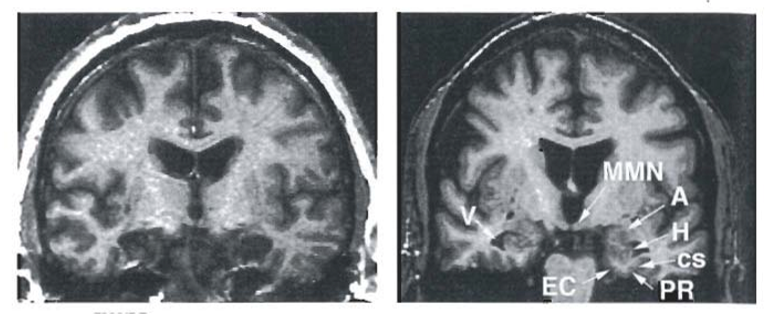
Patient EP
**exactly same as HM except on how he got lesions
suffered from herpes simplex encephalitis (severe inflammation of brain)
Effects:
1. Severe anterograde amnesia (declarative memory)= can’t convert new SM into LM
Retrograde amnesia= but perfect memory of childhood streets
non-mnemonic functions and immediate memories are spared
Normal perception, intelligence, and personality
Larry Squire studied him
HM and EP show
The medial temporal lobe (MTL), including the hippocampus, is required to recall newer memories,
but older memories eventually become independent of the MTL.
This is called systems consolidation.
Patient RG
had an ischemic episode (loss of blood/oxygen) that selectively damaged CA1, a subfield of the hippocampus.
Effects
Severe anterograde amnesia → could not form new memories
Minimal or no retrograde amnesia → old memories were mostly intact
No other cognitive impairments → language, intelligence, reasoning all normal
After death, an autopsy confirmed:
Only the CA1 region was bilaterally destroyed
Other hippocampal and cortical regions were spared
***WHAT IT SHOWS
R.G. tells us that:
The CA1 region is essential for forming new long-term memories
But remote memories are hippocampus-independent, so CA1 lesions do not erase them
Memory impairment can occur without any other cognitive deficits when damage is isolated
This makes R.G. a crucial case supporting:
The role of the hippocampus in anterograde memory
The independence of remote memories
The idea that memory traces shift from hippocampus to cortex over time
Patient KC
Had a closed-head injury that caused asymmetrical bilateral damage to the medial temporal lobes, plus some additional cortical involvement.
Effects
Severe episodic memory loss → no personal memories from his entire past
Preserved semantic memory → intact general knowledge and even expert knowledge from work done 3 years pre-injury
Normal intelligence → reasoning and language unaffected
Anterograde amnesia → cannot form new personal episodic memories
***What It Shows
K.C. tells us that:
Episodic and semantic memory rely on different neural systems
Medial temporal lobe/hippocampal regions are crucial for episodic memory
Semantic memory can remain intact despite massive episodic memory loss
You can lose the “autobiographical self” while keeping knowledge about the world
This makes K.C. a landmark case showing:
The functional separation between episodic vs. semantic memory
How hippocampal damage selectively disrupts episodic memory
That semantic knowledge becomes stored in cortex and survives MTL injury
What strategies has been used to reveal memory representations?
Studying amnesia patients is a key strategy for revealing which memory representations exist and which brain systems support them. By comparing what each patient can and cannot remember, researchers uncover distinct memory types:
H.M. → Lost episodic/declarative memory but kept procedural learning
→ Shows procedural representations are separate from hippocampal episodic ones.K.C. → No episodic memory but intact semantic knowledge
→ Reveals episodic vs. semantic representations are dissociable.Clive Wearing → Severe episodic loss but intact piano skills
→ Reinforces explicit vs. implicit representations.M.S. → Normal explicit memory but impaired priming
→ Shows perceptual priming representations rely on sensory cortex.
Overall:
These dissociations demonstrate that memory is not one system, but a set of multiple, specialized representations distributed across different brain networks.
Using patient deficits to map which memory functions survive is a powerful strategy to reveal the structure and organization of memory representations in the human brain.
___is a distinct process that serves to maintain, strengthen and modify memories that are already stored in long term memory
****Reconsolidation
Consolidation: stabilizing a new memory after learning.
Stabilization: immediate post-learning phase where the memory becomes resistant to disruption.
Permanence: long-term durability after full consolidation.
Reconsolidation: re-stabilizing a memory after recall—creates a window for updating or altering the memory.
 Note
Note  Flashcards (33)