Lecture 5: Week 4: Case Briefings: Part 2 Miller v. Alabama and Jackson v. Hobbes (2012)

0.0(0)
Studied by 0 people
call kaiCall Kai
learnLearn
examPractice Test
spaced repetitionSpaced Repetition
heart puzzleMatch
flashcardsFlashcards
GameKnowt Play
Card Sorting

1/51

encourage image

There's no tags or description

Looks like no tags are added yet.

Last updated 12:35 AM on 3/11/26
Name
Mastery
Learn
Test
Matching
Spaced
Call with Kai

No analytics yet

Send a link to your students to track their progress

52 Terms

1
New cards

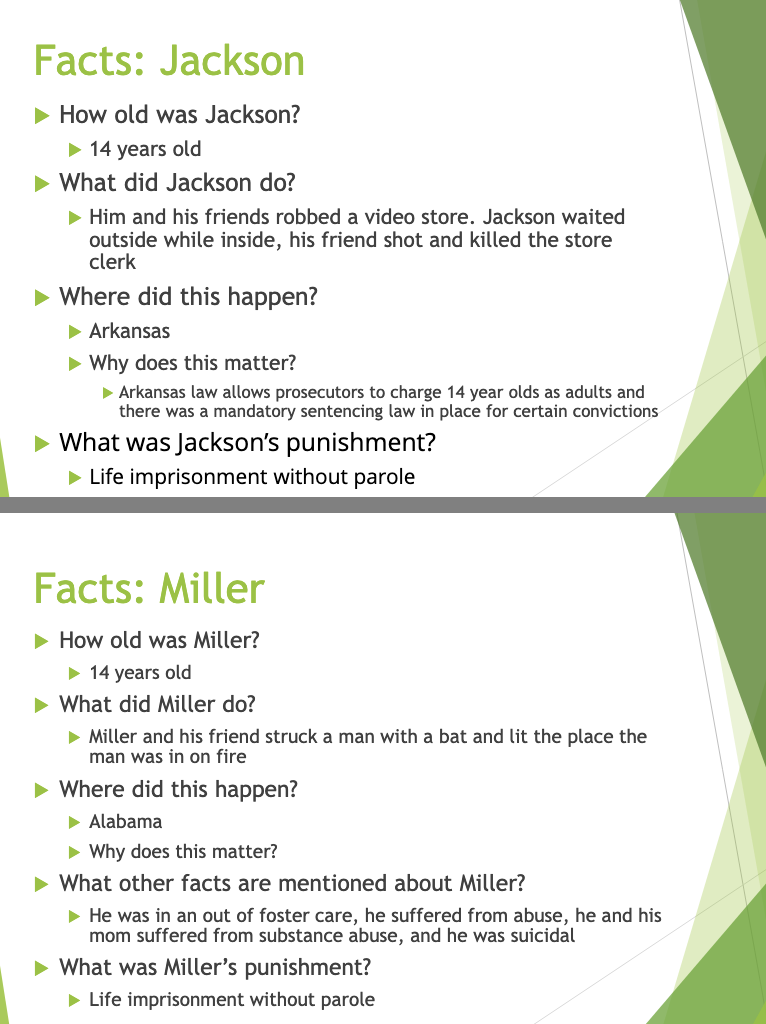
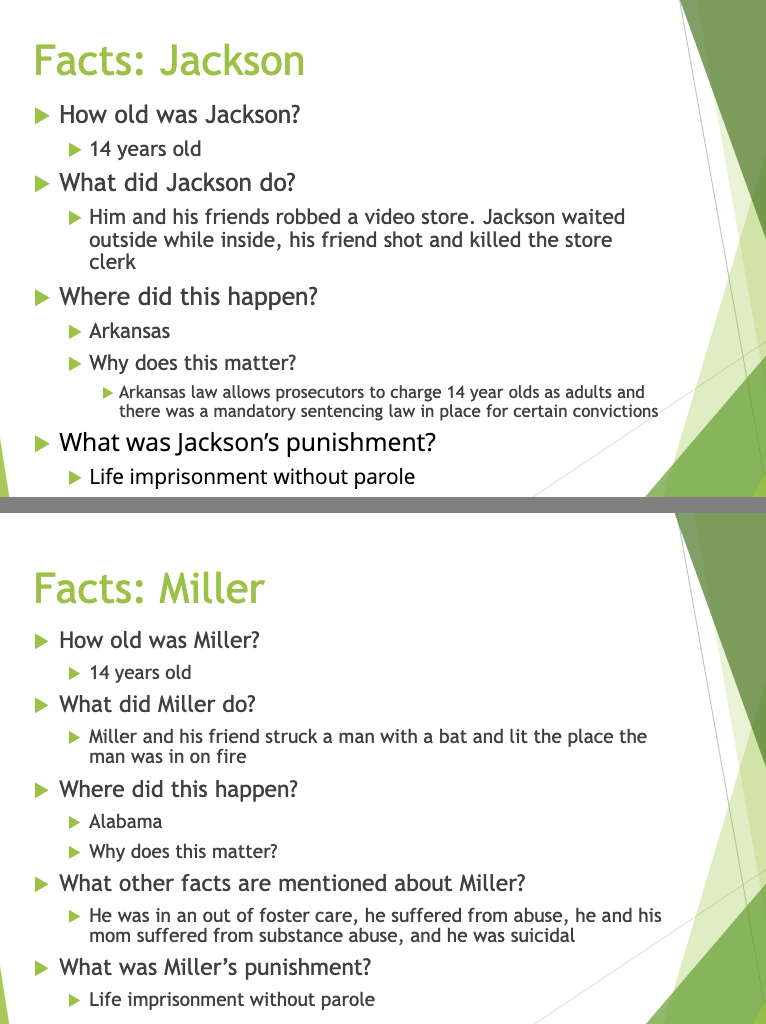
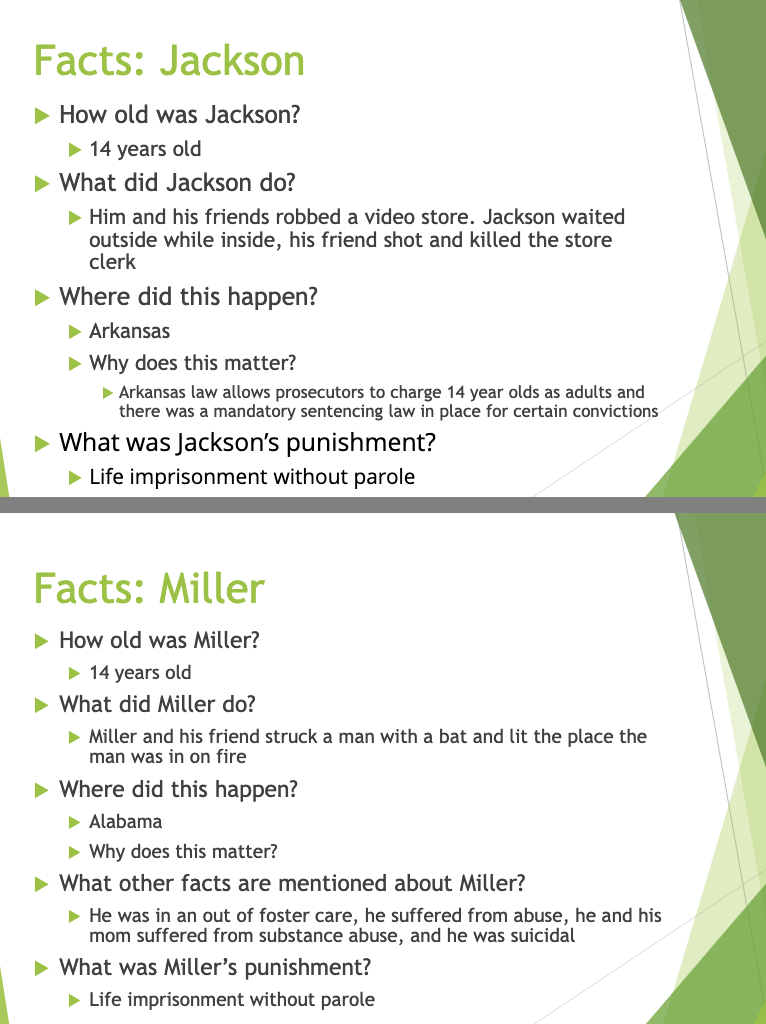
What are the overall facts in Jackson v. Hobbes (2012)?a

14-year-old Jackson and friends robbed a video store in Arkansas. Jackson waited outside, and inside, a friend shot and killed the store clerk. Jackson was sentenced under a mandatory sentencing law and received life without parole.

  • This case challenged the constitutionality of sentencing minors to life without parole for crimes they did not directly commit.
<p><strong>14-year-old Jackson</strong> and friends <strong>robbed a video store</strong> in <strong>Arkansas</strong>. Jackson <strong>waited outside</strong>, and inside, a friend <strong>shot and killed the store clerk</strong>. Jackson was sentenced under a <strong>mandatory sentencing law</strong> and received <strong>life without parole</strong>.</p><ul><li><p>This case challenged the constitutionality of sentencing minors to life without parole for crimes they did not directly commit. </p></li></ul><p></p>
2
New cards

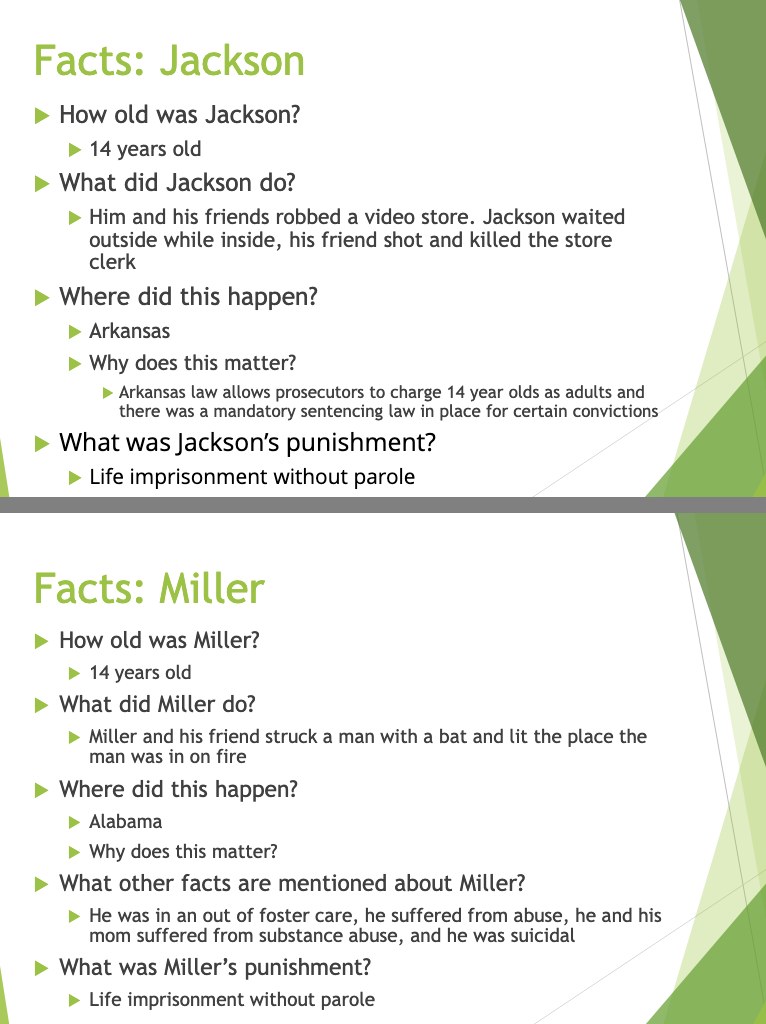
How old was Jackson, and why is that important?

He was 14 years old. It’s important because the case focuses on whether extremely harsh mandatory punishment is constitutional for such a young juvenile.

  • His age, 14 years, raises questions about the constitutional limits on sentencing juveniles, particularly regarding life without parole for non-homicidal offenses.
<p>He was <strong>14 years old</strong>. It’s important because the case focuses on whether extremely harsh mandatory punishment is constitutional for such a young juvenile.</p><ul><li><p>His age, 14 years, raises questions about the constitutional limits on sentencing juveniles, particularly regarding life without parole for non-homicidal offenses. </p></li></ul><p></p>
3
New cards

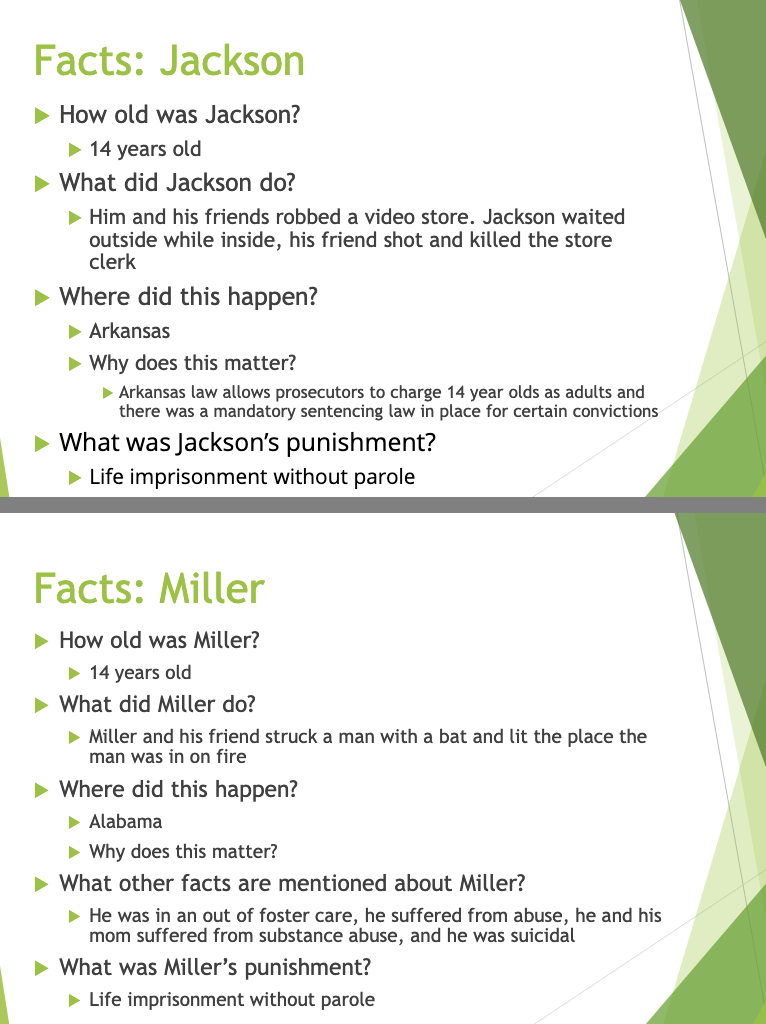
What did Jackson do in the offense? Explain his role.

Jackson and friends robbed a video store; Jackson waited outside, while his friend inside shot and killed the clerk. His role matters because he did not fire the shot, yet faced the harshest sentence.

  • This raises questions about accountability and the application of mandatory sentencing laws for juveniles involved in felony murder.
<p>Jackson and friends <strong>robbed a video store</strong>; Jackson <strong>waited outside</strong>, while his friend inside <strong>shot and killed</strong> the clerk. His role matters because he did not fire the shot, yet faced the harshest sentence.</p><ul><li><p>This raises questions about accountability and the application of mandatory sentencing laws for juveniles involved in felony murder. </p></li></ul><p></p>
4
New cards

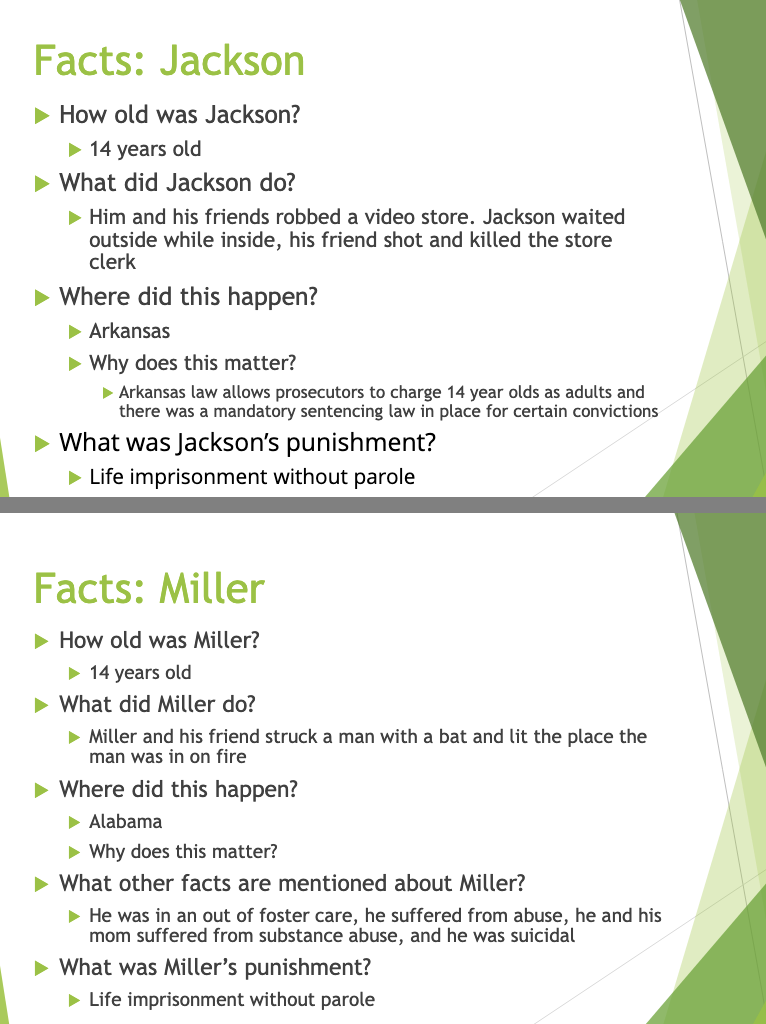
Where did Jackson’s case happen, and why does that matter?

Arkansas. It matters because Arkansas law allowed prosecutors to charge 14-year-olds as adults, and Arkansas had a mandatory sentencing law for certain convictions—setting up the constitutional issue.

  • This context is significant as it highlights the interplay between state laws and the rights of juveniles in the criminal justice system, particularly regarding life sentences.
<p><strong>Arkansas.</strong> It matters because <strong>Arkansas law allowed prosecutors to charge 14-year-olds as adults</strong>, and Arkansas had a <strong>mandatory sentencing law</strong> for certain convictions—setting up the constitutional issue.</p><ul><li><p>This context is significant as it highlights the interplay between state laws and the rights of juveniles in the criminal justice system, particularly regarding life sentences. </p></li></ul><p></p>
5
New cards

What was Jackson’s punishment, and what does that mean?

Life imprisonment without parole (LWOP). That means he would spend his life in prison with no possibility of release through parole.

  • This raises significant ethical and constitutional concerns about the treatment of juvenile offenders and the implications of such a harsh sentence at such a young age.
<p><strong>Life imprisonment without parole (LWOP).</strong> That means he would spend his life in prison with <strong>no possibility of release through parole</strong>.</p><ul><li><p>This raises significant ethical and constitutional concerns about the treatment of juvenile offenders and the implications of such a harsh sentence at such a young age. </p></li></ul><p></p>
6
New cards

What are the overall facts in Miller v. Alabama (2012)?

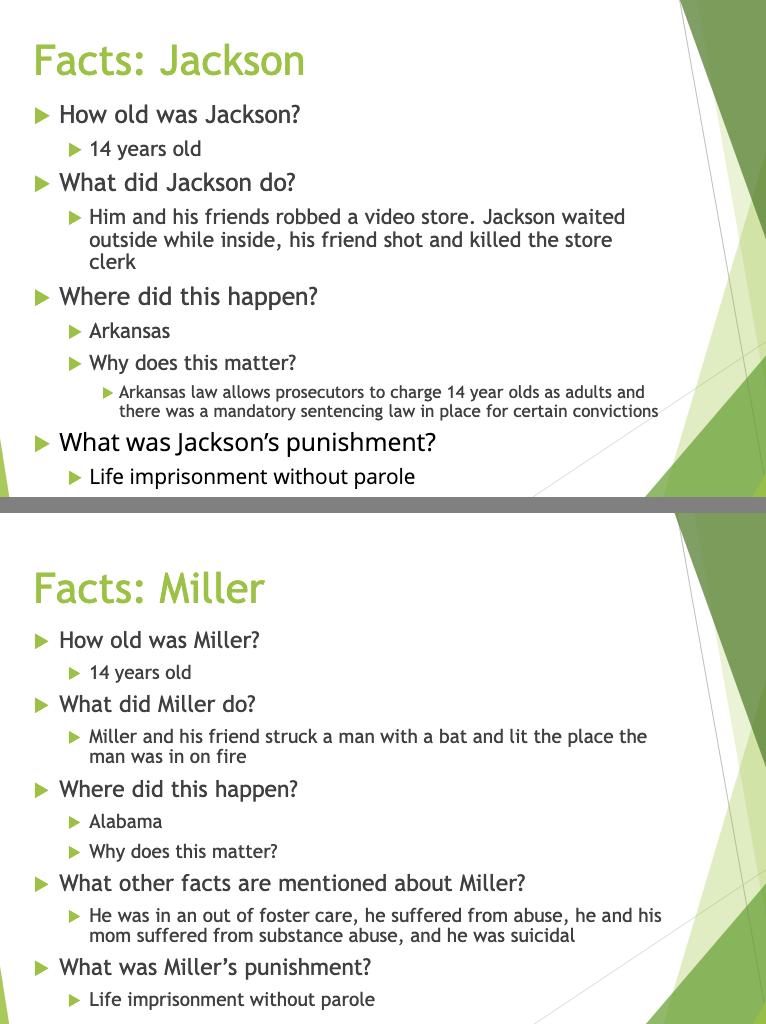
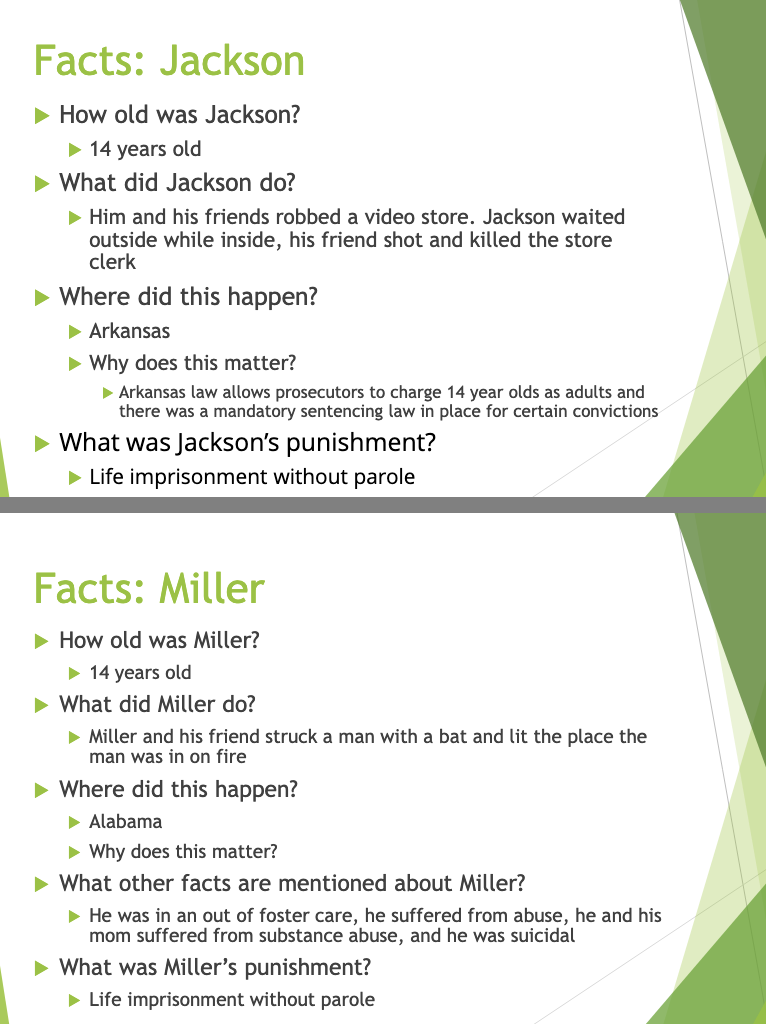
14-year-old Miller and a friend struck a man with a bat and lit the place the man was in on fire in Alabama. Miller had severe background issues (foster care, abuse, substance issues, suicidality) and was sentenced to life without parole.

  • This case highlights the complexities of sentencing juveniles, particularly in light of their developmental capacities and backgrounds, raising questions about the constitutionality of such sentences.
<p><strong>14-year-old Miller</strong> and a friend <strong>struck a man with a bat</strong> and <strong>lit the place the man was in on fire</strong> in <strong>Alabama</strong>. Miller had severe background issues (foster care, abuse, substance issues, suicidality) and was sentenced to <strong>life without parole</strong>.</p><ul><li><p>This case highlights the complexities of sentencing juveniles, particularly in light of their developmental capacities and backgrounds, raising questions about the constitutionality of such sentences. </p></li></ul><p></p>
7
New cards

How old was Miller, and why is that important?

He was 14 years old. It’s important because the case examines whether mandatory LWOP is constitutional for a 14-year-old juvenile, especially given developmental differences and circumstances.

  • The age of 14 raises critical issues regarding the appropriateness of harsh sentences for juveniles, who may not fully understand the consequences of their actions and are still undergoing significant psychological development.
<p>He was <strong>14 years old</strong>. It’s important because the case examines whether mandatory LWOP is constitutional for a <strong>14-year-old juvenile</strong>, especially given developmental differences and circumstances.</p><ul><li><p>The age of 14 raises critical issues regarding the appropriateness of harsh sentences for juveniles, who may not fully understand the consequences of their actions and are still undergoing significant psychological development. </p></li></ul><p></p>
8
New cards

What did Miller do? Explain.

Miller and a friend hit a man with a bat and then set fire to the place where the man was. This was treated as a very serious homicide-related offense leading to LWOP.

  • This act of violence ultimately resulted in Miller receiving a life sentence without parole, highlighting the gravity of the crime and its consequences.
<p>Miller and a friend <strong>hit a man with a bat</strong> and then <strong>set fire</strong> to the place where the man was. This was treated as a very serious homicide-related offense leading to LWOP.</p><ul><li><p>This act of violence ultimately resulted in Miller receiving a life sentence without parole, highlighting the gravity of the crime and its consequences. </p></li></ul><p></p>
9
New cards

Where did Miller’s case happen, and why does that matter?

Alabama. It matters because Alabama also had a legal structure that resulted in mandatory LWOP for certain juvenile homicide convictions—creating the same constitutional issue as Arkansas.

  • Alabama. This is significant because Alabama's legal framework mandated life without parole for specific juvenile homicide offenses, thus raising similar constitutional concerns as those in other states like Arkansas.
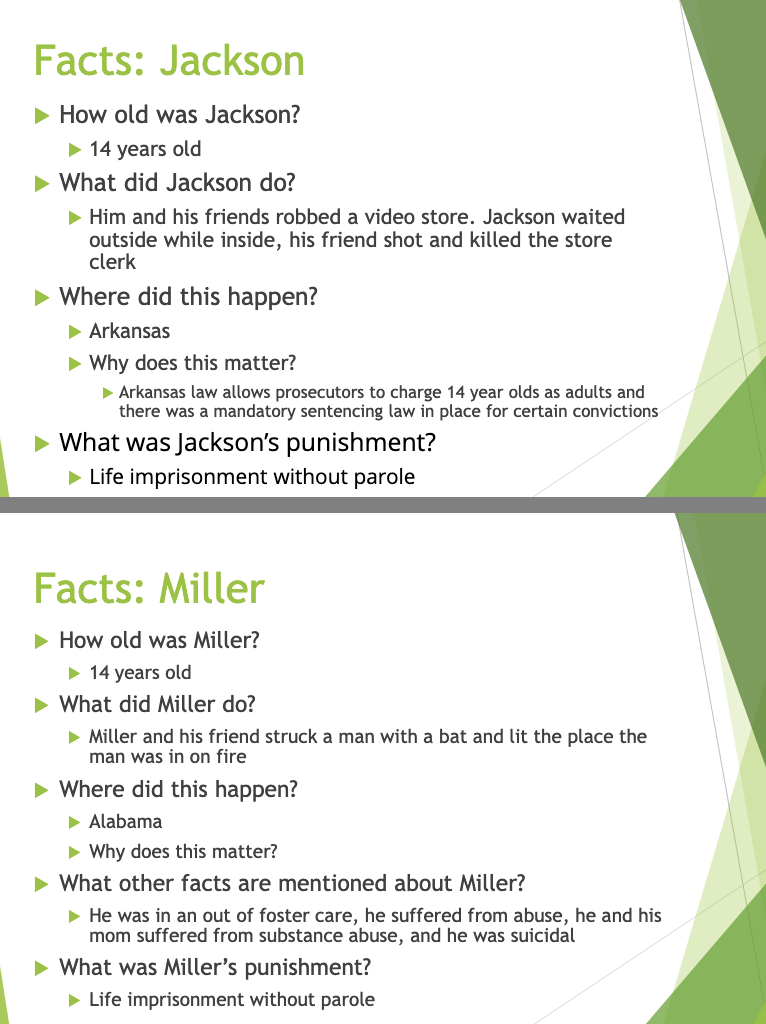
<p><strong>Alabama.</strong> It matters because Alabama also had a legal structure that resulted in <strong>mandatory LWOP</strong> for certain juvenile homicide convictions—creating the same constitutional issue as Arkansas.</p><ul><li><p>Alabama. This is significant because Alabama's legal framework mandated life without parole for specific juvenile homicide offenses, thus raising similar constitutional concerns as those in other states like Arkansas. </p></li></ul><p></p>
10
New cards

What other facts are mentioned about Miller, and why do they matter?

He was in and out of foster care, suffered abuse, he and his mom had substance abuse, and he was suicidal. These matter because they show serious mitigating circumstances and why individualized sentencing is crucial.

  • These factors illustrate the challenges Miller faced in his upbringing, which could affect his culpability and the appropriateness of a life sentence without parole.
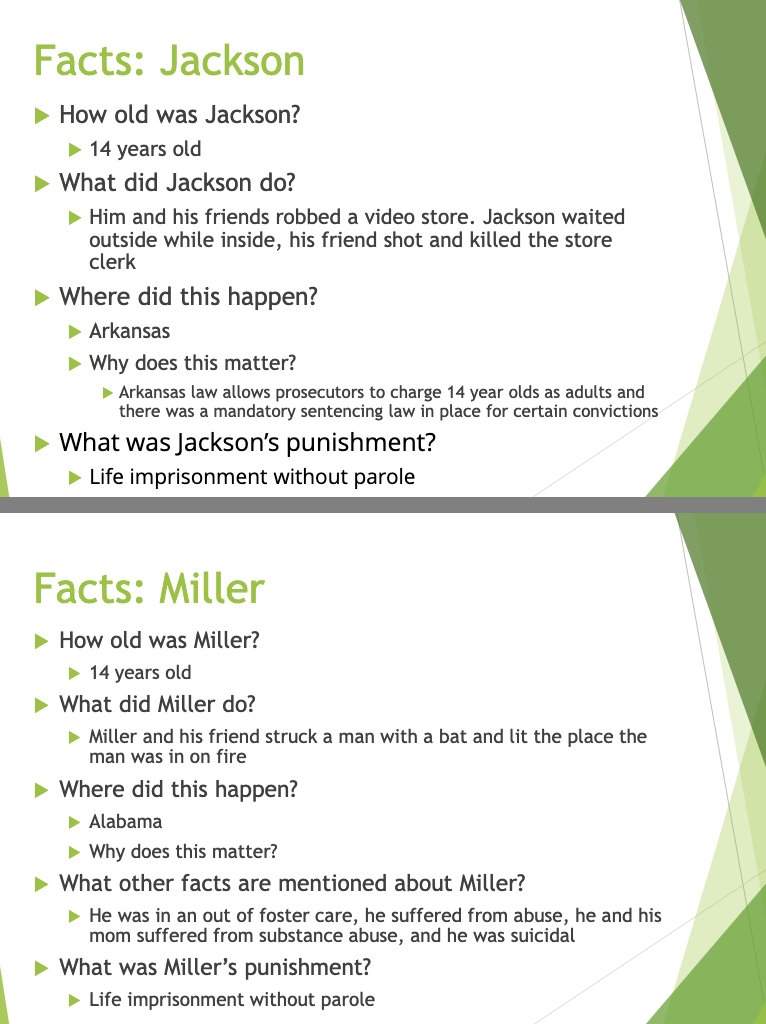
<p>He was <strong>in and out of foster care</strong>, suffered <strong>abuse</strong>, he and his mom had <strong>substance abuse</strong>, and he was <strong>suicidal</strong>. These matter because they show serious <strong>mitigating circumstances</strong> and why individualized sentencing is crucial.</p><ul><li><p>These factors illustrate the challenges Miller faced in his upbringing, which could affect his culpability and the appropriateness of a life sentence without parole. </p></li></ul><p></p>
11
New cards

What was Miller’s punishment, and what does that mean?

Life imprisonment without parole (LWOP)—a sentence that offers no parole release, meaning prison for life unless changed by later legal action.

  • This punishment means that Miller will spend the rest of his life in prison without the possibility of being released on parole, reflecting the severity of his crime and the legal interpretation of his actions as irredeemable.
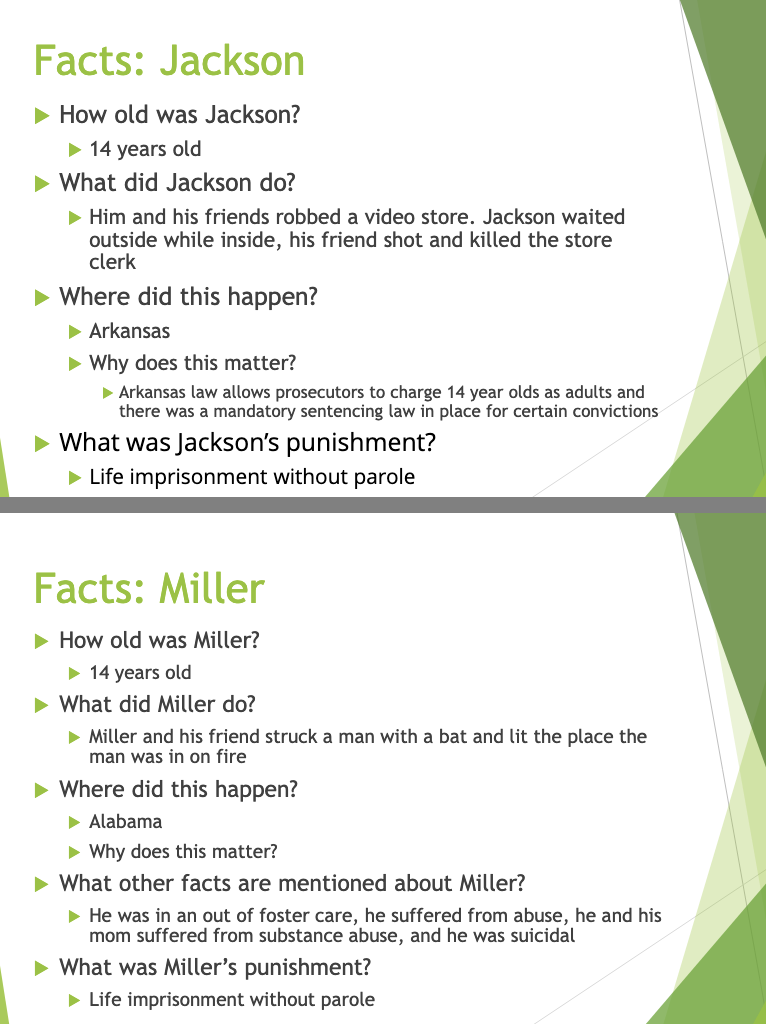
<p><strong>Life imprisonment without parole (LWOP)</strong>—a sentence that offers <strong>no parole release</strong>, meaning prison for life unless changed by later legal action.</p><ul><li><p>This punishment means that Miller will spend the rest of his life in prison without the possibility of being released on parole, reflecting the severity of his crime and the legal interpretation of his actions as irredeemable. </p></li></ul><p></p>
12
New cards

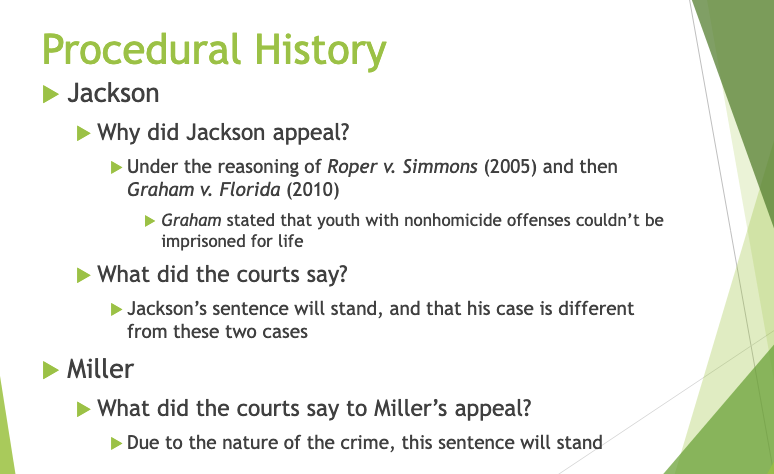
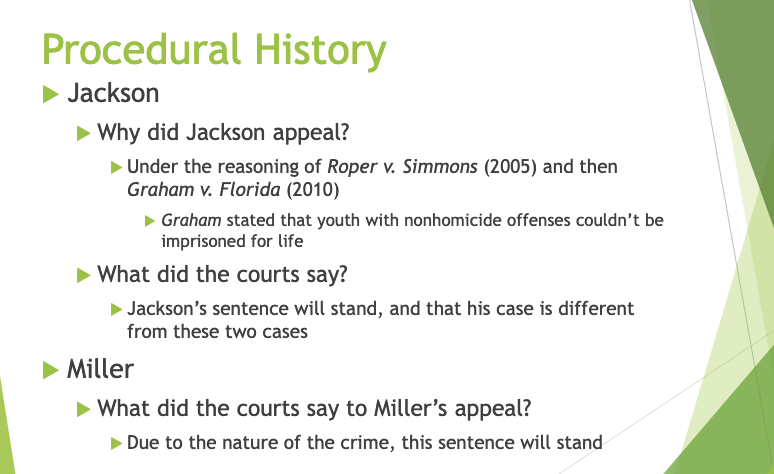
What is the procedural history for Jackson?

Jackson appealed his mandatory LWOP sentence using reasoning from Roper v. Simmons (2005) and Graham v. Florida (2010), but lower courts said his sentence would stand because they viewed his case as different.

  • This procedural history highlights the ongoing legal debate regarding the applicability of Eighth Amendment protections for juvenile offenders, as Jackson sought to challenge the constitutionality of his sentence based on precedents about juvenile sentencing.
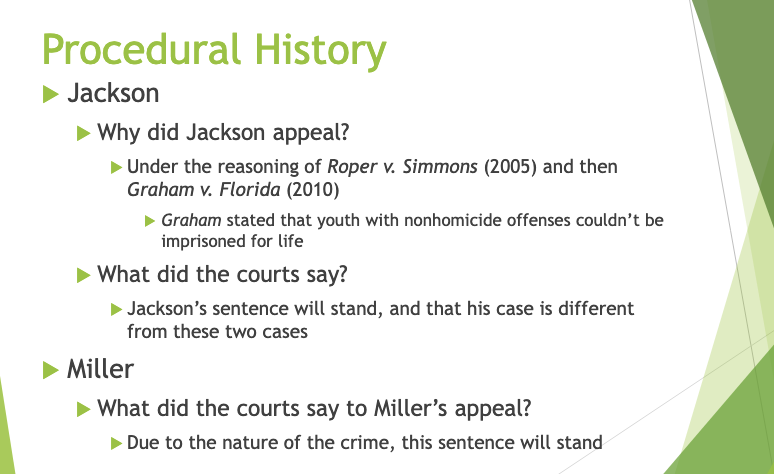
<p>Jackson appealed his mandatory LWOP sentence using reasoning from <strong>Roper v. Simmons (2005)</strong> and <strong>Graham v. Florida (2010)</strong>, but lower courts said his sentence would <strong>stand</strong> because they viewed his case as <strong>different</strong>.</p><ul><li><p>This procedural history highlights the ongoing legal debate regarding the applicability of Eighth Amendment protections for juvenile offenders, as Jackson sought to challenge the constitutionality of his sentence based on precedents about juvenile sentencing. </p></li></ul><p></p>
13
New cards

Why did Jackson appeal? Explain the legal reasoning he used.

He appealed based on Roper (2005) and Graham (2010). Graham said youth who committed nonhomicide offenses couldn’t be imprisoned for life—so Jackson used the trend of limiting harsh punishments for juveniles to argue against mandatory LWOP.

  • This reasoning argues that, as a juvenile, he should be granted more leniency in sentencing due to his age and circumstances.
<p>He appealed based on <strong>Roper (2005)</strong> and <strong>Graham (2010)</strong>. <em>Graham</em> said youth who committed <strong>nonhomicide</strong> offenses couldn’t be imprisoned for life—so Jackson used the trend of limiting harsh punishments for juveniles to argue against mandatory LWOP.</p><ul><li><p>This reasoning argues that, as a juvenile, he should be granted more leniency in sentencing due to his age and circumstances. </p></li></ul><p></p>
14
New cards

What did the courts say about Jackson’s appeal? Explain.

They said his sentence would stand and that his situation was different from Roper and Graham, so those cases didn’t change his outcome at that time.

  • This affirmed the lower courts' decisions, indicating that Jackson's case did not meet the criteria established in those precedents for overturning mandatory life imprisonment without parole.
<p>They said <strong>his sentence would stand</strong> and that his situation was <strong>different</strong> from <em>Roper</em> and <em>Graham</em>, so those cases didn’t change his outcome at that time.</p><ul><li><p>This affirmed the lower courts' decisions, indicating that Jackson's case did not meet the criteria established in those precedents for overturning mandatory life imprisonment without parole. </p></li></ul><p></p>
15
New cards

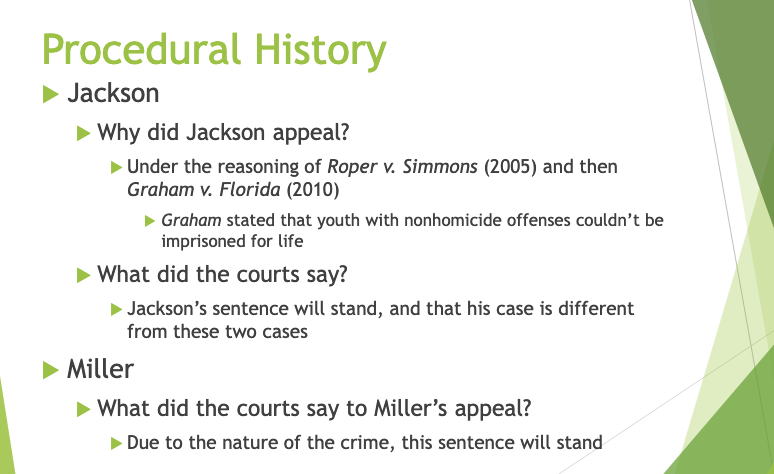
What is the procedural history for Miller?

Miller appealed his mandatory LWOP sentence, but courts responded that due to the nature of the crime, his sentence would stand.

  • This response emphasized that his case did not sufficiently demonstrate the need for consideration of his youth and potential for rehabilitation, in line with the evolving standards of decency related to juvenile sentencing.
<p>Miller appealed his mandatory LWOP sentence, but courts responded that <strong>due to the nature of the crime</strong>, his sentence would <strong>stand</strong>.</p><ul><li><p>This response emphasized that his case did not sufficiently demonstrate the need for consideration of his youth and potential for rehabilitation, in line with the evolving standards of decency related to juvenile sentencing. </p></li></ul><p></p>
16
New cards

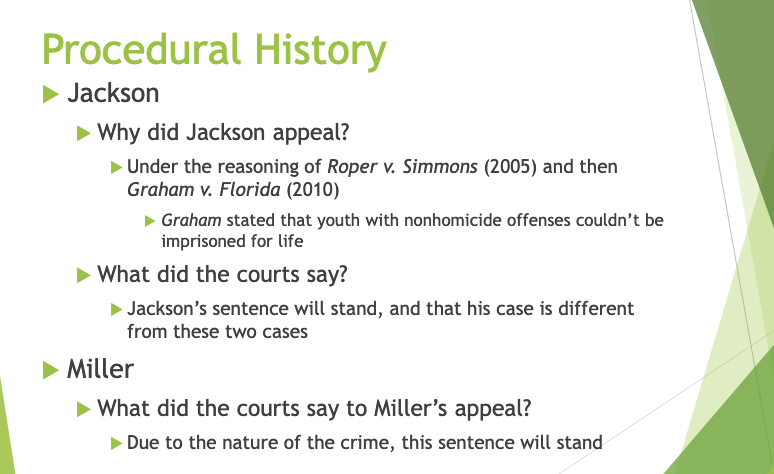
What did the courts say to Miller’s appeal, and why?

They said the sentence would stand because of the nature of the crime (treated as severe enough to justify LWOP under the then-existing law).

  • This reaffirmed the original ruling, indicating that the court did not find sufficient grounds to reconsider Miller's eligibility for leniency due to his status as a juvenile.
<p>They said the sentence would <strong>stand</strong> because of the <strong>nature of the crime</strong> (treated as severe enough to justify LWOP under the then-existing law).</p><ul><li><p>This reaffirmed the original ruling, indicating that the court did not find sufficient grounds to reconsider Miller's eligibility for leniency due to his status as a juvenile. </p></li></ul><p></p>
17
New cards

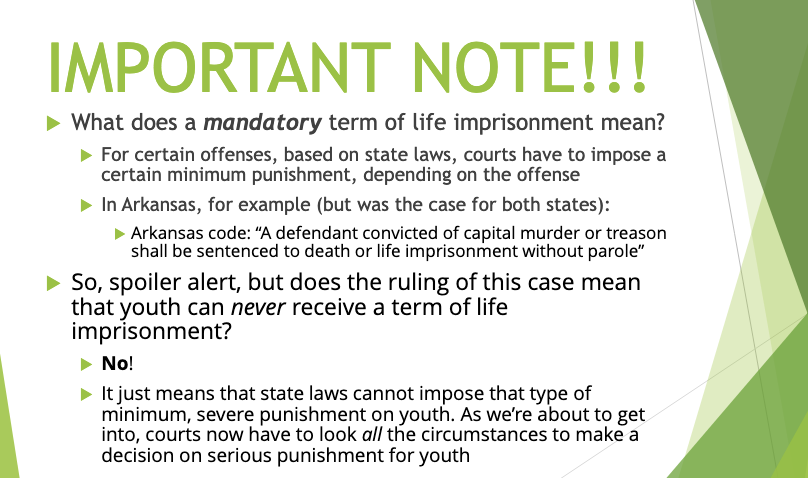
What does a mandatory term of life imprisonment mean? Explain simply.

It means that for certain offenses, state law forces the judge to give a specific minimum severe sentence—the judge doesn’t get discretion to consider individual circumstances.

  • This guarantees a sentence of life without the possibility of parole, regardless of the offender's age or background.
<p>It means that for certain offenses, <strong>state law forces the judge to give a specific minimum severe sentence</strong>—the judge <strong>doesn’t get discretion</strong> to consider individual circumstances.</p><ul><li><p>This guarantees a sentence of life without the possibility of parole, regardless of the offender's age or background. </p></li></ul><p></p>
18
New cards

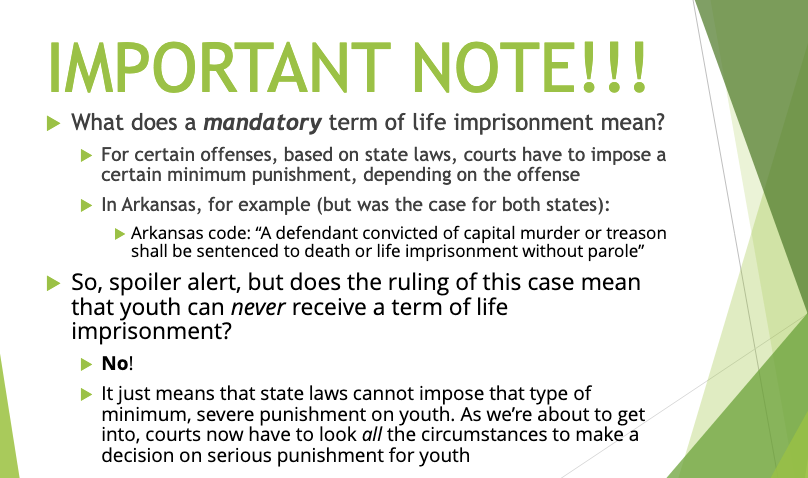
What did the Arkansas code say about mandatory sentencing, and what does it mean?

Arkansas code stated: “A defendant convicted of capital murder or treason shall be sentenced to death or life imprisonment without parole.”
Meaning: once convicted of those offenses, the court must choose death or LWOP—no option for a lesser sentence.

  • This means that under Arkansas law, individuals convicted of certain serious crimes are subject to a mandatory sentence of either the death penalty or life imprisonment without parole, leaving no room for judges to impose lesser penalties regardless of individual circumstances.
<p>Arkansas code stated: <strong>“A defendant convicted of capital murder or treason shall be sentenced to death or life imprisonment without parole.”</strong><br>Meaning: once convicted of those offenses, the court must choose <strong>death or LWOP</strong>—no option for a lesser sentence.</p><ul><li><p>This means that under Arkansas law, individuals convicted of certain serious crimes are subject to a mandatory sentence of either the death penalty or life imprisonment without parole, leaving no room for judges to impose lesser penalties regardless of individual circumstances. </p></li></ul><p></p>
19
New cards

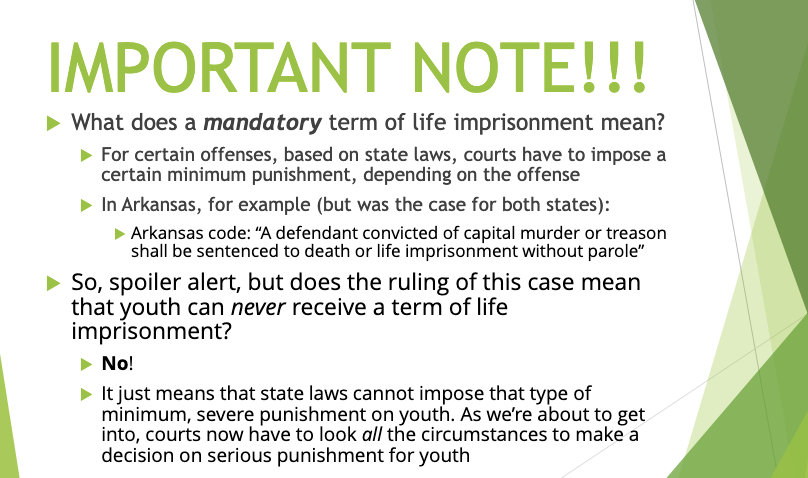
Does the ruling in Miller/Jackson mean youth can never receive life imprisonment? Explain.

No. It means states cannot require mandatory LWOP for juveniles. Courts must consider all circumstances (individualized sentencing) before imposing such severe punishment on youth.

  • This ruling allows for the possibility of life imprisonment for juveniles, but mandates a thorough examination of the offender's background and the nature of the crime during sentencing.
<p><strong>No.</strong> It means states <strong>cannot require mandatory LWOP</strong> for juveniles. Courts must consider <strong>all circumstances</strong> (individualized sentencing) before imposing such severe punishment on youth.</p><ul><li><p>This ruling allows for the possibility of life imprisonment for juveniles, but mandates a thorough examination of the offender's background and the nature of the crime during sentencing. </p></li></ul><p></p>
20
New cards

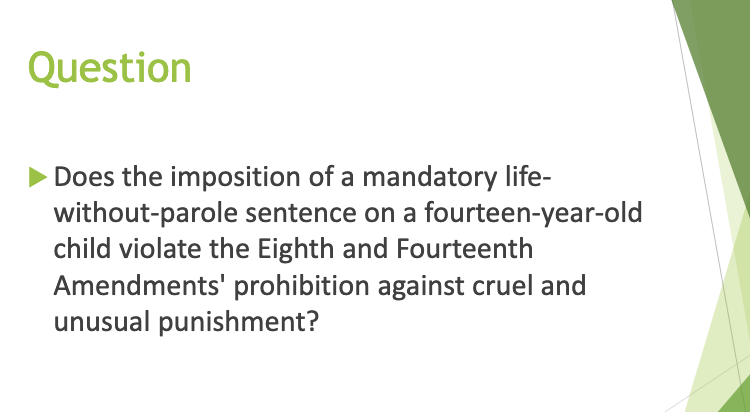
What question did Miller v. Alabama and Jackson v. Hobbes ask (and why does it matter)?

Whether imposing mandatory life without parole on a 14-year-old violates the Eighth and Fourteenth Amendments’ ban on cruel and unusual punishment. It matters because it addresses whether youth can receive the harshest sentences without individualized review.

  • This question matters as it explores the balance between crime accountability and the recognition of juvenile development, impacting sentencing laws across the country.
<p>Whether imposing <strong>mandatory life without parole</strong> on a <strong>14-year-old</strong> violates the <strong>Eighth and Fourteenth Amendments’</strong> ban on <strong>cruel and unusual punishment</strong>. It matters because it addresses whether youth can receive the harshest sentences without individualized review.</p><ul><li><p>This question matters as it explores the balance between crime accountability and the recognition of juvenile development, impacting sentencing laws across the country. </p></li></ul><p></p>
21
New cards

What was the Supreme Court’s decision in Miller/Jackson (2012)? Explain.

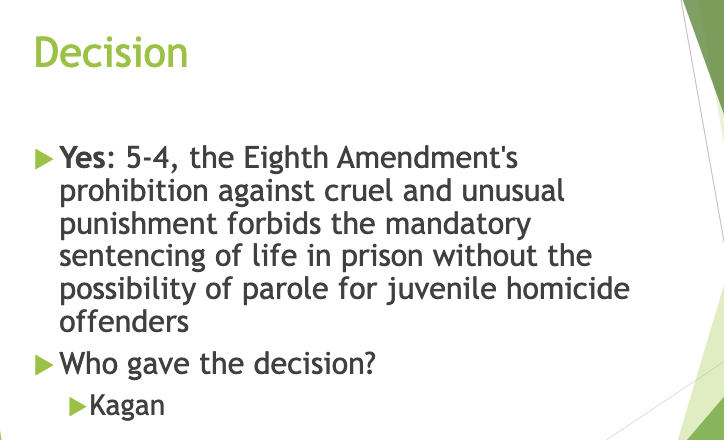
Yes (5–4): The Eighth Amendment forbids mandatory life-without-parole sentences for juvenile homicide offenders. The key is mandatory—courts must have discretion and consider circumstances.

  • This decision emphasizes individualized sentencing, requiring judges to evaluate a juvenile's unique situation before imposing severe penalties like life without parole.
<p><strong>Yes (5–4):</strong> The Eighth Amendment forbids <strong>mandatory</strong> life-without-parole sentences for <strong>juvenile homicide offenders</strong>. The key is <strong>mandatory</strong>—courts must have discretion and consider circumstances.</p><ul><li><p>This decision emphasizes individualized sentencing, requiring judges to evaluate a juvenile's unique situation before imposing severe penalties like life without parole. </p></li></ul><p></p>
22
New cards

Who delivered the Court’s decision in Miller v. Alabama (2012), and what does that mean?

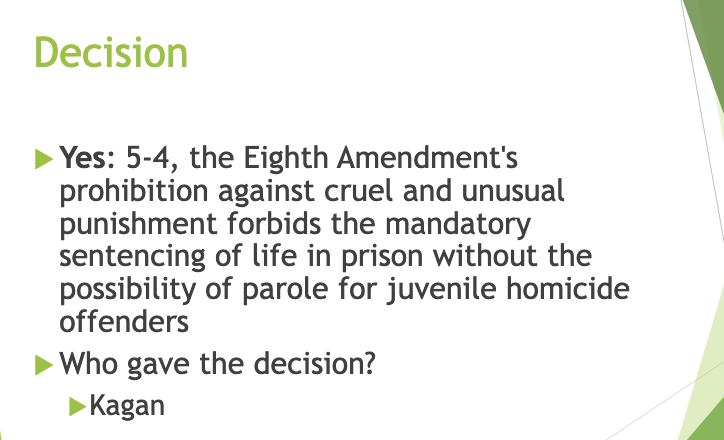
Justice Kagan. That means she wrote the majority opinion explaining why mandatory LWOP for juveniles is unconstitutional.

  • This signifies a shift in how the legal system views juvenile offenders, emphasizing the need for individualized consideration in sentencing.
<p><strong>Justice Kagan.</strong> That means she wrote the majority opinion explaining why mandatory LWOP for juveniles is unconstitutional.</p><ul><li><p>This signifies a shift in how the legal system views juvenile offenders, emphasizing the need for individualized consideration in sentencing. </p></li></ul><p></p>
23
New cards

What was the overall reasoning in Miller v. Alabama and Jackson v. Hobbes (2012)?

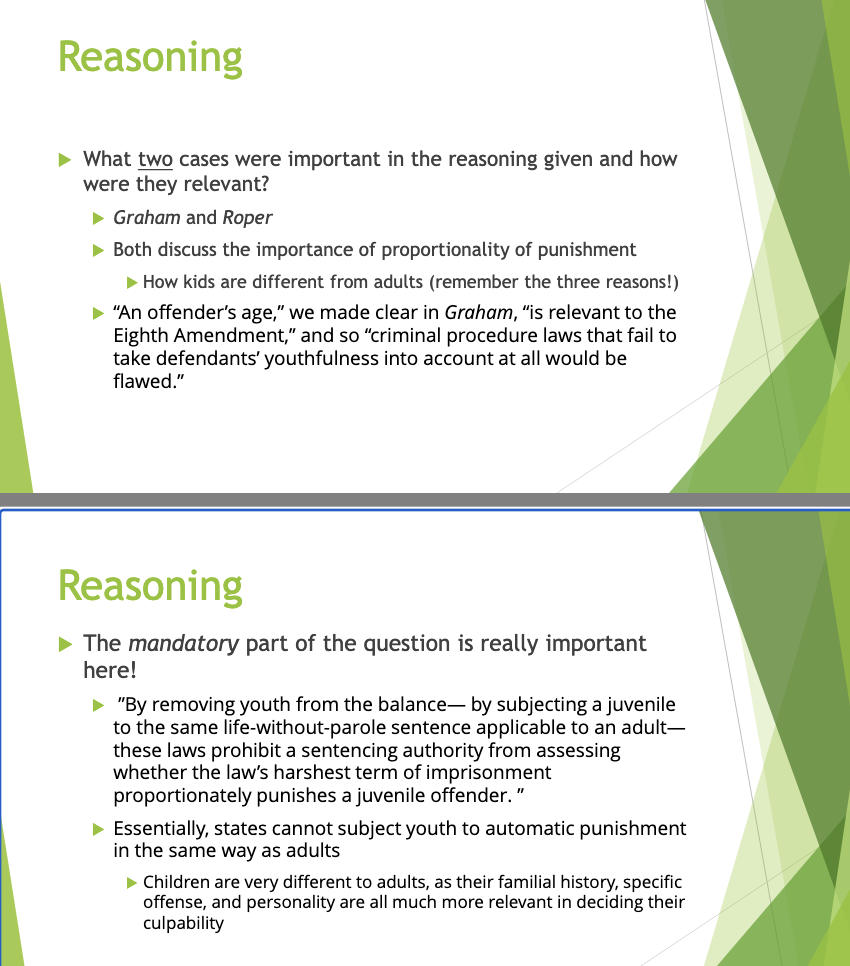
The Court said mandatory LWOP for juveniles is unconstitutional because youth are different from adults and punishment must be proportionate. Mandatory laws remove a judge’s ability to consider youthfulness and individual circumstances, which is especially important for kids.

  • The Court reasoned that juveniles have a greater capacity for change and rehabilitation than adults, and therefore, should not be subjected to the harshest penalties without individualized assessment.
<p>The Court said mandatory LWOP for juveniles is unconstitutional because youth are different from adults and punishment must be <strong>proportionate</strong>. Mandatory laws remove a judge’s ability to consider youthfulness and individual circumstances, which is especially important for kids.</p><ul><li><p>The Court reasoned that juveniles have a greater capacity for change and rehabilitation than adults, and therefore, should not be subjected to the harshest penalties without individualized assessment. </p></li></ul><p></p>
24
New cards

What two cases were important in the reasoning, and how were they relevant?

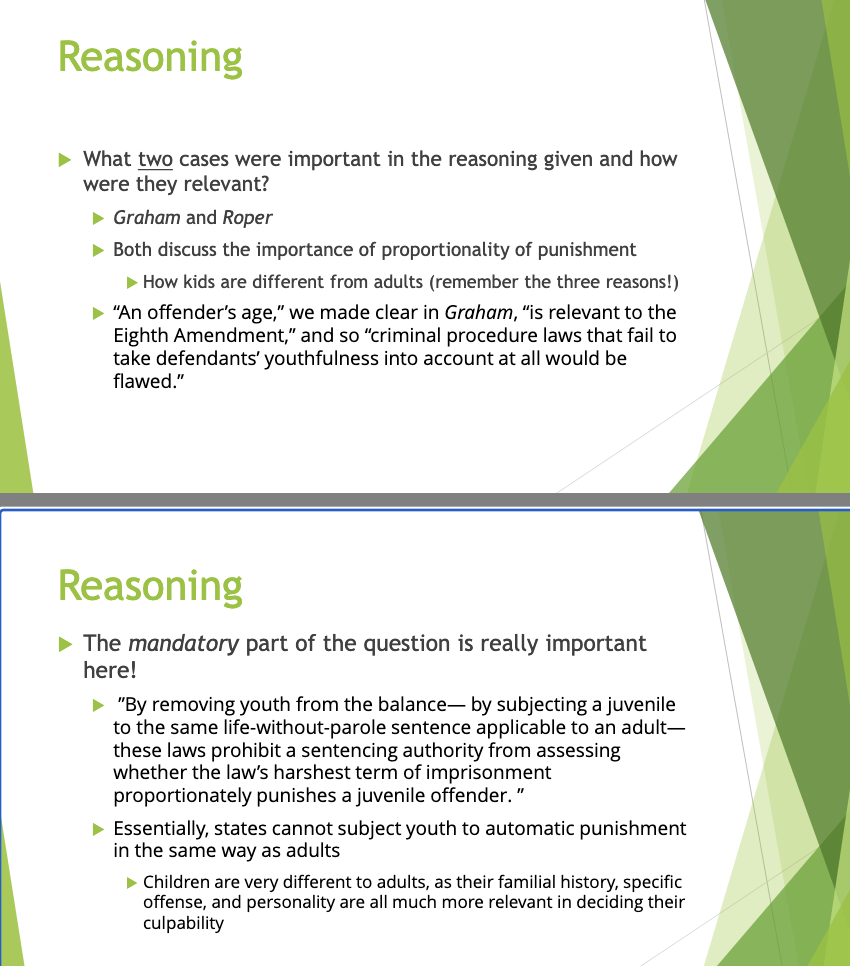
Roper and Graham.

  • Roper: established that youth are different from adults (less culpable) and some extreme punishments are disproportionate for minors.

  • Graham: emphasized proportionality and stated that age matters under the Eighth Amendment; laws that don’t consider youthfulness are flawed.

Both cases informed the Court's decision by highlighting that juvenile offenders deserve individualized assessments, and the severity of sentences must reflect their developmental differences.
<p><strong>Roper</strong> and <strong>Graham.</strong></p><ul><li><p><strong>Roper:</strong> established that youth are different from adults (less culpable) and some extreme punishments are disproportionate for minors.</p></li><li><p><strong>Graham:</strong> emphasized <strong>proportionality</strong> and stated that <strong>age matters</strong> under the Eighth Amendment; laws that don’t consider youthfulness are flawed.</p></li></ul><p>Both cases informed the Court's decision by highlighting that juvenile offenders deserve individualized assessments, and the severity of sentences must reflect their developmental differences. </p><p></p>
25
New cards

What happened in Graham v. Florida (as used in this reasoning)?

Graham held that juveniles who commit nonhomicide offenses cannot be sentenced to life without parole, and it highlighted that age is relevant under the Eighth Amendment.

  • This case reinforced the principle that punishments must be proportionate to the offender's age and circumstances, further establishing limits on severe penalties for juveniles.
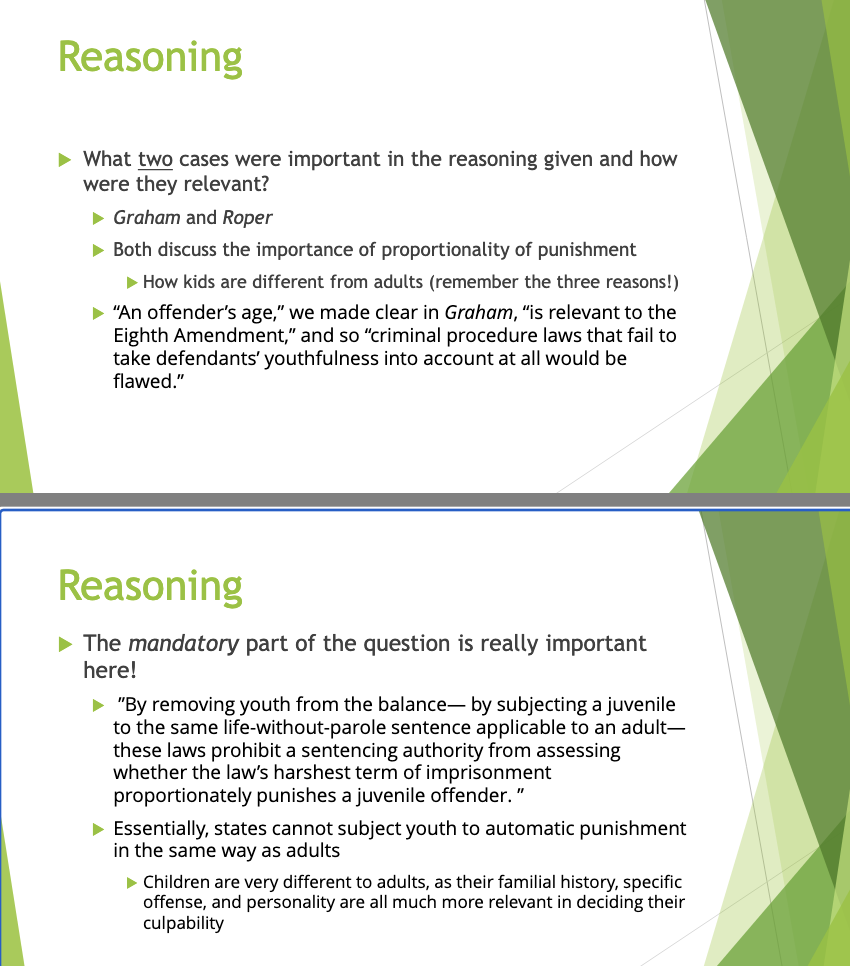
<p><em>Graham</em> held that juveniles who commit <strong>nonhomicide</strong> offenses <strong>cannot be sentenced to life without parole</strong>, and it highlighted that <strong>age is relevant</strong> under the Eighth Amendment.</p><ul><li><p>This case reinforced the principle that punishments must be proportionate to the offender's age and circumstances, further establishing limits on severe penalties for juveniles. </p></li></ul><p></p>
26
New cards

What happened in Roper v. Simmons (as used in this reasoning)?

Roper held minors can’t receive the death penalty and emphasized that kids differ from adults in ways that reduce culpability (the “three reasons” framework).

  • The Court ruled that imposing the death penalty on juveniles is unconstitutional, citing differences in maturity, decision-making ability, and susceptibility to influence. This established that such extreme punishments are inconsistent with evolving standards of decency.
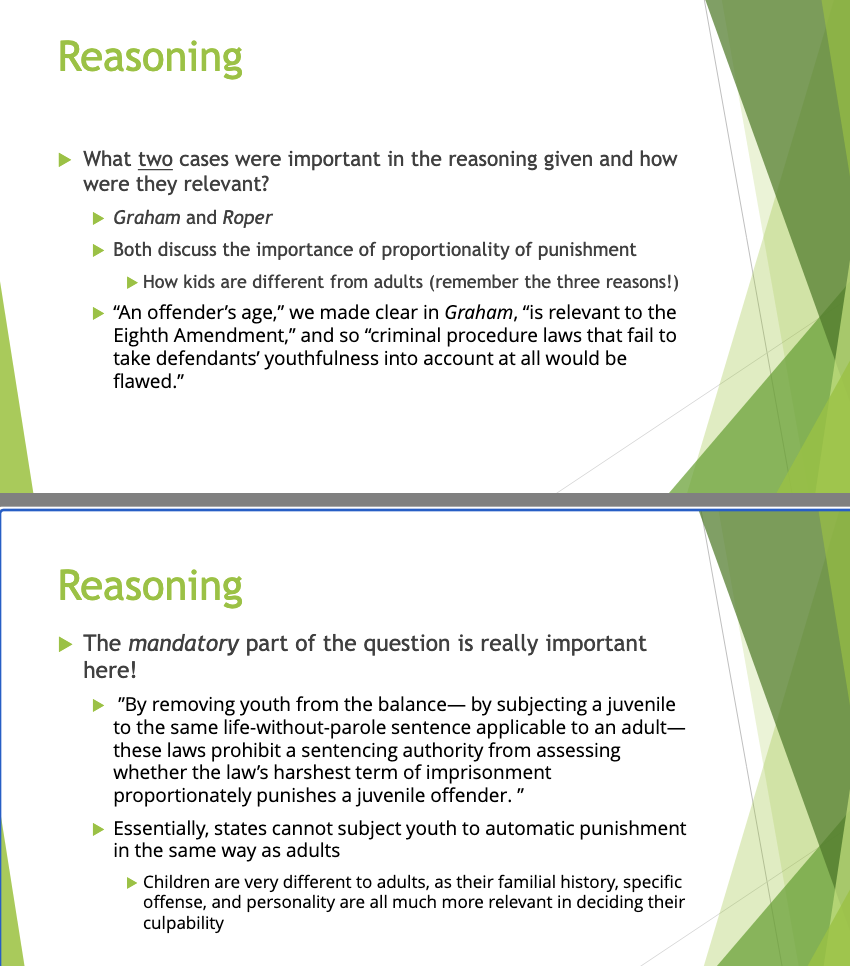
<p><em>Roper</em> held minors can’t receive the <strong>death penalty</strong> and emphasized that kids differ from adults in ways that reduce culpability (the “three reasons” framework).</p><ul><li><p>The Court ruled that imposing the death penalty on juveniles is unconstitutional, citing differences in maturity, decision-making ability, and susceptibility to influence. This established that such extreme punishments are inconsistent with evolving standards of decency. </p></li></ul><p></p>
27
New cards

What do Roper and Graham discuss that mattered in Miller/Jackson?

They discuss proportionality of punishment and how kids are different from adults, meaning youthfulness must be considered when deciding harsh punishment.

  • They emphasize the need for individualized sentencing for juveniles, considering their developmental differences and the constitutional implications of extreme punishments in light of the Eighth Amendment.
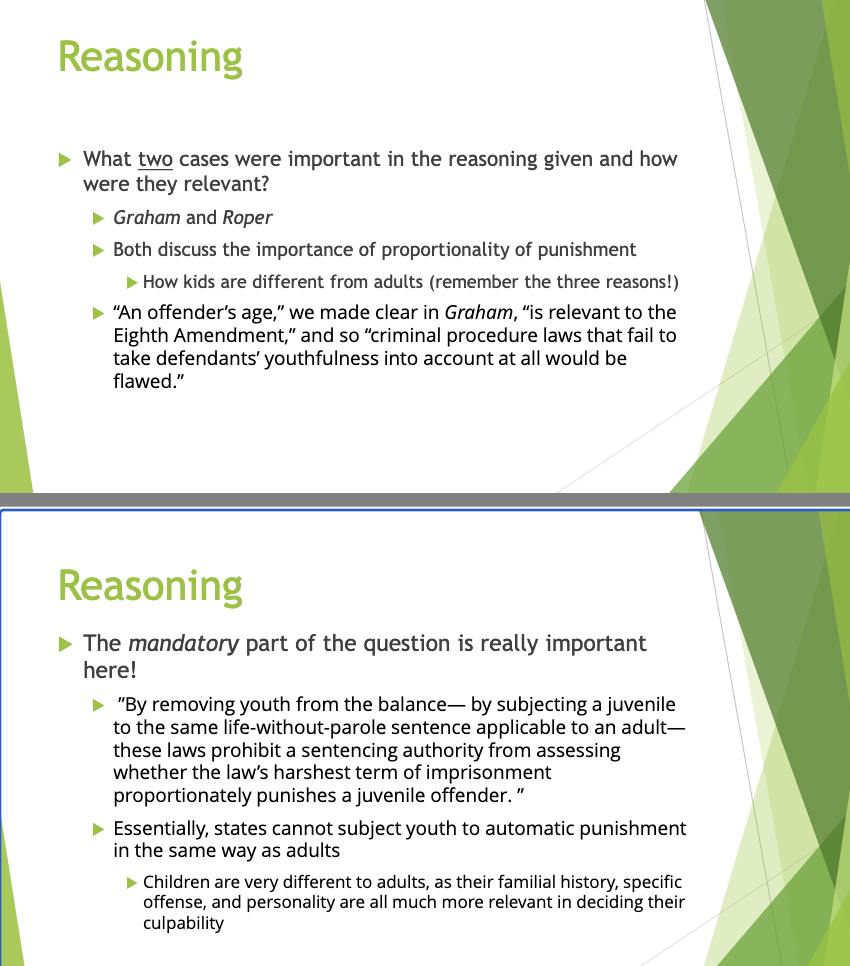
<p>They discuss <strong>proportionality of punishment</strong> and how <strong>kids are different from adults</strong>, meaning youthfulness must be considered when deciding harsh punishment.</p><ul><li><p>They emphasize the need for individualized sentencing for juveniles, considering their developmental differences and the constitutional implications of extreme punishments in light of the Eighth Amendment. </p></li></ul><p></p>
28
New cards

Why is the “mandatory” part of the question really important in Miller/Jackson?

Because mandatory LWOP forces the same harsh sentence as for adults and removes youth from the balance—it prevents the sentencing authority from deciding whether the harshest prison term is proportionate for a juvenile.

  • This insensitivity to a juvenile's individual circumstances and potential for rehabilitation violates the Eighth Amendment principles established in previous cases.
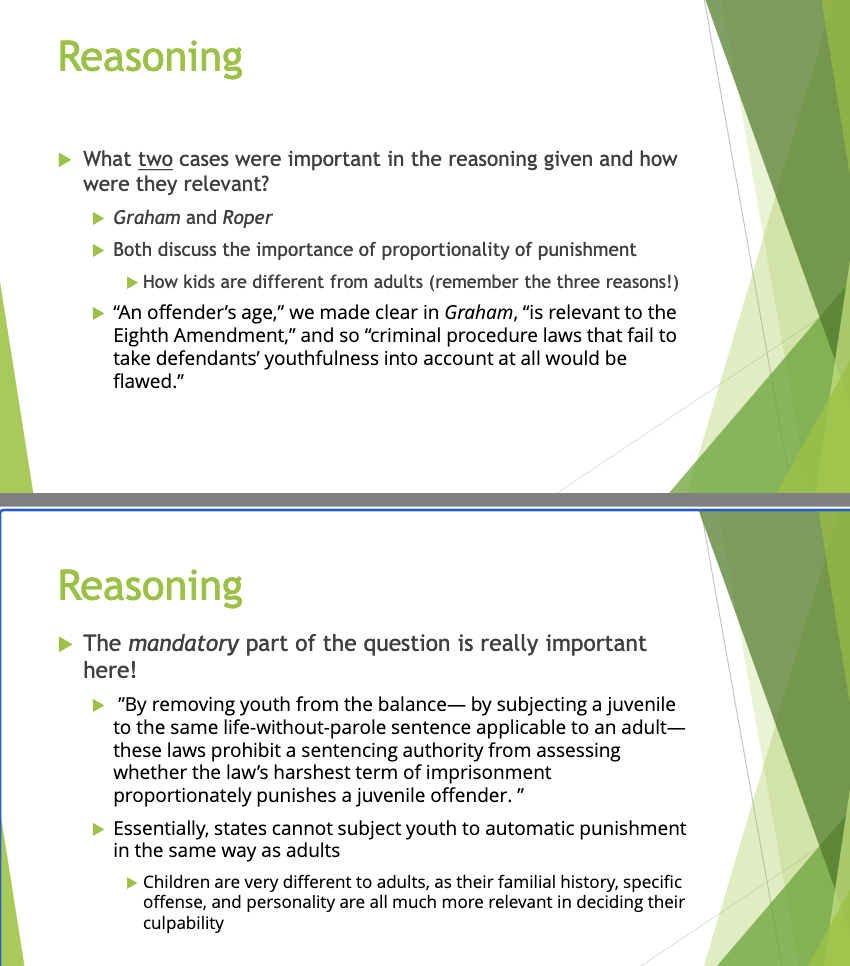
<p>Because mandatory LWOP forces the same harsh sentence as for adults and <strong>removes youth from the balance</strong>—it prevents the sentencing authority from deciding whether the harshest prison term is <strong>proportionate</strong> for a juvenile.</p><ul><li><p>This insensitivity to a juvenile's individual circumstances and potential for rehabilitation violates the Eighth Amendment principles established in previous cases. </p></li></ul><p></p>
29
New cards

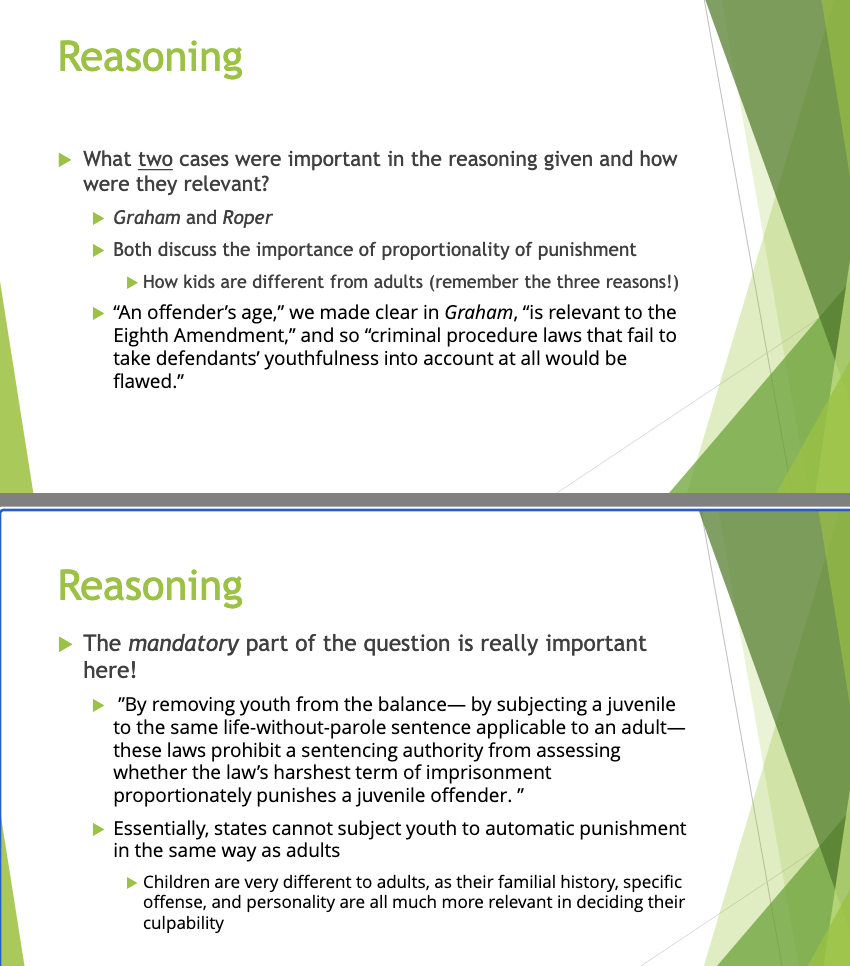
What does this quote essentially state? “By removing youth from the balance… these laws prohibit a sentencing authority from assessing whether the law’s harshest term of imprisonment proportionately punishes a juvenile offender.”

It means states can’t automatically punish youth like adults—judges must be able to weigh youthfulness and decide if the harshest punishment fits the child.

  • This emphasizes that youth must be taken into account, preventing the automatic imposition of adult-level penalties on juvenile offenders.
<p>It means states <strong>can’t automatically punish youth like adults</strong>—judges must be able to weigh youthfulness and decide if the harshest punishment fits the child.</p><ul><li><p>This emphasizes that youth must be taken into account, preventing the automatic imposition of adult-level penalties on juvenile offenders. </p></li></ul><p></p>
30
New cards

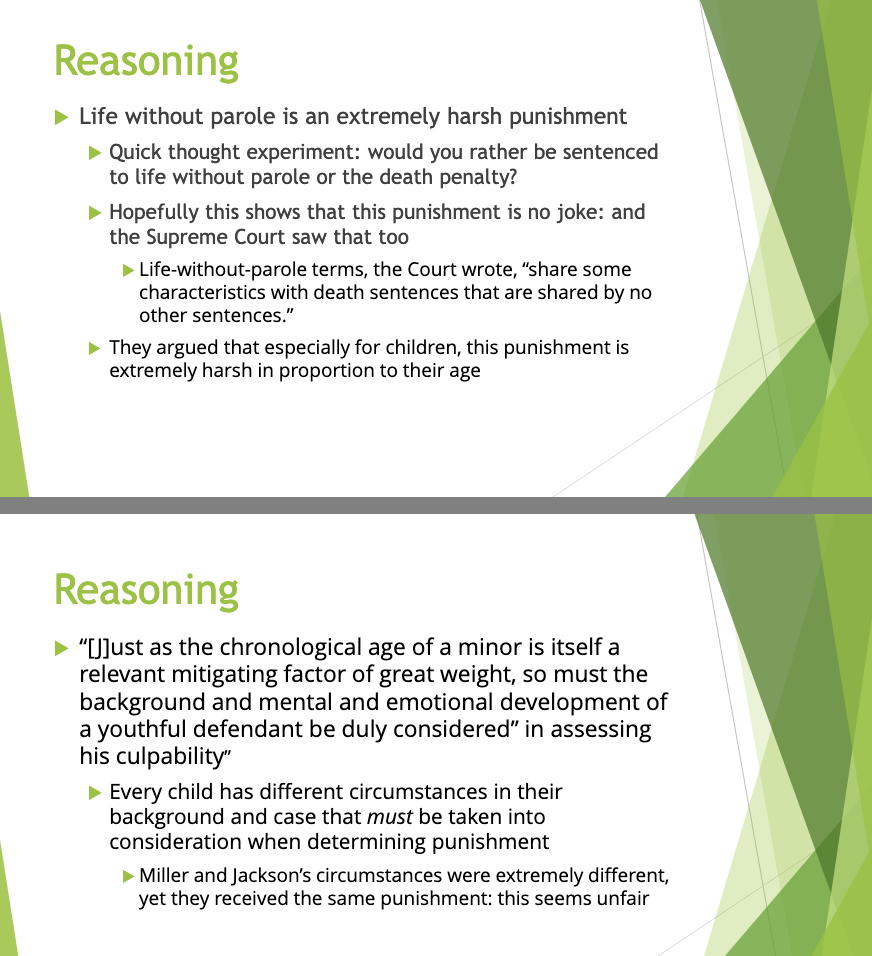
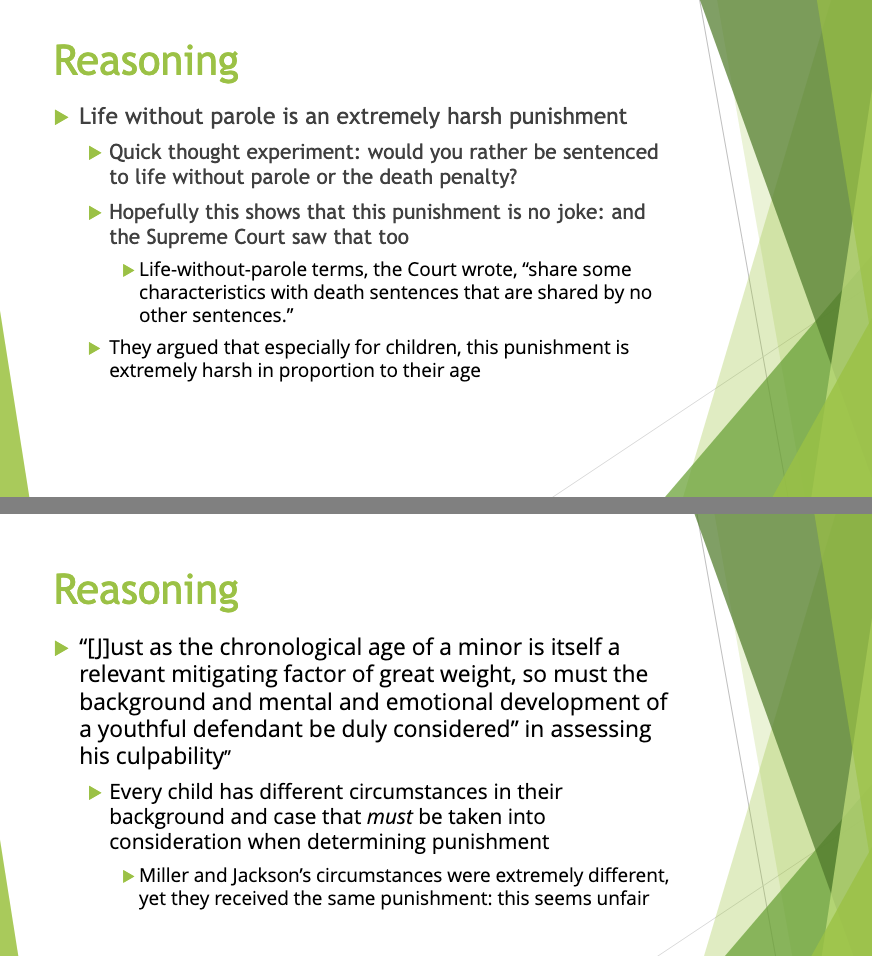
Why is life without parole an extremely harsh punishment (and what scenarios did the slide use)?

The slide frames LWOP as “no joke” using a thought experiment: LWOP vs. the death penalty to show how severe it feels. The Court saw LWOP as especially harsh for kids because it permanently removes the chance to ever rejoin society—despite youth being still-developing.

  • It highlights that LWOP is irrevocable, denying future opportunities for growth and rehabilitation, particularly for juvenile offenders who can show change.
<p>The slide frames LWOP as “no joke” using a thought experiment: <strong>LWOP vs. the death penalty</strong> to show how severe it feels. The Court saw LWOP as especially harsh for kids because it permanently removes the chance to ever rejoin society—despite youth being still-developing.</p><ul><li><p>It highlights that LWOP is irrevocable, denying future opportunities for growth and rehabilitation, particularly for juvenile offenders who can show change. </p></li></ul><p></p>
31
New cards

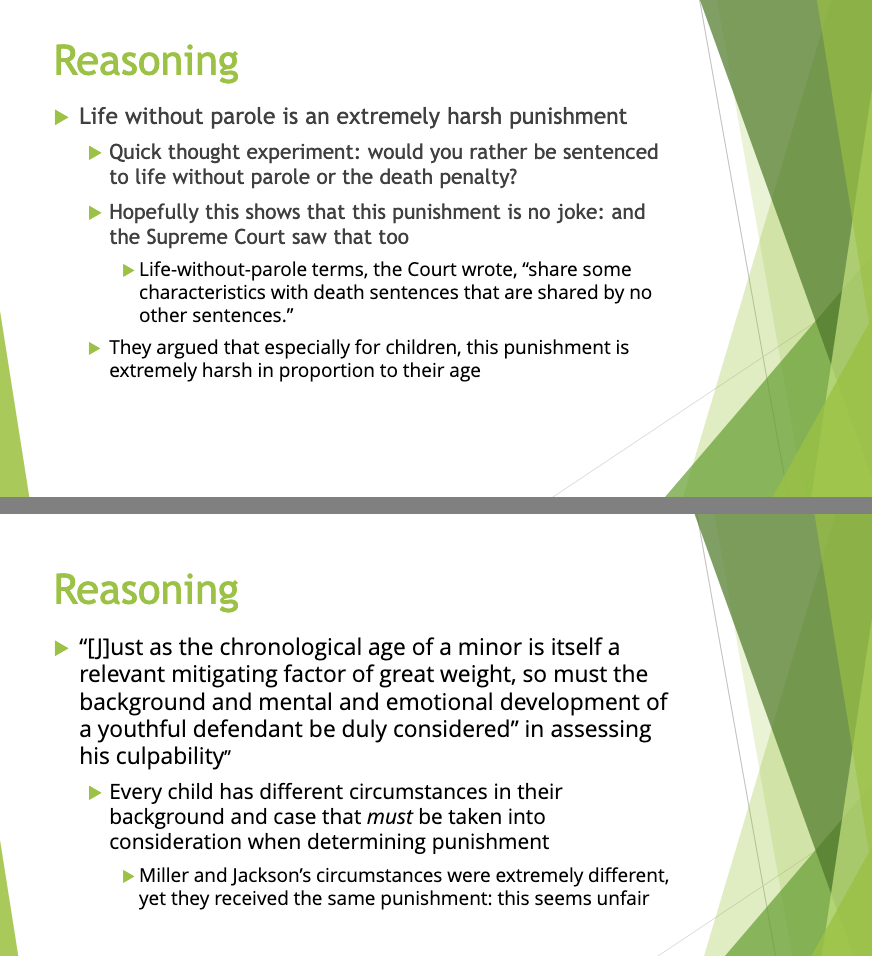
What did the Court write about life-without-parole terms, and what was argued?

The Court wrote LWOP sentences “share some characteristics with death sentences that are shared by no other sentences.” They argued this is especially harsh for children, and often disproportionate given their age and development.

  • In their opinions, the Court expressed that LWOP effectively denies juveniles the opportunity for redemption and rehabilitation, comparing its severity to that of death sentences.
<p>The Court wrote LWOP sentences <strong>“share some characteristics with death sentences that are shared by no other sentences.”</strong> They argued this is <strong>especially harsh for children</strong>, and often disproportionate given their age and development.</p><ul><li><p>In their opinions, the Court expressed that LWOP effectively denies juveniles the opportunity for redemption and rehabilitation, comparing its severity to that of death sentences. </p></li></ul><p></p>
32
New cards

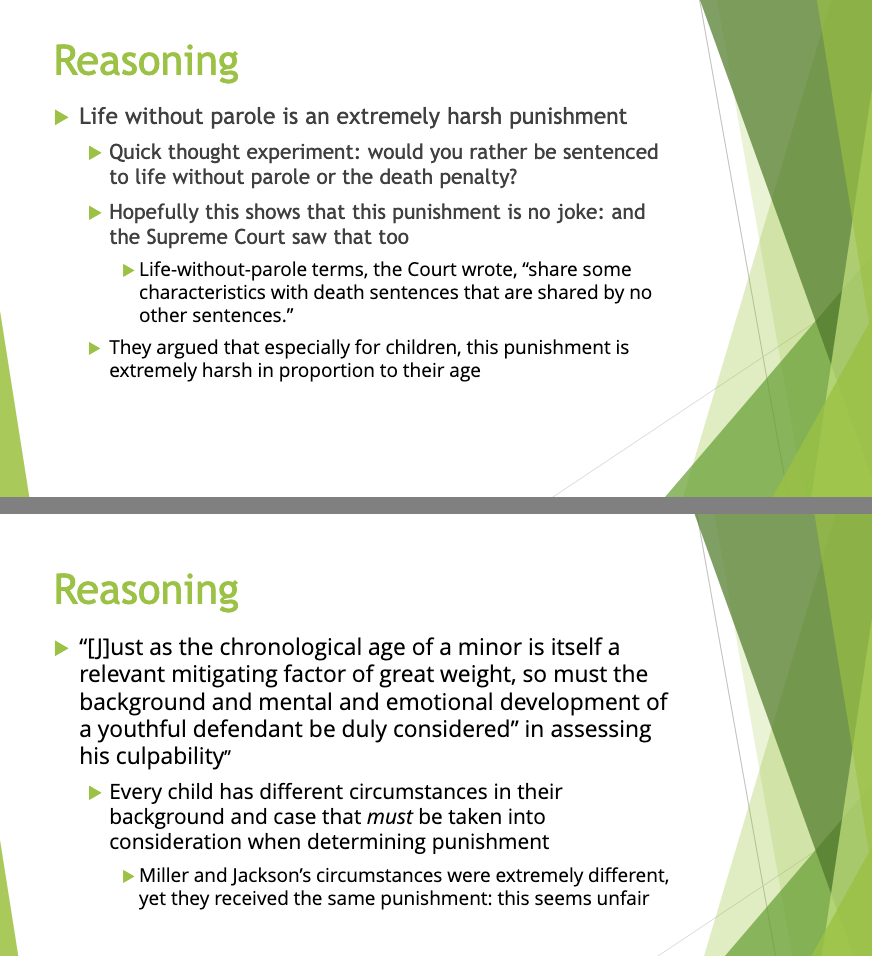
Explain “every child has different circumstances” in the Court’s reasoning.

A child’s background, family history, mental and emotional development, and the specifics of the offense can drastically affect culpability. So courts must consider these factors instead of giving automatic one-size-fits-all punishment.

  • Judges are required to evaluate individual circumstances of each juvenile offender, ensuring that each child's unique context is considered in sentencing decisions.
<p>A child’s <strong>background</strong>, <strong>family history</strong>, <strong>mental and emotional development</strong>, and the specifics of the offense can drastically affect <strong>culpability</strong>. So courts must consider these factors instead of giving automatic one-size-fits-all punishment.</p><ul><li><p>Judges are required to evaluate individual circumstances of each juvenile offender, ensuring that each child's unique context is considered in sentencing decisions. </p></li></ul><p></p>
33
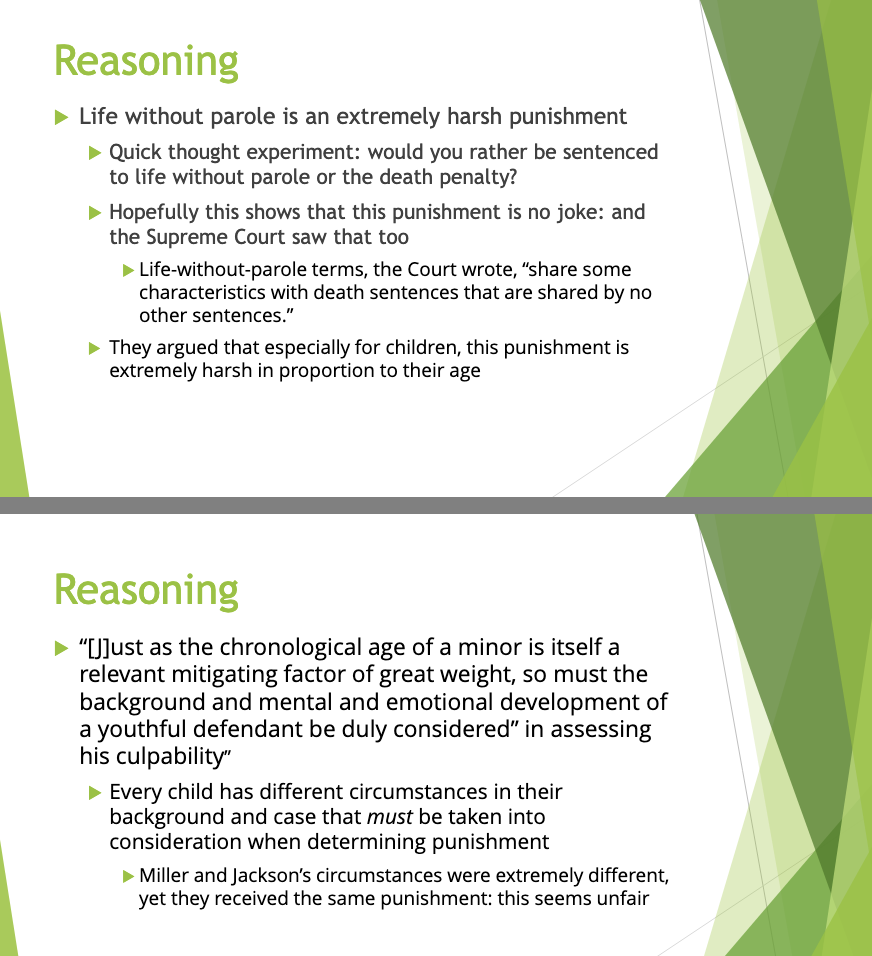
New cards

What does this quote mean? “[A]ge… is a relevant mitigating factor… so must the background and mental and emotional development of a youthful defendant be duly considered…”

It means youthfulness itself reduces blameworthiness, and courts must also weigh the juvenile’s development and life background when deciding punishment.

  • This quote emphasizes that a juvenile's age is an important factor in determining their culpability and that their unique circumstances, including emotional and mental growth, should influence sentencing decisions.
<p>It means youthfulness itself reduces blameworthiness, and courts must also weigh the juvenile’s <strong>development and life background</strong> when deciding punishment.</p><ul><li><p>This quote emphasizes that a juvenile's age is an important factor in determining their culpability and that their unique circumstances, including emotional and mental growth, should influence sentencing decisions. </p></li></ul><p></p>
34
New cards

Why did the slide say it seems unfair that Miller and Jackson got the same punishment?

Because their circumstances were extremely different, yet mandatory sentencing gave them the same LWOP punishment, which ignores individualized culpability.

  • The mandatory sentencing laws failed to account for the significant differences in their life experiences, backgrounds, and the nature of their offenses, leading to an unjust equivalence in punishment.
<p>Because <strong>their circumstances were extremely different</strong>, yet mandatory sentencing gave them <strong>the same LWOP punishment</strong>, which ignores individualized culpability.</p><ul><li><p>The mandatory sentencing laws failed to account for the significant differences in their life experiences, backgrounds, and the nature of their offenses, leading to an unjust equivalence in punishment. </p></li></ul><p></p>
35
New cards

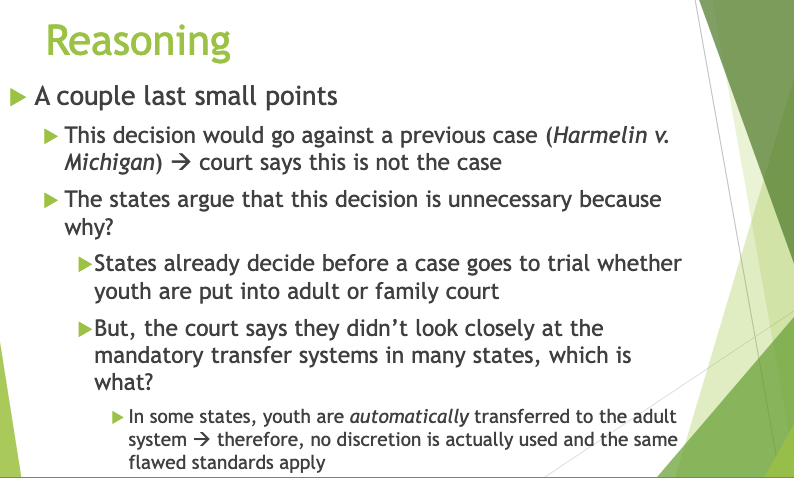
What prior case did this decision seem like it would go against?

Harmelin v. Michigan.
<p>Harmelin v. Michigan. </p>
36
New cards

What happened in Harmelin v. Michigan. ?

The Supreme Court upheld a life sentence without parole for a defendant convicted of possessing a large amount of cocaine, ruling that the sentence was not cruel and unusual punishment under the Eighth Amendment.
<p>The Supreme Court upheld a life sentence without parole for a defendant convicted of possessing a large amount of cocaine, ruling that the sentence was not cruel and unusual punishment under the Eighth Amendment. </p>
37
New cards

How did the Court argue this decision did NOT go against Harmelin v. Michigan?

The slide says the Court stated it is not the case that Miller goes against Harmelin—meaning the Court distinguished Miller (juveniles + mandatory LWOP) from whatever Harmelin addressed.

  • The Court argued that Miller addressed unique circumstances related to juvenile offenders and their capacity for rehabilitation, which were not present in Harmelin's case involving adult drug offenses.
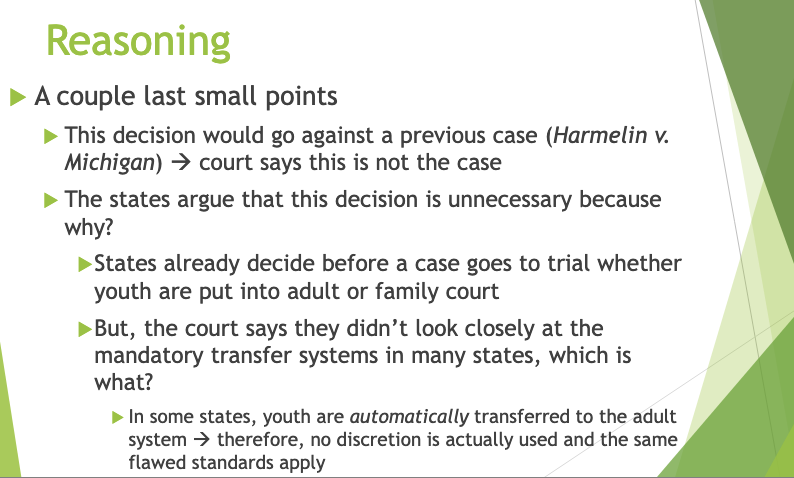
<p>The slide says the Court stated <strong>it is not the case</strong> that <em>Miller</em> goes against <em>Harmelin</em>—meaning the Court distinguished <em>Miller</em> (juveniles + mandatory LWOP) from whatever <em>Harmelin</em> addressed.</p><ul><li><p>The Court argued that Miller addressed unique circumstances related to juvenile offenders and their capacity for rehabilitation, which were not present in Harmelin's case involving adult drug offenses. </p></li></ul><p></p>
38
New cards

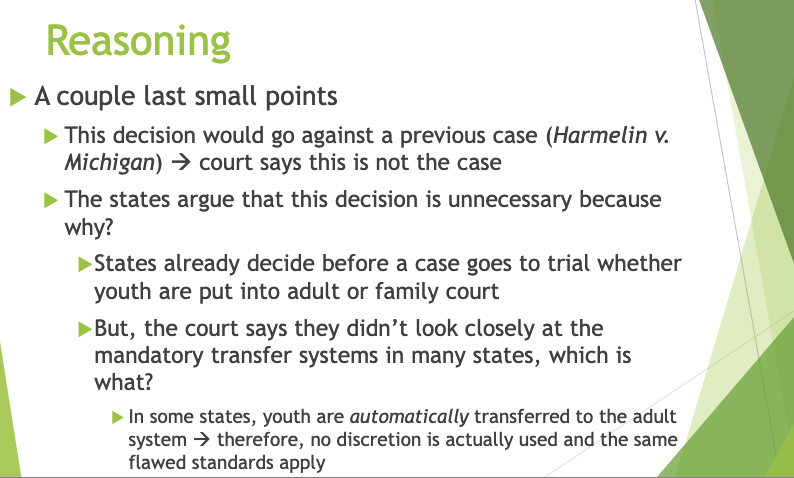
Why did the states argue this decision was unnecessary? Explain fully.

States argued it’s unnecessary because they already decide before trial whether youth are placed in adult court or family court—implying there’s already discretion built into the system. (there is no real discretion actually used by individuals).
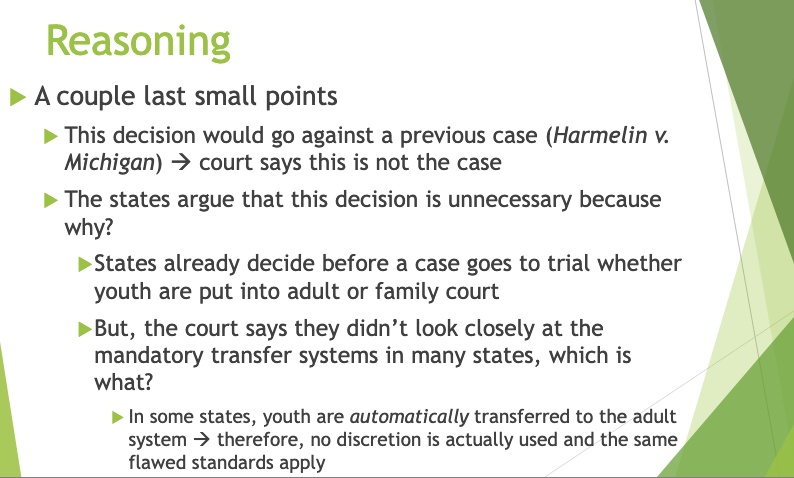
<p>States argued it’s unnecessary because they already decide <strong>before trial</strong> whether youth are placed in <strong>adult court or family court</strong>—implying there’s already discretion built into the system. (there is no real discretion actually used by individuals). </p>
39
New cards

When do states decide whether youth are put into adult court or family court?

Before a case goes to trial, states decide where the youth will be handled.

  • This decision is made during pre-trial proceedings through a process involving judicial discretion, often considering the severity of the offense and the offender's age.
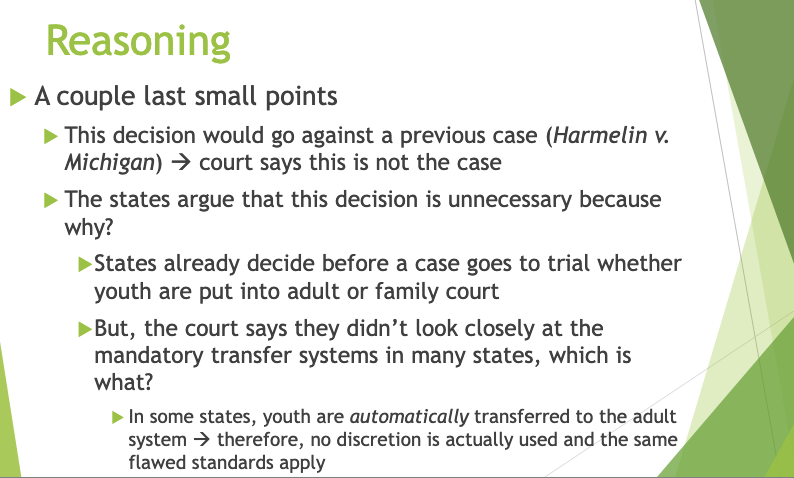
<p><strong>Before a case goes to trial</strong>, states decide where the youth will be handled.</p><ul><li><p>This decision is made during pre-trial proceedings through a process involving judicial discretion, often considering the severity of the offense and the offender's age. </p></li></ul><p></p>
40
New cards

What are mandatory transfer systems, and what do they mean for discretion?

Systems where certain youth are automatically transferred to adult court by law. That means no real discretion is used—youth are treated under adult standards automatically, which the Court criticized as flawed.

  • Mandatory transfer systems limit judicial discretion, automatically moving youth to adult court based on specific offenses or age, often disregarding individual circumstances.
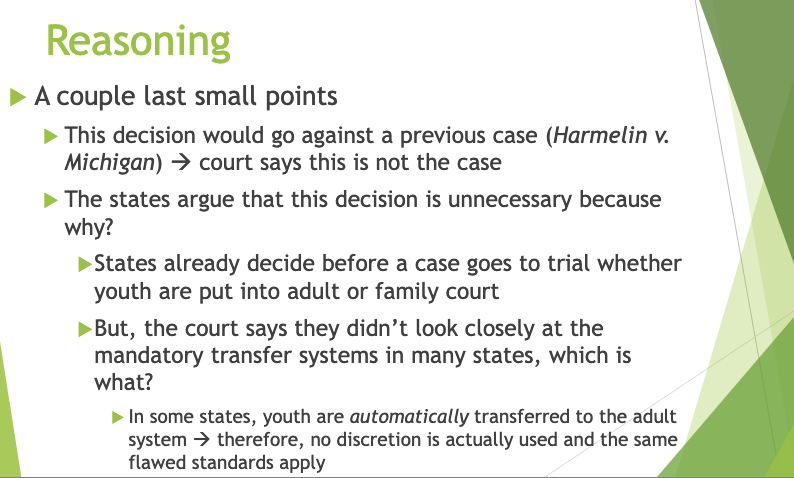
<p>Systems where certain youth are <strong>automatically transferred to adult court</strong> by law. That means <strong>no real discretion</strong> is used—youth are treated under adult standards automatically, which the Court criticized as flawed.</p><ul><li><p>Mandatory transfer systems limit judicial discretion, automatically moving youth to adult court based on specific offenses or age, often disregarding individual circumstances. </p></li></ul><p></p>
41
New cards

What is a concurrence in a Supreme Court case?

A concurrence is when a justice agrees with the outcome of the majority decision but writes separately to emphasize or add reasoning.

  • A concurrence often elaborates on legal principles, clarifies views on the case, or highlights aspects not fully addressed in the majority opinion. It can provide future guidance and insights into the justice's interpretation of the law.
<p>A concurrence is when a justice <strong>agrees with the outcome</strong> of the majority decision but writes separately to emphasize or add reasoning.</p><ul><li><p>A concurrence often elaborates on legal principles, clarifies views on the case, or highlights aspects not fully addressed in the majority opinion. It can provide future guidance and insights into the justice's interpretation of the law. </p></li></ul><p></p>
42
New cards

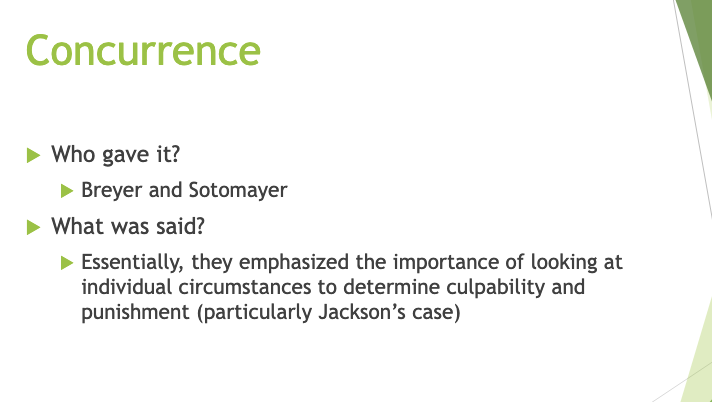
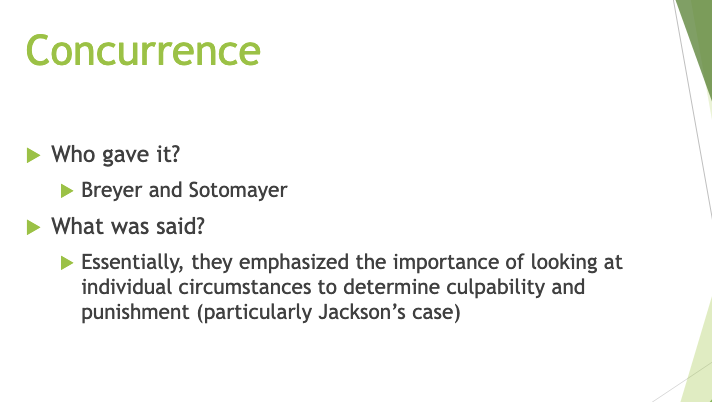
Who gave the concurrence in Miller/Jackson (2012), and what does that mean?

Breyer and Sotomayor. They agreed with the main result and wrote separately to stress the importance of individualized circumstances (especially in Jackson’s situation).

  • This means they emphasized the need for courts to consider the unique factors of each youth's case, advocating for a more nuanced approach rather than a one-size-fits-all standard.
<p><strong>Breyer and Sotomayor.</strong> They agreed with the main result and wrote separately to stress the importance of individualized circumstances (especially in Jackson’s situation).</p><ul><li><p>This means they emphasized the need for courts to consider the unique factors of each youth's case, advocating for a more nuanced approach rather than a one-size-fits-all standard. </p></li></ul><p></p>
43
New cards

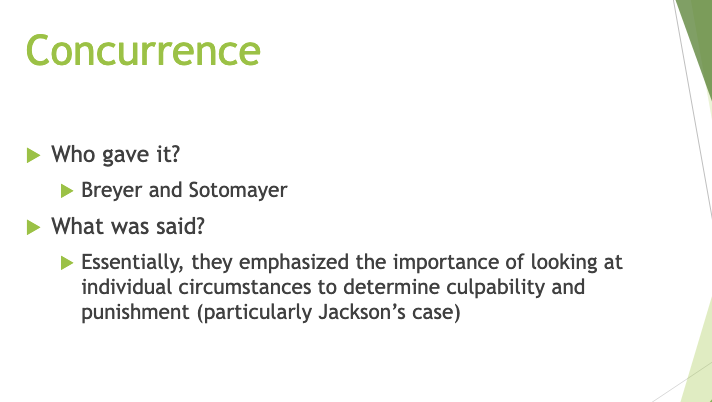
What was said in the concurrence, and what did it mean?

They emphasized the importance of looking at individual circumstances to determine culpability and punishment—particularly highlighting why Jackson’s case shows the danger of automatic LWOP.

  • This approach advocates for a more personalized evaluation in sentencing, rather than relying solely on mandatory minimums that could lead to disproportionately harsh outcomes.
<p>They emphasized the importance of looking at <strong>individual circumstances</strong> to determine culpability and punishment—particularly highlighting why Jackson’s case shows the danger of automatic LWOP.</p><ul><li><p>This approach advocates for a more personalized evaluation in sentencing, rather than relying solely on mandatory minimums that could lead to disproportionately harsh outcomes. </p></li></ul><p></p>
44
New cards

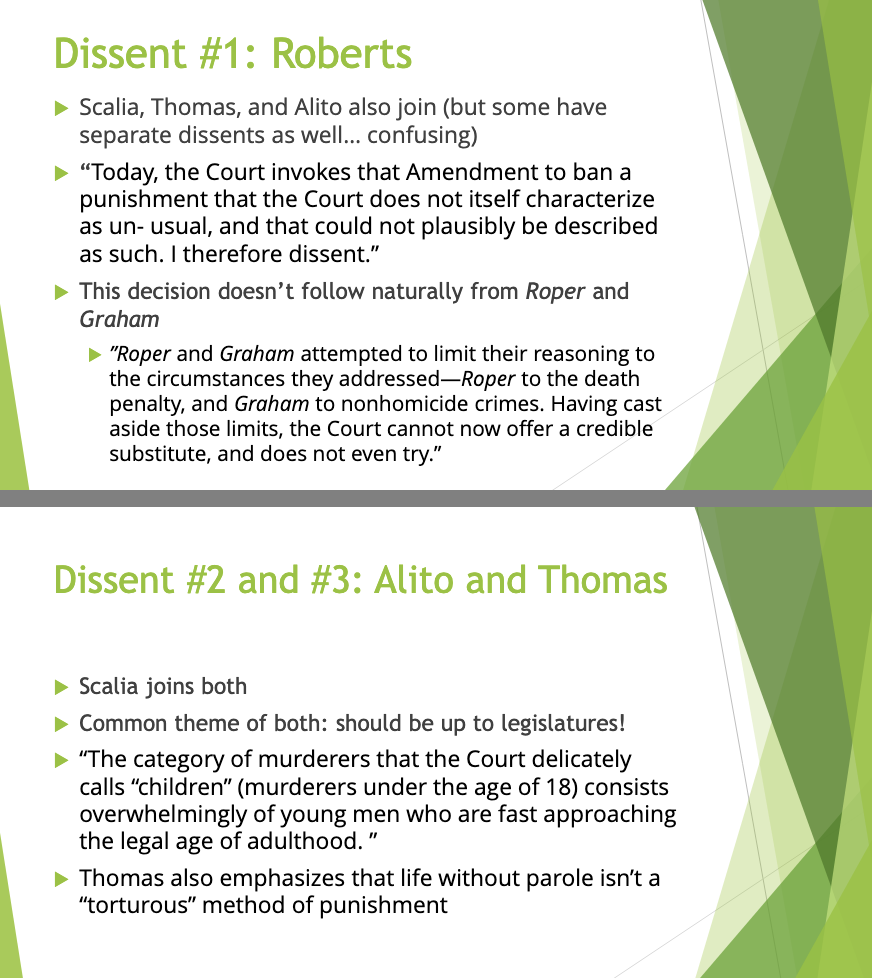
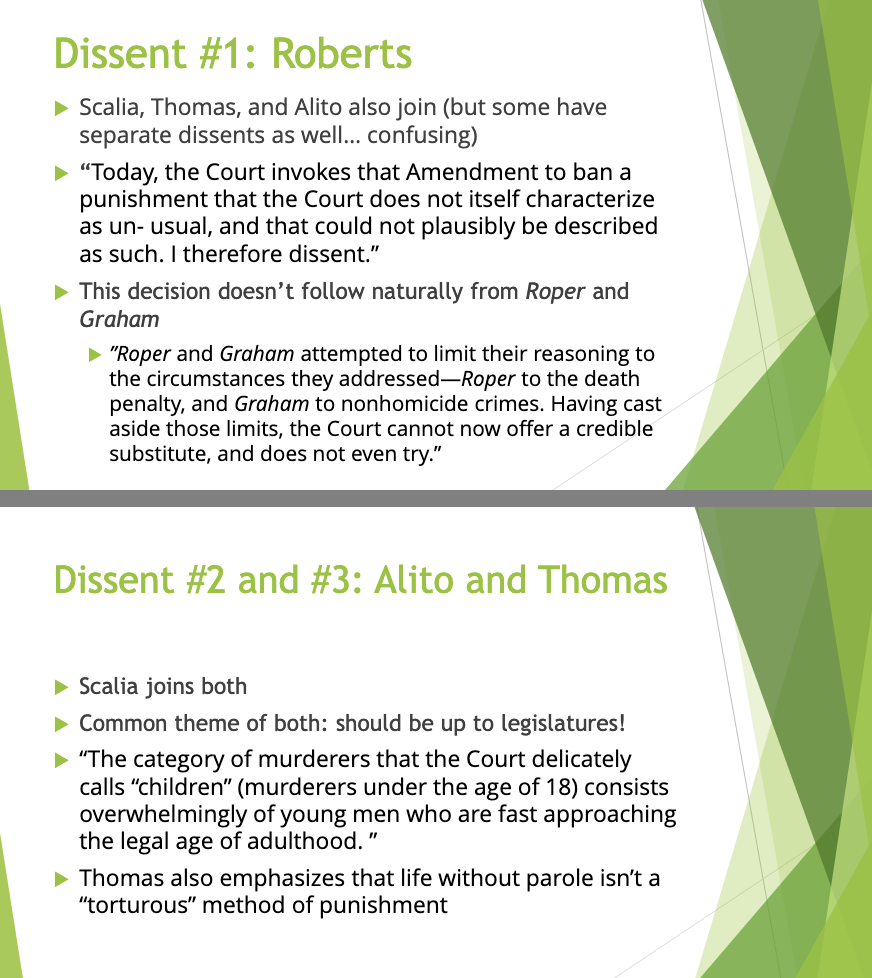
What did Chief Justice Roberts argue in Dissent #1, and what does it mean?

He argued the Court was banning a punishment that isn’t truly “unusual,” saying:

  • The Court uses the Eighth Amendment to ban something it doesn’t even call “unusual”

  • Therefore, he dissents
    Meaning: he believed the Court improperly expanded the Eighth Amendment here.

    • He argued that the Court was prohibiting a penalty that is not genuinely considered "unusual" under the Eighth Amendment, stating that the Court shouldn't classify the punishment in such a manner.
<p>He argued the Court was banning a punishment that isn’t truly “unusual,” saying:</p><ul><li><p>The Court uses the Eighth Amendment to ban something it doesn’t even call “unusual”</p></li><li><p>Therefore, he dissents<br>Meaning: he believed the Court improperly expanded the Eighth Amendment here.</p><ul><li><p>He argued that the Court was prohibiting a penalty that is not genuinely considered "unusual" under the Eighth Amendment, stating that the Court shouldn't classify the punishment in such a manner. </p></li></ul></li></ul><p></p>
45
New cards

How did Roberts argue the decision didn’t follow naturally from Roper and Graham?

He said:

  • Roper was limited to the death penalty

  • Graham was limited to nonhomicide crimes
    He argued the Court threw away those limits and didn’t offer a credible replacement principle.

    • This disregard for established limits leads to an illogical extension of the Court's rulings, which he believes undermines judicial consistency.
<p>He said:</p><ul><li><p><em>Roper</em> was limited to the <strong>death penalty</strong></p></li><li><p><em>Graham</em> was limited to <strong>nonhomicide</strong> crimes<br>He argued the Court threw away those limits and didn’t offer a credible replacement principle.</p><ul><li><p>This disregard for established limits leads to an illogical extension of the Court's rulings, which he believes undermines judicial consistency. </p></li></ul></li></ul><p></p>
46
New cards

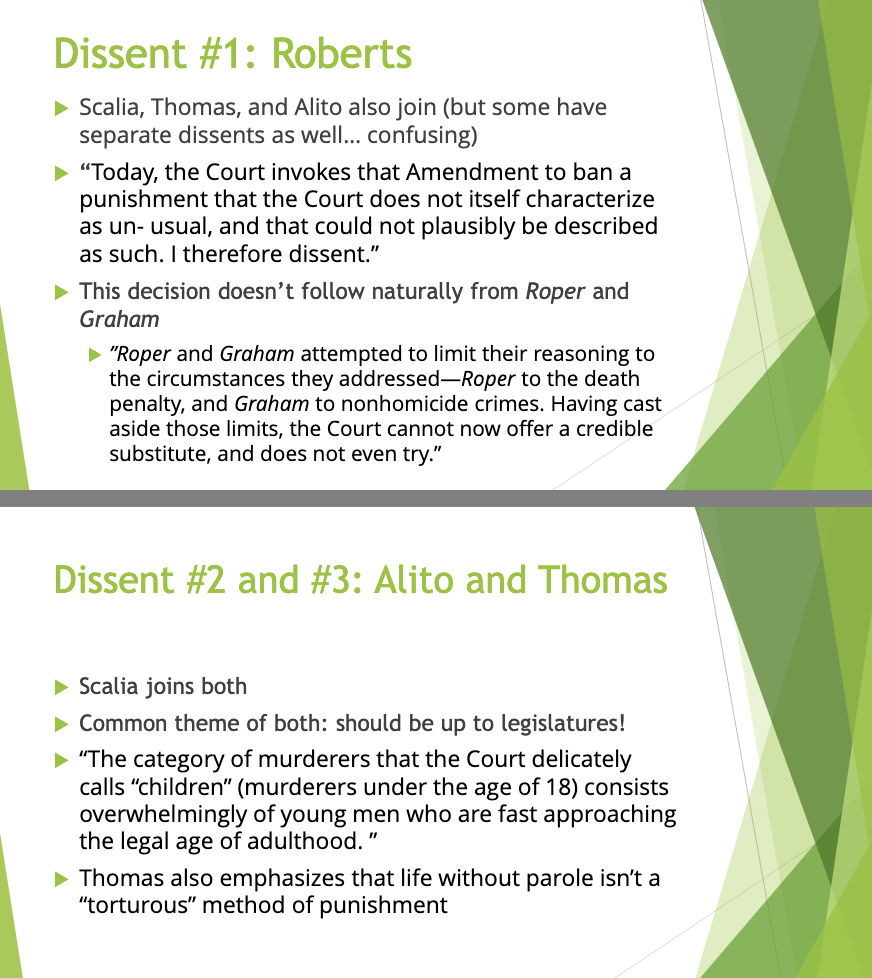
What common theme did Alito and Thomas share in their dissents?

The decision should be left to legislatures, not made by the Court (judicial overreach argument).

  • They argued that policy decisions regarding sentencing are better suited for legislative bodies and should not be determined by the judiciary, emphasizing the role of elected officials in shaping laws.
<p>The decision should be left to <strong>legislatures</strong>, not made by the Court (judicial overreach argument).</p><ul><li><p>They argued that policy decisions regarding sentencing are better suited for legislative bodies and should not be determined by the judiciary, emphasizing the role of elected officials in shaping laws. </p></li></ul><p></p>
47
New cards

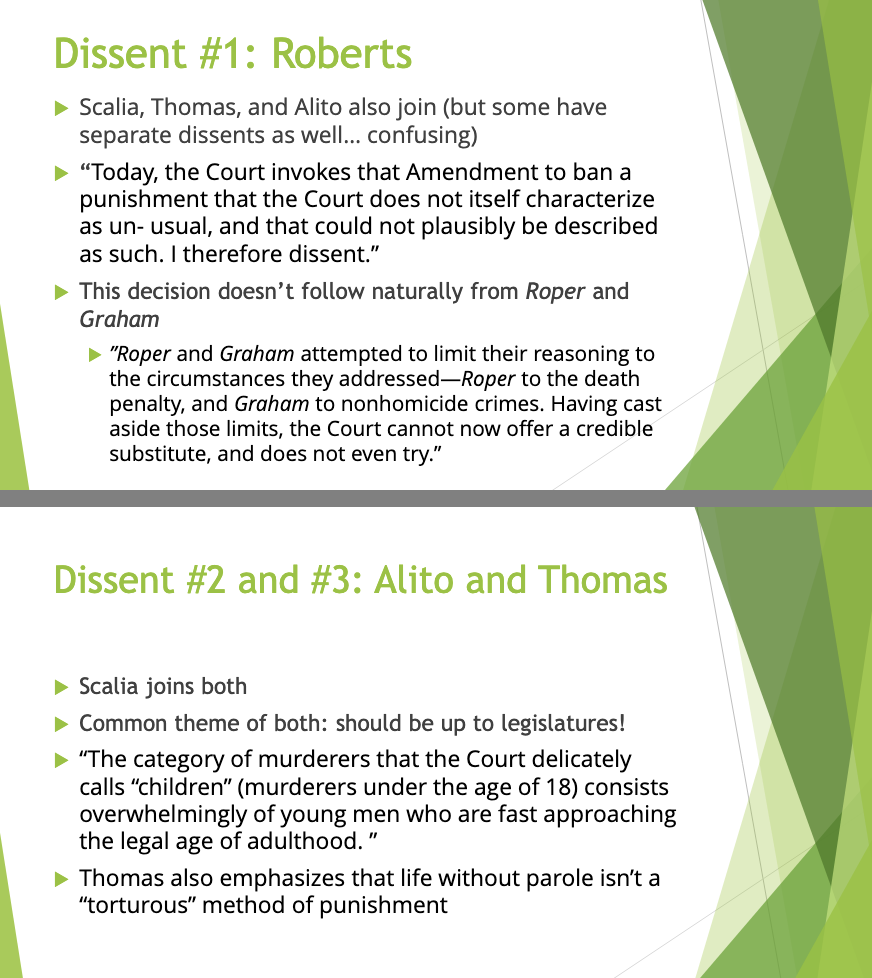
What did Alito and Thomas say about “children murderers”? Explain fully.

They emphasized that the category the Court calls “children” (murderers under 18) is overwhelmingly young men close to adulthood, implying the label “children” is misleading and that many are mature enough that legislatures should be allowed to impose severe penalties.

  • They argued that labeling murderers under 18 as "children" is deceptive, as most are young men nearing adulthood; therefore, legislatures should have the authority to impose harsher penalties based on their maturity.
<p>They emphasized that the category the Court calls “children” (murderers under 18) is overwhelmingly <strong>young men close to adulthood</strong>, implying the label “children” is misleading and that many are mature enough that legislatures should be allowed to impose severe penalties.</p><ul><li><p>They argued that labeling murderers under 18 as "children" is deceptive, as most are young men nearing adulthood; therefore, legislatures should have the authority to impose harsher penalties based on their maturity. </p></li></ul><p></p>
48
New cards

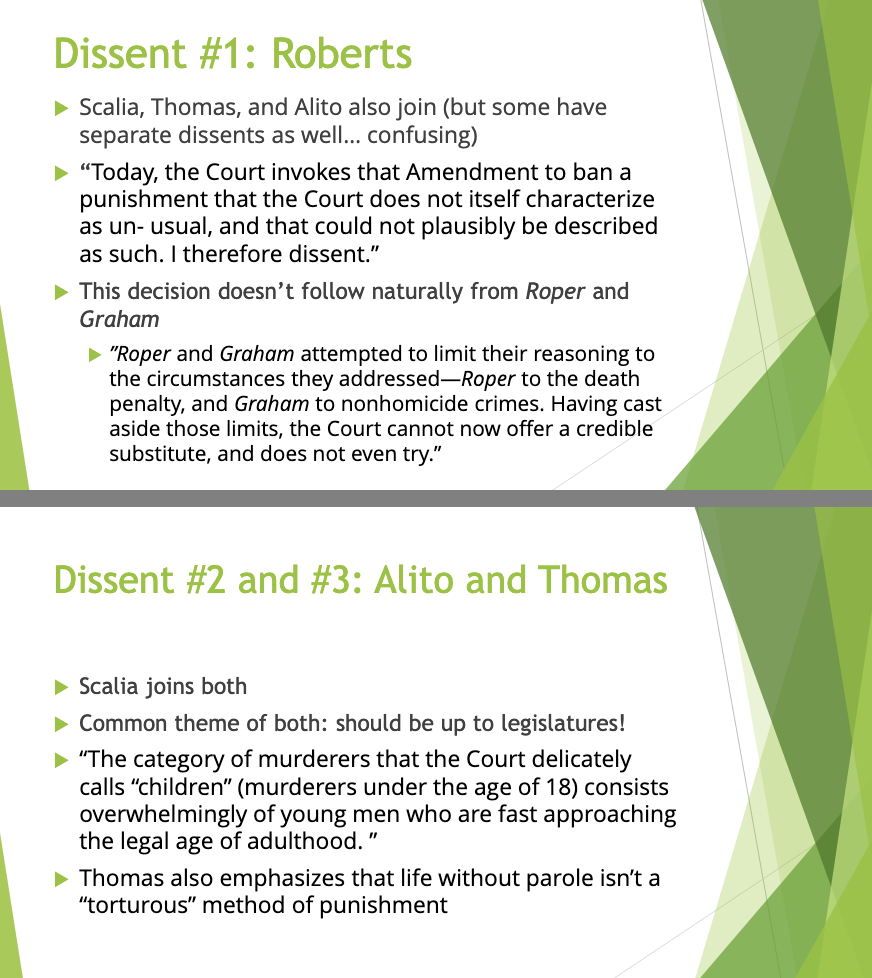
What did Thomas emphasize in Dissent #2/#3 about life without parole?

He emphasized that LWOP is not a “torturous” method of punishment—arguing it doesn’t fit the kind of cruelty the Eighth Amendment was meant to prohibit.

  • He argued that life without parole (LWOP) serves as a legitimate punishment, as it does not amount to torture or inhumane treatment that the Eighth Amendment seeks to prevent.
<p>He emphasized that LWOP is not a <strong>“torturous”</strong> method of punishment—arguing it doesn’t fit the kind of cruelty the Eighth Amendment was meant to prohibit.</p><ul><li><p>He argued that life without parole (LWOP) serves as a legitimate punishment, as it does not amount to torture or inhumane treatment that the Eighth Amendment seeks to prevent. </p></li></ul><p></p>
49
New cards

What were the overall important takeaways from Miller/Jackson (2012)?

  • Mandatory LWOP is different from LWOP in general

  • The Court is moving away from punishment for kids (toward more individualized/rehab-aware reasoning)

  • Every child and circumstance is different, so courts must consider those differences

The decisions in Miller and Jackson (2012) underscore the distinction between mandatory life without parole (LWOP) sentences and discretionary LWOP, highlighting a shift towards rehabilitation and individualized consideration in juvenile sentencing. The Court emphasizes that each child's circumstances are unique and must be taken into account during sentencing, reflecting a growing awareness of developmental differences among youth.
<ul><li><p><strong>Mandatory</strong> LWOP is different from LWOP in general</p></li><li><p>The Court is moving away from punishment for kids (toward more individualized/rehab-aware reasoning)</p></li><li><p>Every child and circumstance is different, so courts must consider those differences</p></li></ul><p>The decisions in Miller and Jackson (2012) underscore the distinction between mandatory life without parole (LWOP) sentences and discretionary LWOP, highlighting a shift towards rehabilitation and individualized consideration in juvenile sentencing. The Court emphasizes that each child's circumstances are unique and must be taken into account during sentencing, reflecting a growing awareness of developmental differences among youth. </p><p></p>
50
New cards

How is mandatory life without parole different from life without parole in general?

Mandatory LWOP is automatic—law forces it, no discretion. LWOP in general could still be imposed, but only after a court considers individual circumstances and decides it’s appropriate.

  • Mandatory LWOP is imposed by law without the possibility of discretion, whereas general LWOP allows courts to consider each case's specific circumstances before imposing a life sentence.
<p><strong>Mandatory LWOP</strong> is automatic—law forces it, no discretion. <strong>LWOP in general</strong> could still be imposed, but only after a court considers <strong>individual circumstances</strong> and decides it’s appropriate.</p><ul><li><p>Mandatory LWOP is imposed by law without the possibility of discretion, whereas general LWOP allows courts to consider each case's specific circumstances before imposing a life sentence. </p></li></ul><p></p>
51
New cards

How did Miller/Jackson solidify that the Court is moving away from punishment (especially for kids)?

It rejected one-size-fits-all extreme sentencing for juveniles and required courts to consider youthfulness and circumstances—showing a shift toward proportionality and individualized treatment rather than automatic harsh punishment.

  • This case set a precedent for ensuring that juvenile sentencing reflects the developmental differences of youth, emphasizing rehabilitation over strict punishment.
<p>It rejected one-size-fits-all extreme sentencing for juveniles and required courts to consider youthfulness and circumstances—showing a shift toward <strong>proportionality and individualized treatment</strong> rather than automatic harsh punishment.</p><ul><li><p>This case set a precedent for ensuring that juvenile sentencing reflects the developmental differences of youth, emphasizing rehabilitation over strict punishment. </p></li></ul><p></p>
52
New cards

What did the Miller/Jackson decision emphasize most?

That every child and circumstance is different, and those factors must be taken into account when courts decide serious punishments for youth.

  • The Miller/Jackson decision emphasized the need for individualized consideration in sentencing, reflecting the unique circumstances of each child.
<p>That <strong>every child and circumstance is different</strong>, and those factors must be taken into account when courts decide serious punishments for youth.</p><ul><li><p>The Miller/Jackson decision emphasized the need for individualized consideration in sentencing, reflecting the unique circumstances of each child. </p></li></ul><p></p>

Explore top notes

note
Chapter 16: The Judiciary
Updated 1033d ago
0.0(0)
note
AP Chemistry Ultimate Guide
Updated 81d ago
0.0(0)
note
Invisible Man Chapter 15
Updated 1186d ago
0.0(0)
note
war of the worlds characters
Updated 47d ago
0.0(0)
note
Unit 3 - Cellular Energetic
Updated 1082d ago
0.0(0)
note
Early Childhood: Health and Safety
Updated 1170d ago
0.0(0)
note
Chapter 16: The Judiciary
Updated 1033d ago
0.0(0)
note
AP Chemistry Ultimate Guide
Updated 81d ago
0.0(0)
note
Invisible Man Chapter 15
Updated 1186d ago
0.0(0)
note
war of the worlds characters
Updated 47d ago
0.0(0)
note
Unit 3 - Cellular Energetic
Updated 1082d ago
0.0(0)
note
Early Childhood: Health and Safety
Updated 1170d ago
0.0(0)

Explore top flashcards

flashcards
Species Cards 1-20
20
Updated 1226d ago
0.0(0)
flashcards
progressive era
23
Updated 545d ago
0.0(0)
flashcards
APUSH Easy Test Unit 7
29
Updated 892d ago
0.0(0)
flashcards
western civ test 1
100
Updated 570d ago
0.0(0)
flashcards
REL A 250 Final Questions
132
Updated 712d ago
0.0(0)
flashcards
Biology Final Review
143
Updated 341d ago
0.0(0)
flashcards
The Book Thief Vocab Words
47
Updated 111d ago
0.0(0)
flashcards
mikrobiologi inför duggan
58
Updated 1224d ago
0.0(0)
flashcards
Species Cards 1-20
20
Updated 1226d ago
0.0(0)
flashcards
progressive era
23
Updated 545d ago
0.0(0)
flashcards
APUSH Easy Test Unit 7
29
Updated 892d ago
0.0(0)
flashcards
western civ test 1
100
Updated 570d ago
0.0(0)
flashcards
REL A 250 Final Questions
132
Updated 712d ago
0.0(0)
flashcards
Biology Final Review
143
Updated 341d ago
0.0(0)
flashcards
The Book Thief Vocab Words
47
Updated 111d ago
0.0(0)
flashcards
mikrobiologi inför duggan
58
Updated 1224d ago
0.0(0)



