Elastic Potential Energy
 Studied by 0 people
 Call Kai
 Learn
Learn Practice Test
 Spaced Repetition
 Match
Match Flashcards
 Knowt Play
1/13

There's no tags or description
Looks like no tags are added yet.
Name | Mastery | Learn | Test | Matching | Spaced | Call with Kai |
|---|
No analytics yet
Send a link to your students to track their progress
14 Terms
The work done in stretching a material is equal to the:
Force applied multiplied by the extension created
The area under a force-extension graph is equal to the:
Work done to stretch the material
Draw a force-extension graph that obeys Hooke’s law:
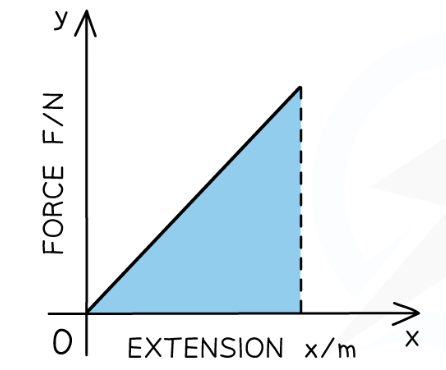

What is work done equal to?
1/2Fx
Draw a force-extension graph that does not obey Hooke’s law:
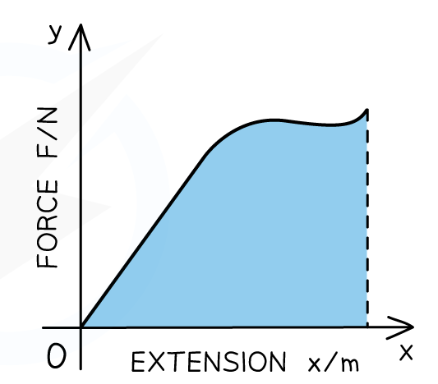
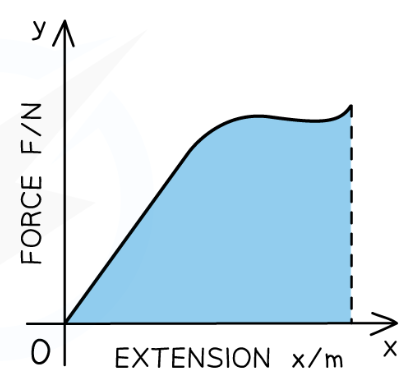
What is work done equal to?
Area under graph
Elastic potential energy is defined as the:
Energy stored within a material when it is stretched or compressed
The elastic potential energy for a material deformed within its limit of proportionality is found from the:
Area under force-extension graph
When a material demonstrates elastic potential up to the limit of proportionality, work done is equal to:
Elastic potential energy stored in material
When a material demonstrates elastic potential up to the limit of proportionality, elastic potential energy stored in material is equal to:
Work done
When is work done equal to elastic potential energy stored in material?
When it demonstrates elastic behavior up to limit of proportionality
If a material obeys Hooke’s Law (within limit of proportionality), the elastic potential energy and work done can be calculated using the following equation:
Work done = EPE = 1/2Fx
Equation for elastic potential energy in terms of spring constant k:
EPE = 1/2kx², where k= spring constant (N/m) and x= extension (m)
Why is EPE = 1/2kx²
EPE=1/2Fx, and F=kx
 Note
Note  Flashcards (57)