Lecture 10 Pain Systems
 Call Kai
 Learn
Learn Practice Test
 Spaced Repetition
 Match
Match Flashcards
 Knowt Play
1/75

There's no tags or description
Looks like no tags are added yet.
Name | Mastery | Learn | Test | Matching | Spaced | Call with Kai |
|---|
No analytics yet
Send a link to your students to track their progress
76 Terms
pain is a ___ feeling often caused by ___
distressing
intense or damaging stimuli
pain motivates you to
withdraw from a damaging situation
what are the two types of pain?
somatic and visceral
somatic pain is pleasant/unpleasant?
both
visceral pain is pleasant/unpleasant?
unpleasant
somatic pain is caused by
touch
temperature
cutting
ischemia
inflammation
visceral pain is caused by
ischemia
inflammation
distension/stretching
cramping
visceral pain is not elicited by ___, ___, or ___
squeezing
burning
cutting
free nerve ending is a(n) ___, ___ ___ ___ that sends its signal to a ___ ___
unspecified
afferent nerve fiber
sensory neuron
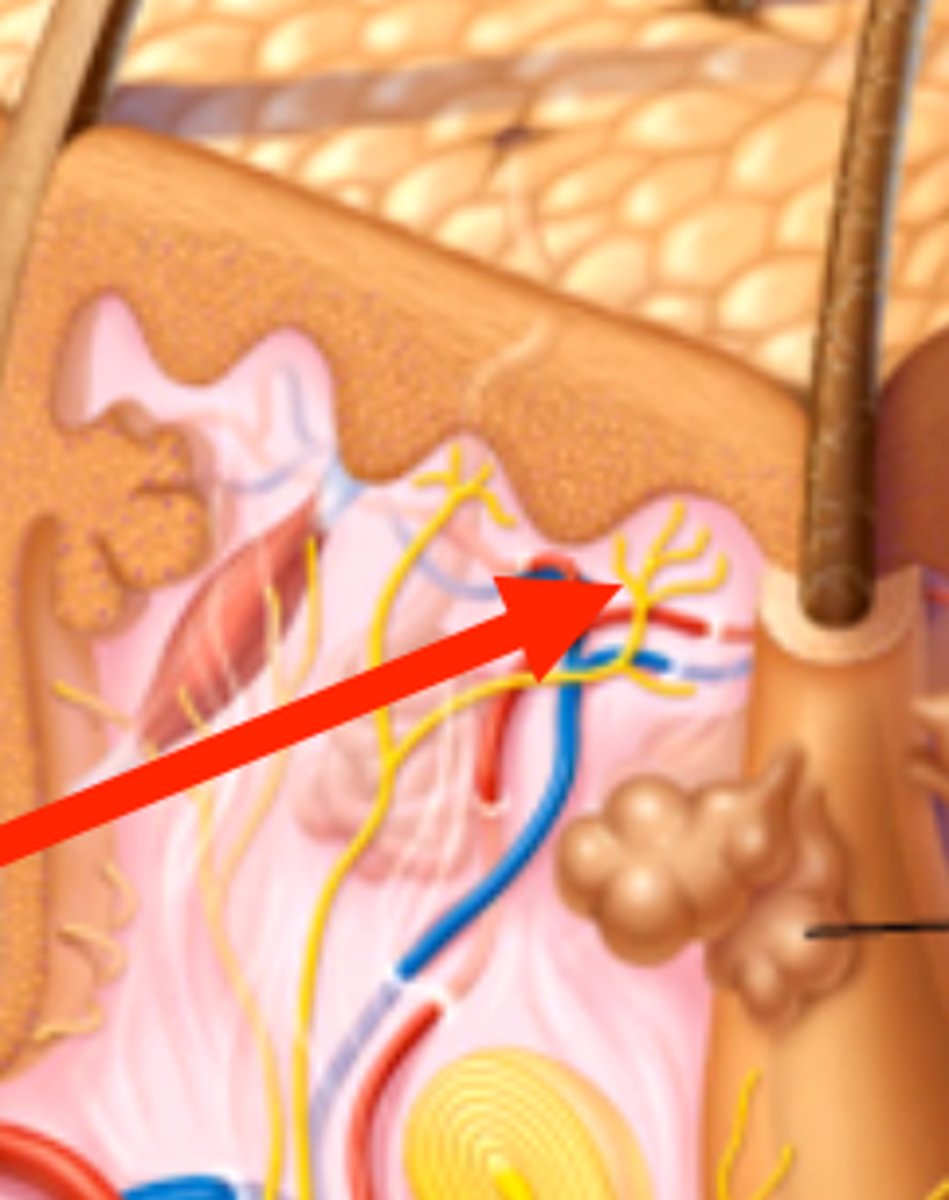
free nerve endings are also called
cutaneous nociceptors
most abundant type of nerve endings
free nerve endings
nociceptors are ___ receptors
pain
nociceptors are found in
any area of the body that can sense noxious stimuli either externally or internally
nausea, vomiting is what type of pain?
visceral
cutaneous means
related to skin
four major processes of pain
1. transduction/conduction
2. transmission
3. modulation
4. perception
transduction/conduction
tissue damaging stimuli activate nerve endings
stimuli that can activate pain include
mechanical (pressure, pinch)
heat
chemical
transmission
relay of message from site of injury to brain regions involved with perception
modulation
the brain can reduce or increase activity in the transmission system
why do we shake our hand when we jam our finger?
increasing peripheral sensory input inhibits the pain gate
perception
subjective awareness produced by sensory signals
neuroanatomical reasons why people's perception of pain differs lies in what process of pain?
modulation
pain pathway in CNS is unique because it has
both ascending and descending pathways
the cell bodies of the primary afferent pain neurons from the ___, ___, and ___ are located in the ___ and ___ respectively
dorsal root ganglia (DRG)
trigeminal nerve (CN V)
free nerve endings arise from ___ and ___, which are scattered together
A delta fibers
unmyelinated C fibers
A delta neurons are what group
III
C neurons are what group
IV
A delta neurons carry ___ or ___ and are ___myelinated
sharp pain
cool/cold info
thinly
C neurons carry ___, are the ___ axons and are ___myelinate
dull pain, deep pain, crude touch, or warm/hot info
smallest different
un(myelinated)
3 major types of pain
nociceptive
neuropathic
nociplastic "other"
nociceptive pain involves
- damage to body tissues
- radicular (back and hip), somatic, visceral
most common type of pain
nocicpetive
neuropathic pain involves
- damage to nerves that transfer info b/t brain and spinal cord
- burning sensaiton, sensitive, numbness
- cancer, surgery, viral infections
nociplastic pain involves
- altered process of pain-related pathways
- "unknown"
- chronic pain
sharp, stinging pain sensation carried fast by A delta fibers. pain is precisely located and of short duration "fast pain"
pricking pain
pricking pain is mainly
nociceptive
caused by inflammation, burned skin, etc. Carries by C fibers (slowly conducted). diffuse, slower to onset, and longer in duration
burning (soreness) pain
burning (soreness) pain is mainly
nociceptive
arises mainly from viscera and somatic deep structures. not distinctly localized and carries by C fibers
aching pain
aching pain is mostly
neuropathic, nociplastic
decussate means
cross over
spinothalamic tract (1-3rd order neuron pathway)
- 1st order comes from body, comes in via afferent fiber to dorsal horn
- synapses with 2nd order in dorsal horn
- 2nd order decussates at level of spinal cord and out through ventral horn
- synapses with 3rd order at thalamus
- 3rd order terminates at somatosensory cortex
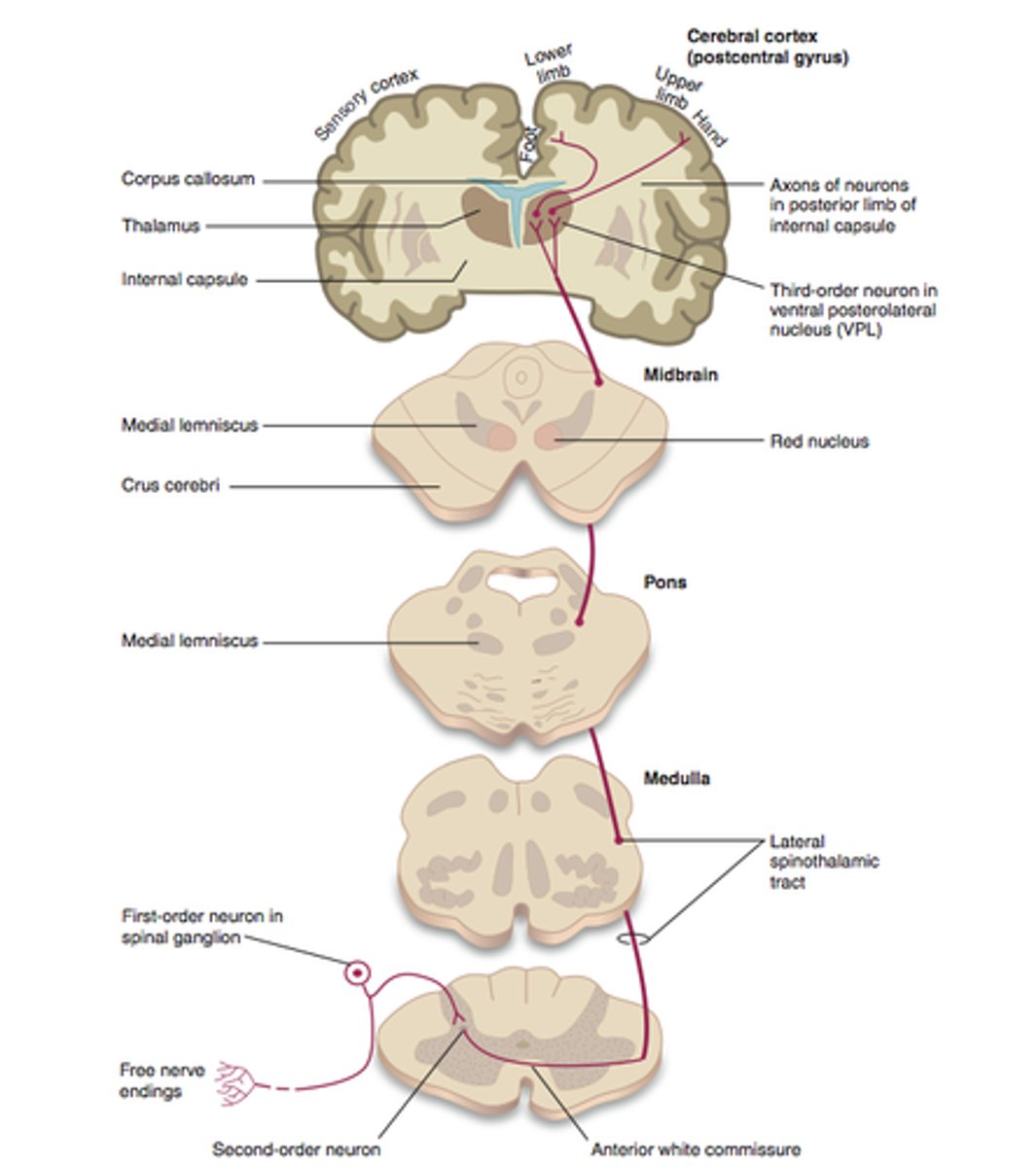
spinoreticular/spinomesencephalic tract (1-3rd order neuron pathway)
- 1st order comes from body, comes in via afferent fiber to dorsal horn
- synapses with 2nd order in dorsal horn
- 2nd order decussates at level of spinal cord and out through ventral horn
- 2nd order terminates at brainstem/reticular formation
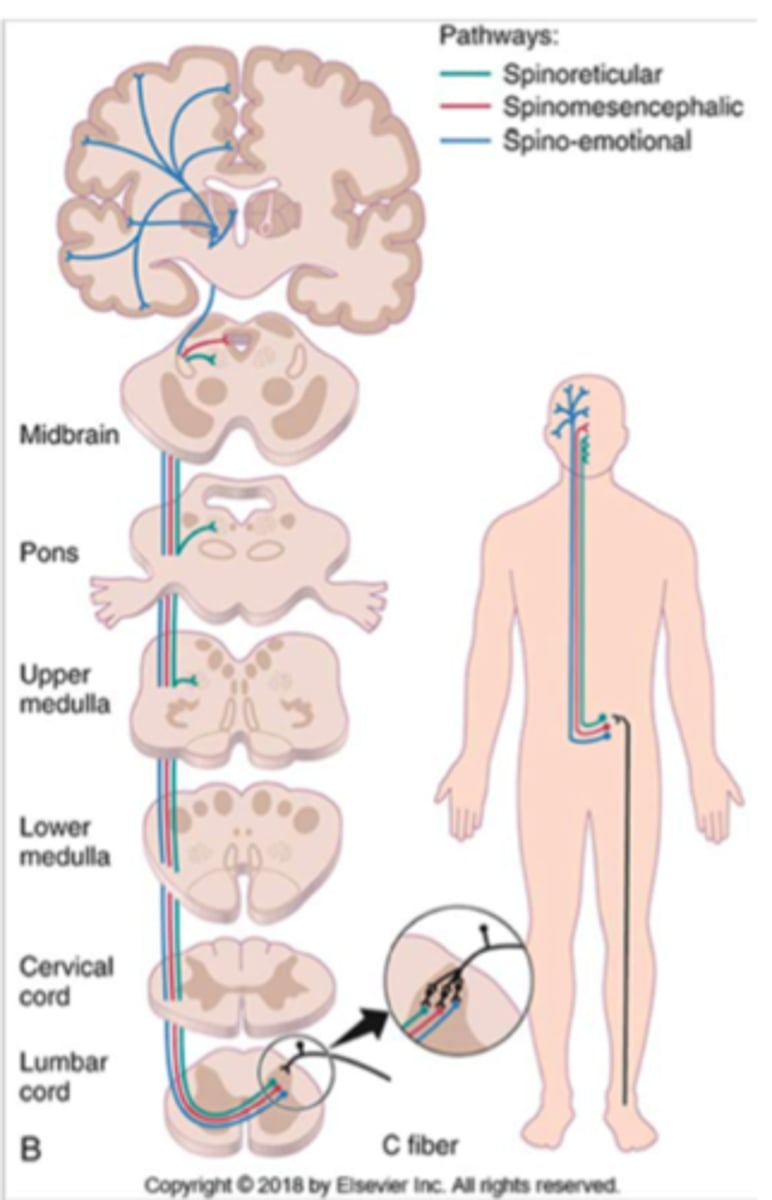
which tract is involved with burning, throbbing, long-lasting pain?
spinoreticular/spinomesencephalic tract
ascending pain pathways = ___ system
anterolateral
what three tracts make up the anterolateral system?
spinothalamic
spinoreticular
spinomesencephalic
which tract conveys pain, temperature, and crude touch
spinothalamic
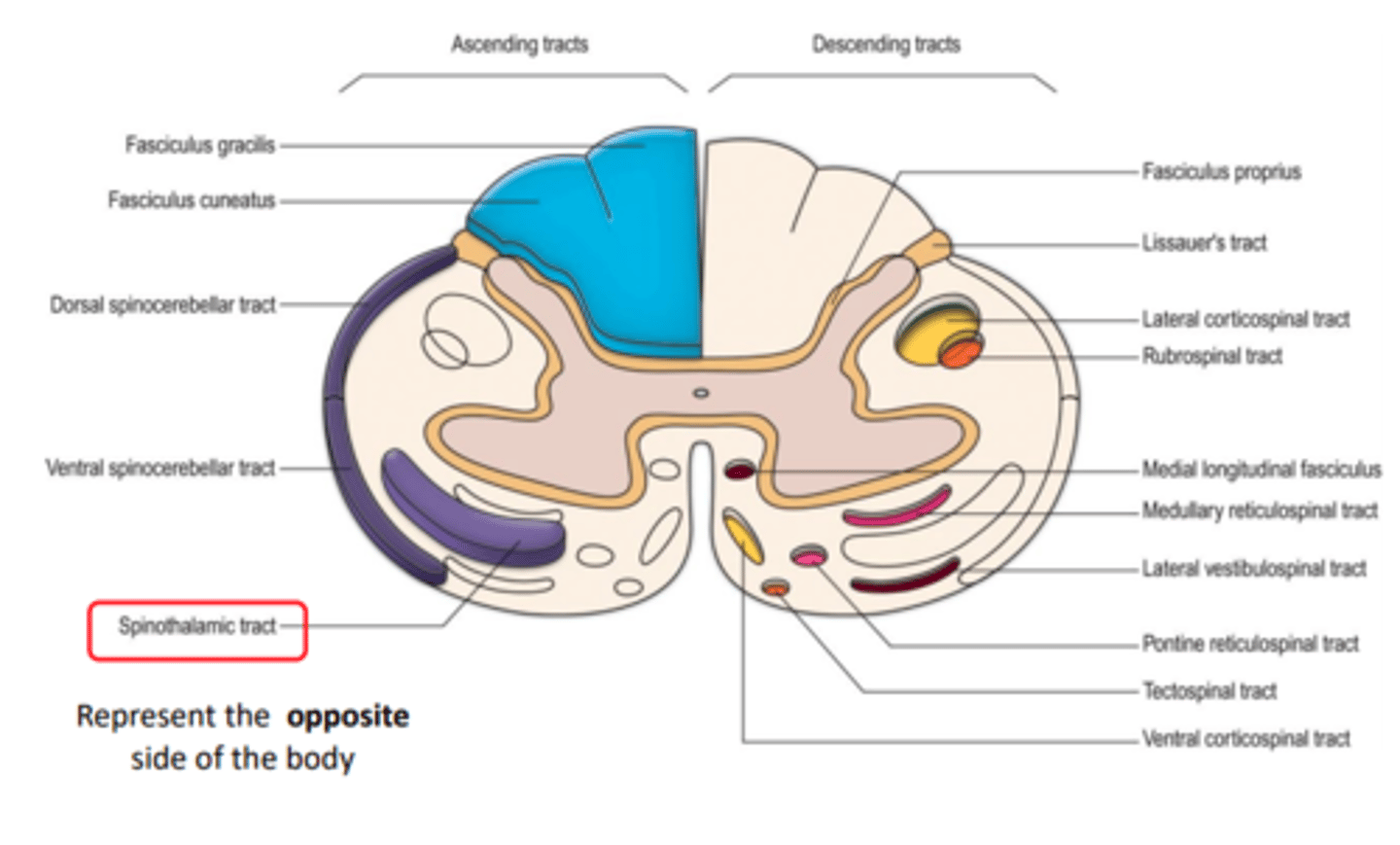
some aspects of touch are carried by both the ___ and the ___
dorsal column
spinothalamic tract
which tract is involved with fast, localizing pain?
spinothalamic
reticular formation is a set of
interconnected nuclei located throughout the brainstem
what tract is involved with "deep" pain and pain modulation
spinoreticular
reticular formation serves as a
major integration and relay center for many brain functions
reticular formation is involved with
arousal, consciousness, pain
spinoreticular tract axons terminate in
(brainstem) medulla and pons
third order neurons of spinoreticular tract project to the
thalamus
spinomesencephalic tract terminates in the
periaqueductal gray (PAG)
periaqueductal function
release of endorphins or other natural analgesics that can suppress pain signals at level of spinal cord
descending inhibition refers to the ability of
activation in various brain areas to attenuate spinal (or trigeminal) dorsal horn neuronal responses to peripheral stimuli, most commonly applied with noxious stimuli
___ and ___ contain high concentrations of opioid receptors and endogenous opioids
midbrain
rostral medulla
descending pathways project to the ___ and ___ pain transmission
dorsal horn
inhibit
descending inhibition lower the ___ and changes how your ___ responds to pain
number of pain signals your body sends to your brain
brain
gate control theory of pain: activation of nerves that...
do not transmit pain interfere with large pain fibers
activation of nerves in gate control theory excites the ___ neurons which ___ the transmission of pain info via ___ or ___
inhibitory
diminishes
mechanical stimulation
release of natural opioids
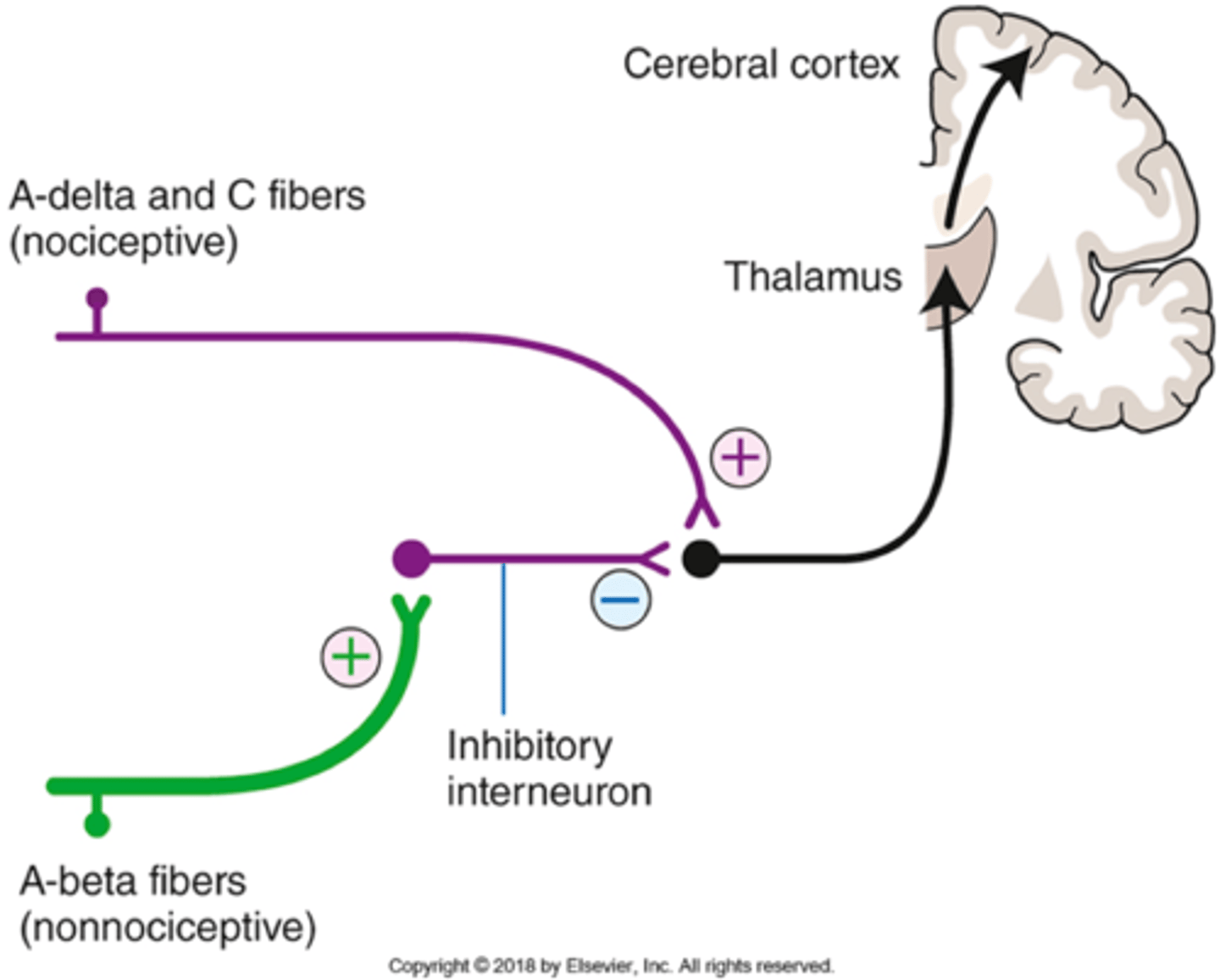
gate control takes place in
substantia gelatinosa region of dorsal horn
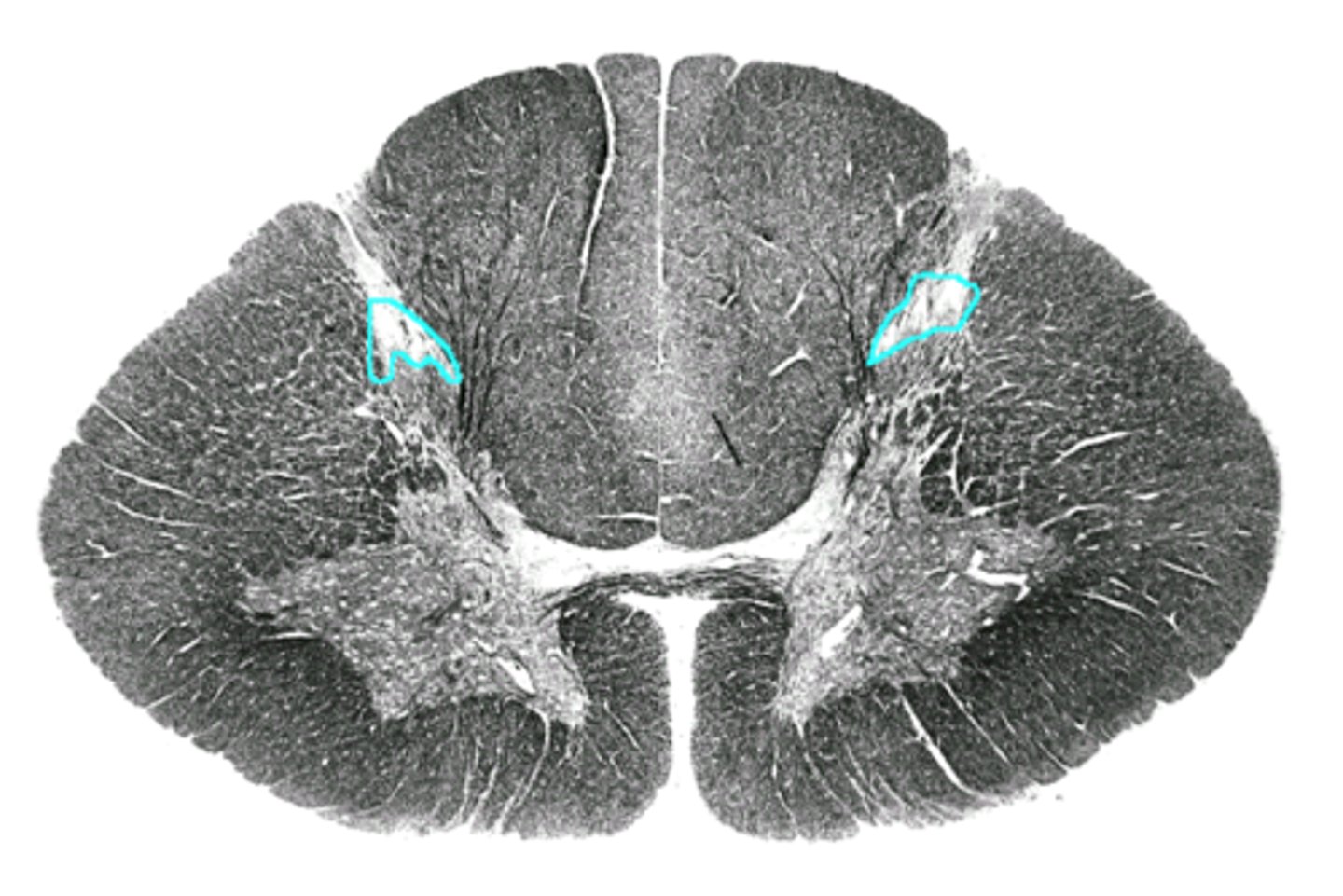
when first order neurons are excited, they excite the ___ and inhibit the ___
2nd order neuron
inhibitory interneuron
non-painful signals are transduced via
A-beta fibers
A-beta fibers are activated by
non-painful signals such as skin rubbing, hot/cold packs
activation of A-beta fibers leads to
reactivation of inhibitory interneuron
endorphins released from the brain reduce transmission of pain by
1. preventing release of neurotransmitter pre-synaptically (1st order neuron)
2. inhibiting action potentials post-synaptically (2nd order neuron)
referred pain occurs due to the
convergence of different afferents onto the same dorsal horn neurons in the spinal cord
physiological processes that enhance and lead to chronic pain
sensitization (repeated stimuli leads to thresholds decreasing)
hyperactivity of the sympathetic nervous system
acute vs chronic pain
acute pain
- activation of nociceptors for limited time
- not associated with significant tissue damage
chronic pain
- prolonged pain lasting for months or longer
- arises from tissue injury, inflammation, nerve damage, tumor growth, lesion, or occlusion of blood vessels
phantom pain
the experience of pain w/o any signals from nociceptors
phantom pain typically relates to
a limb or an organ that is not physically part of the body
characteristics of phantom pain
- remaining cut ends of nerves grow nodules called neuromas
- overactive spinal neurons
- abnormal somatosensory cortex activation
- burst firing thalamus neurons

