Psych 2AA3.
 Studied by 10 people
 Call Kai
 Learn
Learn Practice Test
 Spaced Repetition
 Match
Match Flashcards
 Knowt Play
1/270

There's no tags or description
Looks like no tags are added yet.
Name | Mastery | Learn | Test | Matching | Spaced | Call with Kai |
|---|
No analytics yet
Send a link to your students to track their progress
271 Terms
Perspectives on child development
1. Biological
2. Psychodynamic
3. Learning
4. Cognitive
5. Contextual
Biological Perspective
- Psychological dev is a consequence of biological maturation of body & controlled by DNA (nativism)
- environment does NOT play a factor in child dev
Psychodynamic perspective
- Sigmund Freud: focus on unconscious
- Erikson's psychosocial theory: dev is driven by resolving social challenges
Learning Perspective
- Children are blank slates are learning determines their outcome
- Skinner & Watson
- Behaviour explained by paired associations b/w stimuli & response
- Classical + operant conditioning
- Rewards & punishments
Cognitive Perspective
- how intellectual capacity / thinking develops
- Piaget (stages of cognitive dev)
- informational processing theories
Contexual Perspective
- Dynamic interaction b/w child & others
- Vygotsky's theory of dev (through social interactions)
Scientific Method
1. Observation
2. Form hypothesis
3. Test hypothesis
4, Gather data
5. Draw a conclusion (interpret data)
*requires critical thinking
Measuring children's behaviour
- Observations (naturalistic, structured (lab setting))
- Experiments (relationship b/w 2 variables)
How to measure the dependent variable in an experiment
- sampling a behaviour
- self-report (ask what they think)
- physiological measures (HR, cortisol, etc.)
Experimental Designs
- correlational (evaluate rel b/w 2 naturally existing variables)
- developmental designs (longitudinal & cross-sectional)
Longitudinal vs cross-sectional design
- Longitudinal: same people followed across time
- Cross-sectional: people of different ages viewed at the same time
longitudinal design advantages
- same individuals measured (variables consistent across measurements, addresses individual differences)
- expensive & time-consuming
longitudinal design disadvantages
- practice effect
- selective attrition
- cohort effects (ex: covid cohort)
cross-sectional study advantages
- saves time
- saves money
- most common in dev studies (efficient)
- if large enough sample, individual differences cancel out
cross-sectional study disadvantages
- cohort effect
- lack of continuity in sample
Longitudinal Sequential Design
- Begin with cross-sectional study, continue with same individuals longitudinally
- continuity across individuals, less prone to selective attrition & cohort effects
Ethological Theory (part of biological perspective)
views development from an evolutionary perspective (inherit adaptive behaviours and learning can occur but only at certain stages)
Critical period (part of ethnological theory)
Time when a specific type of learning can take place; before or after the critical period the same learning is difficult or even impossible
Erikson's Psychosocial Theory (definition)
development consists of a sequence of stages, each defined by a unique crisis or challenge
Erikson's Psychosocial Theory- birth to 1 year
Basic trust of caregiver or mistrust
-Child looks towards the primary caregiver for stability and consistency of care
Erikson's Psychosocial Theory - 1-3 years
Autonomy versus shame and self doubt
-children are focussed on developing a sense of personal control or physical skills and a sense of independence
Erikson's Psychosocial Theory- 3-6
Initiative versus guilt
-The child is regularly interacting with other children please provide children with the opportunity to explore their interpersonal skills through initiating activities
Erikson's Psychosocial Theory- 6-teens
Industry versus inferiority
-The child now feels the need to win approval by demonstrating specific competencies that are valued by society and begin to develop a sense of pride in their accomplishments
Erikson's Psychosocial Theory- Adolescence
Identity versus identity confusion
-Child searches for a sense of self and personality identity through an intense exploration A personal values beliefs and goals
Erikson's Psychosocial Theory- Young adulthood
Intimacy versus isolation
Erikson's Psychosocial Theory- middle adulthood
Generativity versus stagnation
Erikson's Psychosocial Theory- late life
Integrity versus despair
Operant conditioning-positive reinforcement
Reward good behaviour
Increases likelihood of reoccurrence
Operant conditioning - negative reinforcement
Taking away a negative when child starts engaging in good behaviour
Increases likelihood of reoccurrence
Operant conditioning - positive punishment
Negative consequence after undesired behaviour to decrease likelihood in future
Operant conditioning - negative punishment
Removing a desired stimulus after undesired behaviour to decrease likelihood in future
Observational learning (part of learning perspective)
Children can learn by watching people around them
Bandura's Bobo doll (observational learning)
Children observed an adult hitting a blowup doll
Only some children spontaneously imitated behaviour (more likely if the adult appeared to be smart and talented)
All children could repeat behaviours on command
self-efficacy (part of learning perspective)
Beliefs about on abilities and talents dictates how much children relate to others and imitate that behaviour
Cognitive developmental perspective
- Children's thinking changes as they grow
- Jean Piaget: children try to make sense of the world
- Create theories about physical and social world
- Revise their theories often and radically
Brofenbrenner's Ecological Systems Theory (definition)
Individuals in the middle and is directly and indirectly affected by many systems
Five systems: microsystem, mesosystem, Exosystem, macrosystem and Chronosystem
Microsystem (Bronfenbrenner)
People and objects in an individual's immediate environment (Family)
Mesosystem (Bronfenbrenner)
Microsystems affecting one another (school might affect neighborhood; neighbourhood might affect home)
Exosystem (Bronfenbrenner)
Social systems that a child might not experience firsthand (parents workplace)
Macrosystem (Bronfenbrenner)
Cultures and subcultures in which the other systems are embedded (culture of mothers coworker, cultures of students teacher)
Chronosystem (Bronfenbrenner)
Systems are always in flux within the microsystem (sister might leave for University, or mother has a new coworker)
Themes in child development
Continuity, nature versus nurture, the active child, links between domains of development
Continuous vs discontinuous development
Continuous: once a child starts on a certain trajectory, they stay on that path throughout life
Discontinuous: early behaviours and situations never predict later development
Active and passive child
Passive child: at mercy to their environment
Active child: actively influences their own development through their unique individual characteristics
Links between domains of development
Each domain have impacts on one another but not necessarily at the same time
Genes
- smallest unit of biochemical instructions found in DNA
- each chromosome consists of 1 DNA molecule
- less than 1% accounts for individual differences (99% same)
Genotype
genetic makeup (sum of all genes a person has)
Allele
Different versions of a gene
Phenotype
visible traits
Sickle cell anaemia
- from homozygous recessive alleles
- heterozygous phenotype: sickle-cell trait (carrier)
- Incomplete dominance: dominant alleles do not always dominate recessive alleles completely
Sickle cell trait
- Heterozygous for sickle cell anaemia
- Most asymptomatic
- Mild form of the disease with hypoxia
Down Syndrome (Trisomy 21)
- extra chromosome 21
- distinct facial features
- mental & motor delays
- Often from egg (mother)
- Likelihood of passing on extra chromosome 21 increases with mothers age (age 20: 1/1000, age 40: 1/50)
Evolutionary theory
- evolution
- natural selection
- heritability
Natural selection
environmental conditions allow some members of species to survive & pass on genes to future generations, while others do not, env selects hereditary traits that improve survival
Evolution
- process of change in gene frequencies over many generations
- does NOT act on individuals
- does NOT act on traits that are not hereditary (passed on gen-gen)
Polygenetic inheritance
- most traits determined by multiple genes (+ their interactions with env)
- leads to a normal distribution
Evolutionary theory in child development (behaviours that have changed across generations)
- selected traits may be maximally adaptive at each stage of dev
- Ex: infant's poor visual acuity (so there is no sensory overload)
Heritability
- proportion of variation among individuals that we can attribute to genes
- index 0-1 (0: none of the variance is due to genetics, 1: all variance is due to genetics)
- greater variability in env -> less heritability
When environment constant, but differences are observed, heritability is
high (genetics is driving the difference)
When environment changes, & differences are observed, heritability is
low (environment drives some of the difference)
How do genes & environment interact?
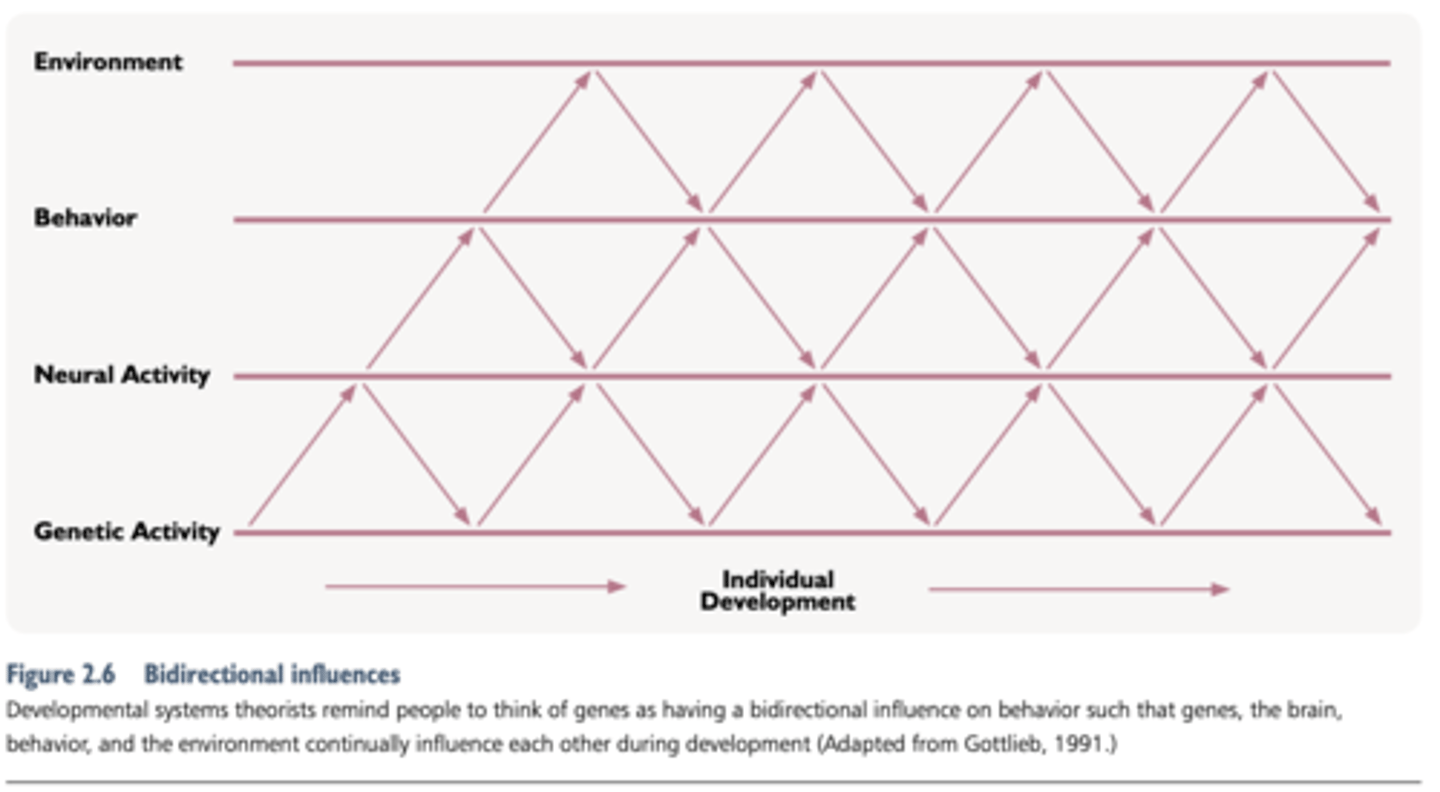
1. Developmental Systems Theory
2. Gene to Environment Theory
*complementary theories, describe different aspects of development
Developmental Systems Theory
- Development from reciprocal interactions b/w individual & their environment
- Interaction at 4 levels: environment, behaviour, neural activity, genetic activity
- genetics & environment interact through this mechanisms
Epigenetics
- functional change in genome that doesn't involve alteration in DNA sequence (i.e. gene expression)
- experience modifies chemistry of gene activity, leading to changes in behaviour
- ex: lizard exposed to snake has offspring with longer tails, larger, & more reactive
HG vs LG pups
HG: lower stress response, become HG moms
LG: higher stress response, become LG moms
HG & LG moms with adopted offspring
Same
HG: lower stress response, become HG moms
LG: higher stress response, become LG moms
Conclusion of HG/LG mice study
Environment > Genetics
Methylation
turns OFF gene expression
Methylation & stress response
- methylation: silences gene for creating receptors, poor stress regulation
- demethylation: allows receptor formation, better stress regulation
Environment -> Genetic activity in HG/LG mice study (effects of methylation on stress)
- birth: equal methylation in HG & LG pups
- day 6: demethylation of receptor-creating genes in HG pups only (better stress regulation)
HG/LG mice study + second variable (human handling)
- handling of pups (tactile stimulation) increases cortisol receptors & behaviourally increases frequency of maternal grooming
- LG handled pups had high receptor formation
- non-handled pups had lower receptor formation
Apply dynamic systems theory to HG/LG mice study
- Environment: presence of human handling
- Behaviour: being groomed by mom
- Neural: brain processes tactile (+ other) sensations
- Genetic: demethylation of genes
- Neural: more cortisol receptors
- Behaviour: better stress regulation, become HG moms
Gene to Environment Theory
- 3 types of genotype-environment effects: passive, evocative, active (not mutually exclusive)
Passive gene-environment effect
- genetically related parents provide rearing environment
- child's family shares genetically determined abilities and interests
- stronger earlier in life
Evocative gene-environment effect
- children's genotype causes them to act in a way that evokes certain responses from those around them
- child elicits response from others
- ex: smily baby, smile back, adults are happy people
Active gene-environment effect
- genotype influences types of environments the child selects
- stronger later in life
Breast-feeding & IQ
- breast fed babies had higher IQs as children, adolescents, & adults (FAs in human breast milk foster brain dev)
- BUT, alleles (C) on gene determined whether breast fed babies had higher IQ
- therefore, genetics matter!
- BUT, not enough to recommend one or the other
Conduct disorder
- children/adolescents who consistently break rules or violate others' rights
- more common in boys
- early onset (
Effect on environment - Conduct disorder
- higher maltreatment group had higher conduct disorder %
- therefore, environment matters
- BUT, not all maltreated children dev disorder, & not all with disorder were maltreated
- maltreatment significantly impacts dev in people with low MAOA gene (metabolizes NE, serotonin, dopamine)
- high MAOA mediates effects of maltreatment on later antisocial behaviour
- therefore, genetic disposition may impact environment
Steps of prenatal brain development
1. Formation of neural tube
2. Neurogenesis
3. Migration
4. Differentiation
5. Cell & synaptic pruning
prenatal brain development - formation of neural tube
- folding/closing of neural plate (becomes spinal cord)
- 18-24 days after conception
- location on plate determines what cell will become (peripheral vs central)
- failure to properly close causes birth defects (spina bifida)
prenatal brain development - neurogenesis
- neurons form in a region of neural tube
- occurs 10-28 weeks after conception
- at peak: 4000 neurons/s
- no neurons after birth (except in hippocampus)
prenatal brain development - migration
- neurons move to permanent location via glial cells
- by 7 months after conception
- faulty migration associated with neural disorders (epilepsy, cerebral palsy)
prenatal brain development - differentiation
- neurons become larger, form dendrites & axons
- specialize
- synaptogenesis begins
- myelination (inc conduction velocity, dec signal leakage)
When does myelination occur
some prenatally + early in infancy to adulthood
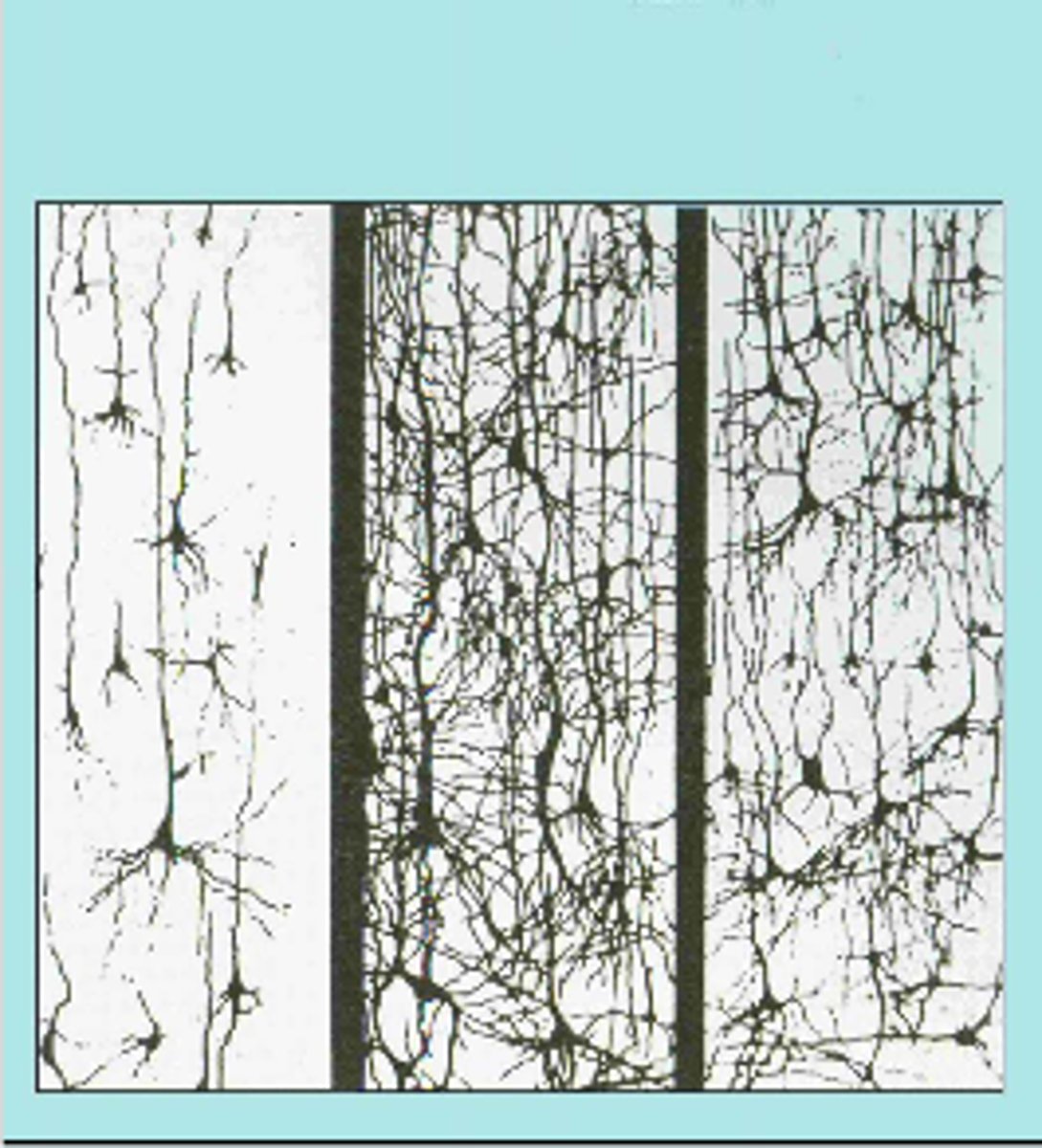
prenatal brain development - cell & synaptic pruning
- removal of neurons & synapses not being used
- to increase efficiency of brain
- use it or lose it
- continues into adulthood
prenatal hearing
- cannot hear words
- at 16 weeks gestation, fetus can perceive sound outside womb through fluid-filled ears
- no evidence to suggest reading to baby stimulates brain development
- prenatal experience is not necessary for auditory development
prenatal hearing - can moms encourage bilingualism?
- Moms may be able to encourage bilingualism
- Sounds shape brain dev & will predispose children to learn those languages
- familiarity
hearing development in children with deaf parents
- no evidence that hearing of deaf parents experience language delay
- after birth, 5-10 hours a week of exposure to spoken sounds is sufficient to dev normal hearing
- newborns of deaf have same preferences as newborns of hearing parents (infant-directed speech)
- prenatal experience is not necessary for auditory development
Prenatal hearing & familiarity study (Dr Seuss reading)
- mothers read Dr Seuss out loud while pregnant
- after birth, newborns controlled sucking to hear Dr Seuss more than other book
- preferred moms voice over a different voice (no pref for dads)
- fetus can only hear through amniotic fluid, likely only hears moms voice internally
Prenatal taste study with carrot juice
- women planning on breast-feeding assigned to: (1) 300mL carrot juice 3 weeks before birth, (2) 300mL water before birth & carrot juice after birth, or (3) 300mL water 3 weeks before birth
- when solid foods started (~6m), babies given cereal made of water or carrot juice
- results: babies with prenatal or after birth exposure to carrot juice showed less negative expressions with carrot cereal, enjoyed more, & no difference in control group
- also showed that infants memory can last as long as 6 months!
Direct observation prenatal taste study
- 4D scans of facial movements
- moms given: (1) carrot-flavour capsule, (2) kale-flavoured capsule (bitter), or (3) no capsule
- results: kale flavour showed unpleasant facial expressions, carrot flavour showed happy facial expressions
Sex linked genetic disorders
A mutation that occurs on the sex chromosomes
Klinefelter's syndrome (XXY)
- 1 in 500-1000 male births
- Tall, small testicles, sterile, below average intelligence, enlarged breasts, broad hips
Turner Syndrome (XO)
- 1 in 2500-5000 female births
- short, limited development of secondary sex characteristics, problems perceiving spatial relations
XXX Syndrome (Metafemale)
One in 500-1200 female births
Delayed motor and language development, average intelligence and regular growth
polygenic inheritance
Combined activity of many separate genes
Results in behavioural traits
Most all around average (follows a normal distribution)
Eg. intelligence
monozygotic twins
identical twins formed when one zygote splits into two
100% the same DNA
Dizygotic twins
Two separate eggs fertilized by two separate sperm, 50% same DNA
twin studies
Same environments, similar development
Compare which twins are more like:
If monozygotic twins are more like trait is likely inherited
adoption studies
Comparing child scores with biological and adoptive parents
Who is more similar
 Note
Note  Flashcards (118)