Challenge and change-test 1
 Call Kai
 Learn
Learn Practice Test
 Spaced Repetition
 Match
Match Flashcards
 Knowt Play
1/79

There's no tags or description
Looks like no tags are added yet.
Name | Mastery | Learn | Test | Matching | Spaced | Call with Kai |
|---|
No analytics yet
Send a link to your students to track their progress
80 Terms
What do psychologists look at?
How individuals act + think
Psychoanalysis- include the concept, what are the parts of the unconscious mind (and describe each)
Concept: Unconscious vs conscious mind- unconscious has more control of our personality and behaviour
Unconscious has 3 parts-
ID (pleasure seeker- encourages us to seek physical satisfaction, eg. Sex (he described this as anything physical that feels good), food, etc.),
SUPEREGO (prompts us to do the moral thing- not the thing that feels best-kinda like guilt/a conscience),
EGO (referees between the 2 and deals with reality)
What did Freud believe abt dreams + sleep (in terms of the unconscious mind)-and therefore what did he think was important. What other thing did Freud think the unconscious mind came out- and what could this be used for?
Freud said unconscious came out during sleep-therefore thought that dreams are important + mean smth because he thought that they come from unconscious mind
Therefore, he thought dream analysis was important
He also thought unconscious also comes out during hypnosis- thought we can unlock memories from our unconscious ind thru hypnosis
What did Freud think that psychology would replace?
Religion
How did Freud feel about religion?
He was very critical of it
However it’s ironic because psychoanalysis can’t be proven scientifically- even tho Freud thought he was scientific like he couldn’t prove it- unconscious mind can’t be seen thru brain scans
Therefore, in this sense, psychoanalysis is similar to religion- based on beliefs and faith
However, whenever confronted abt this irony, Freud js pretended to faint
What did Freud believe about the unconscious mind?
He believed that the mind was always in conflict-ID and superego were always in conflict- product of the conflict was ego
What is neurosis and what did Freud think caused neurosis?
Frustration causes neurosis
Neurosis being like anxiety depression- mental illness basically
Behaviorism- include concept, what it studies, and what it focuses on
Concept: Psychology should only study what can be observed- the mind cannot be observed but behavior ca
Study how people react to their environments
Focus on behaviour modification (example- anger management)-classic behavioural therapy
What do behaviorists believe?
Behaviourists believe that psychologists can predict and control or modify human behaviour by identifying the factors that motivate it in the first place
Behaviorists don’t really believe in maybes-only study what they can prove-don’t rly think abt/believe in unconscious mind
What is a criticism of behaviorism?
Ignores root childhood causes and only focuses on specific behaviour (symptom of the cause)- different from psychoanalysis because psychoanalysis would focus on childhood/root cause while behaviorists focus on js controlling the anger itself-try to manage when they feel that anger in the future
Only focus on symptom cause they don’t know exactly scientifically if childhood event causes a behaviour- can’t prove it so don't focus on it- i think
E.g. breathing, counting down from 10, leaving the room, etc.
Key people in the field of behaviourism
B.F Skinner, Benjamin Spock
Some examples of things that are considered behaviourism- name 3
Smth like a therapy to get u less afraid of smth is also considered behaviourism-slowly introduce yourself to an elevator if ur afraid to go up
Relationship counselling
Marriage counselling, etc
Learning theory- include concept, what they thought was important, and example
Concept: Learning can alter the way an individual interprets the world around them and can lead to behavioural changes
Important to understand childhood as this is the time when most behaviour is learned- role models are the most important thing (modelling theory)
Eg. bobo doll- shows importance of role models in learning
How has technology like the internet impacted learning and behaviour?
We might lose the ability to perform these functions ourselves
Bandura’s Bobo Doll- include what it shows (and what this is called), criticisms and key people involved in making the experiment
Shows that people not only learn by being rewarded or punished itself (behaviourism), they can also learn from watching somebody being rewarded or punished (observational learning- also called Modelling Theory)
Criticism: experiments like the Bobo Doll study are "artificial" (kids may be “play fighting” and not truly aggressive, they might do this to a doll but not a person) and ignores any biological or especially environmental basis for aggression-don’t know how they’d actually react with real people and violence
Key people: Albert Bandura
Sigmund Freud- include focus of research and major contributions to the discipline
Focus: Psychoanalysis
Major contributions:
Psychoanalysis-psycho-analytic theory
Topographical model of mind
Psychosexual development theory- libido- all r actions r based on sex/sex drive
Defense mechanisms
Dream analysis
Personality
Carl Jung- include focus of research and major contributions to the discipline
Focus: Analytical psychology, relations between psychology and religion
Major contributions:
Theory of personality
Introversion vs extroversion
Personality types-inspired them
Synchronicity
Alfred Adler- include focus of research and major contributions to the discipline
Focus: Individual psychology,
Major contributions:
Theory of individual psychology and personality
Birth order
Compensation defense mechanism
B.F. Skinner- include focus of research and major contributions to the discipline
Focus: Behaviorism- specifically radical behaviourism
Major contributions:
Operant conditioning
Skinner box
Principles of programmed learning
Abraham Maslow- include focus of research and major contributions to the discipline
Focus: Humanistic psychology
Major contributions:
Maslow’s hierarchy of needs
Humanistic psychology
Opposed behaviourism and psychoanalysis- called his new thing/research the third force
Jean Piaget- include focus of research and major contributions to the discipline
Focus: Developmental psychology, genetic epistemology (before his psych interest)
Major contributions:
Pioneer of constructivist theory (not his main thing tho)
Idea of schemas- kids sort acquired knowledge into schemas
The stages of cognitive development- sensorimotor stage, preoperational stage, concrete operational stage, formal operational stage
Harry Harlow- include focus of research and major contributions to the discipline
Focus: Developmental psychology
Major contributions:
Cloth mother vs wire mother experiments
Pit of despair experiment- kept monkeys in total isolation to induce severe depression
Tried to find a cure to depression thru his experiments- was severely depressed himself
Also researched love and affection and fear and security
Carol Gilligan- include focus of research and major contributions to the discipline
Focus: Developmental psychology, moral development in girls + women- feminist perspective
Major contributions:
Ethics of care- more of a philosophy thing but whatever
Theory of moral development- 3 level outline of morals- preconventional morality, conventional morality, and postconventional morality- includes women in her theory
Why is road rage becoming a bigger problem in our society?- list 5
We’re more anonymous in cars- feel less personally responsible
People feel like they own the road
Everyone thinks the other person is the problem- think they are above average so if a mistake happens they think it’s someone else’s fault and will road rage
Road conditions, weather, stress-can make people more mad than what would be considered within reason because of added pressures
Drive more aggressively to make up for lost time- running late has consequences in our society
Why do people join gangs? (include an example)
People are typically pressured into gangs, or forced to because their environment doesn't have jobs or whatever to support them except for gangs- so people join but if there were good job opportunities people wouldn't join gangs- they won't willingly pick to be in a gang- eg. Toronto has a lot of pressure to join gangs so people do
Join gangs cause feel that their needs won't be met- both for survival and belonging and love
Functionalism- include concept, an example, what do functionalists believe abt ppl in society, what do we call it if an institution is not meeting it’s intended purpose, what does society need in order to function well, key figures, explain Emile Durkheim, and criticisms- js know kind general idea of what it is
Concept: Specific cultural institutions (family, education, law, religion, etc.) function to support the structure of society and serve the needs of individuals in society for the common good
If there is a problem with one institution, it could lead to problems in others and society could become unstable- eg. if u have problems at home/with ur family, it can affect ur performance at school
Everyone has an equal chance/shot in society is what functionalists believe- believe that the system works for most people
The institutions work similar to organs in a human body
If an institution is not meeting its intended purpose we call it DYSFUNCTIONAL
Society must have a shared set of values in order to function well
Emile Durkheim was one of the first functionalists- also he was an atheist but believed the religion was good for society because it brought people together
Basically believe that society functions most of the time- usually when it doesn’t they say tis a one off or smth
Criticism: Too hypothetical, not applicable to the real world; assumes institutions exist for the benefit of all people equally; assumes all in society share the same basic values
Key people: August Comte (founder), Emile Durkheim
Neo-Marxism (Conflict Theory)- Include concept, how powerless and powerful ppl will feel in society, and example of Marxists vs functionalist belief differences, beliefs (4). criticisms, and key people
Concept: economic power and the struggle for control of resources is the key to understanding societies
Institutions were created and are secretly manipulated by those who control the “means of production” while others must sell their labour (and be exploited) to survive
The powerless will feel alienated from society, the powerful will run it
Believe that the income disparity is really bad and the power imbalance is bad
Example: functionalists would say that if there's a problem in the law they'd say is a few bad apples and not the system but neo-Marxists would say that it's the system set up against people who didn't have money
Basically believe that it’s the system that’s the problem
Believe that the mass of the middle and lower class could take over the upper class but don’t because the upper class control u- thru the body like police and guards or whatever to protect themselves and control thru the mind: brainwashing, religion, etc.
Believe that religion is bad and used to control u- if functionalists believe that religion brings us together. Marxists believe that religion keeps us from rebelling
Criticism: too much focus on money and class
Key People: Karl Marx
Symbolic Interactionalism- include concept, criticisms and key people
Concept: It is how we as individuals process and interpret what we observe in society that form the core of our value system.
How we interact and interpret this interaction is much more significant to human behaviour than institutions or economics- how we interact with each other is more important for human behaviour than things like money, religion, family structure, etc.
Criticism: Ignores the influence of institutions and economics on human behaviour- basically ignores everything but human interaction
Key People: Max Weber
Feminism- include the concept, what it’s influenced by, the 2 types and their beliefs, criticisms and key people and 2 fun facts (fun facts is optional tbh)
Concept: the interests of men in all societies have been favored to the disadvantage of women (patriarchal, patrilineal)- say that societies are usually male centered (power is generally used by men)
Influenced strongly by Marxism- thought he didn't focus enough on power tho but also believed in a LOT of things he was saying- believe that people in power are using the power but also say that men are using the power more than women
“Liberal” Feminism; basic social institutions need to be made more welcoming and inclusive to women (ex. Better maternity leave, more affordable childcare centers, diminish wage gap)- liberal feminism is more mainstream
More “Revolutionary” forms of Feminism- men have exploited women throughout history so therefore much more radical measures must be taken to “destroy the patriarchy that is everywhere in today’s society”- ex. Language- “womyn” (get rid of the men part of the word-believe it implies ownership), “diminish” capitalism, views on sex work and erotica/pornography- make a distinction between erotica and pornography- erotica= clothes off and engage in sexual acts but no evidence that erotica effects ppl negatively- difference between pornography is that women have to be seen in a subservient way-if women are seen as less equal to men during these things it is considered pornography- i don’t think this will be on the test but still good to know- this could be like no means yes- can give ppl a warped view
Criticism: too much emphasis on gender
Key People: Rosemarie Tong
Rule of thumb comes from being able to beat ur wife with a stick as long as it wasn't bigger than ur thumb- omg bro- this is more of a cool fact rather than smth u need to memorize
2/3rds of murderers that were men in jail were there for murdering women- a statistic that shows the imbalance kinda
Karl Marx comic- the theory of communism
A. Class conflict is the most important part of all happenings throughout history
B. The final quarrel between social classes (below) is between the middle class bourgeois-capitalists and the working class (proletariat). This will break out as A revolution- this breaks out in industrialized countries where there are a large number of working people in the towns to rise up in revolt
C. After the revolution, the party rules the country for a while on behalf of the working class. This government is called the dictatorship of the Proletariat
D. When all opposition to the new government has been crushed, no government is needed because all people are treated fairly and are contented. - “The state will wither away”
E. Then the communist society comes into being. There are no different classes. All people are treated in the following way:
From each according to his ability: To each according to his needs- take what u need give what u can
Thought that the revolution would happen eventually- people will get sick of people in power taking advantage of them-workers had no rights
Idea if everybody in the world that had nothing got together and said lets take the rich ppl on, if it was an army they’d still be able to take them on- once the people realize this the revolution will occur
Next part was that for a little bit the people in the revolt will rule but when it gets stable would eventually step out and there’ll be no government
No culture has given up control of the government after a revolt tho (everyone gets to step c but no one really gets to e)
Said that all workers should get paid the same- legit everyone is equal- thought everyone should work hard to help their neighbor- but if sm1 was selfish and didnt believe this he said she should kill all those ppl and the only people left will be those that get along
Take what you need- regardless if your job is harder
What were Karl Marx’s ideas?- describe them too- for 1., include the parts that contribute to society and what supports society and what these parts are, for 2., include examples of this idea throughout history, for 3., include the idea and the steps of carrying it out + describe (briefly) what happens in each step, and for 4., include like motto/idea of it and 3 things it entails
Power is based on economic control
Society
Government- Law- School- Entertainment
And the things that feed society/support it are:
Means of production
Land- Factories- Mines- Money
There are always two classes in society- the oppressors and the oppressed
All of history is a class struggle- eg. Ancient world was emperor’s, upper class and priests as oppressors and slaves as the oppressed, middle ages was kings and nobles as the oppressors and peasants as the oppressed, modern world is Bourgeoise (middle class employers) as the oppressors and Proletariat (lower class workers) as the oppressed
When workers are oppressed to the point where they have nothing to lose revolution against capitalism is inevitable
Steps to revolution:
a) Workers conditions worsen
Competition
Lower wages
b) Revelation
Spontaneous revelation
Workers overthrow bosses
c) Dictatorship of Proletariat
Workers dictatorship
Temporary to get rid of bosses/ppl who agree with old regime
Re-evaluate workers
d) Pure socialism
Classless society
People contribute according to their abilities and receive according to their needs
People work at jobs they enjoy
Everyone contributes to a common pot
Ppl take what they need
Court and police not needed so will disappear
Everyone equal
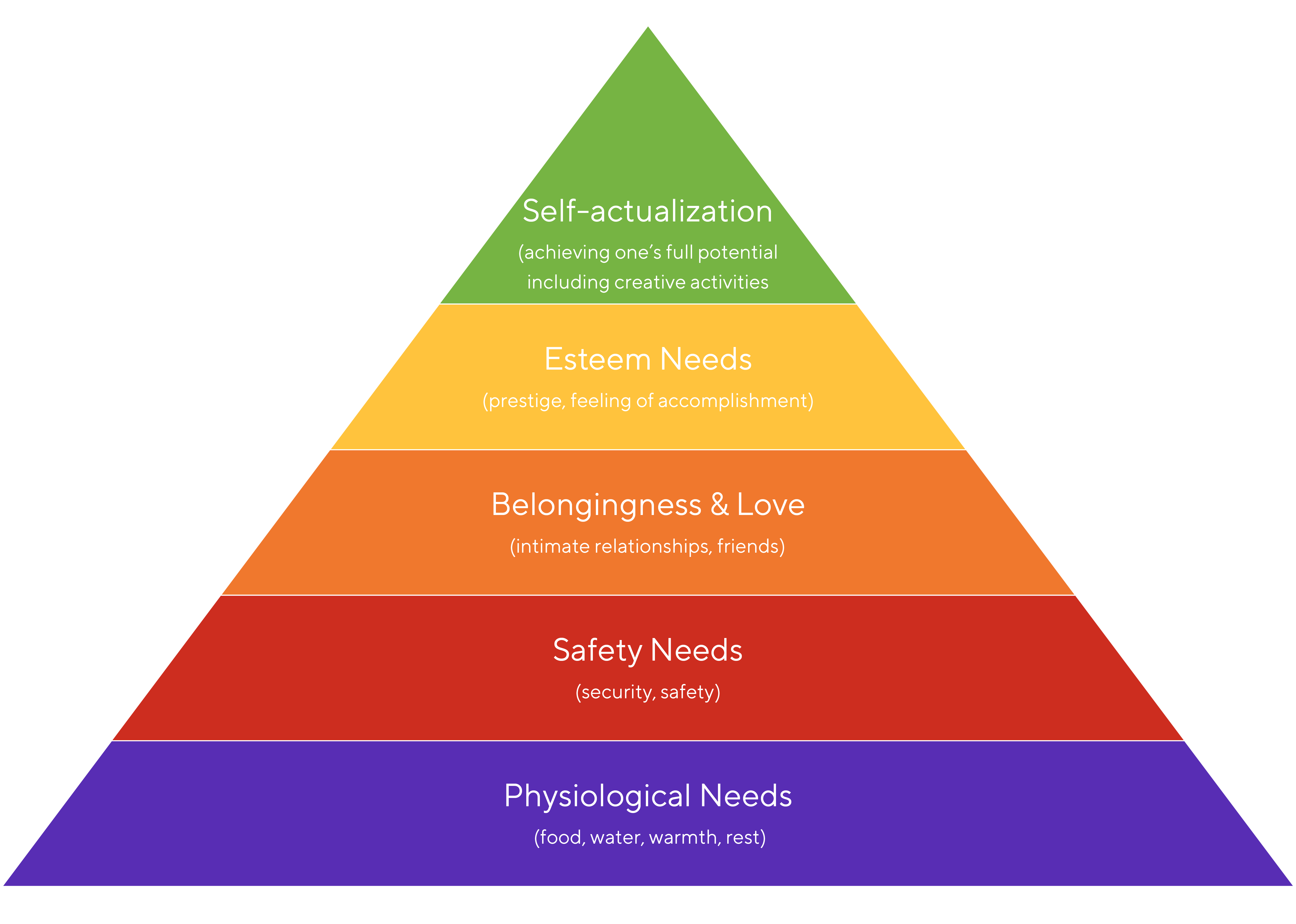
What are the stages of Maslow’s hierarchy of needs + describe each stage (include example and at what stages happiness kinda plays a part).
Stage 1: Bottom, Physiological/survival- e.g. air, water, food, sleep- needs required to sustain life/stay alive
Stage 2: Safety needs- e.g. living in a safe area, medical insurance, job security, financial reserves, etc. - helps u be free from the threat of physical and emotional harm- not necessarily happy js wanna be safe
Stage 3: Love, affection and belonging needs, Social needs- related to interaction with others- eg. friendship, belonging to a group, giving and receiving love, starts to get into happiness
Stage 4: Esteem needs- e.g. self respect, achievement, attention, recognition, reputation, etc.- cn be internal or external esteem, internal esteem= related to self esteem such as self respect and achievement, external esteem= social status and recognition- happiness related need
Stage 5: Self actualization- reaching ur full potential, e.g. truth, justice wisdom and meaning- happiness related need- this is kinda when u start giving to others and helping others
Who was Sigmund Freud?- include what he was viewed as, what his jobs were, what idea he formulated and where he grew up and how this could’ve impacted him
One of the most influential and authoritative thinkers of the twentieth century
physiologist, medical doctor, psychologist
father of psychoanalysis
formulated idea that many neuroses (phobias, hysterical paralysis and pains, paranoia, etc.) originated in deeply traumatic experiences which had occurred in the past life of the patient but which were now forgotten, hidden from consciousness
Grew up in an antisemetic environment- could have contributed to why he hates religion- cause he was born into a Jewish family
Sexuality- Freud theory- include how he defined sexuality and describe the theory based on this def
Freud defined the term 'sexuality’ to make it cover any form of pleasure which is or can be derived from the body
Therefore, the human being is energized or driven from birth by the desire to acquire and enhance bodily pleasure.
Theory of Psychosexual Development- Freud- include the stage, and the corresponding ages, focus of libido, major development and adult fixation example for each stage
Stage | Ages | Focus of Libido | Major Development (in life) | Adult Fixation Example |
Oral | 0-1 | Mouth, tongue, lips | Weaning off of breast feeding or formula | Smoking, overeating |
Anal | 1-3 | Anus | Toilet training | Orderliness, messiness |
Phallic | 3-6 | Genitals | Resolving Oedipus/Electra Complex (electra is the girls one), an unconscious reaction to the opposite sex parent | Deviancy, sexual dysfunction |
Latency | 6-12 | None | Developing defense mechanisms | None |
Genital | 12+ | Genitals | Reaching full sexual maturity | If all stages were successfully completed then the person should be sexually matured and mentally healthy |
The “Unconscious” (Freud theory)- include the description of like what the unconscious entails, what allows the best access to this, and how thoughts end up in the unconscious
Thoughts occurring “below the surface" whose “logic" is different from the logic of conscious thought.- painful thoughts that u dont wanna think abt go here
Dreams provide the best access to unconscious and are best illustration of its operation
People often experience thoughts and feelings that are so painful that people cannot bear them - banished from consciousness to constitute the “unconscious”
The Structure of the Mind : The ID, Ego and Superego- also include how these can lead to neurosis- Freud
There are three structural elements within the mind:
Id : The instinctual sexual (pleasure) drives which require satisfaction
Super-ego: Contains the ‘conscience’ (socially-acquired control mechanisms) - a little guilt can be good but shame or too much guilt is bad
Ego : the conscious self created by tensions between id and the super-ego ; must reconcile their conflicting demands with the requirements of external reality
If the external world cannot satisfy id’s pleasure drives, or if the satisfaction of these drives would break the moral rules of the super-ego, then an inner conflict occurs - failure to resolve can lead to neurosis. (deep – seated frustration, anxiety, depression)
Defense mechanisms- include how they develop + 2 examples- Freud
The mind possesses a number of 'defense mechanisms’ to attempt to prevent conflicts between the parts of the mind from becoming too acute.
Examples:
Denial:
Person fends off awareness of unpleasant truth that is a threat to the ego. (ex. student receives a bad grade- tells self that “grades don’t matter”)- if u dont believe it tho ur js a liar
Reaction formation:
A person acts the opposite compared to what they want unconsciously. (ex. violence against another race because members of the race are "inferior", when unconsciously it is that very person who feels inferior).
The Therapy of Psychoanalysis- Freud- include what psychoanalysis aims to do, what patients are encouraged to do + what do they do in sessions, what is reduced or aimed to reduce during psychoanalysis, what does the analyst need to help the patient realize, what’s a method in which psychoanalysis can be done (describe this method) and what factors lead to the analyst being bale to identify what’s causing the neurotic symptoms
Aim - to re-establish harmonious relationship between id, ego and super-ego by excavating and resolving unconscious repressed conflicts
Hysterical patient encouraged to talk freely about the earliest occurrences of their symptoms and fantasies - symptoms began to abate, and were eliminated entirely when patient helped to remember the initial trauma which caused them
Patient relaxes (lie on “the couch” in quiet, darkened office) - analyst virtually silent and out of sight
Patient encouraged to speak freely without forethought - therapist discerns the unconscious forces lying behind what was said (‘free-association')
Super-ego’s efficiency as a screening mechanism is reduced - material which would otherwise be completely repressed, is allowed to filter through to the conscious ego
Analyst needs to help patient to recognize and overcome their own natural resistance - may exhibit as hostility towards analyst - process can be long and difficult (Freud always took the occurrence of resistance as a sign that he was on the right track in his assessment)
Dream interpretation: super-ego functions less effectively in sleep
analyst distinguished between manifest content (what dream appeared to be about) and latent content (real but unconscious, repressed desires or wishes)
Correct interpretation of patient's dreams, slips of tongue, free-associations, responses to selected questions leads analyst to where he can locate the unconscious repressions (in psychosexual development, how conflicts during development were handled, the libidinal content of family relationships) producing the neurotic symptoms
What are the forms treatment of neuroses can take?- Freud- like what did Freud say can fix it
Channeling of the sexual energy into the achievement of social, artistic or scientific goals
Conscious, rational control of the formerly repressed drives
If super-ego, and the social constraints which inform it, which are at fault, patient may decide in the end to satisfy the instinctual drives
Cure is essentially a release of the pent-up psychic energy, the constriction of which was the basic cause of the neurotic illness.
Criticism of Freud’s Ideas- but also include one thing that does support Freud’s theories
Freud's basic claim — that many of our conscious thoughts and actions are driven by unconscious desires and fears — should be rejected because it implicitly challenges the possibility of making universal and objective claims about the world - invalidates Freudian theory as a means of interpreting and explaining human behaviour.
Psychosexual development theory:
Over-emphasis on sexual drives to explain behaviour – are infants really sexual beings?
Pattern of psychosexual development is not universal, nor necessary for the development of a healthy adult
Social and environmental (external) sources also influence patterns of development
Feminist critics : Freud believed women are a kind of mutilated male, who must learn to accept their "deformity" (the "lack" of a penis) and submit to some imagined biological imperative (main role is child-bearing)
"Penis envy" and "castrating" (used to describe women who attempted to excel in any field outside the home) contributed to discouraging women from obtaining education or entering any field dominated by men, until the 1970s.
Psychoanalytic theory must be adapted by women to free it from vestiges of sexism
“Freudianism is essentially completely accurate, with the exception of one crucial detail: everywhere that Freud writes ‘penis’, the word should be replaced with ‘power’ “
Theories are not real science (Karl Popper):
Freud's theories can never be properly "verified," because no type of behavior could ever falsify them (e.g. someone who denies having any sort of Oedipal conflict (the unconscious desire theory thing) is interpreted as repressing it)
However, numerous experimental and correlational studies have provided empirical support for certain Freudian concepts, such as the pattern of the anal personality.
Freud’s Legacy- what did he devise abt psychological development and mental conditions, what did e elaborate on the mind, what cure did he create + how did this have an effect on even todays world, and what did his theories provide a basis for. What are some stuff tho that kinda disprove the stuff he was saying and what does the effectiveness of psychoanalysis still remain
Devised a new frame of reference for the understanding of human psychological development and the treatment of abnormal mental conditions.
Elaborated the theory that the mind is a complex energy-system, the structural investigation of which is proper province of psychology
The "talking-cure" (psychotherapy) - basic model of treatment stems largely from his work, even though many psychotherapists today partly or wholly reject the specifics of Freud's theories
Provides a basis for the beneficial treatment of neurotic illness
BUT
Such clinical tests as have been conducted indicate that the proportion of patients who have benefited from psychoanalytic treatment does not diverge significantly from the proportion who recover spontaneously or as a result of other forms of intervention
The question of the therapeutic effectiveness of psychoanalysis remains an open and controversial one.
Ruth Benedict- field of study/focus of research and major contributions to anthro
Focus of research:
Culture and personality school of thought
Cultural anthropology
Major contributions:
Patterns of culture- book, The chrysanthemum and the sword: patterns of Japanese culture
Theory that culture is “personality writ large”- culture is not random traits but rather a whole personality-eg. Japan has shame
Cultural relativism
Argued against racism in one of her books-race and racism
Studied how culture influences personality-anthro + psych
Franz Boaz- field of study/focus of research and major contributions to anthro
Focus of research:
Cultural, linguistic, archeological and physical anthropology- developed the 4 field approach to anthro
Mostly cultural anthro tho
Major contributions:
Worked to stop scientific racism and work towards cultural variation to explain differences in humans
Studied Indigenous Peoples for cultural variation- Baffin Island Inuit specifically
Created the 4 field approach to anthro
Claude Levi-Strauss- field of study/focus of research and major contributions to anthro
Focus of research:
Founder of structural anthropology
Focused on identifying universal structures of human thoughts
Major contributions
The theory of structuralism- cultural phenomena come from and are organized by hidden and unconscious structures of human thought and are based on binary opposites (hot/cold, etc.)
Kinship/Alliance theory- kinship isn't based on biological descent but rather structural alliances made through marriages
Structural analysis of myth-analyzed myths around the world to find common elements that show underlying humans through patterns
Culinary triangle
A.R. Radcliffe Brown- field of study/focus of research and major contributions to anthro
Focus of research:
Social anthropologist- believed in structural functionalism theory
Focused on how social institutions maintain their stability and order
Focused on social structure
Major contributions:
Believed in structural functionalism- created theory of functionalism
Studied social structure- focused on empirical, observable social relations rather than individual needs
Kinship studies- kinship isn’t biological ties but a system of social roles and obligations that structure society- studied this in Australian and African kinship systems
Rituals and social structures- said that rituals and customs are made to manage potential social social tensions and maintain social cohesion
Methodological shift- wanted a more comparative and synchronized approach to identify the "natural laws” of society
Sherry Ortner- field of study/focus of research and major contributions to anthro
Focus of research:
Cultural anthropology
Focused on feminist theory and social theories (eg. social inequality)
Major contributions:
Feminist anthropology
Practice theory- looks at how everyday actions by individuals can shape, reproduce or change social structures
Symbolic/interpretive anthro- focused on symbolic meanings of rituals
Ethnographic studies- did research with the Sherpas of Nepal- “Life and Death on Mt. Everest”- publication
Studied class culture in America- “New Jersey Dreaming” publication
Margaret Mead- field of study/focus of research and major contributions to anthro
Focus of research:
Cultural anthropology
Relationship between culture and individual personality
Adolescence and culture
How societies socialize children and define gender roles
Focused on cultural determinism and gender roles
Major contributions:
Said that traits considered normal in society are actually culturally defined roles and not inherent to a specific sex- explored this in her work- “Sex and Temperament in Three Primitive Societies”
Coming of Age of Samoa- studied adolescence- suggested that stress and emotional turmoil in adolescence isn’t universal and instead influenced by culture
Used visual techniques like photographs and film the practices of raising a child and cultural behaviour
One of the first people to apply psychological techniques to anthropological research
Mary Leakey- field of study/focus of research and major contributions to anthro
Focus of research:
Paleoanthropologist
Focused on early human ancestors and stone tool cultures
Also studied human evolution
Major contributions:
Discovered Laetoli footprints- showed human ancestors- hominins that walked on two legs
Uncovered major hominin fossils- found a near complete skull of an early homonin (Zinjanthropus boisei or Paranthropus boisei or "Nutcracker man"
Found the first complete skull of Proconsul (a species that is an ancestor of apes and humans)- contributed to human evolution stuff
Helped discover an early species called Homo habilis
Leith Mullings Marable- field of study/focus of research and major contributions to anthro
Focus of research:
The intersection of race, class and gender and how it relates to health disparities, urban inequality and social movements
Cultural anthropologist
Had feminist views on things
Major contributions:
Developed the “Sojourner Syndrome”- how black women navigate challenges caused by their race, gender and class- specifically in terms of health disparities and in urban settings
When did street gangs first develop in America?
18th and 19th centuries- 1783
Why did some Irish immigrants turn to gangs?
For survival because they were facing things like extreme poverty, discrimination, and unsafe housing in the slums- ad to fight for territory in the ghettos (they were forced there due to the extreme poverty and discrimination that they faced), most were forced into low paying and unsafe jobs- caused them to result to criminal activity within gangs for financial income + support system
Name the first ever organized American street gang
The 40 thieves- in New York
When and why did the average age of gang members eventually drop?
Happened around 1970s-1980s and accelerated in then 1990s and early 2000s
Why:
Gangs used children to sell drugs- kids were less likely to receive harsh legal punishments compared to adults
Many children were orphaned and therefore to find a community and support system they banded together and formed gangs
Younger members had more long term loyalty and therefore were recruited more often
What does “CRIPS” stand for and why were they originally formed?
CRIPS was thought to either be short for cripples, or stood for Community Revolution in Progress or Community Resources for Independent People
Originally formed for self-defense and protection (to protect its members and their neighborhoods from other, more established street gangs), as a response to police brutality (police harassment and the "mass arrests, jailing, and killings of black youth"), and they were also influenced by the Black Panthers (gang) and aimed to serve as a form of community empowerment or a youth-driven resistance force against injustice,
What caused gang violence to “explode” in the early 1980s?
The introduction of crack cocaine- gangs wanted to control the income that came from selling it - caused gangs to transition from localized, territorial turf battles to highly organized, violent drug trafficking operations
What did “the truce” between the Bloods and the Crips signify?
Signified a strategic shift in Los Angeles street culture, where rival gang factions agreed to cease violence, focus on community upliftment, and challenge police brutality (gang leaders basically united to fight against police brutality)
Resulted in a significant decrease in gang violence for several years
What are the three (3) main reasons people join gangs?
Protection- usually occurs in more high crime neighborhoods where people need more protection
Belonging- usually happens with youth who want a family and a place to belong/a community
Economic opportunities- gangs allow people to access things like money and other resources- usually when someone can’t find/get a legitimate job (either due to lack of skill or just jobs being unavailable)
Compare and contrast the key methodological approaches of the social sciences (3) in terms of purpose of research, role of values in research, and Type of Data Collected (and Research Designs Used)
Methodological Approach | Purpose of Research | Role of Values in Research | Type of Data Collected (and Research Designs Used) |
Positivist |
|
|
|
Interpretive / Constructionist |
|
|
|
Critical |
|
|
|
Auguste Comte- focus of research + major contribution to soc
Focus:
Positivism as a way to study sociology
“The science of sociology”
Major contributions:
Created positivism (the scientific method) to study soc
Law of 3 stages- human thinking has 3 stages
Social statistics and dynamics- soc had 2 parts: social statistics and and social dynamics- helped study social institutions
Made the term altruism and saw a scientific “religion of humanity” to make social cohesion
Focused a lot on science basically
Emile Durkheim- focus of research + major contribution to soc
Focus:
Focused on establishing soc as a science
Studied how societies were able to have order and cohesion during industrialization
Study of “social facts”
Major contributions:
Established sociology as a science- in his work, The Rules of Sociological Method, he said that soc should study social facts (e.g. laws, religious beliefs, etc.) as distinct from individual psychology- helped establish the field of soc as an academic discipline
Social solidarity and the division of labour- said that pre-industrial and modern societies are held by different things (specifically shared beliefs (mechanical solidarity) vs dependence on each other due to specialization (organic solidarity))
Anomie- said what it was
Studied suicide- said it was influenced by social forces
Collective consciousness and religion
Talcott Parsons- focus of research + major contribution to soc
Focus:
Structural functionalism
Tried to make a “grand theory” of society to see how social institutions and norms maintained order and stability (did this through his AGIL paradigm)
Major contribution:
Developed action theory + structural functionalism- tried to create a grand, unified theory for social behaviour
AGIL paradigm- all social systems must meet the criteria for this
Pattern variables- categorize types of decisions people make during social interactions
Proposed a model of social change
Patricia Hill Collins- focus of research + major contribution to soc
Focus:
Analyzed how race, class, gender, sexuality, and nation function to affect individuals
Focused on black feminist thought + the sociology of knowledge
Major contributions:
Intersectionality and matrix domination- oppression is a matrix domination where many factors intersect to make it happen- forms of oppression are not separated but connected
Standpoint theory- those experiencing oppression have a unique "standpoint" that provides a more comprehensive view of power structures.
Karl Marx- focus of research + major contribution to soc
Focus:
Class conflict
Capitalism
Historical materialism
Exploitation between the owners and workers (bourgeoisie and proletariat)
Major contribution:
Created conflict theory
Historical materialism made the idea- basically the economic system drives history and everything else
Alienation- said that workers lose control of their work under capitalism + become alienated from their work and themselves
Class consciousness
Base and superstructure- economic foundation (base) determines social, political and intellectual aspects of life (superstructure)
Max Weber- focus of research + major contribution to soc
Focus:
Interpretive sociology- finding meaning behind human action
Focused on understanding the rise of modern Western society- processes of rationalization, bureaucratization, and "disenchantment".
Explored how culture, religion, and ideas shaped capitalism and social action
Major contributions:
Rationalization and the iron cage- modern day society is driven by efficiency rather than tradition and emotion
Showed how religious beliefs (specifically Calvinist ideas about work) contributed to the development of modern capitalism
Defined bureaucracy and classified authority into 3 ideal types
Social action theory
Verstehen and Ideal Types- to understand motivations behind social behavior + developed the ideal types used to analyze complex social phenomena
Social stratification (Class, Status, and Party)- not just an economic class like Marx said but economic class, status (social prestige) and party (power) contribute to an individual's life chances
George Mead- focus of research + major contribution to soc
Focus:
Social behaviour
Self-development
Symbolic interactionism
Major contributions:
Created symbolic interactionism
Believed that the self develops through social interaction
Introduced idea of “I” and “Me”
I = spontaneous self
Me = social self (how society sees you)
Said we learn who we are by taking the role of others
Charles Cooley- focus of research + major contribution to soc
Focus:
Self-identity
Social interaction
Groups
Major contributions:
Created concept of the Looking-Glass Self
Idea: We form our self-image based on the judgement of others basically
Studied primary groups (family, close friends)
Rosemarie Tong- focus of research + major contribution to soc
Focus:
Feminist theory,
Gender equality
Ethics
Major contribution:
Wrote about different types of feminism
Famous for book Feminist Thought
Explained and compared different types of feminism (eg radical feminism vs liberal feminism, etc.)
Studied gender inequality and women’s rights
What approach to Erik Erickson have for describing human development and like what we’re driven by?
He had the life-span approach- said that there are Psychosocial Stages of Personality Development (psychosocial instead of psychosexual like Freud)
Erik Erickson lifespan
1902 - 1994
Describe Erik Erickson’s psychosocial stages of development- include how many stages, what it addresses, what the crisis is + what happens based on how they respond + response types, and basic strengths
8 successive stages over the lifespan
Addresses biological, social, situational, personal influences
Crisis: must adaptively or maladaptively cope with task in each developmental stage:
-Respond adaptively: acquire strengths needed for next developmental stage
-Respond maladaptively: less likely to be able to adapt to later problems
Basic strengths: Motivating characteristics and beliefs that derive from successful resolution of crisis in each stage
Stage 1: Basic Trust vs. Mistrust- psychosocial stages of development- include age range where this happens + characteristics of this stage (what affects this stage) + the like negative and positively impacting things and basic strength learned/gained from this stage
Birth to age 1
Totally dependent others- child isn’t doing smth that can go wrong js based on how others treat them
If caregiver meets physical and psychological needs: child develops trust
If caregiver does not meet needs: child develops mistrust- eg. if they’re abused
Basic strength: Hope
-Belief our desires will be satisfied
-Feeling of confidence
Stage 2: Autonomy vs. Shame and Doubt- psychosocial stages of development- include age range, characteristics of this stage (what is the person supposed to do during this stage that can go wrong), what the negative outcome is, basic strength learned from this stage, what happens (typically) to ppl who get the negative outcome of this?
Ages 1-3
Child able to exercise some degree of choice
If child’s independence is thwarted: child develops feelings of self-doubt, shame in dealing with others
Basic Strength: Will
- Determination to exercise freedom of choice in face of society’s demands
Basically: if u make a mistake and ur yelled/shamed at u develop shame, but if ur told its ok and stuff u feel ok making decisions and doing things
people that feel shame often become violent later
Stage 3: Initiative vs. Guilt- psychosocial stages of development- include age range, characteristics of this stage (what is the person supposed to do during this stage that can go wrong), what happens if negative outcome happens, what are the basic strengths developed from this if u pass this stage, and give an example of a negative response
Ages 3-5
Child expresses desire to take initiative in activities
If parents punish child for initiative or failures: child develops feelings of guilt that will affect self-directed activity throughout life
Basic strength: Purpose
-Courage to envision and pursue goals
Eg. parent yells at u for dropping a plate yk stuff like that
Stage 4: Industriousness vs. Inferiority- psychosocial stages of development- include age range, characteristics of this stage/what needs to happen in this stage, what is the negative outcome/response of this stage, what is the basic strength gained if u pass this stage
Ages 6-11
Child develops cognitive abilities to enable in task completion (school work, play)
If parents/teachers do not support child’s efforts: child develops feelings of inferiority and inadequacy unrealistic expectations
Basic strength: Competence
-Exertion of skill and intelligence in pursuing and completing tasks
Which stages of psychosocial development are determined by others vs individually?
Stages 1-4
Largely determined by others (parents, teachers)
Stages 5-8
The individual has more control over their environment
Individual responsibility for crisis resolution in each stage
Stage 5: Identity vs. Role Confusion- psychosocial stages of development- include age range this happens in, what forms during this stage/characteristics of this stag/what’s supposed to happen during this stage-what’s a positive outcome, what’s a negative outcome of this stage if what’s supposed to happen doesn’t happen (if u don’t do what ur supposed to), and basic strength gained if u pass this stage
Ages 12-18
Form ego identity: self-image
Strong sense of identity: face adulthood with certainty and confidence
Identity crisis: confusion of ego identity
Basic strength: Fidelity
-Emerges from cohesive ego identity
-Sincerity, genuineness, sense of duty in relationships with others
Stage 6: Intimacy vs. Isolation- psychosocial stages of development- include age range, what’s supposed to happen during this stage, what is the negative outcome of this stage, and the basic strength obtained if u pass this stage
Ages 18-35 (approximately)
Undertake productive work and establish intimate relationships
Inability to establish intimacy leads to social isolation, bad relationships
Basic strength: Love
-Mutual devotion in a shared identity
-Fusing of oneself with another person
Stage 7: Generativity vs. Stagnation- psychosocial stages of development- include age range, what is supposed to happen during this stage/what we’re supposed to do, what is the negative outcome of this stage, and what is the basic strength developed if u pass this stage
Ages 35-55 (approximately)
Generativity: Active involvement in teaching/guiding the next generation
Stagnation involves not seeking outlets for generativity, lack of concern for others
Basic strength: Care
-Broad concern for others
-Need to teach others
Stage 8: Ego Integrity vs. Despair- psychosocial stages of development- include age range, what is supposed to happen during this stage, what are the positive and negative outcomes, and what is the basic strength gained from this stage if u pass it
Ages 55+
Evaluation of entire life
Integrity: Look back with satisfaction
Despair: Review with anger, frustration; mid-life crisis
Basic strength: Wisdom
-Detached concern with the whole of life

