Hearing

0.0(0)
studied byStudied by 0 people
call kaiCall Kai
learnLearn
examPractice Test
spaced repetitionSpaced Repetition
heart puzzleMatch
flashcardsFlashcards
GameKnowt Play
Card Sorting

1/24

encourage image

There's no tags or description

Looks like no tags are added yet.

Last updated 1:22 PM on 2/4/26
Name
Mastery
Learn
Test
Matching
Spaced
Call with Kai

No analytics yet

Send a link to your students to track their progress

25 Terms

1
New cards

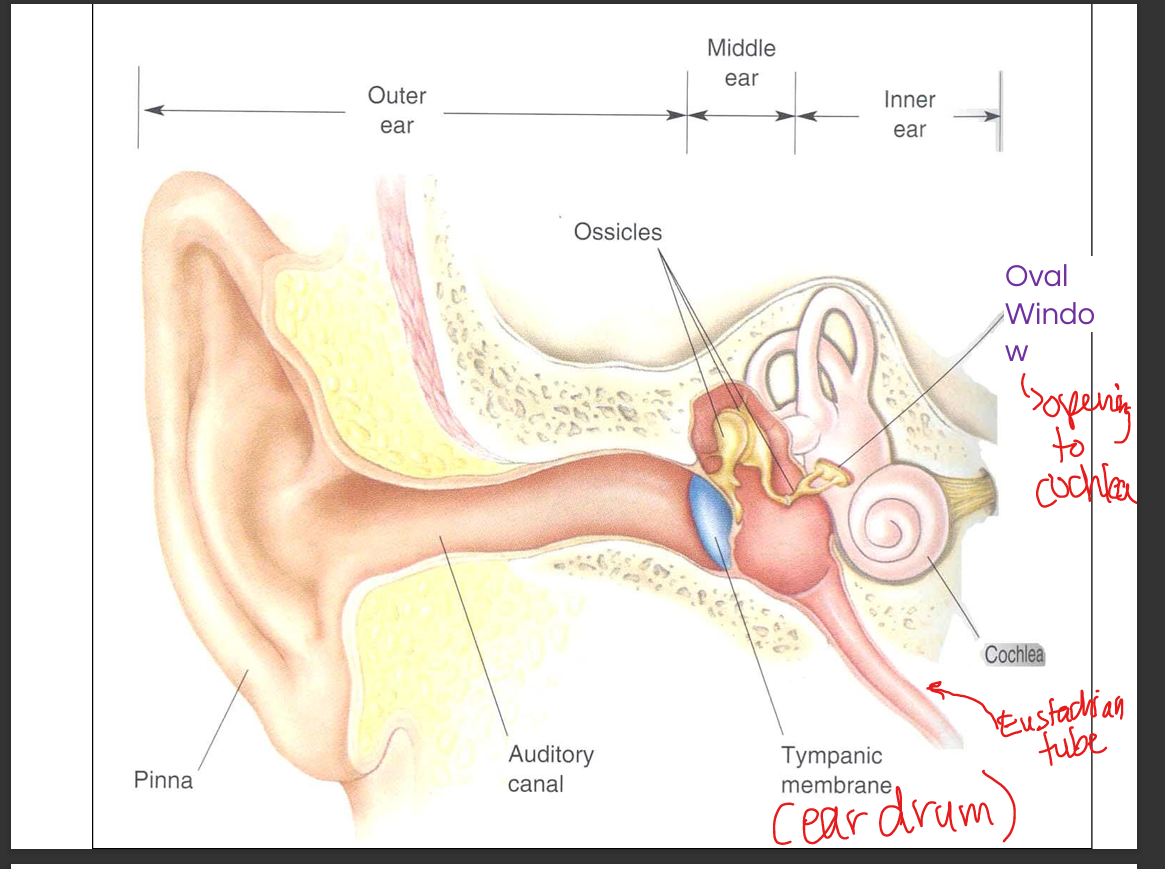
Discuss the functional anatomy of the external ear.

The external ear includes the pinna and external auditory canal; it collects sound waves and funnels them toward the tympanic membrane, helping with sound localization.
knowt flashcard image

<p>The external ear includes the pinna and external auditory canal; it collects sound waves and funnels them toward the tympanic membrane, helping with sound localization.</p><img src="https://knowt-user-attachments.s3.amazonaws.com/f3666cb7-c0f0-4f82-8b84-4b2772bf2e50.png" data-width="100%" data-align="center" alt="knowt flashcard image"><p></p>
2
New cards

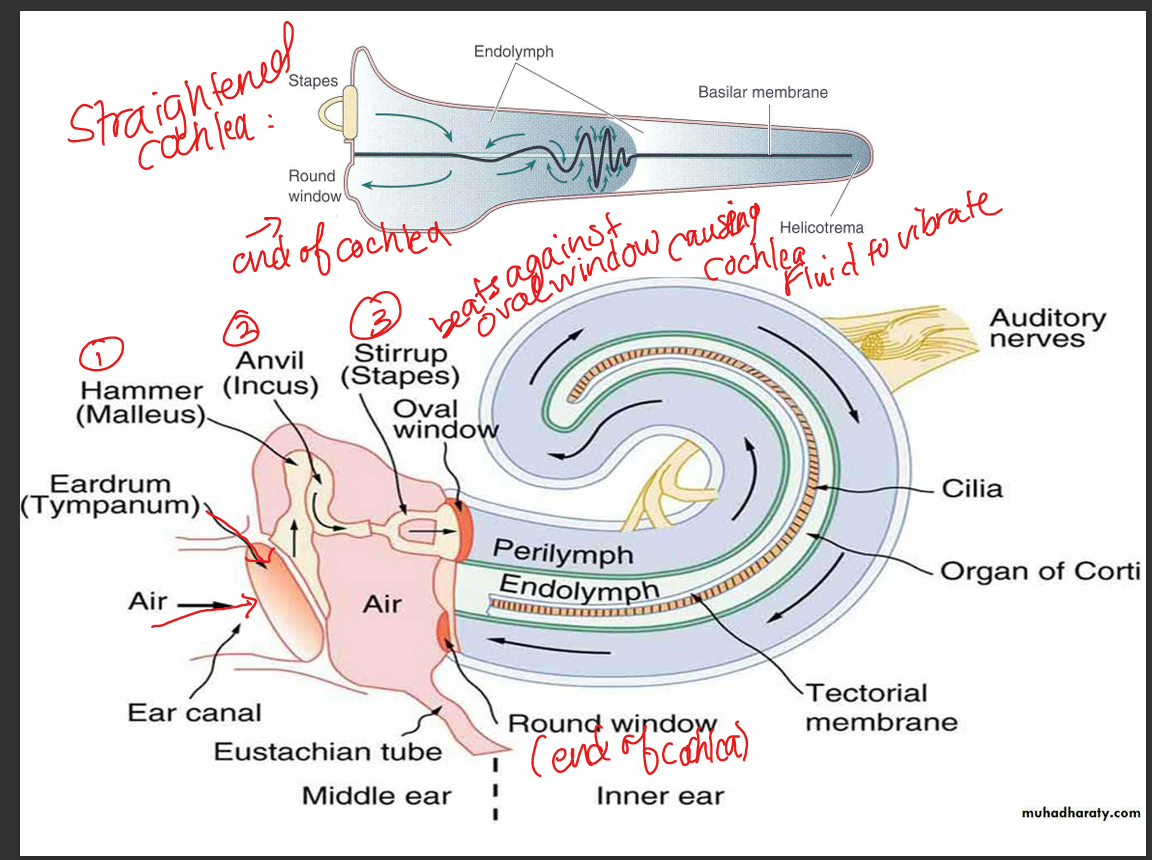
Discuss the functional anatomy of the middle ear.

The middle ear contains the tympanic membrane and ossicles (malleus, incus, stapes); it amplifies sound via lever action and area difference before transmitting vibrations to the oval window.
knowt flashcard image

<p>The middle ear contains the tympanic membrane and ossicles (malleus, incus, stapes); it amplifies sound via lever action and area difference before transmitting vibrations to the oval window.</p><img src="https://knowt-user-attachments.s3.amazonaws.com/d4ad2a92-b130-4cad-a4e2-c41ad42da47f.png" data-width="100%" data-align="center" alt="knowt flashcard image"><p></p>
3
New cards

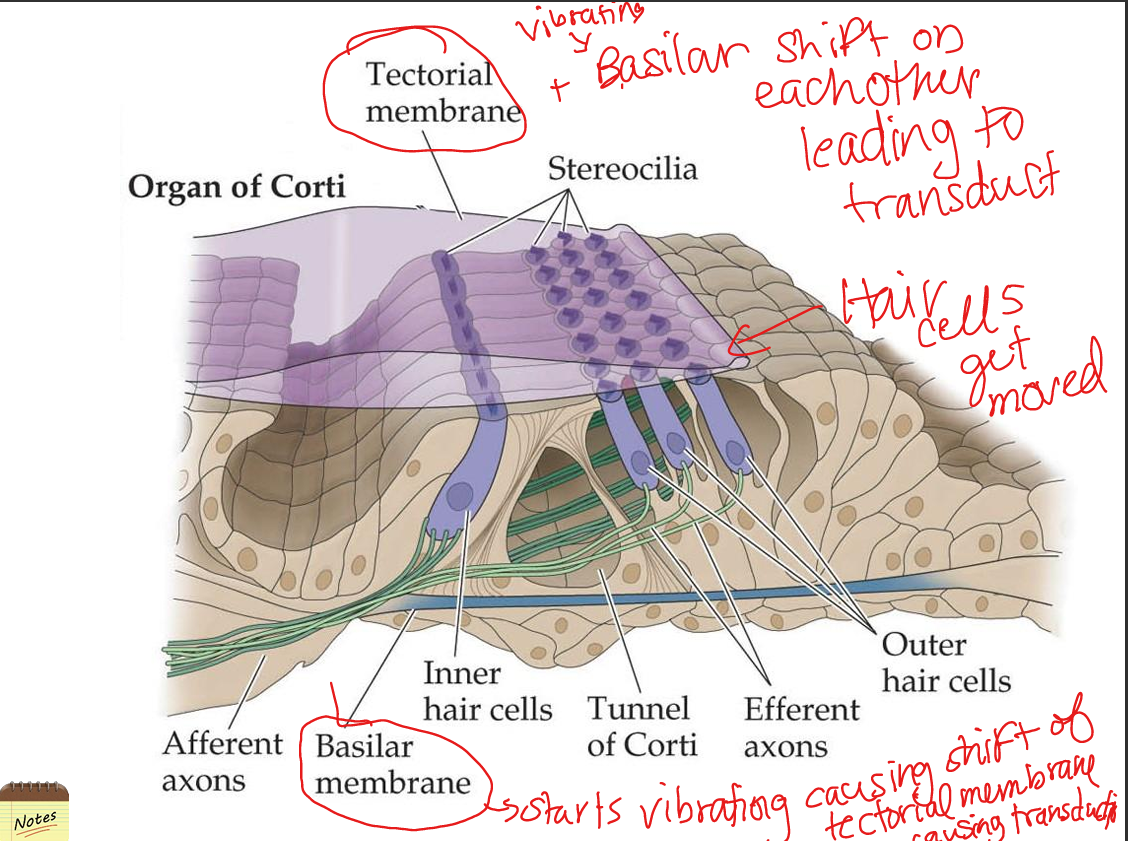
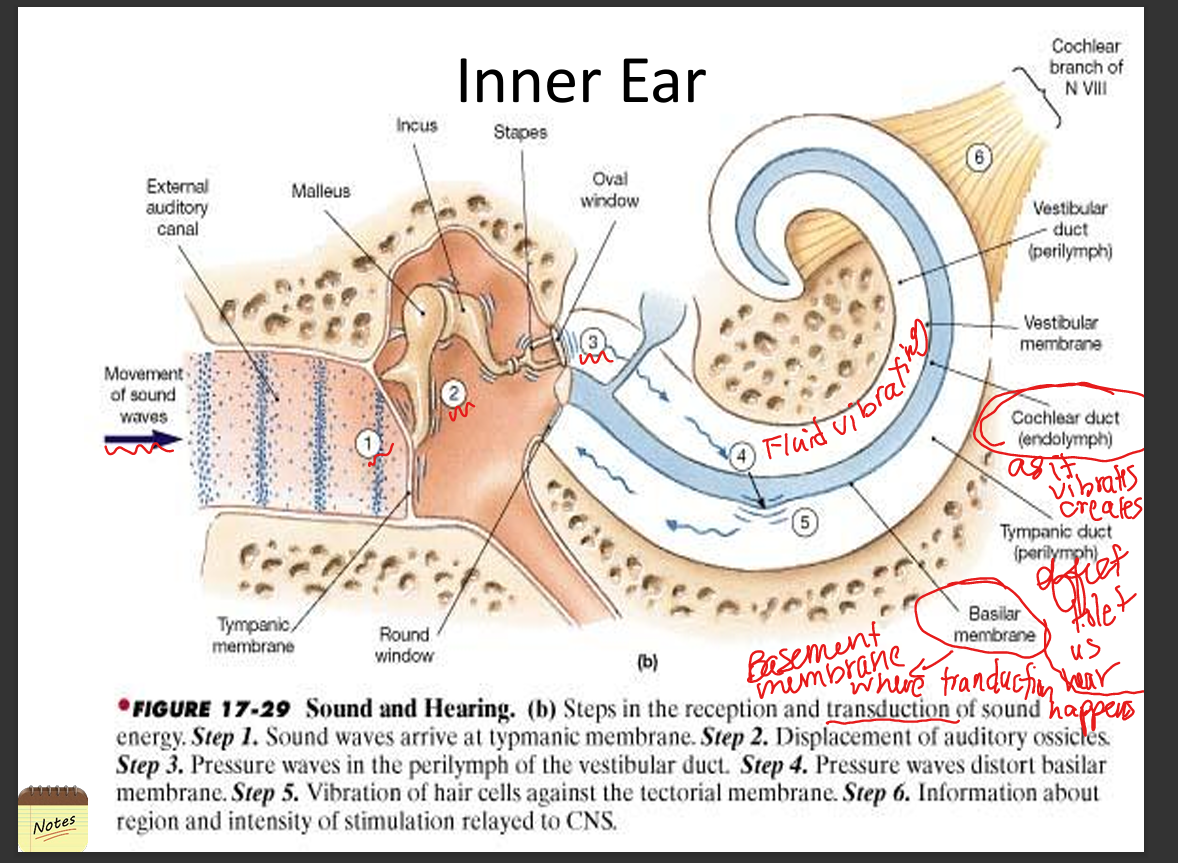
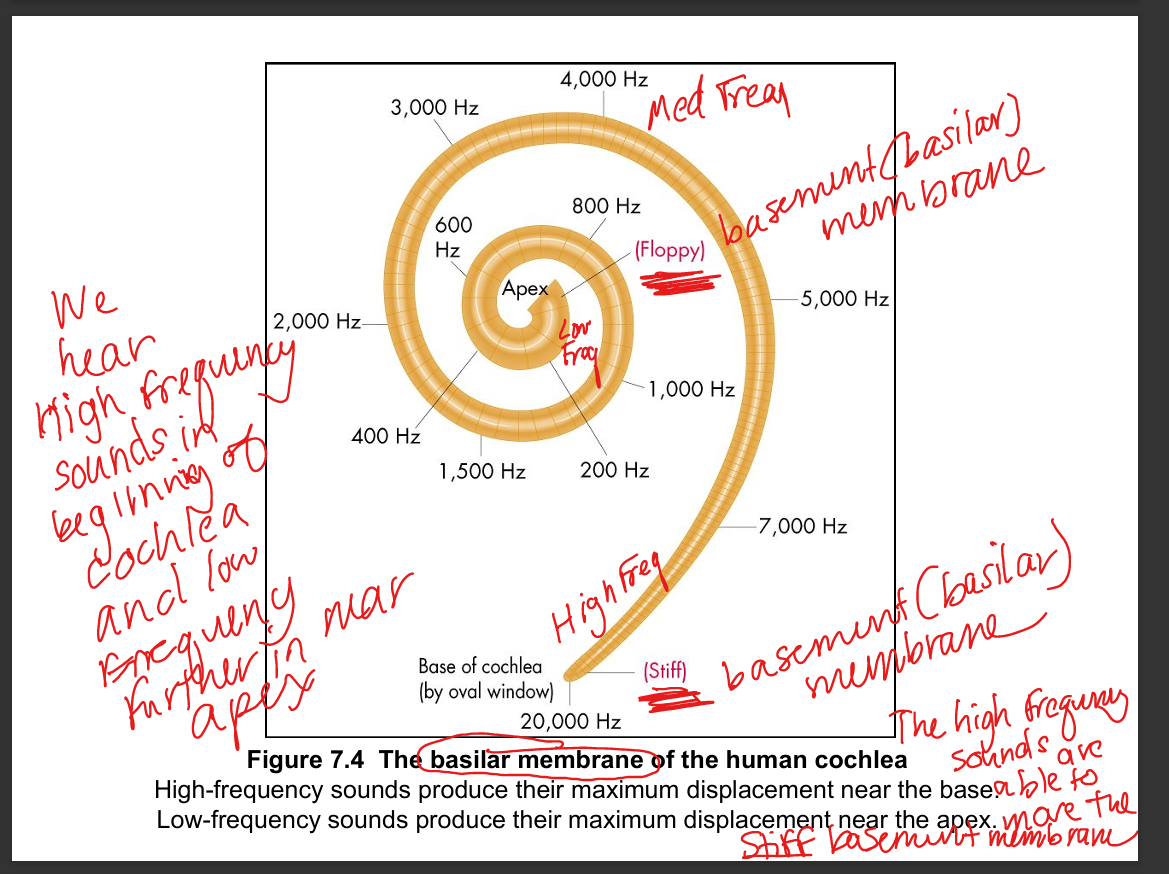
Discuss the functional anatomy of the inner ear.

The inner ear contains the cochlea, vestibule, and semicircular canals; the cochlea converts mechanical vibrations(that vibrate fluid) into neural signals via hair cells in the Organ of Corti.
knowt flashcard imageknowt flashcard imageknowt flashcard image

<p>The inner ear contains the cochlea, vestibule, and semicircular canals; the cochlea converts mechanical vibrations(that vibrate fluid) into neural signals via hair cells in the Organ of Corti.</p><img src="https://knowt-user-attachments.s3.amazonaws.com/244b8cbe-9eff-4d91-b389-f191fd2a71ef.png" data-width="100%" data-align="center" alt="knowt flashcard image"><img src="https://knowt-user-attachments.s3.amazonaws.com/3fc395cb-f88a-4d53-b180-f56d5fad8ec1.png" data-width="100%" data-align="center" alt="knowt flashcard image"><img src="https://knowt-user-attachments.s3.amazonaws.com/95fe747b-14b4-485a-befd-0fd4d901a751.png" data-width="100%" data-align="center" alt="knowt flashcard image"><p></p>
4
New cards

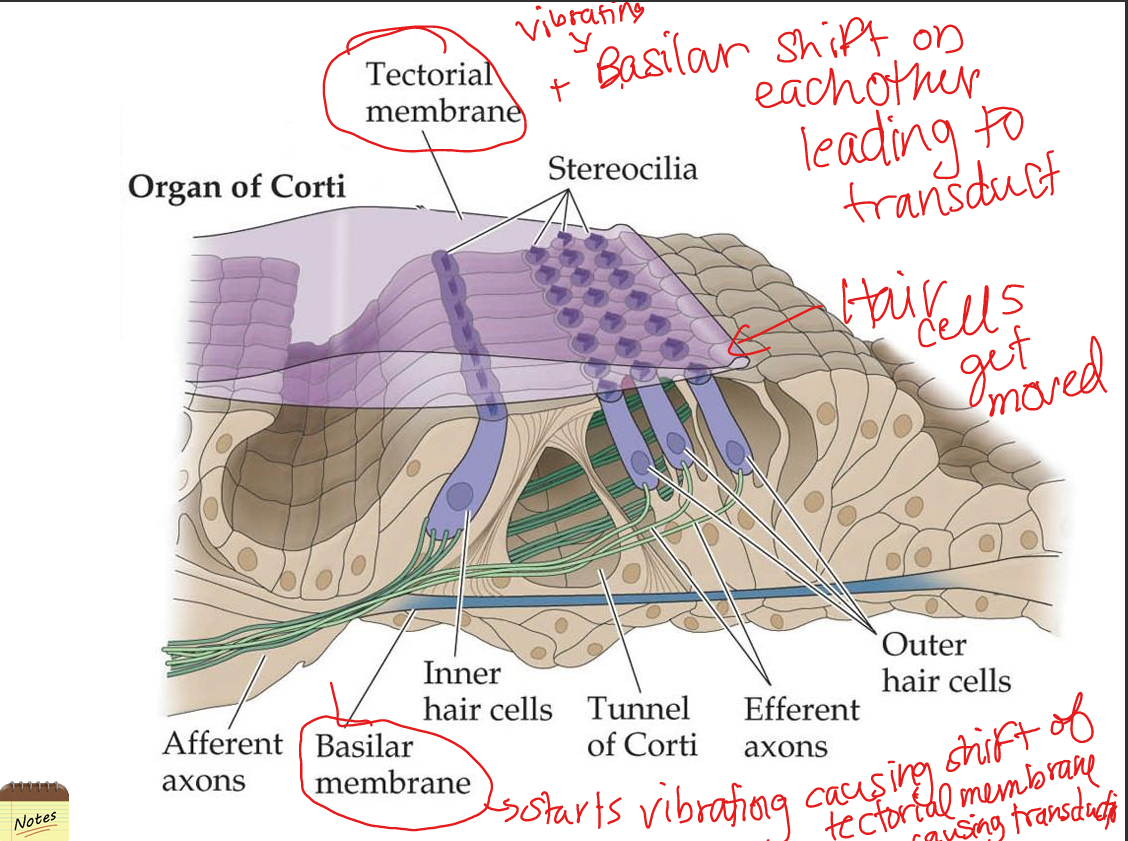
Explain how pressure waves in air are processed by the cochlea.

Sound waves vibrate the tympanic membrane → ossicles → oval window → perilymph in scala vestibuli → basilar membrane displacement → hair cell transduction → auditory nerve firing.
knowt flashcard image

<p>Sound waves vibrate the tympanic membrane → ossicles → oval window → perilymph in scala vestibuli → basilar membrane displacement → hair cell transduction → auditory nerve firing.</p><img src="https://knowt-user-attachments.s3.amazonaws.com/78c8ea95-e17f-463c-8284-6803af9545d4.png" data-width="100%" data-align="center" alt="knowt flashcard image"><p></p>
5
New cards

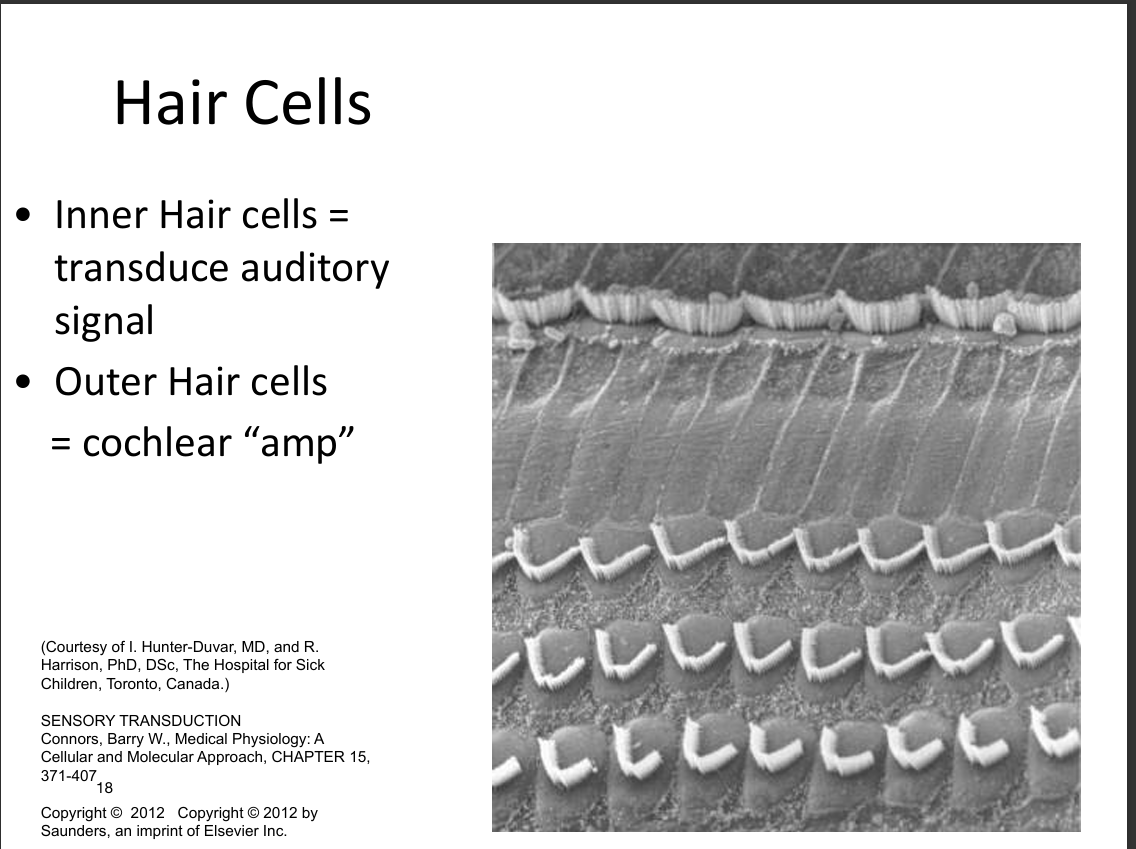
Compare inner and outer hair cells.

Inner hair cells transduce sound into neural signals; outer hair cells amplify and fine‑tune basilar membrane vibrations via electromotility.
knowt flashcard image

<p>Inner hair cells transduce sound into neural signals; outer hair cells amplify and fine‑tune basilar membrane vibrations via electromotility.</p><img src="https://knowt-user-attachments.s3.amazonaws.com/9fb0acf4-fcec-4914-9736-ba478b988626.png" data-width="100%" data-align="center" alt="knowt flashcard image"><p></p>
6
New cards

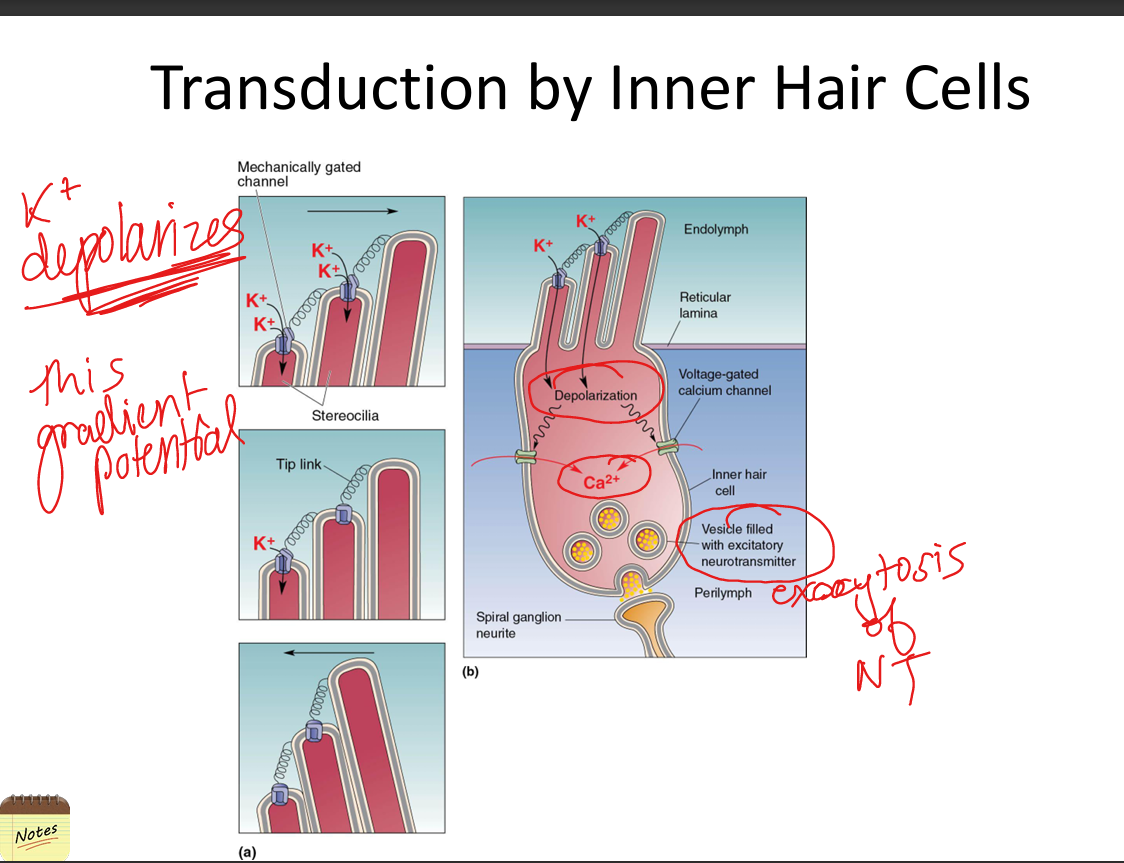
Explain how transduction of sound occurs.

Bending of stereocilia opens mechanically gated K+ channels (due to high‑K+ endolymph), causing depolarization → Ca2+ influx → glutamate release onto spiral ganglion neurons.
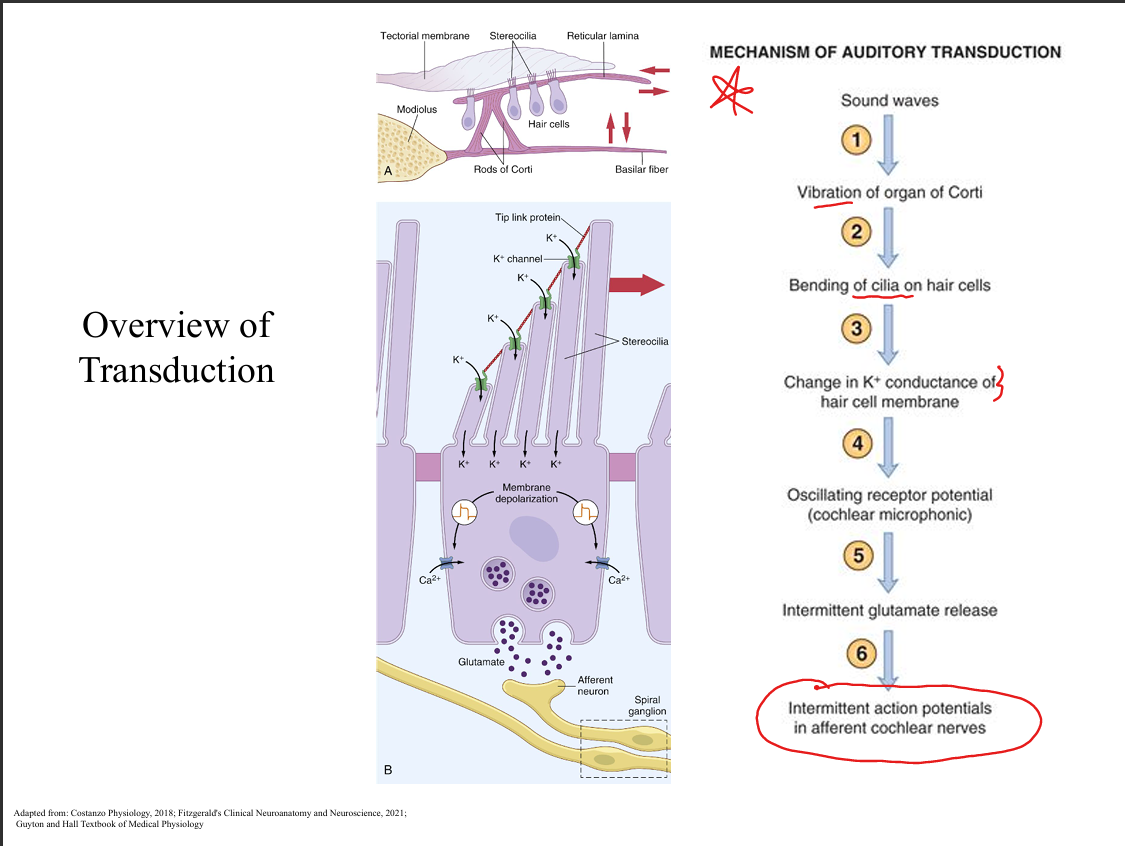
knowt flashcard imageknowt flashcard image

<p>Bending of stereocilia opens mechanically gated K+ channels (due to high‑K+ endolymph), causing depolarization → Ca2+ influx → glutamate release onto spiral ganglion neurons.</p><img src="https://knowt-user-attachments.s3.amazonaws.com/25ddedd9-de6a-41be-b553-358700271b80.png" data-width="100%" data-align="center" alt="knowt flashcard image"><img src="https://knowt-user-attachments.s3.amazonaws.com/8d65fff5-5311-49c5-be4f-b0042e3459f3.png" data-width="100%" data-align="center" alt="knowt flashcard image"><p></p>
7
New cards

Explain how sound frequencies assort along the basilar membrane.

High frequencies peak at the stiff, narrow base; low frequencies peak at the wide, floppy apex — creating a tonotopic map.
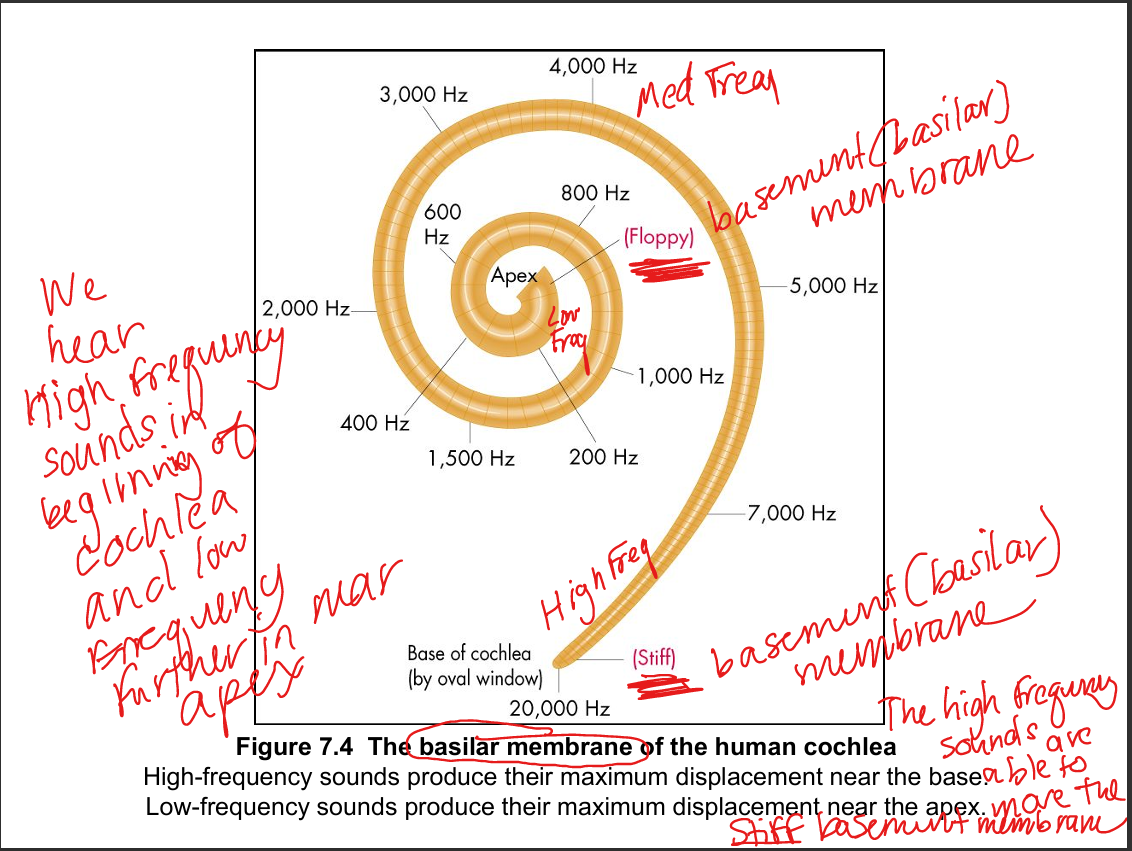
knowt flashcard image

<p>High frequencies peak at the stiff, narrow base; low frequencies peak at the wide, floppy apex — creating a tonotopic map.</p><img src="https://knowt-user-attachments.s3.amazonaws.com/91d0fa4b-ca13-4b32-93b1-726ac1811b7a.png" data-width="100%" data-align="center" alt="knowt flashcard image"><p></p>
8
New cards

Outline the auditory pathway.

Organ of Corti → spiral ganglion → cochlear nerve → cochlear nuclei → superior olivary complex(intensity+timing) → lateral lemniscus → inferior colliculus(localization + body integration) → medial geniculate nucleus → primary auditory cortex.
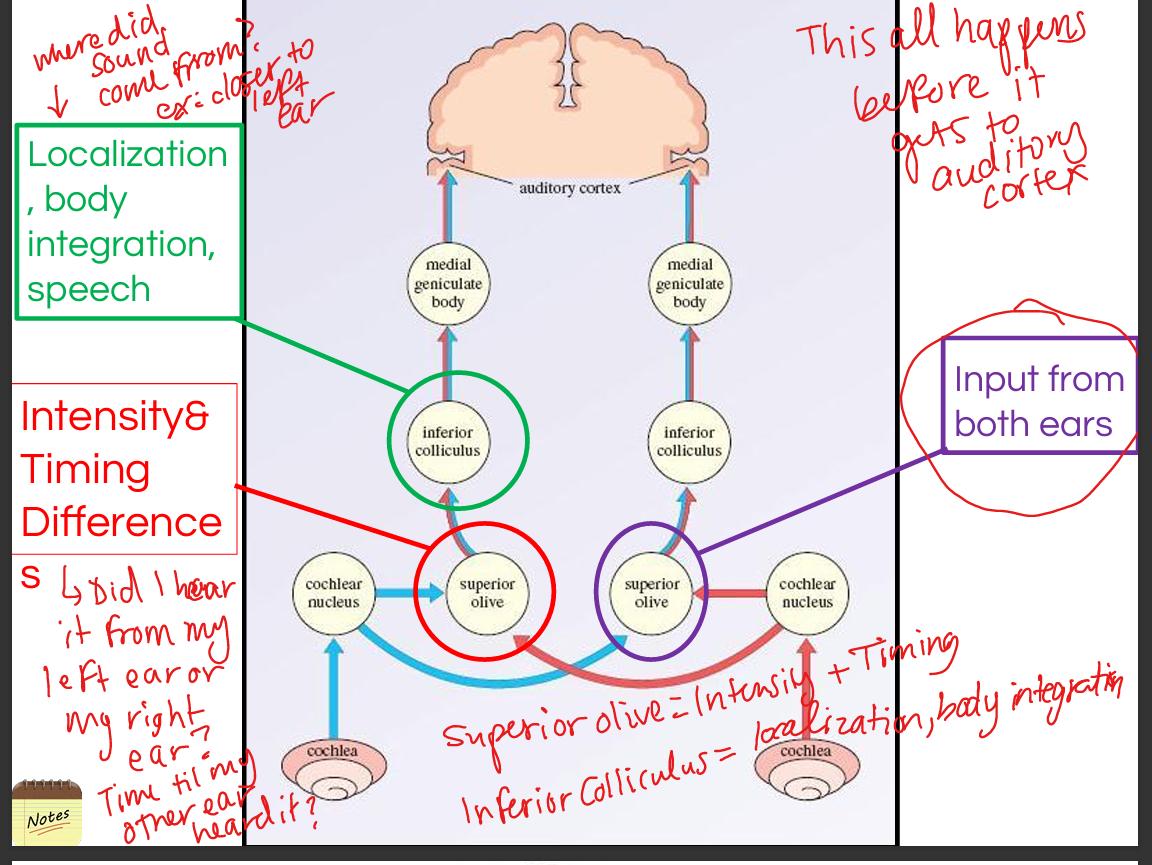
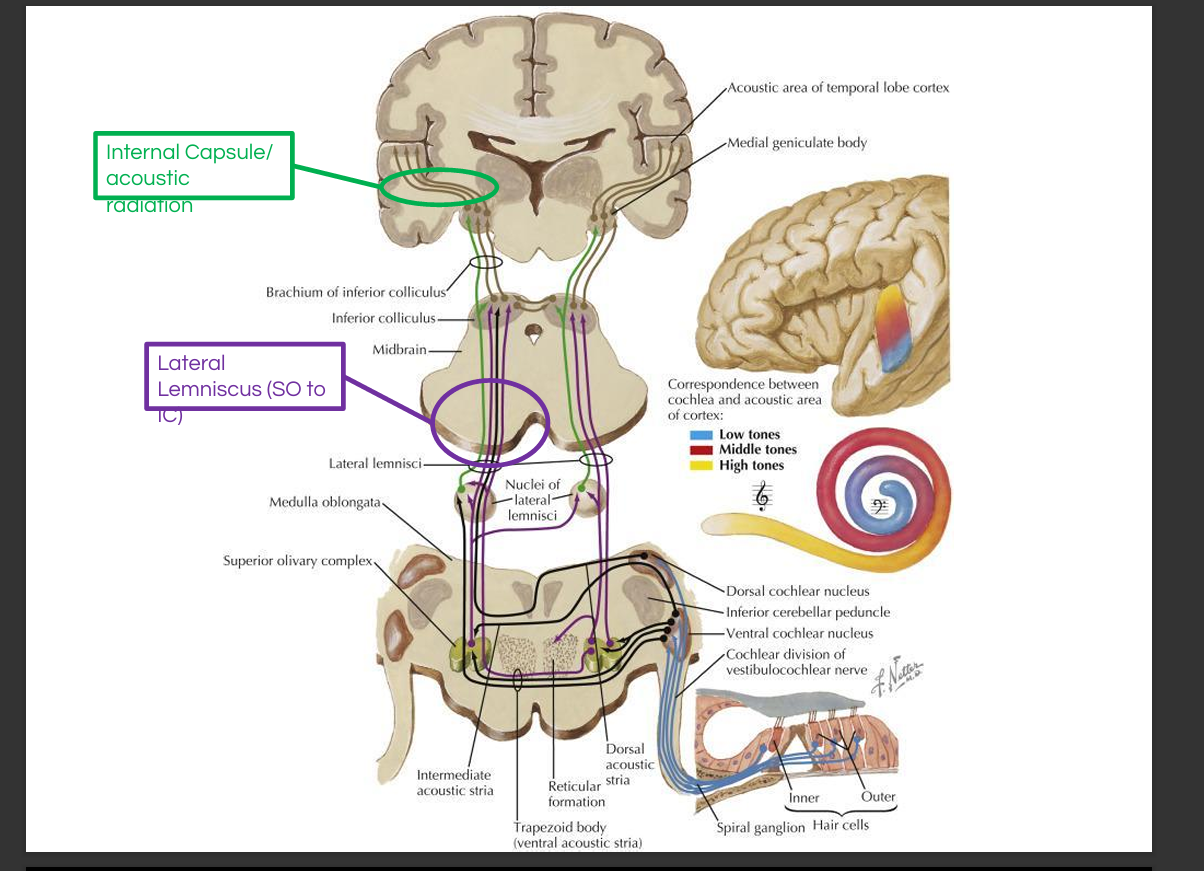
knowt flashcard imageknowt flashcard image

<p>Organ of Corti → spiral ganglion → cochlear nerve → cochlear nuclei → superior olivary complex(intensity+timing) → lateral lemniscus → inferior colliculus(localization + body integration) → medial geniculate nucleus → primary auditory cortex.</p><img src="https://knowt-user-attachments.s3.amazonaws.com/356ee670-7675-4236-9a82-7f5910848a03.png" data-width="100%" data-align="center" alt="knowt flashcard image"><img src="https://knowt-user-attachments.s3.amazonaws.com/f102b0b2-279e-4f90-a0ab-9d6f8f89ec8b.png" data-width="100%" data-align="center" alt="knowt flashcard image"><p></p>
9
New cards

Describe the role of the superior olivary complex.

It computes sound localization using interaural time differences (medial SOC) and interaural intensity differences (lateral SOC).

knowt flashcard image

10
New cards

Describe the role of the inferior colliculus.

It integrates spatial auditory information and contributes to reflexive orientation toward sound.

knowt flashcard image

11
New cards

Describe the role of auditory cortex.

Primary auditory cortex (Heschl’s gyrus) processes pitch and tonotopy; secondary areas process speech, music, and temporal patterns.
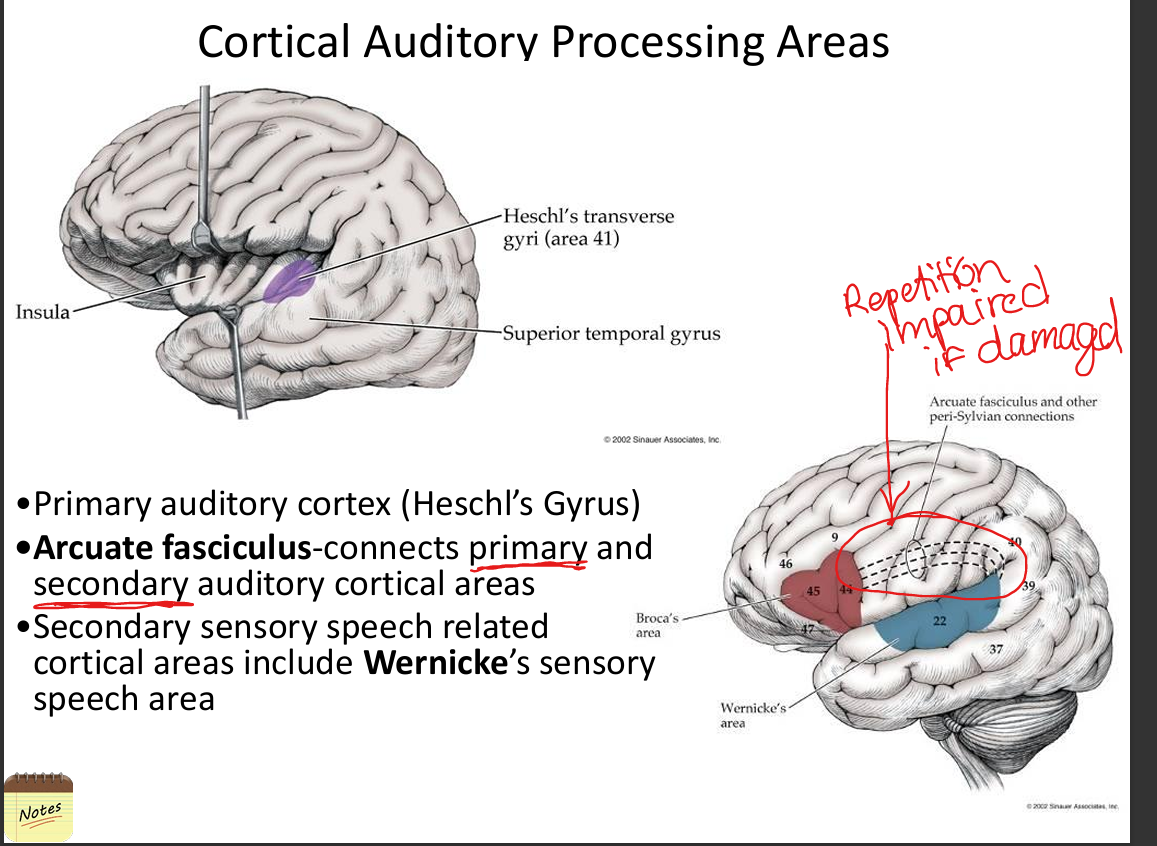
knowt flashcard image

<p>Primary auditory cortex (Heschl’s gyrus) processes pitch and tonotopy; secondary areas process speech, music, and temporal patterns.</p><img src="https://knowt-user-attachments.s3.amazonaws.com/58bb3172-e256-4639-b4c4-210517d8f2a3.png" data-width="100%" data-align="center" alt="knowt flashcard image"><p></p>
12
New cards

Compare conduction vs sensorineural deafness.

Conduction deafness affects outer/middle ear sound transmission; sensorineural deafness affects inner ear hair cells or CN VIII.
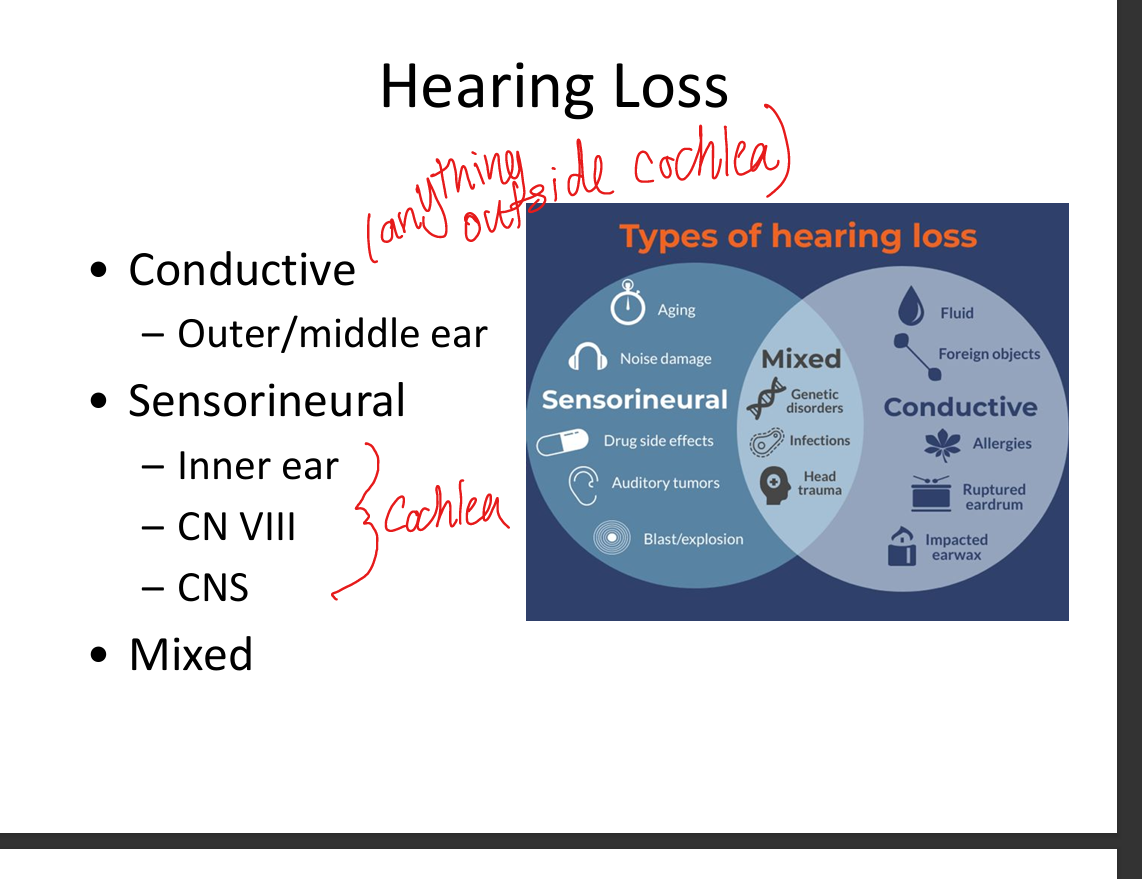
knowt flashcard image

<p>Conduction deafness affects outer/middle ear sound transmission; sensorineural deafness affects inner ear hair cells or CN VIII.</p><img src="https://knowt-user-attachments.s3.amazonaws.com/2365b8cd-75bb-4958-8971-d09b422d6451.png" data-width="100%" data-align="center" alt="knowt flashcard image"><p></p>
13
New cards

Describe clinical tests for conduction vs sensorineural deafness.

Weber: lateralizes to affected ear in conductive loss, to unaffected ear in Sensorineural Hearing Loss.

Rinne: Air Conduction>Bone Conduction =normal/SNHL; Bone Conduction>Air Conduction=conductive.
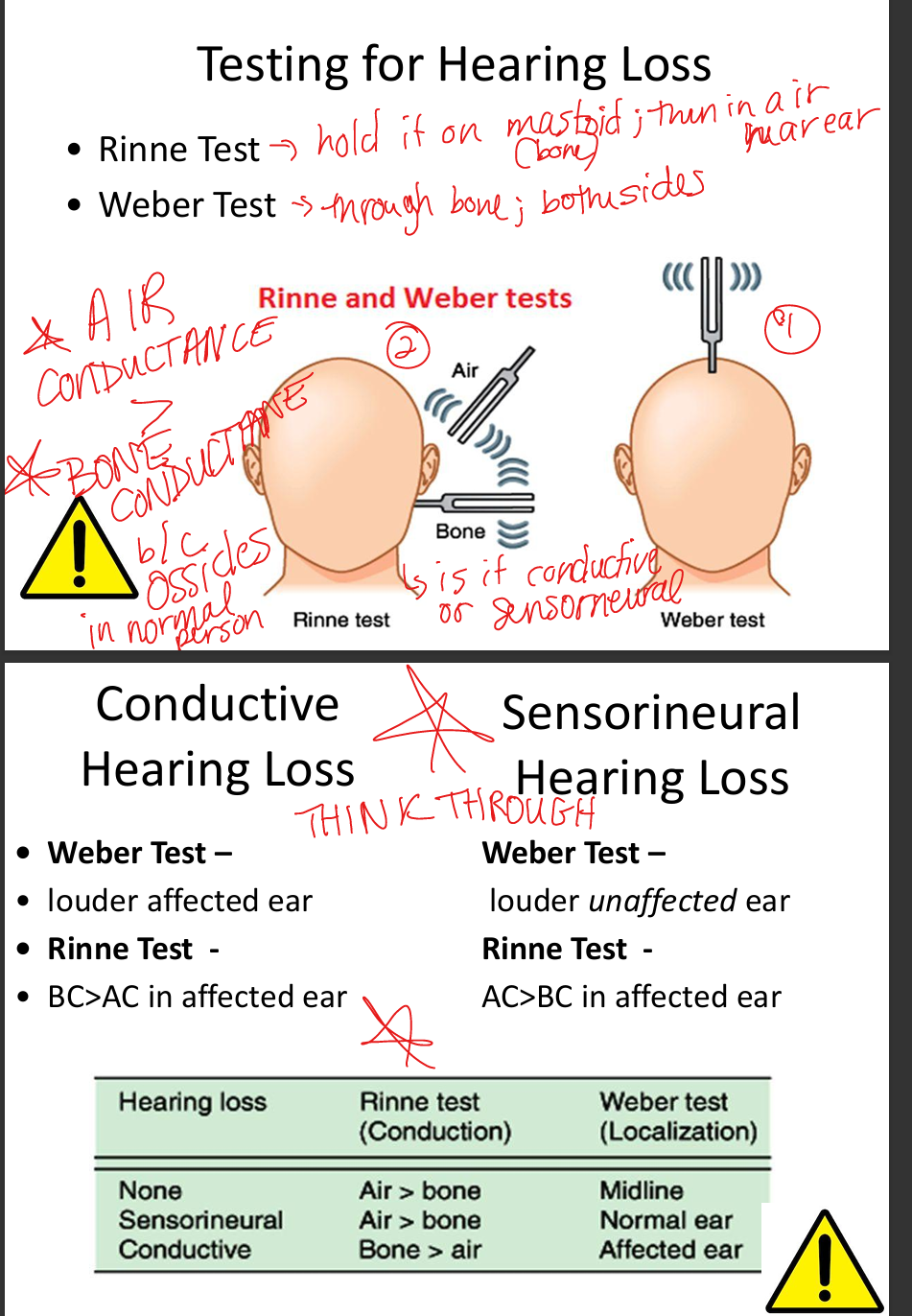
knowt flashcard image

<p><strong>Weber:</strong> lateralizes to affected ear in conductive loss, to unaffected ear in Sensorineural Hearing Loss.</p><p><strong>Rinne:</strong> Air Conduction&gt;Bone Conduction =normal/SNHL; Bone Conduction&gt;Air Conduction=conductive. </p><img src="https://knowt-user-attachments.s3.amazonaws.com/93157b24-21a4-4a80-872b-8344dc5b1f3b.png" data-width="100%" data-align="center" alt="knowt flashcard image"><p></p>
14
New cards

List common conductive hearing pathologies.

Otitis media(ear infection), otosclerosis(abnormal bone growth build up), cholesteatoma, Tympanic membrane perforation, obstruction
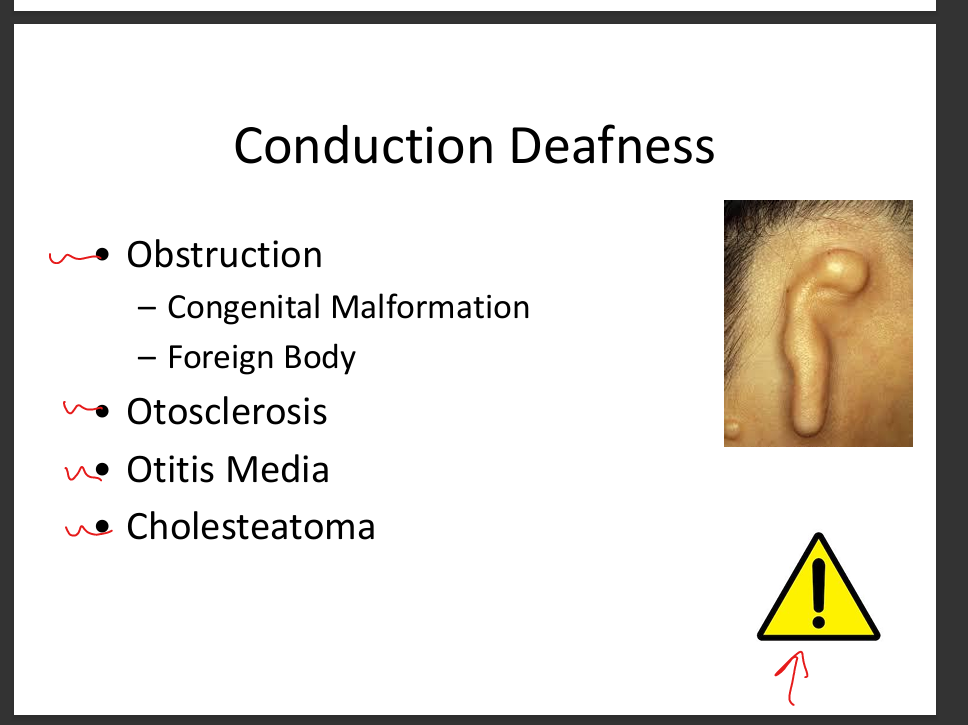
knowt flashcard image

<p>Otitis media(ear infection), otosclerosis(abnormal bone growth build up), cholesteatoma, Tympanic membrane perforation, obstruction</p><img src="https://knowt-user-attachments.s3.amazonaws.com/5412987e-7957-4dee-8c01-a5b3f3615926.png" data-width="100%" data-align="center" alt="knowt flashcard image"><p></p>
15
New cards

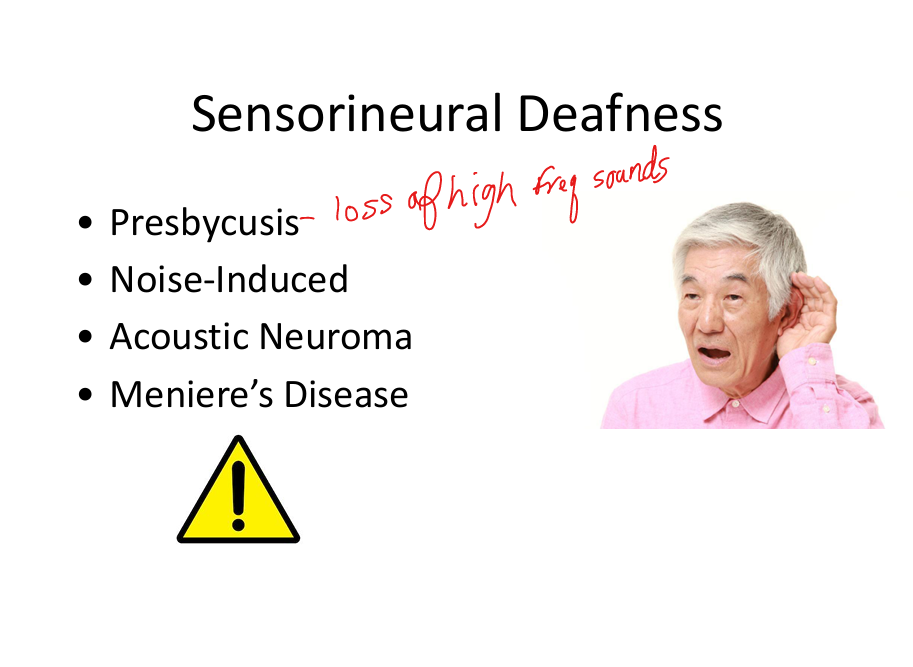
List common sensorineural hearing pathologies.

Presbycusis(loss of high frequency sounds), noise‑induced hair cell loss, Meniere’s disease, vestibular schwannoma, ototoxic drugs (aminoglycosides, loop diuretics).
knowt flashcard image

<p>Presbycusis(loss of high frequency sounds), noise‑induced hair cell loss, Meniere’s disease, vestibular schwannoma, ototoxic drugs (aminoglycosides, loop diuretics).</p><img src="https://knowt-user-attachments.s3.amazonaws.com/add4dd54-3282-4190-b863-627167e179d4.png" data-width="100%" data-align="center" alt="knowt flashcard image"><p></p>
16
New cards

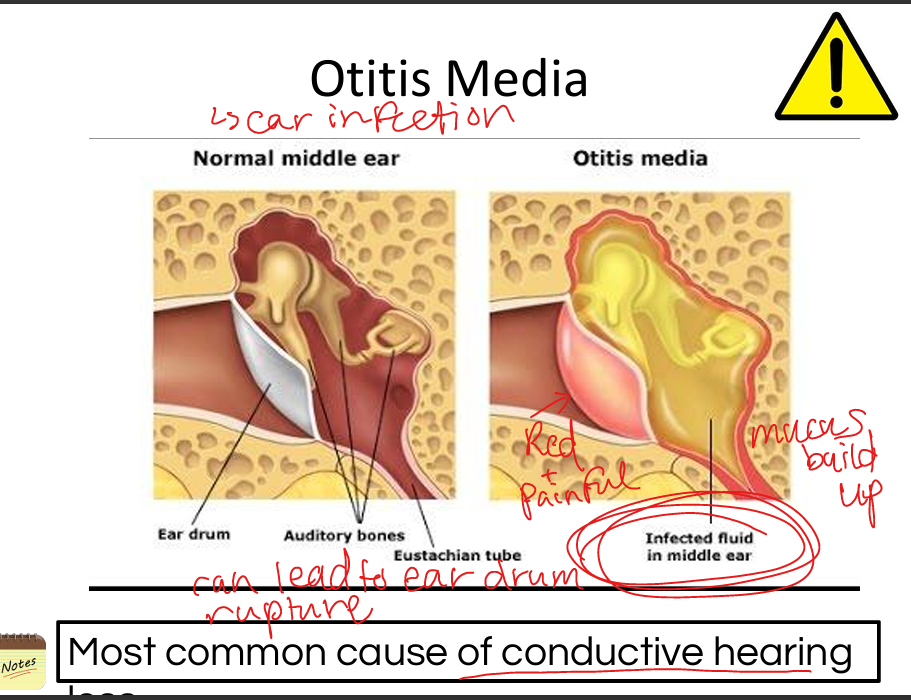
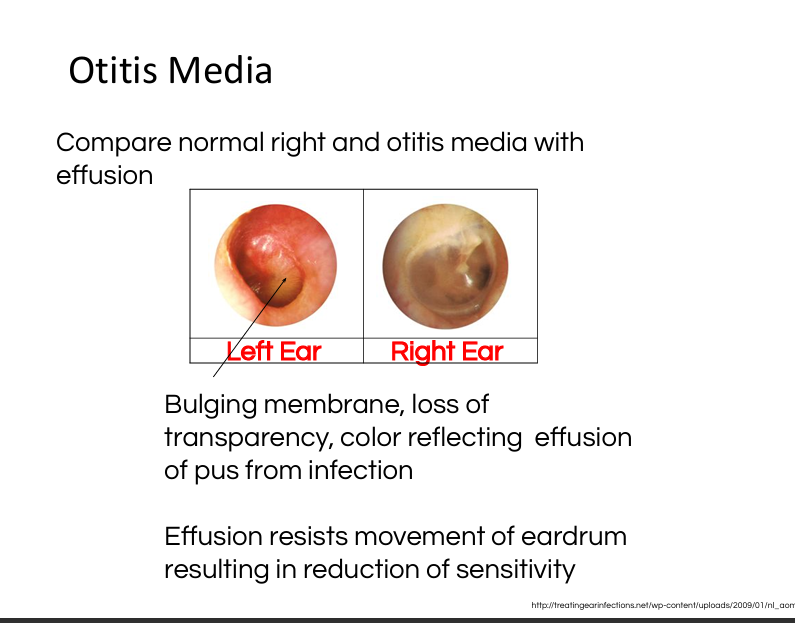
Explain otitis media.

Middle ear infection causing fluid buildup, reduced Tympanic membrane mobility, conductive hearing loss; diagnosed via otoscopy.
knowt flashcard imageknowt flashcard image

<p>Middle ear infection causing fluid buildup, reduced Tympanic membrane mobility, conductive hearing loss; diagnosed via otoscopy.</p><img src="https://knowt-user-attachments.s3.amazonaws.com/cb82261c-e384-4c6b-b750-b55813fbbf00.png" data-width="100%" data-align="center" alt="knowt flashcard image"><img src="https://knowt-user-attachments.s3.amazonaws.com/911c288a-08c1-4b73-abb1-9fa8eda6c7df.png" data-width="100%" data-align="center" alt="knowt flashcard image"><p></p>
17
New cards

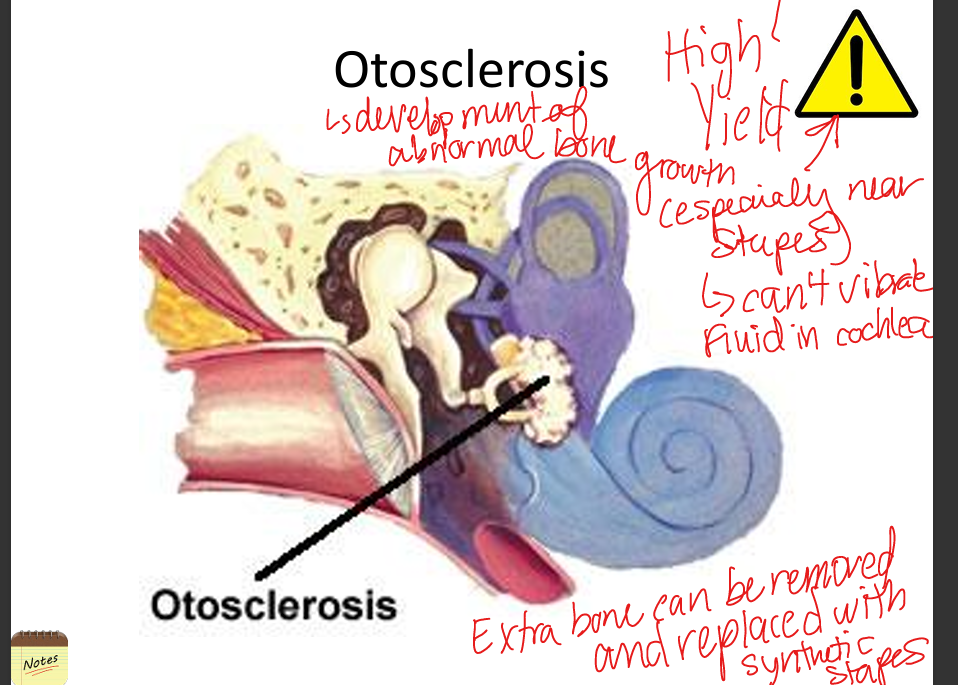
Explain otosclerosis.

Abnormal bone growth around stapes footplate causing fixation and conductive hearing loss; treated with stapedectomy.
knowt flashcard image

<p>Abnormal bone growth around stapes footplate causing fixation and conductive hearing loss; treated with stapedectomy.</p><img src="https://knowt-user-attachments.s3.amazonaws.com/de9d640b-1fb1-45ef-8898-ab3849d65a72.png" data-width="100%" data-align="center" alt="knowt flashcard image"><p></p>
18
New cards

Explain cholesteatoma.

Benign keratinizing cyst in middle ear that erodes ossicles; causes conductive hearing loss and requires surgical removal.
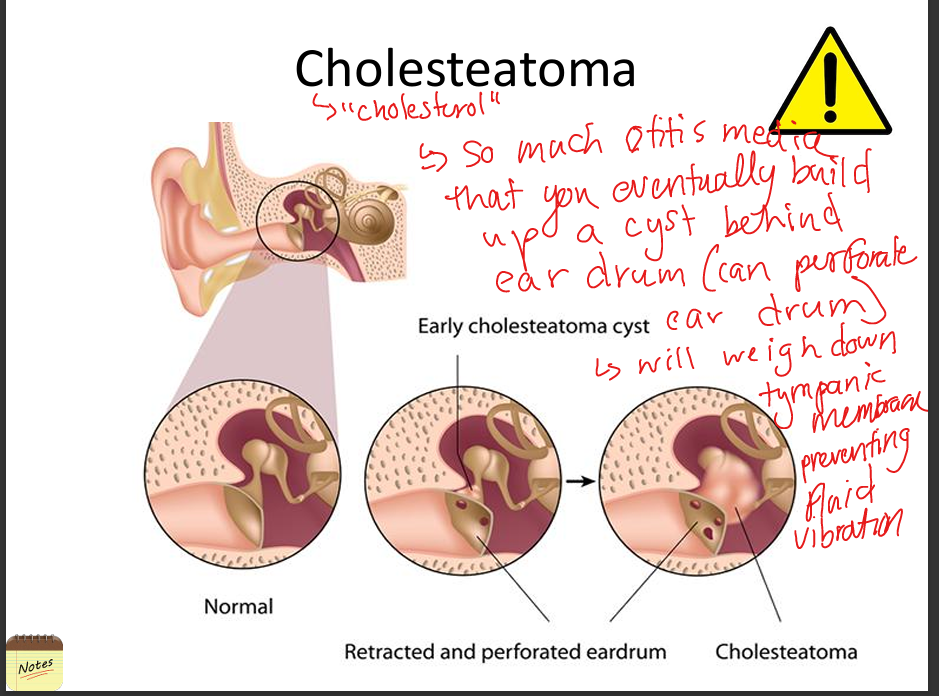
knowt flashcard image

<p>Benign keratinizing cyst in middle ear that erodes ossicles; causes conductive hearing loss and requires surgical removal.</p><img src="https://knowt-user-attachments.s3.amazonaws.com/a8f012fc-5430-46c7-8813-a3b88062e3a4.png" data-width="100%" data-align="center" alt="knowt flashcard image"><p></p>
19
New cards

Explain presbycusis.

Age‑related bilateral high‑frequency sensorineural hearing loss due to hair cell degeneration at cochlear base.
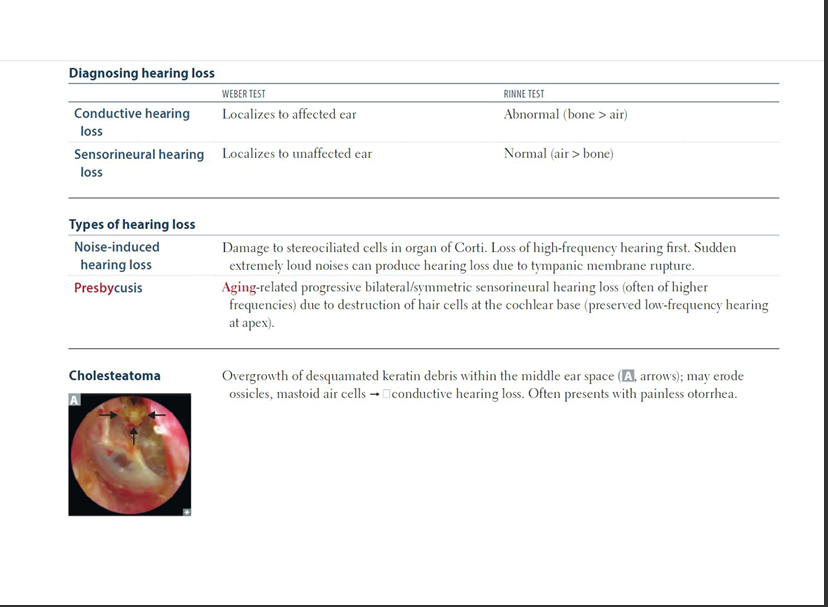
knowt flashcard image

<p>Age‑related bilateral high‑frequency sensorineural hearing loss due to hair cell degeneration at cochlear base.</p><img src="https://knowt-user-attachments.s3.amazonaws.com/b9481a6c-005e-4332-b334-36191acfb00b.png" data-width="100%" data-align="center" alt="knowt flashcard image"><p></p>
20
New cards

Explain noise‑induced hearing loss.

Prolonged loud sound damages outer hair cells; high frequencies lost first; irreversible.
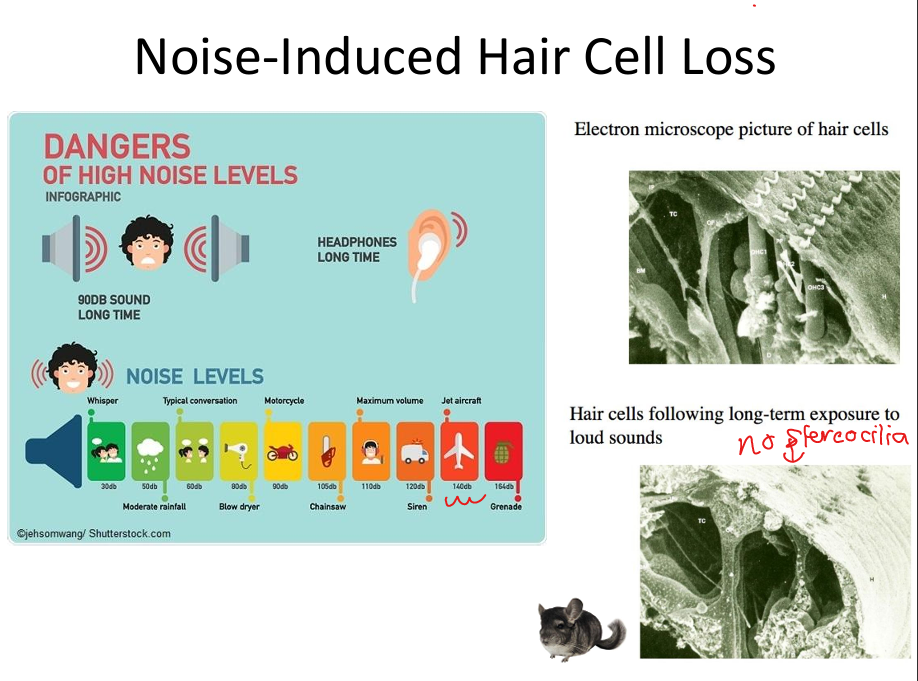
knowt flashcard image

<p>Prolonged loud sound damages outer hair cells; high frequencies lost first; irreversible.</p><img src="https://knowt-user-attachments.s3.amazonaws.com/68422739-a9cb-4e18-ad72-0fcedbea9270.png" data-width="100%" data-align="center" alt="knowt flashcard image"><p></p>
21
New cards

Explain Meniere’s disease.

Excess endolymph causes episodic vertigo, fluctuating hearing loss, tinnitus, and ear fullness.

(Men have too much fluid)
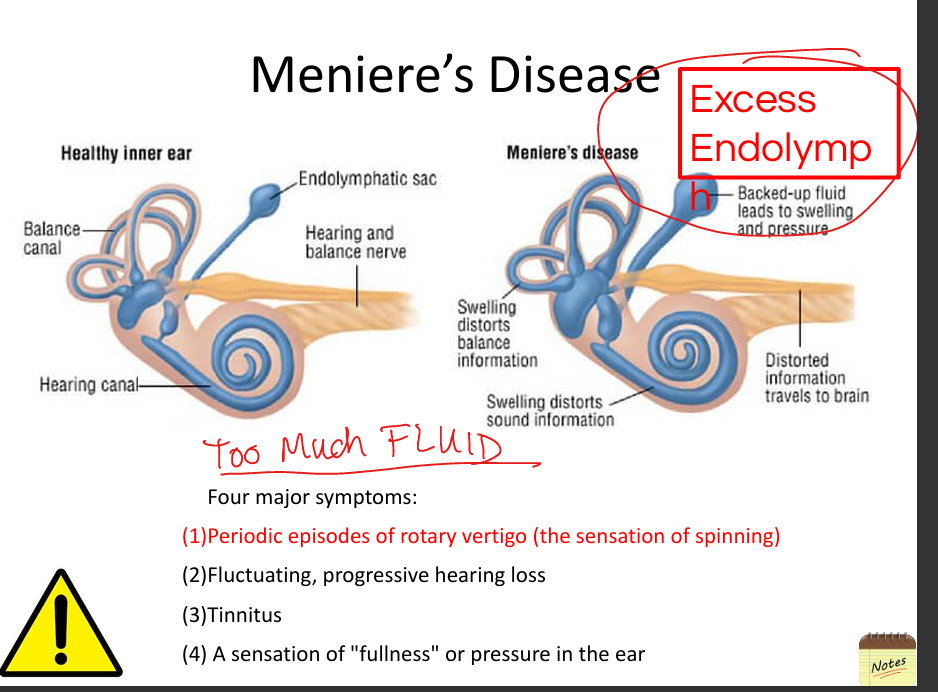
knowt flashcard image

<p>Excess endolymph causes episodic vertigo, fluctuating hearing loss, tinnitus, and ear fullness.</p><p>(Men have too much fluid)</p><img src="https://knowt-user-attachments.s3.amazonaws.com/691b67c8-def2-4383-b017-aaec440c8873.png" data-width="100%" data-align="center" alt="knowt flashcard image"><p></p>
22
New cards

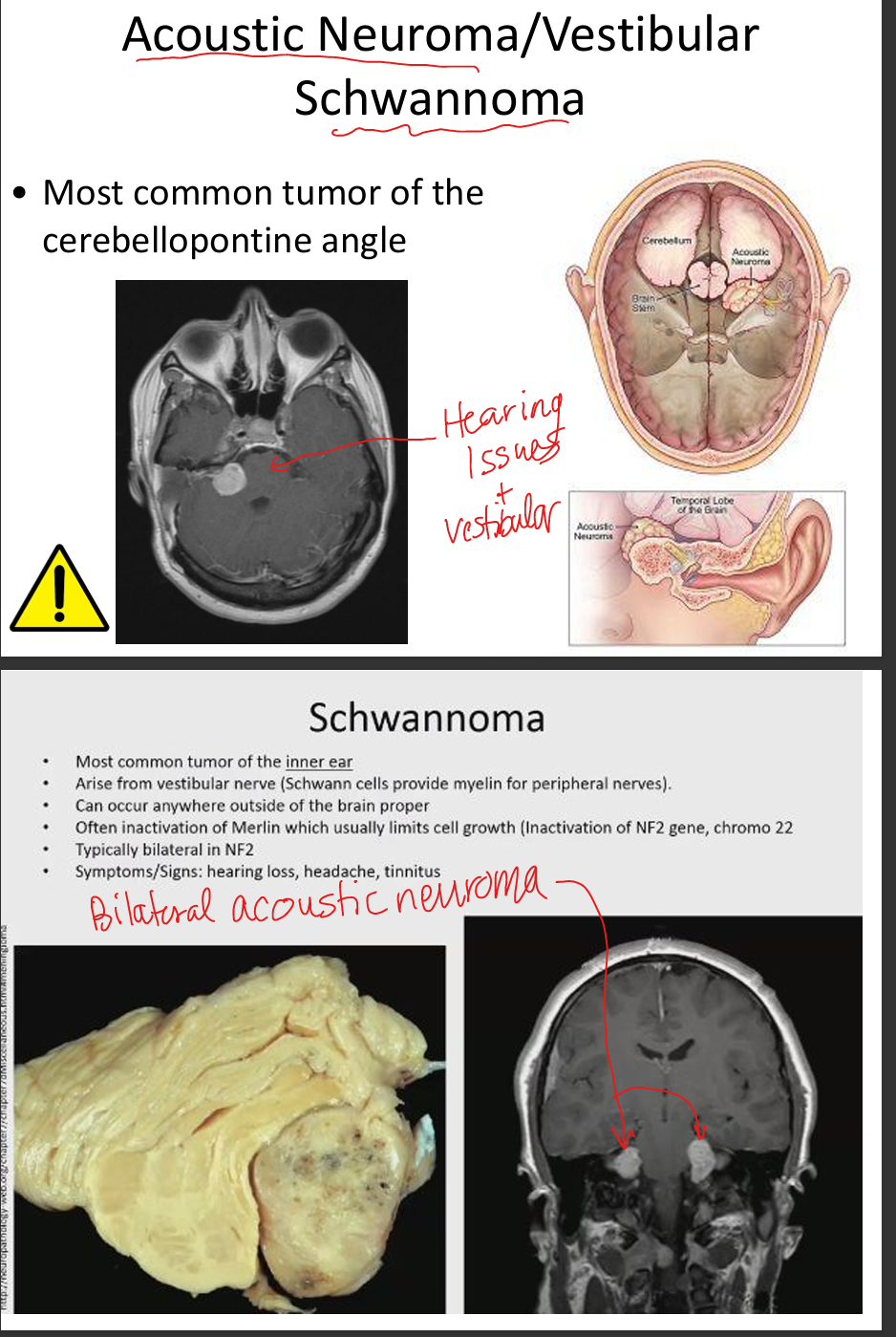
Explain vestibular schwannoma.

Benign tumor of CN VIII Schwann cells causing unilateral SNHL, tinnitus, imbalance; diagnosed with MRI.
knowt flashcard image

<p>Benign tumor of CN VIII Schwann cells causing unilateral SNHL, tinnitus, imbalance; diagnosed with MRI.</p><img src="https://knowt-user-attachments.s3.amazonaws.com/f4a449cf-a50c-4a03-99a9-f75a9d5f1730.png" data-width="100%" data-align="center" alt="knowt flashcard image"><p></p>
23
New cards

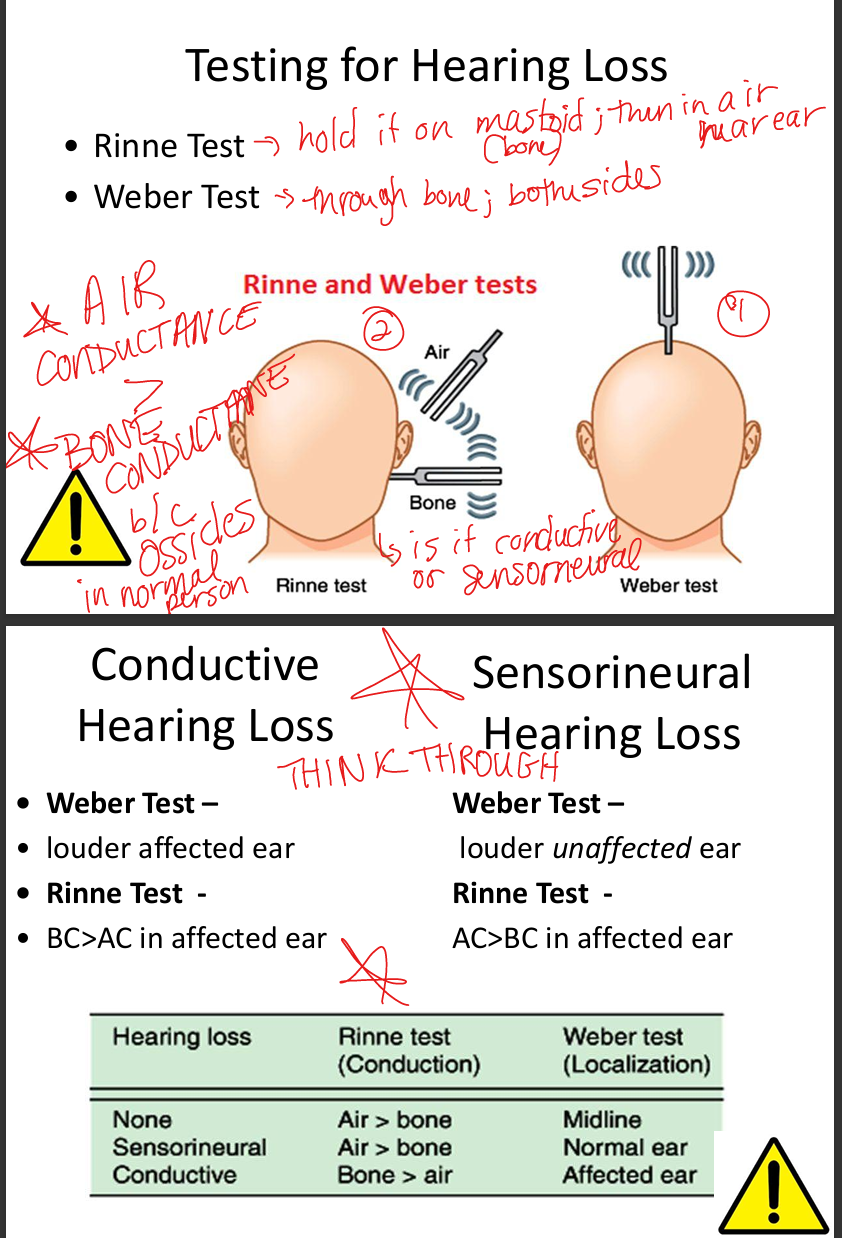
Describe Rinne test interpretation.

AC>BC = normal or SNHL; BC>AC = conductive loss.
knowt flashcard image

<p>AC&gt;BC = normal or SNHL; BC&gt;AC = conductive loss.</p><img src="https://knowt-user-attachments.s3.amazonaws.com/af7f9cef-721f-45f7-95be-f354b727e4cd.png" data-width="100%" data-align="center" alt="knowt flashcard image"><p></p>
24
New cards

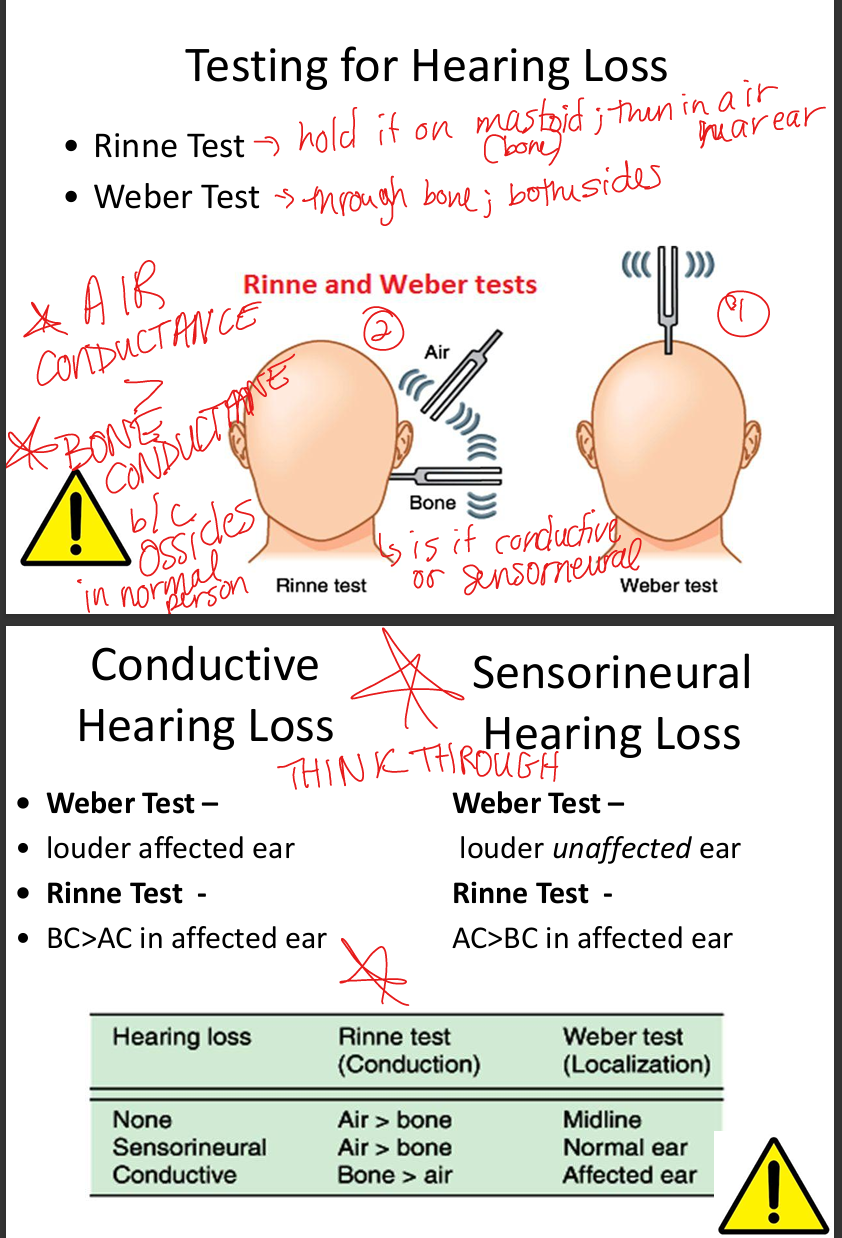
Describe Weber test interpretation.

Lateralizes to affected ear in conductive loss; to unaffected ear in SNHL.
knowt flashcard image

<p>Lateralizes to affected ear in conductive loss; to unaffected ear in SNHL.</p><img src="https://knowt-user-attachments.s3.amazonaws.com/bbf01d5d-5239-4315-ad4e-892c68538e8d.png" data-width="100%" data-align="center" alt="knowt flashcard image"><p></p>
25
New cards

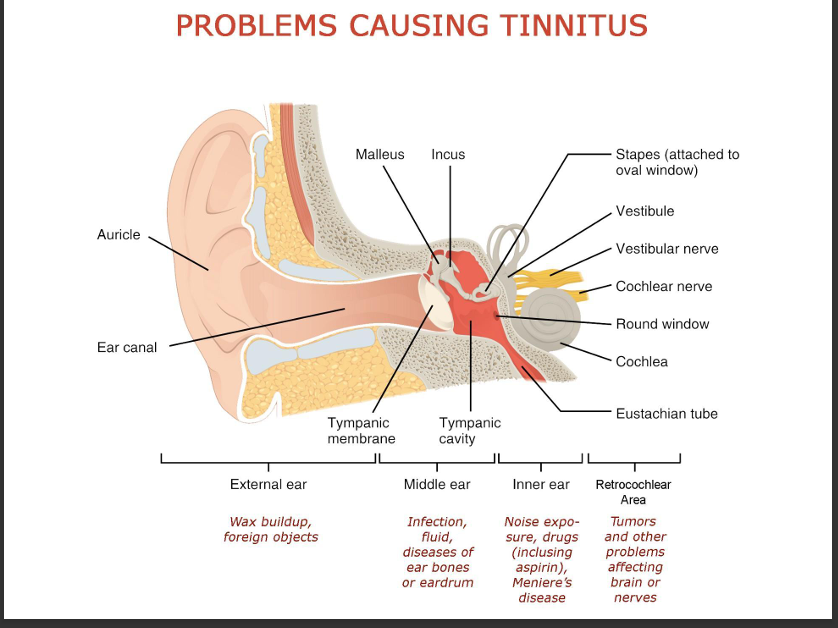
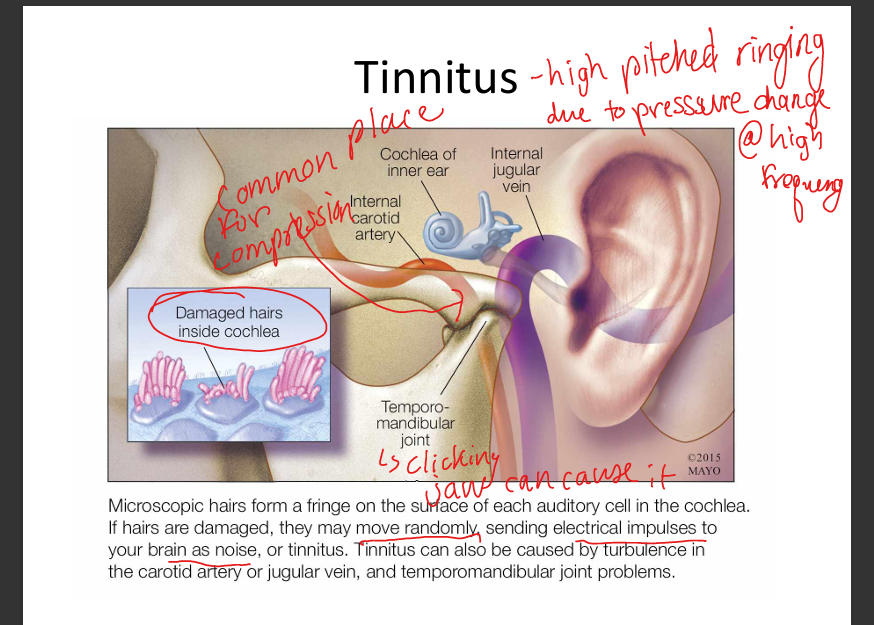
What is tinnitus? What can cause it?

High pitched ringing due to pressure change at high frequency. Causes: Foreign objects, infection, fluid, hair cell damage, turbulance in internal carotid artery and internal jugular vein, or temporomandibular joint porblems.
knowt flashcard imageknowt flashcard image

<p>High pitched ringing due to pressure change at high frequency. Causes: Foreign objects, infection, fluid, hair cell damage, turbulance in internal carotid artery and internal jugular vein, or temporomandibular joint porblems.</p><img src="https://knowt-user-attachments.s3.amazonaws.com/54a8ba92-816a-40ee-8e4a-2218259bcf90.png" data-width="100%" data-align="center" alt="knowt flashcard image"><img src="https://knowt-user-attachments.s3.amazonaws.com/7ff4d5f3-21f2-48ac-ad8f-15679b8e90ad.png" data-width="100%" data-align="center" alt="knowt flashcard image"><p></p>