Cell-to-cell communication
 Call Kai
 Learn
Learn Practice Test
 Spaced Repetition
 Match
Match Flashcards
 Knowt Play
1/10

There's no tags or description
Looks like no tags are added yet.
Name | Mastery | Learn | Test | Matching | Spaced | Call with Kai |
|---|
No analytics yet
Send a link to your students to track their progress
11 Terms
Electrical signals
changes in cell’s membrane potential
→ caused by ion flux —flow—(ex: depolarization, hyperpolarization, repolarization
Chemical signals
molecules secreted by cells into the extracellular fluid
→ active process of secretion: exocytosis
What do we call the cells that create and release these signals to communicate information?
They are called “signal generators”
they control the function of other cells in he body
→ typically neurons, endocrine cells, or immune cells
What do we call the cells that receive or respond to these signals
They are called “target cells”
These could be any cell in your body that performs an action (ex: skeletal muscle cells, cardiac muscle cells, glandular cells, etc)
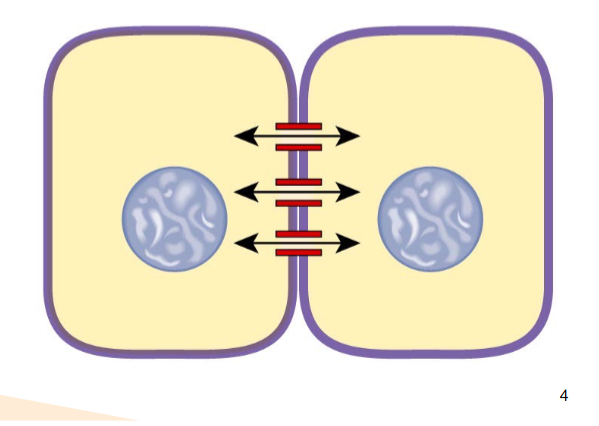
LOCAL cell to cell communication: Gap junctions
form direct cytoplasmic connections between adjacent cells
NOT channels
the fastest form of cell-to-cell communication, they work simultaneously
There is a physical connection between the cytosol of adjacent cells through complexes of membrane-spanning proteins called connexins
There can be a transfer of chemical and/or electrical connected cells
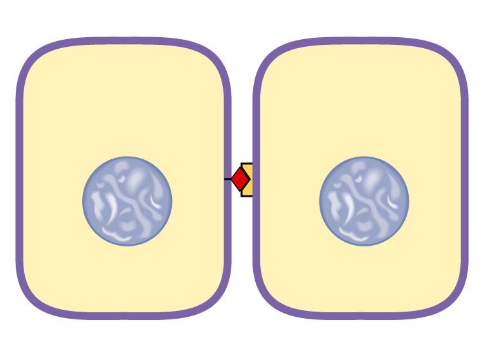
LOCAL cell to cell communication: Contact dependent signals
require interaction between membrane molecules on two cells
via Cell-adhesion molecules (CAMs)
Surface molecules on one bind to protein receptors on the other
Transfers signals in both directions
→ both cells will change function in a specific way
~cells “kiss" and then go opposite directions lol
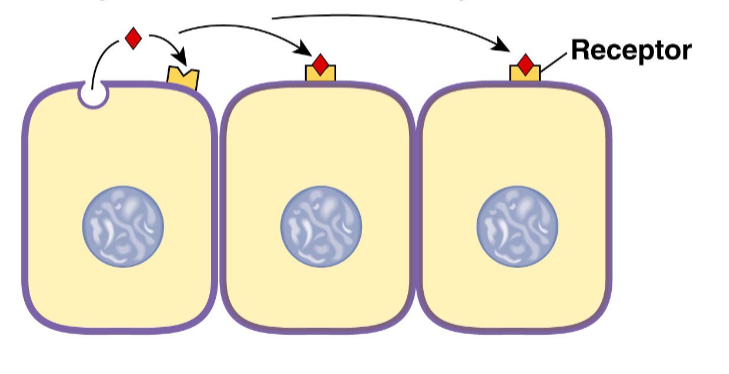
LOCAL cell to cell communication: Autocrine signals + Paracrine signals
Autocrine signals (“auto” = self)
act on the same cell that secreted them
Paracrine signals (“para” = beside or nearby
are secreted by one cell and diffuse to adjacent cells
→ Cells can also secrete signal molecules by exocytosis to affect the function of target cells
→ Paracrine and autocrine signal molecules exist throughout the body
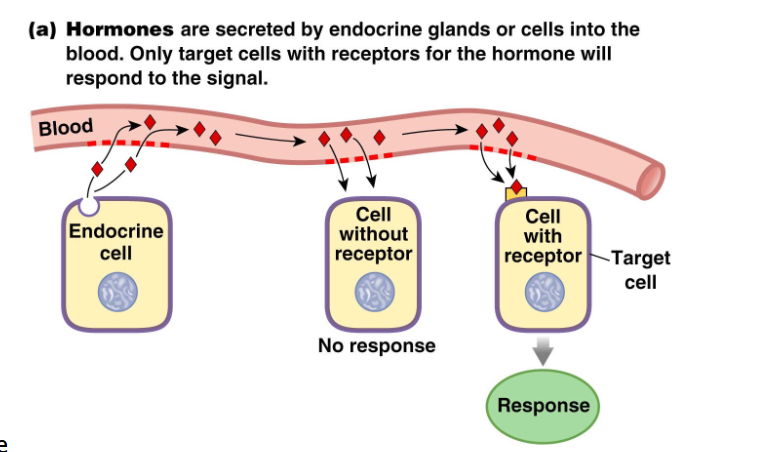
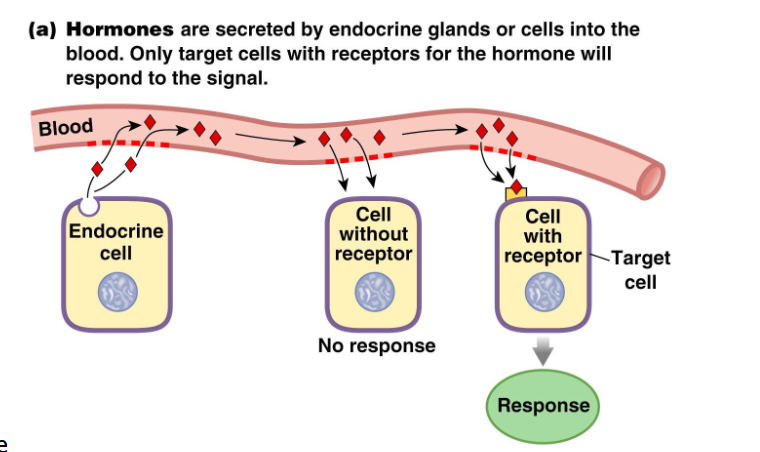
LONG-DISTANCE cell-to-cell communication: Hormones
released by specialized endocrine cells/glands
Travel through blood to distant target cells
→ Target cell has receptor for the hormone
→ May take some time to get there; typically mediate slow changes in body function
LONG-DISTANCE cell-to-cell communication: Cytokines
are very similar to hormones, but since they are also released into the blood, but….
They are made on demand (NOT stored in vesicles, like hormones)
They are NOT released from specialized cells. Cytokines can be produced in and secreted from ANY nucleated cell in the body
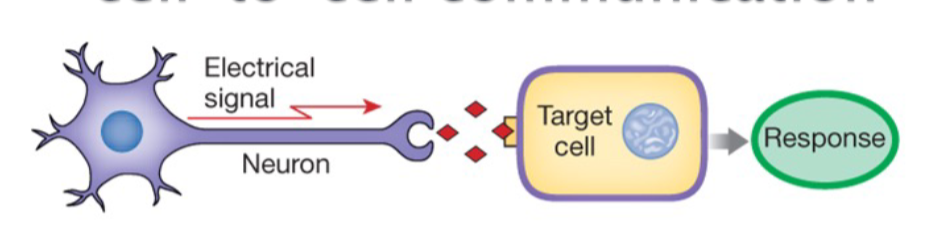
LONG-DISTANCE cell-to-cell communication: Neurotransmitters (NT) and Neuromodulators
released from an axon terminal of a neuron into a synaptic cleft
Cross synapse to its target cell (only a few nanometers away)
→ Neurotransmitters (NT): have a very fast effect on the target cell’s function
→ Neuromodulators (NM): lead to longer-term changes inn target cell function
Narrow synaptic cleft and length of axon allows for very fast, long-distance communication (ex: spinal cord to/from arm or leg muscles)
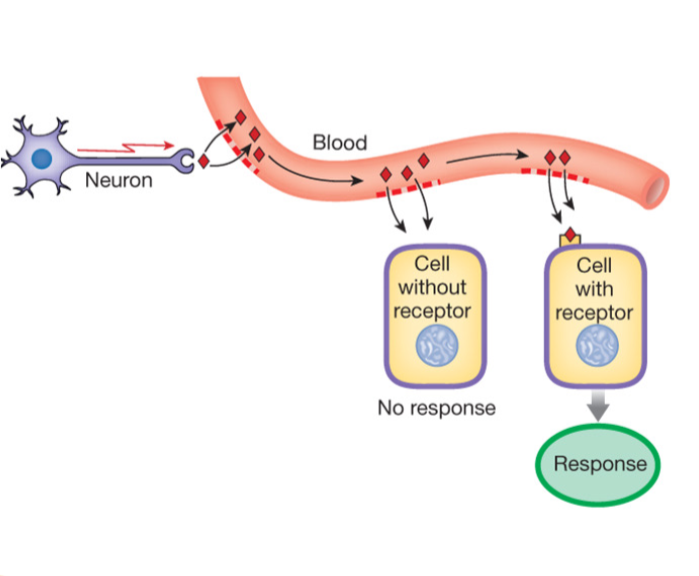
LONG-DISTANCE cell-to-cell communication: Neurohormone
Longer distance, but slower than a NT or NM
→ Neuro = from neuron
→ hormone = signal molecule released into the blood
binds to target cells with specific receptors and changes their function in specific ways

