Nondisjunction and Mutations
 Call Kai
 Learn
Learn Practice Test
 Spaced Repetition
 Match
Match Flashcards
 Knowt Play
1/10

There's no tags or description
Looks like no tags are added yet.
Name | Mastery | Learn | Test | Matching | Spaced | Call with Kai |
|---|
No analytics yet
Send a link to your students to track their progress
11 Terms
Mutations
A mutation is a change in a DNA sequence
Ex. Albinism - a mutation that causes a lack of pigmentation in someone’s skin, hair and eyes.
They usually have sensitivity to light, increased risk of skin cancer, and vision problems.
This mutation also shows up in animals, such as squirrels!
Two Types:
Changes in Chromosome Number
Changes in Chromosome Structure
Change in Chromosome Number
Non-disjunction: a type of mutation when chromosomes fail to separate properly. This can happen in mitosis, but is most common in meiosis I and meiosis II.
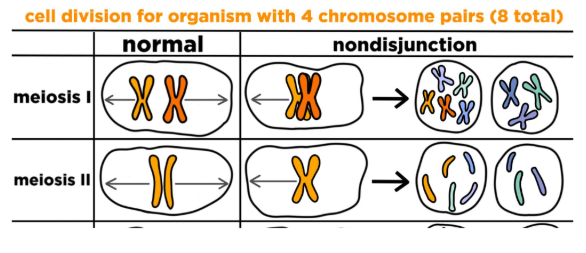
Errors in Meiosis
Mistakes in meiosis can result in an abnormal number of chromosomes in an egg or sperm cell.
The child produced from this zygote (following mitosis and differentiation) will have cells with too few or too many chromosomes, a condition known as aneuploidy
Abnormal Chromosome Number
If fertilization involves a sex cell that is missing a chromosome, the resulting child will have only one copy of a particular chromosome, a condition known as monosomy.
If fertilization involves a sex cell that has an extra chromosome, the resulting child will have three copies of a particular chromosome, a condition known as polysomy, or Trisomy.
Down Syndrome
Typically, a baby is born with 46 chromosomes. Babies with Down syndrome have an extra copy of one of these chromosomes, chromosome 21.
This extra copy changes how the baby’s body and brain develop, which can cause both mental and physical challenges for the baby.
Turner Syndrome
In females who have Turner syndrome, one copy of the X chromosome is missing, partially missing or changed.
The loss or alteration of the X chromosome occurs randomly. Sometimes, it's because of a problem with the sperm or the egg, and other times, the loss or alteration of the X chromosome happens early in fetal development.
Klinefelter syndrome
Klinefelter syndrome is a common genetic condition in which males have an additional X chromosome.
Symptoms may include breast growth, infertility, osteoporosis and learning difficulties.
Treatments usually involve physical and emotional therapy, as well as hormone replacement.
Karyotypes
An ordered display of enlarged photocopies of an individual’s chromosomes arranged in pairs, according to their size and structure shows the chromosomes condensed and doubled, as they appear in metaphase of the cell cycle
Organisms of the same species usually have the same karyotype (unless a mutation (error) is presence) in an individual
Change in Chromosome Structure
Errors in chromosome structure:
Deletion
Duplication
Cri du Chat
Cri du chat syndrome, or cat cry syndrome, is a rare genetic disorder that happens because of a missing piece (deletion) in chromosome 5
It gets its name from the distinct cry that infants with the disease make — it sounds like the high-pitched mewing of a cat. “Cri du chat” means “cry of the cat” in French.
There is no cure for this condition.
Charcot-Marie-Tooth Disease
Named after the 3 doctors that discovered the disease
Most cases are caused by the duplication of a gene on chromosome 17
The most common symptoms are muscle weakness and the loss of sensation in the lower legs, feet, and hands.
A high foot arch with constantly flexed toes is often present.
There is no cure for this disorder.

