Unit 6 Periodic Trends: Chemistry
 Studied by 3 people
 Call Kai
 Learn
Learn Practice Test
 Spaced Repetition
 Match
Match Flashcards
 Knowt Play
1/19

There's no tags or description
Looks like no tags are added yet.
Name | Mastery | Learn | Test | Matching | Spaced | Call with Kai |
|---|
No analytics yet
Send a link to your students to track their progress
20 Terms
Group 18
The Noble Gases
Group 1
Alkali Metals
Group 2
Alkaline Earth Metals
Group 17
Halogens
Periodic Law
Properties of elements often repeat
Actinides
Botton row of the two block row
Lanthanides
Top row of the two block row
nonmetals
Everything on the upper right hand curner after metalloids + Hydrogen
Metalloids
B, Si, Ge, As, Sb, Te, Po
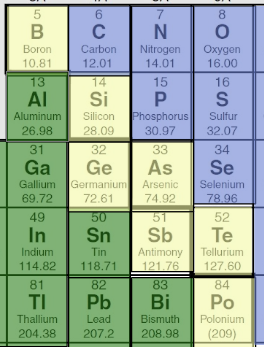
Transition Metals
Groups 3-12
Atomic size/radii is measured…
from teh distance from the center to the outer edge of an atom in picometers (pm)
Atomic size trends (groups and periods)
Increases as it moves down a group and decreases going left to right in a period.
Ionic radii trends (periods and groups)
Ionic raddi increases going down groups and decreases going left to right
Ionization Energy Trends (periods and groups)
Decreases going down a group increases going left to right
Electronegativity Trends (periods and groups)
Decreases going down a group increases going left to right
Ioinc Size trends
Lower value ions are always bigger, tif it is the same it is determined by periodic trend
Cations
Positive ions, because they have lost one or more negativley charged electrons, leaving more protons than electrons
Anions
Negative ions, because they have gained one or more negativley charged electrons resulting in more electrons than protons
Ionization energy
energy required to remove an electrons from an atom, each time you take an electron it takes more energy to remove the next
Ions form
Through ionization where neutral atoms gain or lose electrons to achieve a stable, full outer electron shell, typically mimicking a noble gas configuration. Metals become cations and non metals become anions.
 Note
Note  Flashcards (106)