geo exam 1
0.0(0)
 Studied by 0 people
 Call Kai
 Learn
Learn Practice Test
 Spaced Repetition
 Match
Match Flashcards
 Knowt Play
Card Sorting
1/374

Earn XP
Description and Tags
Last updated 3:05 AM on 12/8/22
Name | Mastery | Learn | Test | Matching | Spaced | Call with Kai |
|---|
No analytics yet
Send a link to your students to track their progress
375 Terms
1
New cards
subduction zones were discovered when
it was noticed that deep earthquakes are found only near ocean trenches, and that earthquakes increase in depth with distance from trench-only one one side (earthquakes are concentrated on plate boundaries, deep earthquakes=ocean trench, earthqakes mark subduction-EARTHQUAKES AND TRENCH RELATIONSHIP-bc normally earthquakes aren't possible in asthenosphere)
2
New cards
tectonic plates of ridgid and brittle lithosphere move over a softer and ductile asthenosphere below
:)
3
New cards
the division of earths interior to mantle/core/crust is used to describe differences in
composition (chemical, physical, behavior)-solid/liquid, how it deforms-->melting point: below (regid+solid), close (soft solid), above (liquid-rare)
-core: mantle warmer, iron
-crust: lighter silicates
-mantle: iron magnesium silicates
-core: mantle warmer, iron
-crust: lighter silicates
-mantle: iron magnesium silicates
4
New cards
what is the relationship between the crust and lithosphere
lithosphere includes both crust+upper mantle (chemical properties of crust+mantle)
5
New cards
how did earths formation make plates possible
-large amounts of heat
-melted as formed which made layers by densities
-heat left from formation means convenction creates motions
-melted as formed which made layers by densities
-heat left from formation means convenction creates motions
6
New cards
crust vs mantle
-crust has more light silicas
(Na, K vs heavy/mantle Fe, Mg)
(Na, K vs heavy/mantle Fe, Mg)
7
New cards
magnetic patterns in rocks making up the oceanic crust appear as
bands of normal and reversed magnetization parallel to the oceanic ridge
8
New cards
oceanic crust is youngest at ridge and gets older with increasing distance away from ridge
:)
9
New cards
when 2 oceanic plates collide
the older subducts
10
New cards
location+ages of Hawaii islands shows
rate+movement of pacific plate
11
New cards
geologic evidence that led to discovery of seafloor spreading
new material being pushed out, old rock farther from ridge, magnetic patters allowed for tracking
12
New cards
geologic evidence that led to discovery of subduction
earthquakes during subduction, strength of earthquake nearer or farther away, volcanoes formed
13
New cards
cleavage
minerals breaking where bonding between atoms is weak
14
New cards
ice is a mineral
:)
15
New cards
accreted terrains are added by
subduction
16
New cards
at a passive continental margin the prime geologic process occuring is
sedimentation (thin crust makes a shelf for sediment to gather on)
17
New cards
solid solution
subsitutuion/proportions
18
New cards
costal ranges formed by
accreation of buoyant material onto overriding plate
19
New cards
cascades formed by
magma intrusion+volcanism above subduction plate
20
New cards
why are silicate minerals so common in crust
most common elements are O and silicon
21
New cards
oxide example:
hematite
22
New cards
biotite vs muscovite
biotite (sheet silicate with excellent cleavage in one direction?) has 2 cleavage directions, muscovite has 1
23
New cards
which mineral is hardest
:)
24
New cards
tectonic cycle
-rift breaks apart continent
-new divergent/ridge forms
-ocean basin forms
-subduction as older (closes again, not wider)
-terranes accreted to continent
-continents collide when oceanic crust completely subducted
red sea, pangea, mountains of west coast/coastal range
-new divergent/ridge forms
-ocean basin forms
-subduction as older (closes again, not wider)
-terranes accreted to continent
-continents collide when oceanic crust completely subducted
red sea, pangea, mountains of west coast/coastal range
25
New cards
Planetary accretion
gravitational attraction+collision between smaller fragments-produced planets (shooting star, kinetic engery converted on impact into heat, resulted in melting of earth/more mobile in liquid state)
26
New cards
Earth’s internal structure: layers of different composition; layers of different physical properties – be able to use and explain both sets of terminology
-lithosphere (crust+upper mantle, cool+rigid+strong but breakable)
-asthenosphere (upper mantle, warmer+soft+flowable, close to melting point-where convection occurs)
-mesophere (lower mantle, high melting point bc high pressure+strong)
-outer core (liquid)
-inner core (solid)
-physical state+behavior: determined by proximity to melting point, controlled by temp+pressure+composition
-below melting point: rigid, solid, brittle
-close to melting point: soft solid
-above melting point: liquid, lacks strength
(core, mantle, crust)
-asthenosphere (upper mantle, warmer+soft+flowable, close to melting point-where convection occurs)
-mesophere (lower mantle, high melting point bc high pressure+strong)
-outer core (liquid)
-inner core (solid)
-physical state+behavior: determined by proximity to melting point, controlled by temp+pressure+composition
-below melting point: rigid, solid, brittle
-close to melting point: soft solid
-above melting point: liquid, lacks strength
(core, mantle, crust)
27
New cards
Tectonic setting of the Pacific Northwest and the plates involved.
-pacific plate: ocean
-juan de fuca plate: small, in ocean off coast, will cause big one?
-north american plate
-an active plate boundary, specifically an ocean-continent convergent plate boundary with a subduction zone.
-juan de fuca plate: small, in ocean off coast, will cause big one?
-north american plate
-an active plate boundary, specifically an ocean-continent convergent plate boundary with a subduction zone.
28
New cards
subatomic particles and the structure of the atom, isotopes, ions, types of bonding.
-ions: change number of electrons (cation: lose, anion: gain)
-isotopes: The atoms belonging to the same element, having same atomic number Z, but different mass number A
-bonding: ionic (negative+positive attract and stick), covalent (sharing an electron rather than transfer), metallic (middle periodic table, share electron with multiple, conducts electricity)
-isotopes: The atoms belonging to the same element, having same atomic number Z, but different mass number A
-bonding: ionic (negative+positive attract and stick), covalent (sharing an electron rather than transfer), metallic (middle periodic table, share electron with multiple, conducts electricity)
29
New cards
families of silicate minerals with examples of minerals from each group
-isolated: olivine (not linked)
-single chain: pyroxene
-double chain: amphibole
-sheet: muscovite
-network: quartz
-single chain: pyroxene
-double chain: amphibole
-sheet: muscovite
-network: quartz
30
New cards
Describe the earth’s structure, in terms of both chemical composition and physical properties.
iron, oxygen, silicon, magnesium, ect.
oceanic crust, continental crust, plates?
oceanic crust, continental crust, plates?
31
New cards
How does accretion and differentiation make plate tectonics possible?
layers?
32
New cards
what causes plates to move
convection in ductile asthenospher (heat)
-accreation+radioactivite decay make heat
-accreation+radioactivite decay make heat
33
New cards
What is the scientific method?
observe, hypothesis, {predict, test, modify hypothesis}
34
New cards
Explain the geologic evidence for continental drift
-Fit of coastlines
-Distribution of fossils
-Similar types/ages of
rocks on widely
separated coastlines
(land bridges, PANGEA, separation rate, lateral)
-Distribution of fossils
-Similar types/ages of
rocks on widely
separated coastlines
(land bridges, PANGEA, separation rate, lateral)
35
New cards
Why does Earth have a magnetic field?
The Earth's magnetic field is believed to be generated by electric currents in the conductive material of its core, created by convection currents due to heat escaping from the core.
(On Earth, flowing of liquid metal in the outer core of the planet generates electric currents. The rotation of Earth on its axis causes these electric currents to form a magnetic field which extends around the planet.)
(On Earth, flowing of liquid metal in the outer core of the planet generates electric currents. The rotation of Earth on its axis causes these electric currents to form a magnetic field which extends around the planet.)
36
New cards
What are hotspots
plume of hot rock rising from deep mantle
37
New cards
planetary differentiation
molten earth segregated into layers by density (dense: iron+nickle-sank to form core, light: si+o+ect-rose to form crust, mantle-middle)
38
New cards
What is the difference between a hypothesis and a scientific theory?
theory: hypothesises repeating (testing)
hypothesis: proposed explanation made on the basis of limited evidence as a starting point for further investigation.
hypothesis: proposed explanation made on the basis of limited evidence as a starting point for further investigation.
39
New cards
How do rocks provide a record of the magnetic field back through time?
polarity locked in as rock cools, iron minerals, polarity made by rotation+molten iron in outer core (normal vs reverse)
40
New cards
How do magnetic reversals provide evidence of seafloor spreading?
reversed: N near south pole, rare? (When the Earth's magnetic field reverses, a new stripe, with the new polarity, begins.
When the Earth's magnetic field reverses, the magnetized minerals align in the opposite direction. The record of magnetic reversals is carried away from each side of the spreading center of a mid-ocean ridge, showing that the molten rock is creating new lithosphere.)
When the Earth's magnetic field reverses, the magnetized minerals align in the opposite direction. The record of magnetic reversals is carried away from each side of the spreading center of a mid-ocean ridge, showing that the molten rock is creating new lithosphere.)
41
New cards
Explain the geologic evidence for sea floor spreading
rocks progressively older away from RIDGES, no old oceanic crust (changes in magnetic field recorded in ocean crust)
42
New cards
Explain the geologic evidence for subduction.
subduction: how oceanic crust is removed
deep earthquakes near trenches+volcanoes (deeper away from trench), cold rock pushed away from ridge into/down into? mantle
deep earthquakes near trenches+volcanoes (deeper away from trench), cold rock pushed away from ridge into/down into? mantle
43
New cards
How does plate tectonics explain continental drift, seafloor spreading, subduction?
continental drift (the movement of continents resulting from the motion of tectonic plates, lateral-fit of coastlines)
seafloor spreading (plates splitting apart from each other, new material pushed out, magnetic patterns=tracking)
subduction(how oceanic crust is removed, earthquakes+volcanoes)
conveyor belt
plates move creating splits/moving earth??
seafloor spreading (plates splitting apart from each other, new material pushed out, magnetic patterns=tracking)
subduction(how oceanic crust is removed, earthquakes+volcanoes)
conveyor belt
plates move creating splits/moving earth??
44
New cards
what can hot spots tell us about plate movement?
magma pushes up from deep Earth to form volcanoes—and can be used to determine how fast tectonic plates move, plates move above the hot spot (divergent or convergent+hotspot track: chain of progressively older volcanoes)
45
New cards
example of divergent boundary
The Mid-Atlantic Ridge
46
New cards
example of convergent boundary
The Pacific Ring of Fire
47
New cards
example of transform boundary
The San Andreas Fault
48
New cards
geologic process that occur at divergent
earthquakes, volcanoes, moving apart (new oceanic crust from magma, ridges, magma goes to the top of asthenosphere, sea floor spreads)
49
New cards
geologic process that occur at convergent
earthquakes, volcanoes, moving together (crust sinks, water is added, magma then floats and creates island arc)
50
New cards
geologic process that occur at transform
faulting+earthquakes, moving side by side
51
New cards
Describe the process of continental rifting
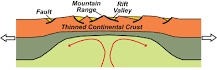
tensional stress & buoyant uplifting of the heated lithosphere cause the upper crust to be broken along normal faults, while the lower crust deforms by ductile stretching
52
New cards
Contrast the geologic processes features occurring along active and passive continental margins
-Active continental margins tend to have narrow continental shelves+The west coast of the United States is an example of an active margin, where the coastline corresponds with the boundary between the Pacific and North America Plates.
-Passive continental margins are continental margins that are not tectonically active. These areas have flat lands and have a wide continental shelf, which is the submerged border of the continent. A passive continental margin occurs where the transition from land to sea is not associated with a plate boundary.
-Passive continental margins are continental margins that are not tectonically active. These areas have flat lands and have a wide continental shelf, which is the submerged border of the continent. A passive continental margin occurs where the transition from land to sea is not associated with a plate boundary.
53
New cards
What is a tectonic setting?
geologic location relative ot nearby plate boundaries/hotspot/types
54
New cards
Use the periodic table and the concept of valence electrons to explain the importance of silicon as a building block in many types of minerals.
-tetrahedron (structure+subsitution+bonds)
-ionic radii (sharing electrons/substituion)
-4 valence electrons
-mineral compound
-ionic radii (sharing electrons/substituion)
-4 valence electrons
-mineral compound
55
New cards
What is a mineral?
naturally occuring (in-organic, solid) combination of specific elements (proportions/range) arrangeged in a particular repeating 3-d structure
56
New cards
color
unreliable, reflects composition
57
New cards
Describe the different ways silicate ions can be joined together to form silicate minerals. Give examples.
-sheet, double chains, framework, single chain, rings, pairs, isolated
58
New cards
Explain the physical properties you would use to distinguish between common minerals such as calcite and halite, graphite and galena, pyroxene and amphibole, talc and mica, etc.
-calcite+halite: shape, color/luster
-graphite+galena: lustre, streaks
-pyroxene+amphibole:
-talc+mica:
-graphite+galena: lustre, streaks
-pyroxene+amphibole:
-talc+mica:
59
New cards
Describe the composition of the mantle and crust and the minerals that are commonly found there.
-mantle: peridotite (45% SiO2)
-continental crust:granite (60-75% SiO2)
-continental crust:granite (60-75% SiO2)
60
New cards
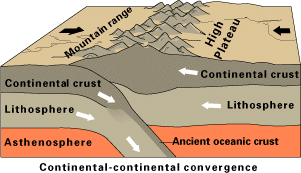
Describe the process of continental collision
-mountains form
61
New cards
major tectonic features associated with continental collision
-Olympics/ Coast Ranges: accretion,
compression
• Cascades/Sierra Nevada: arc
volcanism, intrusion
• Northern Rockies: platform
compressed, folded, thrust faulted
• Southern Rockies: “basement” (craton)
compressed and squeezed upward
• Basin and Range: divergent forces -
crust stretched and thinned while
heated by upwelling mantle
compression
• Cascades/Sierra Nevada: arc
volcanism, intrusion
• Northern Rockies: platform
compressed, folded, thrust faulted
• Southern Rockies: “basement” (craton)
compressed and squeezed upward
• Basin and Range: divergent forces -
crust stretched and thinned while
heated by upwelling mantle
62
New cards
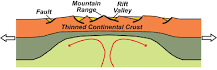
major tectonic features associated with continental rifting
ridge, abyssal plain, continental slope, continental shelf
63
New cards
Describe the tectonic setting of the Pacific Northwest, including the differences between the Coast Range and the Cascades.
-olympic/coast ranges: accretion+compression
-cascades:arc volcanism, intrusion
-cascades:arc volcanism, intrusion
64
New cards
Are minerals that show solid solution different types of minerals? How about minerals that show polymorphism? Explain your answers.
-solid solution: elements can be present in any proportion [(Fe,Mg)2SiO4, homogeneous solutions]
-polymorphs: same chemical composition but different crystal structure (diamond vs graphite, both carbon just different pressure--A polymorph is a mineral with the same chemical composition but a different internal structure)
-polymorphs: same chemical composition but different crystal structure (diamond vs graphite, both carbon just different pressure--A polymorph is a mineral with the same chemical composition but a different internal structure)
65
New cards
streak
more relaible color sample (grind in streak/powder)
66
New cards
luster
way light reflects+degree it penetrates into interior (edges), reliable (metalic vs nonmetallic)
67
New cards
hardness
resistance to stracting (will be scratched by every mineral whith higher hardness, mohs/common objects)
68
New cards
habit
cubic, etc (number words)
69
New cards
cleavage+fracture
-cleavage: three directions of cleavage, 90˚ (grain/layers, SPECIFIC BREAK)
-fracture: irregular break
-fracture: irregular break
70
New cards
density
mass ;)
71
New cards
other
solubility, magnetic, taste, smell, ect
72
New cards
identification properties
color, streak, lustre, hardness, habit, cleavage/fracture, density, other
73
New cards
oxides
O^-2 anion
-hematite, magnetite (hydroxides: limonite, bauxite)
-hematite, magnetite (hydroxides: limonite, bauxite)
74
New cards
sulphites
S^-2 anion
-galena, pyrite, chalcopyrite
-galena, pyrite, chalcopyrite
75
New cards
sulphates
SO^-4 anion
-anhydrite, gypsum
-anhydrite, gypsum
76
New cards
halides
halogen element anions (chlorine, fluorine, bromine, etc.)
-halite, fluorite
-halite, fluorite
77
New cards
carbonates
CO3^-2 anion
-calcite, dolomite, azurite
-calcite, dolomite, azurite
78
New cards
phosphate
PO4^-3 anion
-apatite
-apatite
79
New cards
silicate
silicon, oxygen in various proportions
-olivine, feldspar, quartz
-olivine, feldspar, quartz
80
New cards
native minerals
single-element minerals
-gold, copper, sulphur
-gold, copper, sulphur
81
New cards
mineral groups
oxides, sulphides, sulphates, halides, carbonates, phosphate, silicate, native minerals
82
New cards
Discovery of plate tectonics: (what they are and how they were discovered)
early plate motion evidence:
-contintnetal dirft, seafloor spreading, subduction
-no old oceanic crust
-volcanoes, earthquakes
-magentism
-fossils/rocks
plate tectonic: circulation of solid earth, result of how earth formed
-contintnetal dirft, seafloor spreading, subduction
-no old oceanic crust
-volcanoes, earthquakes
-magentism
-fossils/rocks
plate tectonic: circulation of solid earth, result of how earth formed
83
New cards
rifting/wilson cycle
-heat
-crust stretches+things
-oceanic crust forms between separating continents (narrow sea)
-widens by seafloor spreading (passive margins)
-crust stretches+things
-oceanic crust forms between separating continents (narrow sea)
-widens by seafloor spreading (passive margins)
84
New cards
How are different processes recorded in different rock types?
-sedimentary, igneous, and metamorphic
- physical changes—such as melting, cooling, eroding, compacting, or deforming
(rock cycle)
- physical changes—such as melting, cooling, eroding, compacting, or deforming
(rock cycle)
85
New cards
Distinguishing properties of important minerals from the lab: quartz, feldspar, micas, olivine; or minerals that might be confused with each other: i.e., halite vs. calcite, graphite vs. galena
-calcite+halite: shape, color/luster
-graphite+galena: lustre, streaks
-pyroxene+amphibole:
-talc+mica:
-graphite+galena: lustre, streaks
-pyroxene+amphibole:
-talc+mica:
86
New cards
cratons
very old, highly differentiated crust (silica rich)
87
New cards
orogenic belts
deformed+metamorphosed rocks
88
New cards
accreatred terranes
the blocks of continental fragments and oceanic islands that have collided with a continent and are now permanently attached
89
New cards
how is continental crust made
-subduction zone (separate by density, add instead of sinking)
-accreation of buoyant material as oceanic crust subducts (builds cont. outward)
-terrrane: block of crust with different geologic origin+history from adjacent areas
-melting of subducted plate+mantle (adds silica)---->erupts on surface or emplaced within crust intrusions
-accreation of buoyant material as oceanic crust subducts (builds cont. outward)
-terrrane: block of crust with different geologic origin+history from adjacent areas
-melting of subducted plate+mantle (adds silica)---->erupts on surface or emplaced within crust intrusions
90
New cards
structure of oceanic crust
-marine sediment (top)
-pillow basalts
-dykes (fissures lava erupted through onto coean floor-later filled with basalt)
-gabbro (intrusive fake basalt)
-peridotite: (Fe/Mg rich mantle rock
-pillow basalts
-dykes (fissures lava erupted through onto coean floor-later filled with basalt)
-gabbro (intrusive fake basalt)
-peridotite: (Fe/Mg rich mantle rock
91
New cards
passive margin
transition between oceanic+continental crust, not on active plate boundary (rifted_thin cont. crust)
92
New cards
tectonic features of ocean basins
seafloor spreading, subduciton?
ridge, abyssal plain, cont slope+shelf
ridge, abyssal plain, cont slope+shelf
93
New cards
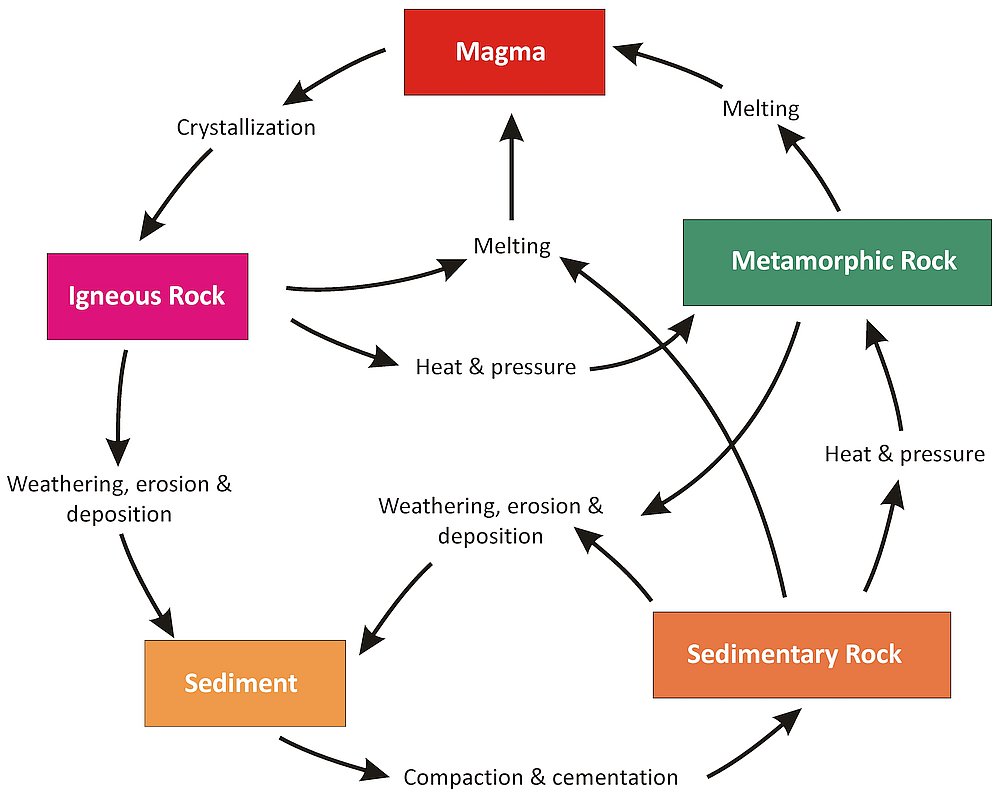
rock cycle
-magma
(cooling)
-intrusive/extrusive igneous
uplift)
-outcrop
(weathering, etc)
-sediment
(buried, compact)
-sedimentary rock
(deeper bury, heat, pressure)
-metamorphic rock
(melting)
driven by internal heat
(cooling)
-intrusive/extrusive igneous
uplift)
-outcrop
(weathering, etc)
-sediment
(buried, compact)
-sedimentary rock
(deeper bury, heat, pressure)
-metamorphic rock
(melting)
driven by internal heat
94
New cards
decompression melting
moved toward surface (mantle plume/convection cell)
95
New cards
flux melting
water
96
New cards
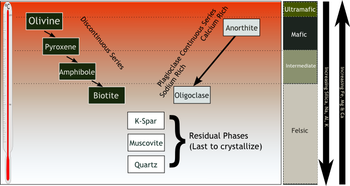
bowen reaction series
composiiton+stage of melting
97
New cards
fractional crystallization
magma compisition changes as crystals form/cool/sink?
98
New cards
igneous
cooling+crystal (magma)
99
New cards
metamorphic
re-crystalize at high temp/pressure without melting
100
New cards
basalt
-high Fe, Mg, Ca, low Na+K
-mafic
-45-55% silica
-low viscosity (thinner crust)
-mafic igneous rock with an effusive texture
-mafic
-45-55% silica
-low viscosity (thinner crust)
-mafic igneous rock with an effusive texture
 Note
Note  Flashcards (45)