Psych 210 Exam 2
 Call Kai
 Learn
Learn Practice Test
 Spaced Repetition
 Match
Match Flashcards
 Knowt Play
1/83

There's no tags or description
Looks like no tags are added yet.
Name | Mastery | Learn | Test | Matching | Spaced | Call with Kai |
|---|
No analytics yet
Send a link to your students to track their progress
84 Terms
Neurons
Form a communication network that allow the brain and the nervous system to communicate with each other
Synapse
A gap between two neurons where messages are sent across from one neuron to another
Neurotransmitters
Chemical messengers that cross the synaptic gap
Neurogenesis
Formation of new neurons
Most neurons are created about 6 months into pregnancy
Synaptogenesis
Formation of new synapses
Process that begins rapidly before birth and continues until about the age of 6. It slows down after 6 and continues for the rest of our lives
Synaptic Pruning
Getting rid of unused synapses
Our brain ends up getting rid of 40 percent of the synapses we develop
Rids the brain of clutter and makes communication easier
Use it or lose it policy/ road building
Myelination
Insulating neurons
Myelin - a fatty substance that coats the outside of the neuron in order to insulate it
Allows the electrical current to pass through neurons faster
Myelination occurs from the inside of our brains to the outside, it occurs first in the brain areas needed to survive.
Myelination of the prefrontal cortex happens relatively late. It controls logical thinking and reasoning, which is not necessary for survival.
Plasticity
The ability of the brain to adapt to its environment
Experience-Expectant Plasticity
Changes in our brain that we are genetically prepared for
Experiences that we expect everyone to have, so if you have a normal developmental experience, you will develop normally
Hubert and Wiesel kitten experiment — kittens exposure to light impacted their development of vision.
Sensitive Periods: Development needs a certain amount of environmental stimulation to continue normally; a period of time when the brain is especially susceptible to stimuli
Experience-Dependent Plasticity
How development can turn out differently based on different experiences
One group of baby rats were raised into an enriching environment and another group were raised in a bare environment. The rats in the enriching environment developed more synapses and had a denser brain development
Visual Acuity
The ability to focus our vision to see things in greater and sharper detail; blurry vs. sharp vision
Infants have low visual acuity
Preferential Looking Paradigm
Giving infants two similar but different looking stimuli. If they infant reliably looks at one stimuli over the other, then it is predicted that they can differentiate between the two. It is theorized that if they look at both equally, then they can differentiate between them.
Habituation
Decreases to sensitivity to stimuli that are repeated or constant over time
Contrast Sensitivity
The ability to detect differences in light areas and dark areas in a visual stimulus
Infants have low contrast sensitivity; can only recognize different shades if it is drastic
Infants prefer to look at:
Faces more than inanimate objects
Human faces over animal faces
Their mother’s face
Development of the senses
Infants’ sense of hearing is working before they are born
Infants recognize and show a preference for their moms’ voice
Infants can recognize their mothers’ scent
Infants prefer sweet-tasing foods
Exposed to flavors of local food through the womb
Infant Reflexes
Rooting, sucking and swallowing, Moro, palmar grasp, stepping
Rooting
When touched, turn head in that direction and open mouth
Lasts until four months
Sucking and Swallowing
When roof of mouth is stimulation
Lasts until two months
Moro
Startle Response — Throwing head back, extending arms, and bringing them back in quickly
Lasts until three months
Palmar Grasp
Clasping fingers around an object that touches the palm
Lasts until six months
Stepping
Dancing with feet when upright and feet on a surface
Lasts until 3 months
Myelination of Motor Neurons is….
Cephalocaudal and proximodistal
Cephalocaudal
Refers to growth and development that proceeds from the head-to-tail/ top-to-bottom
Head & Neck
Neck & Shoulders
Shoulders
Arms & Chest
Hips
Thighs
Legs
Feet
Proximodistal
Development from the center of the body to the extremities
Torso
Arms/Legs
Hands/Feet
Fingers/Toes
Visual Cliff
Eleanor Gibson found that infants can perceive depth, but do not show fear of the “drop off” until they are experienced at crawling
Piaget’s Approach to Cognitive Development
Children are trying to actively understand experiences which drives cognitive development
Schemas
Mental representations of a concept; the storage of ideas in our mind
What are the driving forces behind cognitive development?
Maturation and Experience — part of cognitive development is developing and refining our schemas over time
Assimilation
Using what we already know to categorize information
Accommodation
When we don’t know something and need to create a new schema
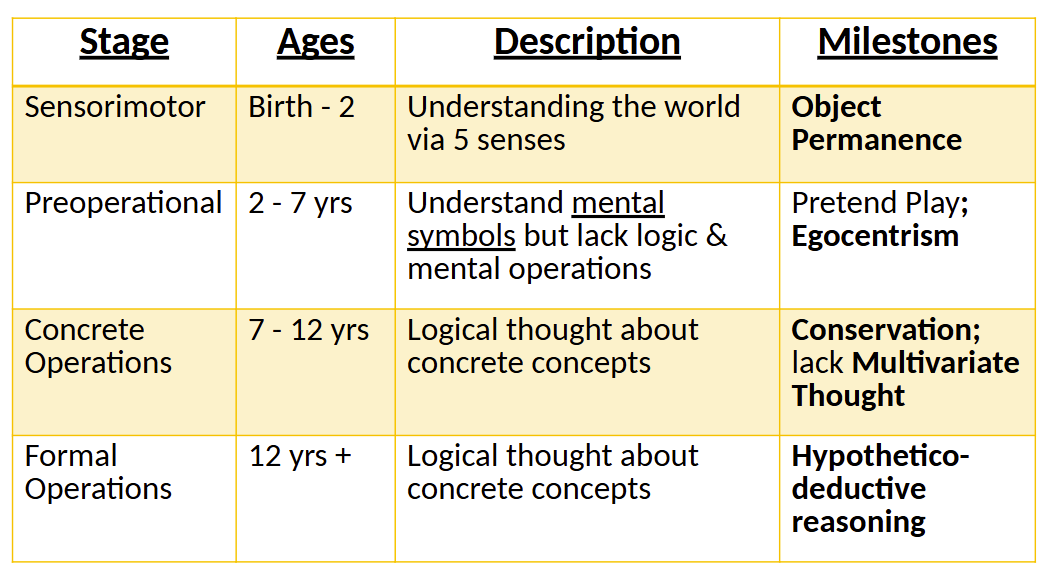
Stages of Cognitive Development
Object Permanence - the knowledge that objects continue to exist even when they are out of sight
Egocentrism — the inability to understand things from someone else’s perspective
Conservation — the understanding that the amount of something
Hypothetico-Deductive Reasoning — ability to form hypotheses about the world and reason logically about those hypotheses
Criticisms of Piaget
People don’t apply stage-relevant reasoning across the board; e.g. you don’t need formal operations to solve every problem
Cognitive development continues into early adulthood— dialectical thought (problems have more than one solution) and pragmatism (practicality) are proposed to be additional stages
Vygotskian Theory
Learning and development is a result of cultural phenomena
Cultural Influences
Social Interactions
Zone of Proximal Development
Children can accomplish a task above their capabilities if they have the guidance by a more cognitively developed person
Scaffolding
Children use the knowledge of others to scaffold their own development — only temporary as they remove this scaffolding when they have learned the knowledge themselves
Private Speech
Talking oneself through a behavior to remind oneself about what you’re supposed to be doing
Spelke’s Theory of Core Knowledge
Humans are born with innate cognitive systems that prepare us to understand certain aspects of the world
Violation of Expectation Procedure
Infants look longer at events that violate their core knowledge
Criticisms of Core Knowledge Theory
Just because knowledge is present early on doesn’t mean it’s innate
What about the role in culture in shaping knowledge? Wouldn’t different cultures have different sets of core knowledge?
Information Processing Theory
Metaphor: brain as a computer
Componential approach: developing “components of thoughts”
Selective Attention
Our ability to focus on relevant info and ignore irrelevant information
Sustained Attention
Our ability to maintain focus or awareness over time; how long we are able to pay attention
Automaticity
The ability to do things automatically, without having to think about them.
Frees up more processing capacity (how much our brain can process over time)
Multitasking = a myth
Just attention shifting; brain is unable to focus on two unrelated tasks at once
“Multitasking” increases in adolescence and is related to texting and driving and poorer performance on school work
What did the Rovee-Collier study demonstrate about infants’ memory?
Infants develop an increase in length of memory
The experiment had babies’ legs attached to a spinning decoration over their bed, when they kicked the device spun
3 months old remembered to kick for a week
18 months old remembered to kick for 13 weeks
What does it mean that infants’ memories are context-specific?
Infants cannot apply what they learned in one situation to other situations
What is infantile amnesia? Why does it happen?
Infantile Amnesia is the inability to remember experiences before the age of three, has to do with language
Magic Shrinking Machine Study - found that children have operational memories but are unable to describe these memories
Memory in childhood
Increases in working memory capacity — our ability to mentally manipulate info, and use that info to solve problems
Increases in processing speed — the quickness of which we can perform cognitive tasks
Executive Functioning
Coordination of attention, memory, an behavior to achieve a goal
Begins during early childhood (ages 4/5)
Cognitive Flexibility
The ability to shift thinking and see situations from multiple perspectives
Inhibitory Control
The ability to stop, pause, or control impulses, behaviors, and automatic responses
Intelligence includes the abilities to…
Learn from experience
Solve problems
Use Knowledge to adapt
Charles Spearman’s Theory of Intelligence
Believed that intelligence is just one general ability, the g-factor
G-factor—an overarching ability that influences everything we do and influences every type of intelligence
Crystallized Intelligence
Refers to the accumulation of knowledge and skills acquired through experience and education, such as vocabulary and general knowledge
Increases and improves throughout the lifespan
Fluid Intelligence
Encompasses the ability to reason, think abstractly, and solve problems in novel situations
Peaks @ 19 y.o.
Analytical Intelligence
The ability to solve well-defined problems that have one, single answer
Creative Intelligence
Our ability to adapt well to new situations; the ability to create, design, invent, and imagine
Practical Intelligence
Dealing with everyday problems that are ill-defined and have multiple solutions that each have advantages and disadvantages
Which type of intelligence do schools emphasize?
Analytical intelligence
Divergent Thinking
Involves thinking “outside of the box”; exploring multiple possible solutions to a problem or multiple possible meanings to a concept
Convergent Thinking
Using all of the information we have to find one correct answer
Howard Gardner’s 9 Multiple Intelligences
Human intelligence is not a single, general ability (IQ), but rather a composite of at least nine distinct, relatively independent types. This framework highlights that individuals possess varying strengths and learn in unique way.
Mental Age (Alfred Binet)
A measure of a individual’s intellectual performance based on the average performance of their specific age group
Used to identify children who were falling behind and needed to be moved to specialized schools
Intelligence Quotient (IQ)
(Mental age divided by chronological age) x 100
The average IQ score is 100
Age Norms in IQ
An individual's score is compared against peers of the same age
What does it mean if a characteristic (like intelligence) is normally distributed?
Normally distributed means scores follow a symmetrical, bell-shaped curve where most people (about 68%) score near the average (100), with fewer individuals having very high or very low scores
Our intelligence is both the result of ______ and ______
Nature and nurture
What characteristics of teachers promote the best achievement?
Responsive — teacher cares about students; is warm and sensitive to students
Demandingness — the extent to which teachers challenge their students; sets challenging but realistic goals
What is the relationship between class size and achievement?
Smaller class sizes are not necessarily better for achievement
In elementary school, small classes = better for achievement
Past elementary school, class size doesn’t make a difference in achievement.
The sweet spot for class size is between 20-40 students
What is the relationship between gender & achievement?
Girls are higher achieving, but they have lower performance in STEM testing (which may be influenced by stereotypes)
What is the relationship between race/ethnicity & achievement?
There is a gap in performance between White, Black, and Latino students
Why? — expectancy effects, self-fulfilling prophecy, stereotype threat
Expectancy Effects
The impacts that expectations have on behavior
Stereotypes about someone’s pursuit of achievement may impact their achievement
Different treatment in education may influence a student’s achievement — teachers tend to have lower expectations for their poor and low income students
Self-Fulfilling Prophecy
When expectations change our behavior and causes these expectations to come true
(if you expect someone to be bad, you treat them bad, and they treat you bad in response)
Stereotype Threat
The fear that we might confirm a negative stereotype of a group we belong to, which leads to less achievement due to performance anxiety
Poverty has a ______ (strong/weak) correlation with achievement
Strong
Head Start Program
Educational program that starts at 3. The idea behind this program is to help impoverished students and give them resources to confront the problems associated with poverty — not a “magic cure all,” once the program is over the support disappears and some children do not benefit
Extrinsic Motivation
External Motivation; because it can provide something in exchange
Intrinsic Motivation
Motivation that comes from internal factors; because it provides personal satisfaction
Does extrinsic motivation increase or reduce intrinsic motivation?
Reduce
What’s the difference between mastery motivation, a helpless orientation, & a performance orientation?
Mastery Motivation: believe that mastering/achieving something is the result of hard work; work toward mastering something/goal and believe that hard work is required to get there
Helpless Orientation: believe that innate ability is the most important thing in achievement; if a task is too challenging, they think that they must not have an innate ability to do it and give up
Performance Orientation: motivated to win and achieve at all costs; don’t care about mastery, only care about success and achievement (e.g. motivated by good grades)
What’s the difference between a fixed mindset & a growth mindset?
Fixed Mindset: abilities are stable; leads to failure avoidance and lower achievement
Growth Mindset: abilities can improve; leads to resilience, effort and high achievement
Self-Efficacy
Belief in ability for success
What can we do to encourage students’ achievement?
Setting goals
Give kids resources and experiences to succeed
Parenting/Teaching — challenge the child; high expectations = increased achievement
Explore top notes

