Perception terms midterm #1
0.0(0)
 Studied by 1 person
 Call Kai
 Learn
Learn Practice Test
 Spaced Repetition
 Match
Match Flashcards
 Knowt Play
Card Sorting
1/109

There's no tags or description
Looks like no tags are added yet.
Last updated 5:19 PM on 6/9/23
Name | Mastery | Learn | Test | Matching | Spaced | Call with Kai |
|---|
No analytics yet
Send a link to your students to track their progress
110 Terms
1
New cards
adaption
reduction in response caused by prior or continued stimulation
2
New cards
perceptual priming
change in perception due to exposure to a previous stimulus
3
New cards
sensory transducer
receptor that converts physical energy into neural activity
4
New cards
nativism
the mind produces ideas that are not derived from external sources
5
New cards
dualism
there are two distinct principles of being in the universe; spirit and matter
6
New cards
monism
mind and matter are united in a signal ultimate substance
7
New cards
idealism
reality is indistinguishable and inseperatable from human perception
reality is a mental construct
reality is a mental construct
8
New cards
materialism
physical matter is the only true reality
the mind can be explained in terms of matter
the mind can be explained in terms of matter
9
New cards
empiricism
experience is the only source of knowledge
10
New cards
panpsychism
all matter has consciousness
11
New cards
psychophysics
science of defining quantitative relationships between physical and psychological/subjective events
12
New cards
just noticeable difference
JND
difference threshold
JND
difference threshold
smallest detectable difference between two stimuli
minimum change in stimulus that can be correctly judged as different
minimum change in stimulus that can be correctly judged as different
13
New cards
two point threshold
minimum distance between two stimuli that can be distinguished
14
New cards
Fechner’s Law
magnitude of subjective sensation increases proportional to the logarithm of the stimulus intensity
15
New cards
absolute threshold
minimum amount of stimulation necessary for a person to detect a stimulus 50% of the time
16
New cards
method of constant stimuli
stimuli presented range from rarely to always perceivable, respond with yes/no
stimuli presented are rarely to always perceivably different from standard stimulus (more/less adj.)
stimuli presented are rarely to always perceivably different from standard stimulus (more/less adj.)
17
New cards
method of limits
dimension of a stimulus is changed incrementally until participant responds differently
difference between two stimuli is changed incrementally until responded differently
difference between two stimuli is changed incrementally until responded differently
18
New cards
method of adjustment
participant changes dimension of a stimuli or the different between two stimuli until they can detect a difference
19
New cards
magnitude estimation
assign values based on perceived magnitudes of stimuli
20
New cards
cross modality matching method
matching intensities of sensation from unrelated stimuli
ex - matching brightness and loudness
ex - matching brightness and loudness
21
New cards
Steven’s Power Law
magnitude of a sensation is proportional to the stimulus’ magnitude raised to an exponent
22
New cards
signal detection theory
quantified the response of an observer to the presentation of a signal in the presence of noise
false alarm, correct rejection, hit, miss
false alarm, correct rejection, hit, miss
23
New cards
doctrine of specific nerve energies
the nature of sensation depends on which sensory fibers are stimulated, not how they are stimulated
24
New cards
vitalism
a special/vital force drives living organisms
25
New cards
Hodgkin Huxley cycle
electrochemical process involving Na+ and K+ moving in/out of the neuron
26
New cards
accommodation
ciliary muscles change the shape of the lens, altering its refractive power
27
New cards
opsin
light sensitive protein
absorbs light of a specific wave length
absorbs light of a specific wave length
28
New cards
myopia
image converges in front of the retina
29
New cards
hyperopia
image converges behind the retina
30
New cards
emmetropia
image converges on the retina
31
New cards
fundus
dark spot observed when looking at an eye through an ophthalmoscope
houses the fovea
houses the fovea
32
New cards
duplex retina
able to have day and night vision
presence of both rods and cones
presence of both rods and cones
33
New cards
astigmatism
different refractory values vertically and horizontally due to having a non-spherical cornea
34
New cards
scotopic vision
black and white vision
only rods are functioning
only rods are functioning
35
New cards
photopic vision
colourful vision
only cones are functioning
only cones are functioning
36
New cards
mesopic vision
combination of colour and black/white vision
both cones and rods are functioning
both cones and rods are functioning
37
New cards
chromophore
captures photons
38
New cards
rhodopsin
visual pigment found in rods
contributes to scotopic/black&white vision
contributes to scotopic/black&white vision
39
New cards
graded potential
potential depends on amount of phots hitting the receptors, not simply a photon hitting it
40
New cards
lateral pathway
horizontal cells and amacrine cells
41
New cards
diffuse bipolar cell
receives input from rods and peripheral cones
input from multiple photoreceptors
high sensitivity, low acuity
input from multiple photoreceptors
high sensitivity, low acuity
42
New cards
midget bipolar cell
receives input from a single foveal cone
high acuity, low sensitivity
high acuity, low sensitivity
43
New cards
midget ganglion cell
parvocellular ganglion cell
p ganglion cell
parvocellular ganglion cell
p ganglion cell
sustained, sensitve, smaller, finer
44
New cards
parasol ganglion cell
magnocellular ganglion cell
m ganglion cell
magnocellular ganglion cell
m ganglion cell
transient response (change in light), insensitivity to colour, large receptive field, coarse spatial resolution
45
New cards
ON centered cell
middle region is activated by light and outer region is deactivated
bipolar or ganglion
bipolar or ganglion
46
New cards
OFF centered cell
middle region is deactivated by light and outer region is activated
bipolar or ganglion
bipolar or ganglion
47
New cards
lateral inhibition
horizontal and amacrine cells interact with vertical pathway cells and allows them to be more sensitive to contrast
48
New cards
concentric
ganglion cells have ________ receptive fields
49
New cards
contrast
sensitive to differences in light intensity
less interested in ambient light intensity
\
less interested in ambient light intensity
\
50
New cards
Mach bands
illusory edges

51
New cards
pupils
can go from 2-8mm
16-fold improvement in sensitivity
16-fold improvement in sensitivity
52
New cards
abundance of photopigments
can detect photos easier, more sensitive
occurs in darkness
occurs in darkness
53
New cards
bleaching of photopigments
less sensitive, harder to detect photons
occurs in light
occurs in light
54
New cards
amacrines
during the daylight ______ cells care inhibited
55
New cards
retinitis pigmentosa
hereditary disease involving progressive death of photoreceptors and degeneration of the pigment epithelium
56
New cards
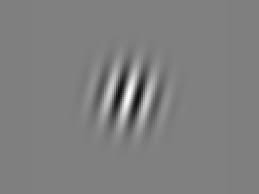
gabors
sine wave within a circular contrast function
57
New cards
cycles per degree
number of dark/bright bars seen per 1 degree of visual angle
58
New cards
0\.017
1/60
1/60
minimum visual angle to detect a cycle of grating for a normal eye
59
New cards
fourier transform
breaks down a function/image into sine waves of different frequencies
60
New cards
spatial frequencies
SF
SF
visual images can be decomposed into since waves with different ________
number of cycles of a grating per unit of visual angle
number of cycles of a grating per unit of visual angle
61
New cards
acuity
smallest spatial detail that can be resolved
62
New cards
aliasing
signal is not reconstructed correctly, detail is missing from the original signal
63
New cards
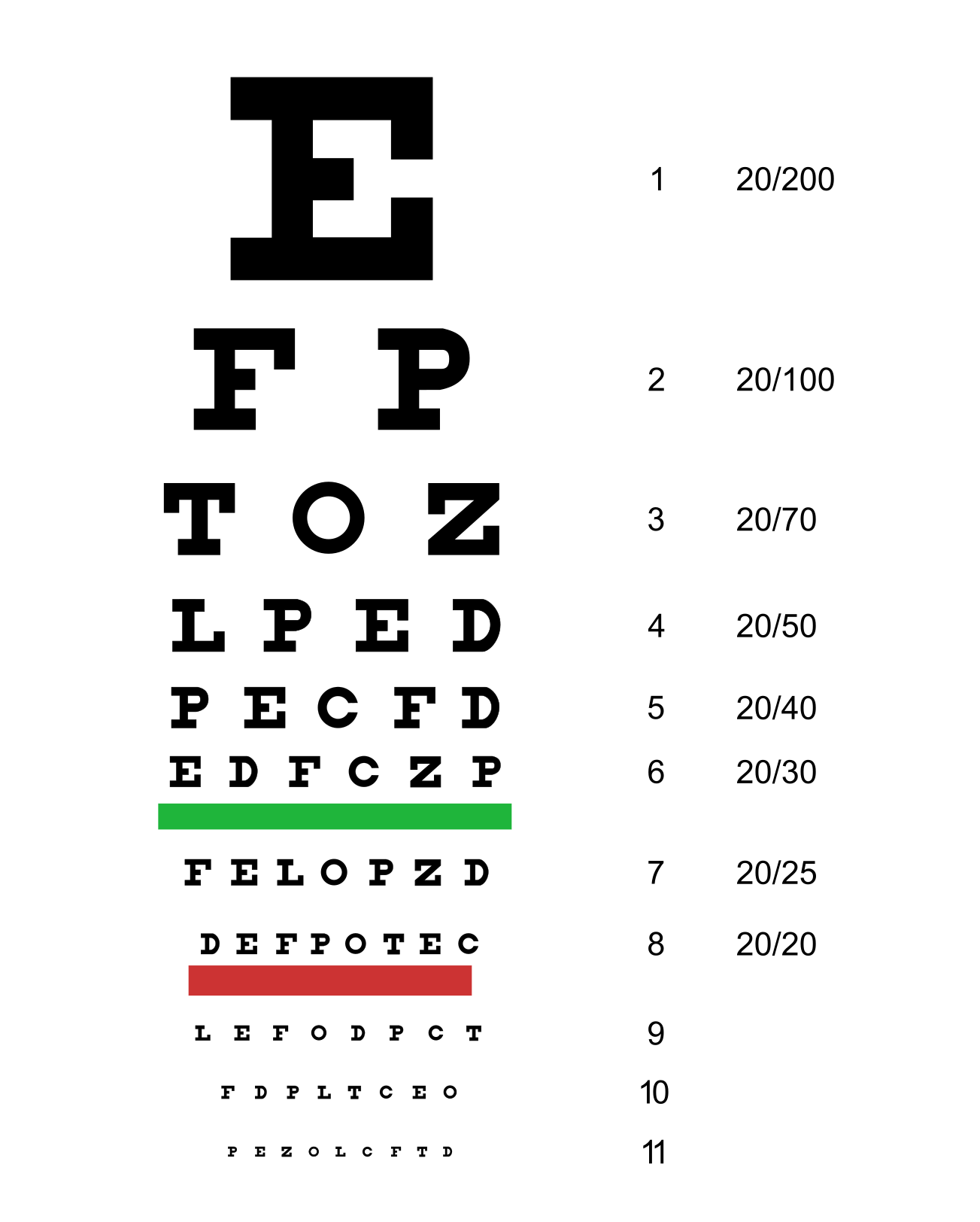
Snellen test
block letters with strokes 5x its size used to test vision
64
New cards
contrast sensitivity function
CSF
CSF
relationship between contrast and spatial frequencies
harder to see spatial frequencies at a low contrast
harder to see spatial frequencies at a low contrast
65
New cards
heteronymous
different detects for the two eyes
66
New cards
homonymous
same defects for the two eyes
67
New cards
hemianopia
half the visual field is blind
68
New cards
quadrantanopia
a quarter of the visual field is blind
69
New cards
scotoma
small visual field defect
70
New cards
lateral geniculate nucleus
LGN
LGN
6 layered structure present in both hemispheres where ganglion cells synapse
2, 3, 5 is from ipsilateral (same) eye
1, 4, 6 is from contralateral (different) eye
2, 3, 5 is from ipsilateral (same) eye
1, 4, 6 is from contralateral (different) eye
71
New cards
topographical mapping
retinotopic mapping
retinotopic mapping
neighbouring points in the visual field are projected onto neighbouring patched of neural tissue (LGN, V1)
72
New cards
cortical magnification
the fovea gets greater representation on neural structures compared the peripherhy
73
New cards
orientation tuning
neurons in the striate cortex respond optimally to certain orientations and less to others
74
New cards
simple cells
respond to edges or bars of a certain orientation in a certain part of the visual field
75
New cards
complex cells
do not have clearly defined exhibitory/inhibitory regions
phase-insensitive
prefer moving stimuli
have large receptive fields
phase-insensitive
prefer moving stimuli
have large receptive fields
76
New cards
magnocellular system
layers 1 & 2 of LGN
high luminance sensitivity, motion/flicker
high luminance sensitivity, motion/flicker
77
New cards
parvocellular system
layers 3-6 in LGN
high spatial frequency, colour
high spatial frequency, colour
78
New cards
koniocellular system
layers within the LGN 6 layer system
79
New cards
end stopping
cells in the cortex increase their firing rate as the bar length increases to fill up its receptive field, then decreases as the bar leaves there receptive field
seen in both simple and complex cells
seen in both simple and complex cells
80
New cards
ocular dominance
LGN cells response to one eye or the other
striate cortex cells respond to inputs from both eyes, but has a preference for one eye
striate cortex cells respond to inputs from both eyes, but has a preference for one eye
81
New cards
column
vertical arrangement of neurons
cells have the same preferred orientation at different depths in V1
cells have the same preferred orientation at different depths in V1
82
New cards
hypercolumn
1mm block of striate cortex with all machinery necessary to look at everything
all orientations preferences are found within 0.5mm laterally
all orientations preferences are found within 0.5mm laterally
83
New cards
CO blobs
systemic columnar arrangement of V1 discovered through cytochrome oxidase straining
84
New cards
title aftereffect
adapting to a pattern of a given orientations allows the perceptual illusion of tilt
85
New cards
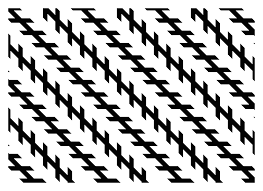
Zöllner illusion
local tilt causes global tilt
86
New cards
dorsal stream
processes *where* information
fast & colour blind
fast & colour blind
87
New cards
ventral stream
processes *what* information
contains LOC, PPA, FFA, EBA
contains LOC, PPA, FFA, EBA
88
New cards
superior temporal sulcus pathway
processes biological motion and social perception
89
New cards
lateral occipital complex
LOC
LOC
responsible for object recognition
90
New cards
parahippocampal place area
PPA
PPA
responsible for recognizing scenery and locations
91
New cards
fusiform face area
FFA
FFA
processes and recognizes faces
also used to recognize things you are a specialist in
also used to recognize things you are a specialist in
92
New cards
extrastriate body area
EBA
EBA
recognizes and processes bodies
93
New cards
perceptual committee models
middle vison is like a collection of specialists for a certain feature who vote on their opinion
94
New cards
pandemonium model
used to explain the parallel processing of letter recognition using demons
demons represent neurons at different levels of the brain, each responsible for detecting a certain feature
demons represent neurons at different levels of the brain, each responsible for detecting a certain feature
95
New cards
middle vision
combines features into objects resulting in perception
96
New cards
object recognition
matching perceived object representations to a representation in our memory
97
New cards
figure ground assignment
determines that some regions in a scene/image belong to the object in the foreground while others belong to the background
uses Gestalt principles of surroundedness, size, symmetry, and parallelism
uses Gestalt principles of surroundedness, size, symmetry, and parallelism
98
New cards
relatability
the degree to which two line segments appear to be apart of the same contour
99
New cards
global superiority effect
properties of a whole object take precedent over parts of the object
100
New cards
recognition by components
RBC
RBC
objects are recognized by the identities and relationships of their geons/component parts
 Note
Note  Flashcards (106)