Psych Nervous System U3 AOS1
 Call Kai
 Learn
Learn Practice Test
 Spaced Repetition
 Match
Match Flashcards
 Knowt Play
1/135

Earn XP
Description and Tags
Conscious and Unconscious Responses, Neurotransmitters and Neuromodulators, and Synaptic plasticity.
Name | Mastery | Learn | Test | Matching | Spaced | Call with Kai | Chat |
|---|
No analytics yet
Send a link to your students to track their progress
136 Terms
The major roles of the human nervous system are to
receive, process and coordinate a response to incoming information.
What are the sub-divisions of the autonomic nervous system?
enteric, sympathetic and parasympathetic nervous systems
A neural pathway is best described as a
circuit of interconnected neurons along which information travels.
The peripheral nervous system
carries information to and from the central nervous system.
2 crucial roles of the spinal cord in regards to the types of messages that travel up and down its length, and the branch of the nervous system to which it connects)
receive sensory info from the body (via the PNS) and transmit it to the brain for processing (via ascending tracts)
receive motor info from the brain and send/relay it to relevant parts of the body (via the PNS) to control muscles, glands and internal organs so that appropriate actions can be taken (via descending tracts).
What is a third role of the spinal cord?
Initiating reflex responses that occur independently of the brain e.g. spinal reflex.
Explain why spinal cord damage can result in loss of brain–body control.
It destroys/damages the neural pathways (axons) that act as the main communication highway between the brain and body.
Describe the relationship between the central nervous system and the peripheral nervous system, with reference to key roles of each of these branches
PNS carries information to the CNS (specifically to the brain via the spinal cord) from the body’s muscles, organs and glands (about the internal environment) and from the sensory organs (about the external environment) for processing by the brain
PNS carries information from the CNS to the body’s muscles, organs and glands so that appropriate actions can be taken
Describe the two main roles of the somatic nervous system.
sensory function: carries sensory information to the central nervous system - afferent
motor function: carries motor information for voluntary movements from the central nervous system.- efferent
Give an example of each of the roles of the somatic nervous system, using examples not referred to in the text.
sensory function: when touching an ice cube with a fingertip, sensory receptors in the skin detect touch (pressure) and temperature information and transmit to the central nervous system
motor function: any voluntary movement involving skeletal muscles e.g. intentional/deliberate and not reflexive.
Distinguish between the afferent and efferent information with reference to the type of information and the direction in which it is transmitted.
afferent: sensory information, towards/incoming/into the central nervous system
efferent: motor information, outwards/outgoing/leaving the central nervous system
The peripheral nervous system contains
All the nerves outside the brain and spinal cord.
The somatic nervous system carries information from _________ to the _________.
Responses
Sensory receptors; CNS
Steps in Spinal Reflex
1.Sensation: Sensory receptors in SNS detect intense heat, pain, etc.
2.Afferent signal: Sensory / afferent neurons carry signal towards CNS
3.Processing: Interneurons in the spinal cord in the CNS relay the message to a motor neuron to initiate reflexive movement
4.Efferent signal: Motor / efferent neuron in SNS carries message to effector site / muscles
5.Response: Withdrawal reflex occurs involuntarily
6.Extra step! Message simultaneously conveyed to brain; conscious awareness of stimuli follows response
The Nervous System (and what it’s made up of)
The body’s info processing system. Lets us receive, interpret, and respond to stimuli.
Made up of the:
-Central nervous system, including the brain and spinal cord
-Peripheral nervous system, including the nerves and sensory receptors in the body
Afferent (or sensory)
Neurons carry signals towards the CNS
Efferent (or motor)
Neurons carry signals away from the CNS
Interneurons (or relay neurons)
Connect afferent and efferent pathways in the CNS. These are essential for processing, because it means the system can produce outputs in response to inputs.
S.A.M.E
Sensory, Afferent, Motor, Efferent
The central nervous system (CNS) is made up of the _______ It:
Brain and spinal cord. Receives messages from the body, processes information, and sends messages to the body (This allows us to perceive and respond to the outside world, as well as experience consciousness and have subjective mental experiences.
The CNS is the only part of the nervous system that contains interneurons)
The Brain
The brain processes sensory info.
The cerebral cortex in the brain is the only place in the nervous system that has consciousness.
The brain has a high proportion of interneurons.
The spinal cord
Connects brain to PNS
Receives sensory info from PNS and sends up the spinal cord to the brain
Receives motor info from the brain and sends to various parts of the body through the PNS .
-The spinal reflex
Peripheral Nervous System (PNS)
Like a neural highway where nerves converge to enter / exit the brain via the brain stem.
Three roles:
Carries sensory info TO the CNS and motor info FROM the CNS
The somatic nervous system (SNS)
Connects brain to body’s skeletal muscles and sensory organs.
Carries sensory info to the CNS (afferent)
Carries motor info from the CNS (efferent)
Two functions of the Somatic Nervous System (SNS)
Two functions:
-Detects stimulation from external stimuli through our various senses, including vision, hearing, smell, taste, touch and heat and transmits this to the CNS
-Allows voluntary movement of skeletal muscles, including walking and talking
The autonomic nervous system (ANS)
The subdivision of the PNS that connects the brain to the body’s cardiac muscles, smooth muscles, and glands.
Adapted to respond automatically to regulate the body’s internal environment.
This information is mostly processed in the hypothalamus and brainstem – parts of the brain that do not experience conscious awareness.
2 functions of the autonomic nervous system (ANS)
Two functions:
-Detects stimulation from internal stimuli, mostly in the cardiac and digestive system.
-Facilitates involuntary movement of cardiac and smooth muscles required for heartbeat and digestion, as well as release of hormones from glands.
Subdivisions of the ANS
-The sympathetic nervous system (increases physiological arousal)
-The parasympathetic nervous system (decreases physiological arousal)
What are the different parts that the Somatic & Autonomic Nervous Systems connect to?
SNS
afferent: five senses
efferent: skeletal muscles
= conscious perception of external environment and voluntary movement
ANS
afferent: internal organs
efferent: cardiac muscle, smooth muscle and glands
= self-regulating internal systems
What’s located in the CNS
The brain and spinal cord
What’s located in the the PNS
-Somatic nervous system
-Autonomic nervous system
-Sympathetic nervous system
-Parasympathetic nervous system
Conscious (or voluntary) nervous system responses typically involve:
Awareness of environmental stimuli, received through the sensory system
-Formation of an intention to act / respond
-A response that involves deliberate movement of the physical body
Sensory receptors
Where information from the outside world or body can be detected by the nervous system, so a sensory / afferent signal can be generated
Effector sites
Places where a motor / efferent signal attaches to a muscle or gland, so a function can be executed
Conscious responses step 1)
1. Sensation (SNS)
Stimulation from ____ is detected by sensory receptors in ____ in the SNS.
Conscious responses step 2)
2. Afferent signal (SNS)
A sensory signal is generated and sent via afferent pathways in the SNS to the CNS
Conscious responses step 3)
3. Processing (CNS – brain)
The sensory signal is received at the brain and perceived consciously as ____. A decision is made to move ____ and the brain initiates a motor signal.
Conscious responses step 4)
4. Efferent signal (SNS)
The motor signal travels via efferent pathways in the SNS towards ____.
Conscious responses step 5)
5. Response (SNS)
The motor signal is received at the effector site of ____, causing ____ to respond by moving ____.
Unconscious responses
Are external or internal actions carried out in response to environmental stimuli, that involve no/minimal awareness or intention to act.
There are two separate reasons why a nervous system response may happen without conscious awareness.
Ø They are happening via the autonomic nervous system (today)
Ø They are happening via the somatic nervous system, but without the brain (next lesson)
Unconscious (autonomic) nervous system responses typically involve:
Stimulation originating from within the body’s internal organs / glands, without our awareness OR external stimulation that is perceived as threatening
-Use of this feedback in the lower parts of the brain to regulate bodily functions
-An automatic response that involves involuntary movement of the cardiac or smooth muscles, or secretion of hormones from glands, in order to stimulate or suppress various bodily functions
The sympathetic nervous system
The subdivision of the ANS that increases physiological arousal, producing a state of biological and behavioural preparedness.
-increases heart rate, dilates pupils, increases oxygen intake and glucose release
-Suppresses activity of the parasympathetic nervous system
-Stimulates release of adrenaline from the adrenal medulla above the kidney, which has similar (additive) effects to above
Overall effect of this is an increase in body systems that enhance physical performance (e.g. glucose release), and decreases unnecessary use of energy by other body systems (e.g. digestion)
-Stimulates the release of noradrenaline in the brainstem
Increases perception of threat
The sympathetic nervous system triggers the fight-or-flight response, which has an evolutionary benefit for survival.
The fight-flight-freeze response
Automatic physiological reaction to an event that is perceived as stressful or frightening.
Perception of threat activates the sympathetic nervous system, which triggers the release of the hormone adrenaline, an acute stress response that prepares the body to fight or flee. It is a sudden and intense stress response that is relatively short-lived.
Adrenaline
A hormone that increases physiological arousal.
The sympathetic nervous system triggers adrenaline to be released from the adrenal medulla, located above the kidneys, in response to perceived threat.
Effects of Adrenaline
Functions that increase the ability to exert ourselves physically are stimulated
Increased glucose production and oxygen to fuel muscles; increased blood pressure, heart rate and bronchiole dilation to deliver these to the skeletal muscles; sweat to cool the body; pupil dilation to enhance vision
Functions not related to physical exertion are suppressed so that energy can be redirected
Decreased salivation (dry mouth), relaxing of bladder (urge to urinate), decreased movement of food through the intestines (constipation)
Survive now, poop later.
The parasympathetic nervous system
The subdivision of the ANS that decreases physiological arousal, allowing life-sustaining functions such as digestion to occur.
-Returns the body to homeostasis (normal, resting function) once the threat has passed.
-Stimulates digestion, salivation etc as well as sexual arousal
-It also contributes to the ‘freeze’ part of the fight-flight-freeze (F-F-F) response
The parasympathetic nervous system is sometimes referred to as the ‘rest and digest’ system or the ‘feed and breed’ system.
Complementary roles- SNS & PNS
The sympathetic nervous system and parasympathetic nervous system function in a complementary way, like the body’s physiological accelerator and brakes. Neither ever ‘shuts off’ completely – they just vary in their dominance at different times.
The freeze part of the fight-flight-freeze response involves both sympathetic and parasympathetic activation at the same time, resulting in inward tension but appearing outwardly at rest.
A spinal reflex
Is an involuntary, nearly instantaneous motor response to specific environmental stimuli.
-Quicker than conscious motor responses, as the motor signal is initiated by interneurons in spinal cord instead of the brain
Shorter pathway due to the spinal reflex arc bypassing the brain
Less processing required
-Adaptive in increasing efficiency (therefore survival) in potentially dangerous situations involving sudden pain or intense heat
-The brain is notified of the stimulation after the response has already been initiated, causing a short delay before conscious perception of the stimulation occurs
Examples of the spinal reflexes include:
-Various reflexes that regulate muscle length and tension during movement
-Patellar reflex (kicking in response to stimulation of the tendon under the kneecap)
-Withdrawal reflex (withdrawal of limb in response to heat or pain; most commonly used in the exam)
Note that not all reflexes happen through the spinal cord – some occur at the base of the brain; for instance, the startle reflex (‘jumping’) to loud noise.
QUESTION: Which division of the peripheral nervous system is involved in the spinal reflex – SNS or ANS?
Pateller reflex
Tap under your kneecap to see your knee move automatically- reflex
Steps in the Spinal Reflex
1.Sensation: Sensory receptors in SNS detect intense heat, pain, etc.
2.Afferent signal: Sensory / afferent neurons carry signal towards CNS
3.Processing: Interneurons in the spinal cord in the CNS relay the message to a motor neuron to initiate reflexive movement
4.Efferent signal: Motor / efferent neuron in SNS carries message to effector site / muscles
5.Response: Withdrawal reflex occurs involuntarily
6.Extra step! Message simultaneously conveyed to brain; conscious awareness of stimuli follows response
Why is the Autonomic Nervous System (ANS) called autonomous
Operates involuntarily and independently of conscious control, ANS is not completely self-regulating as it is linked to the cerebral cortex so voluntary control of some autonomic responses is possible at certain times e.g. with conscious effort, someone can change and therefore control their breathing rate at any time when awake; techniques such as biofeedback can be learnt and used to enable control of certain autonomic responses such as heart rate, perspiration etc.
Describe the Relationship of the Autonomic Nervous System to the Central Nervous System with Reference to a Physiological Response.
ANS regulates activity of visceral muscles, organs and glands but also provides feedback to the brain about their activities, which can in turn influence (increase or decrease) their activity
How do skeletal and visceral muscles differ?
-skeletal muscles are involved in or enable voluntary movements of limbs and other body parts
-Visceral muscles are involved in or enable activity of internal organs and glands
-skeletal muscle activity requires initiation by motor neuron messages from the brain and visceral muscle activity does not require motor neuron information/is under ANS control/has built-in mechanisms for generating activity.
Which sub-division of the autonomic nervous system has its own network of neurons dedicated to its functioning?
Enteric nervous system
Give three examples of bodily functions that increase their activity as a result of sympathetic system activation.
-heart rate
-respiration rate
-adrenal gland activity.
Parasympathetic dominance
The"rest and digest" state of theautonomic nervous system, promoting calm, recovery, and energy conservation over fight-or-flight responses.
What is a neurotransmitter?
Chemical messenger
A neural synapse
A point of communication between neurons where axons and dendrites meet.
The synapse is made up of which three structures?
synaptic gap, terminal buttons, dendrites
What happens to the excess amount of neurotransmitter secreted by a presynaptic neuron
recycled back into the presynaptic neuron.
What can neurotransmitters affect the response of
neurons.
muscles.
glands
Distinguish between excitatory and inhibitory effects of a neurotransmitter with reference to glutamate and GABA.
Excitatory effect= Neurotransmitter such as glutamate stimulates or activates a postsynaptic neuron to perform its functions.
Inhibitory effect= When a neurotransmitter such as GABA blocks or prevents a postsynaptic neuron from firing and therefore performing its functions.
Outline the role of a neurotransmitter involved in the conditioning of Little Albert’s response when he sees a white rat after repeatedly being shown it to have a reaction to it.
The neurotransmitter (glutamate, an excitatory neurotransmitter) sends signals from the pre-synaptic neuron to the post-synaptic neuron, and so there is still a strong communication between these neurons because of the learnt behaviour of seeing a white rat.
Inhibitory neuron
GABA
Excitatory neuron
Glutamate
What would be the impact on the transmission of neuronal messages if there was evidence of the thinning of dendrite branches?
The likelihood of the post-synaptic neuron being activated may decrease, because dendrites receive the neurotransmitters from the synapse.
The correct sequence in which information travels along a neural pathway is
dendrite, axon, synapse, neurotransmitter
Which one of the following best describes the lock-and-key process in synaptic transmission?
Each neurotransmitter has a unique molecular structure that fits into the complementary, chemically distinct receptor site.
Dopamine, serotonin, GABA and glutamate are collectively called
Neurotransmitters
Which neurotransmitters can have a modulatory effect?
serotonin and dopamine
A neuromodulator can influence
How receptors react to another type of neurotransmitter.
When compared to the action of a typical excitatory or inhibitory neurotransmitter at a single synapse, a neuromodulator can
affect the activity of multiple neurons simultaneously.
An entire brain area may be influenced by exposure to
A neuromodulator’s action.
Communication between neurons by sending electrical impulses involves
action potentials.
Which neurotransmitter can have either an excitatory or inhibitory effect?
Dopamine
Which neurotransmitter is least abundant in the brain?
Serotonin
Parkinson's disease is strongly associated with the loss of neurons that produce
Dopamine.
Communication within neurons is:
Inhibitory
Communication between neurons is:
Excitatory
Process through which new connections are made between active neurons to create alternate neural pathways in respone to a brain injury is called synaptic:
Why is stress described as a psychobiological process? Explain with reference to an example.
Stress has both psychological and physiological/biological components and consequences e.g.
psychological: activation/arousal/changes in thoughts/cognitions and feelings/emotions
physiological: bodily arousal/activation/changes
In what three ways can psychological responses be distinguished from physiological responses to stress?
psychological responses primarily involve the mind/mental processes, whereas physiological responses primarily involve the body/bodily processes;
psychological responses are indirectly observed (including self-reports), whereas physiological responses can be directly observed;
physiological responses typically occur involuntarily and cannot be consciously controlled, whereas psychological responses are not necessarily involuntary and many individuals can learn to exercise some degree of control over them;
many physiological responses are largely predictable, whereas psychological responses are more variable among individuals.
Suggest how an individual’s personal interpretation of a stressor may impact on their stress response.
An individual’s personal interpretation of stressor (a kind of stressor ‘appraisal’) and their ability to cope with it may impact on their stress response. For example:
a situation or event will only lead to stress if an individual interprets (appraises) that situation or event as unpleasant, uncomfortable or perhaps ‘the worst thing that could happen to me’ and they also think that they do not have the necessary resources to cope with it.
Neurons
Specialised to communicate information around the body. There’s sensory, motor, and interneurons.
Draw a diagram of the way that an interneuron travels
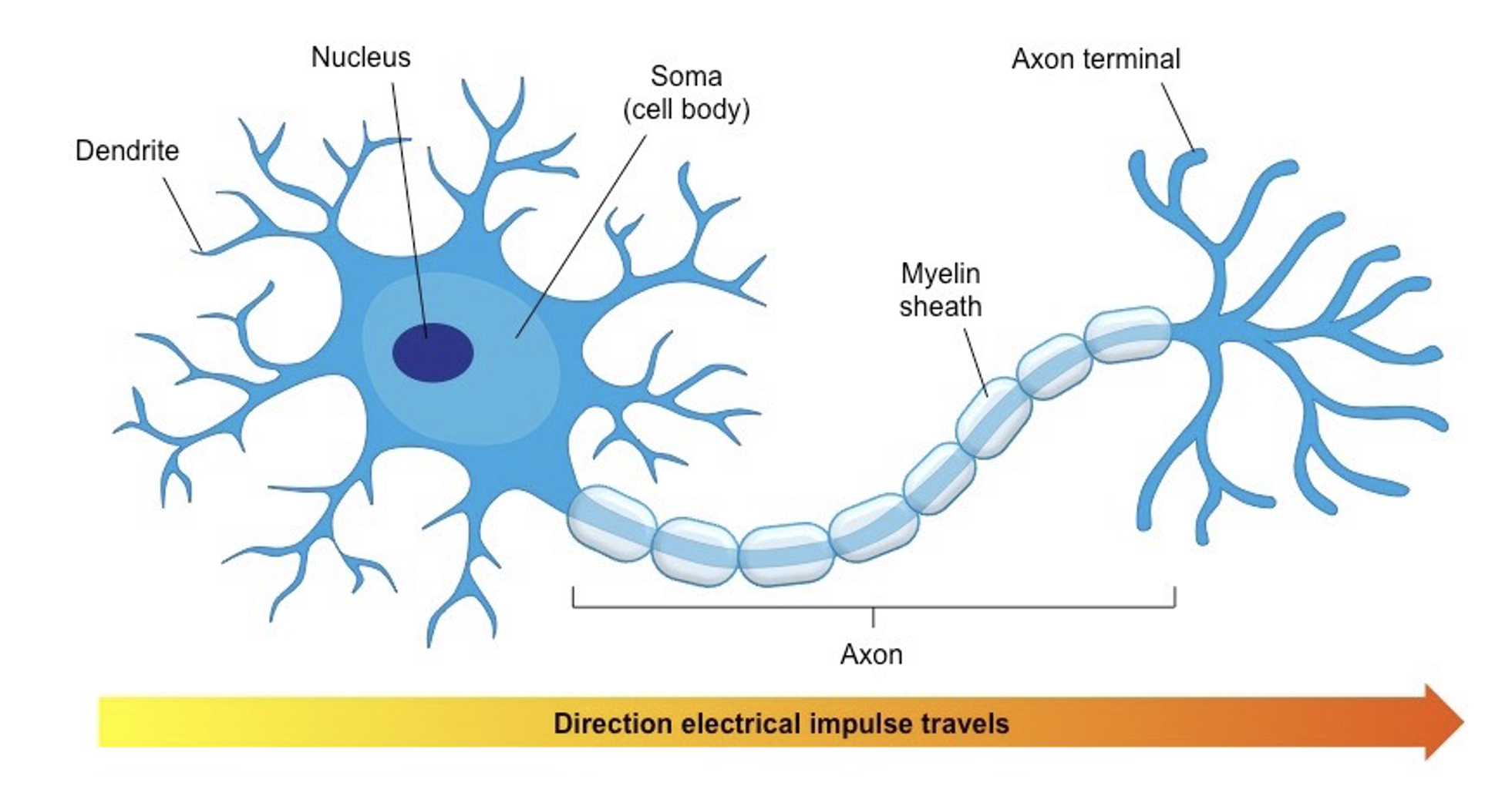
Dendrites
Branch-like structures that reach out from the neuron and can receive stimulation from other neurons / cells.
●Contain neurotransmitter receptor sites to which chemical messages passed from the previous cell can bind
●Stimulation received via the dendrites will determine whether the neuron will ‘fire’
The axon
The portion of the neuron which conveys the signal towards the next cell.
•The signal is considered to be ‘electrochemical’ because it involves the transfer of electrical charge via the flow of positively and negatively charged ions (e.g. potassium K+, chloride Cl-, sodium Na+)
•Ion channels (‘gates’) along the length of the neuron allow the charged particles in and out, this creates an electrical potential (a difference between the charge inside the neuron compared to outside the neuron)
The electrical potential is passed along the axon
Myelin (or the myelin sheath)
A fatty coating (actually made up of other cells - you can see their nuclei in the picture) that wraps around the axon to insulate the signal and speed up transmission.
•Prevents ‘crossed wires’
•Means electrochemical signal can ‘jump’ more efficiently between the nodes (gaps in the myelin)
Axon terminals
At the ends of the axon and release chemicals (neurotransmitters) to convey the signal to the next cell.
●Small swellings on the ends of the axon terminals are called terminal butons or terminal buttons
●Our focus will be on what happens here - transmission between neurons
An action potential (AP)
The technical term for when a neuron ‘fires’ – in other words, an electrochemical signal is propagated along the axon.
•The resting potential of a neuron (its charge when at rest) has a small negative voltage of approximately -70mV
•The neuron receives stimulation from various other neurons which changes the voltage of the cell
•If the charge reaches a threshold of approximately -55mV, the cell will depolarise (have a sharp spike in positive charge) and an AP is ‘fired’
•After the sudden spike in voltage, the neuron ‘resets’ and returns to its resting voltage, ready to be stimulated again
The all-or-none principle
Idea that action potentials either happen, or they don’t. There is no such thing as a big or small AP.
•If stimulation reaches the threshold, the AP will fire every time
•If stimulation does not reach threshold, the AP will not fire at all
Note that you don’t need to memorise the actual voltages at which this happens.
Term
Synapse
The synapse is a point where the axon terminal of one neuron forms a ‘connection’ to the dendrite of the next neuron, so that transmission of information between neurons can occur.
(N.B. They do not physically touch.)
The synaptic gap or synaptic cleft
Th tiny physical space that exists between one neuron and the next, at the synapse.
The pre-synaptic neuron
The neuron that is passing on the signal.
The post-synaptic neuron refers to
The neuron that is receiving the signal.
Neurotransmitters
Chemical messages that are released from the axon terminals of the pre-synaptic neuron into the synapse. The message is received at the receptor sites of the post-synaptic neuron.
Lock-and-key process
Keys: neurotransmitters with unique molecular structures / shapes
Locks: the post-synaptic receptor sites, with a complementary structure
The right key is needed to fit the lock. If there is a match between the chemical shape of the neurotransmitter and the post-synaptic receptor site, the neurotransmitter can bind to the site.
Once the neurotransmitter binds at the post-synaptic receptor site, one of two things will happen:
•The post-synaptic neuron will raise the voltage closer to threshold level, increasing the likelihood that the neuron will ‘fire’ an AP
•The post-synaptic neuron will lower the voltage further away from the threshold level, decreasing the likelihood that the neuron will ‘fire’ an AP
Which one occurs will depend on the neurotransmitter
What is the main excitatory neurotransmitter in the CNS
Glutamate