CH 7 & 8 - Prokaryotic Genomes and Gene Expression

0.0(0)
studied byStudied by 0 people
0.0(0)
full-widthCall Kai
learnLearn
examPractice Test
spaced repetitionSpaced Repetition
heart puzzleMatch
flashcardsFlashcards
GameKnowt Play
Card Sorting

1/38

encourage image

There's no tags or description

Looks like no tags are added yet.

Study Analytics
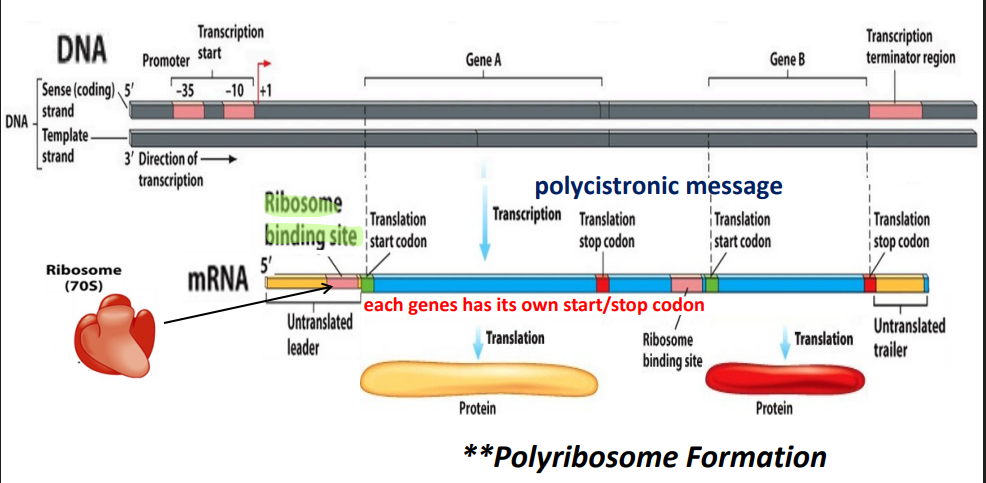
Name
Mastery
Learn
Test
Matching
Spaced

No study sessions yet.

39 Terms

1
New cards

A phenotype generally results from the functioning of one or more:

Genes

  • can have genotype but wont see phenotype all the time

2
New cards

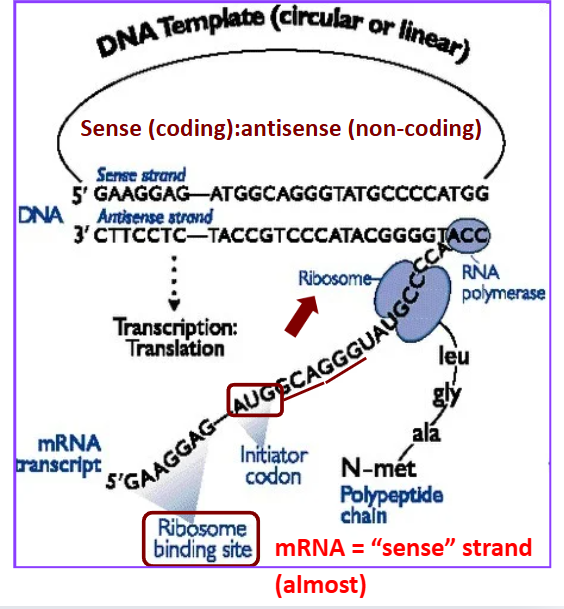
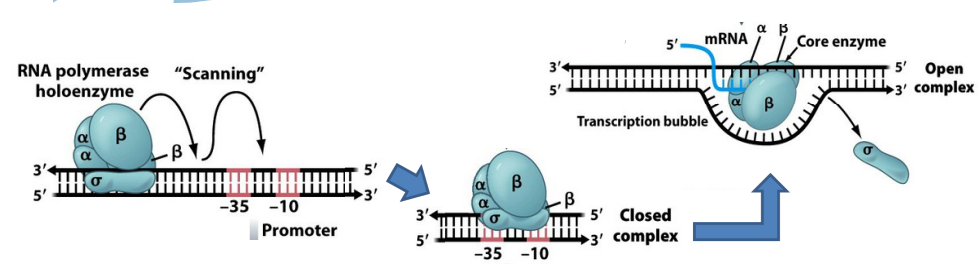
DNA —→RNA—→Protein

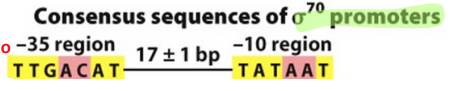
Central Dogma

3
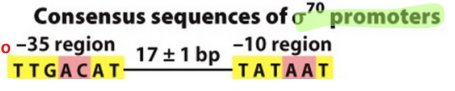
New cards

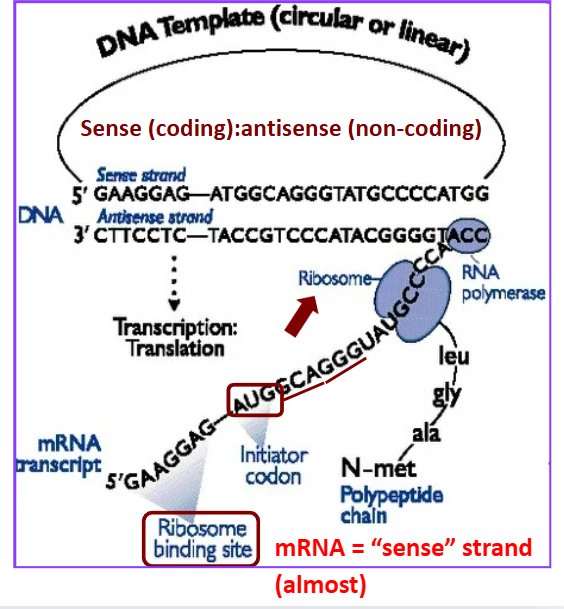
Transcription

DNA—→RNA

  • RNA polymerase; mRNA

4
New cards

Translation

RNA—→Protein

  • genetic code, transfer RNA’s; ribosomal RNA’s
5
New cards
<p><strong><u>Transcription</u></strong> and <strong><u>translation</u></strong> are ______ in prokaryotes</p>

Transcription and translation are ______ in prokaryotes

coupled

<p>coupled</p>
6
New cards
<p><strong>Sense</strong> strand</p>

Sense strand

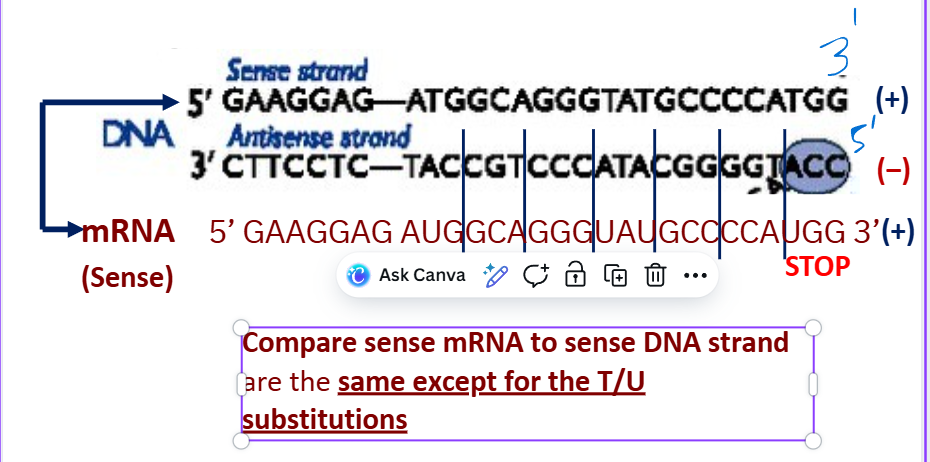
coding strand

  • mRNA = “sense” strand (almost) —→ due to uracil
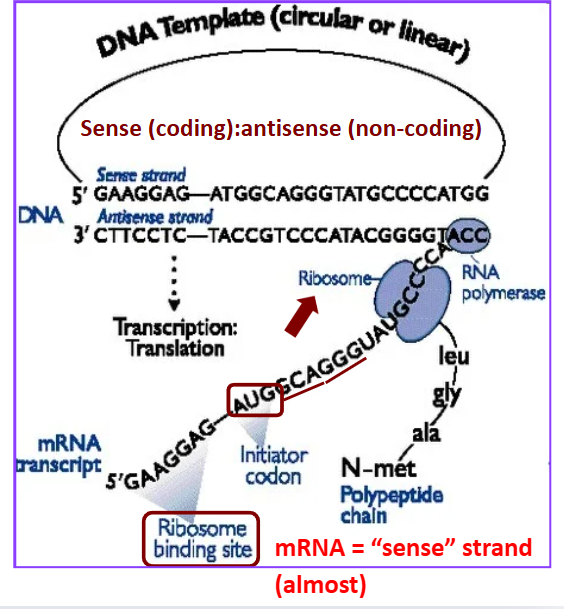
<p><strong>coding</strong> strand</p><ul><li><p><strong>mRNA = “sense” strand</strong> (almost) —→ due to uracil</p></li></ul><p></p>
7
New cards
<p><strong>Antisense</strong> strand</p>

Antisense strand

non-coding template strand

<p>non-coding <strong>template</strong> strand</p>
8
New cards
<p><span style="color: rgb(255, 255, 255);"><strong><span>Compare sense mRNA to sense DNA strand </span></strong><span>are the </span><strong><span>same except _______</span></strong></span></p>

Compare sense mRNA to sense DNA strand are the same except _______

for the T/U substitutions

<p><span style="color: rgb(255, 254, 254);"><strong><span>for the T/U substitutions</span></strong></span></p>
9
New cards
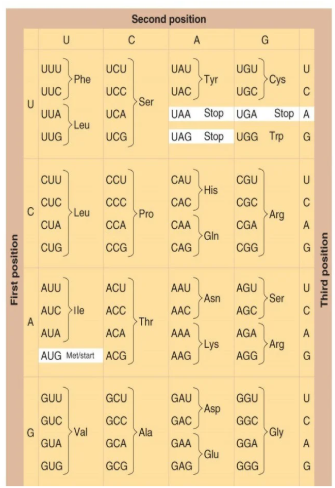
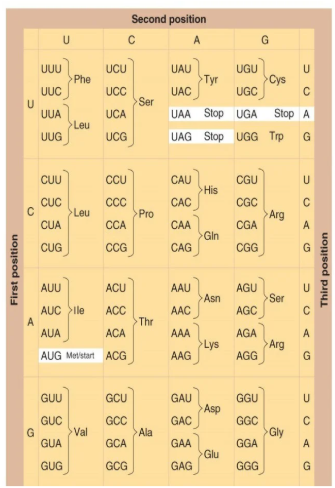
<p>Genetic Code</p>

Genetic Code

  • redundant: 64 codons (20 amino acids)

  • start/stop codons

  • represents mRNA

<ul><li><p><span style="color: rgb(255, 255, 255);"><span>redundant: </span><strong><u><span>64 codons (20 amino acids)</span></u></strong></span></p></li><li><p><span style="color: rgb(255, 255, 255);"><span>start/stop codons</span></span></p></li><li><p><span style="color: rgb(255, 255, 255);"><span>represents mRNA</span></span></p></li></ul><p></p>
10
New cards
<p>Codons process</p>

Codons process

  • The “A” in AUG start codon is not the first base in the transcript

<ul><li><p><span style="color: rgb(255, 251, 251);"><strong><span>The “A” in AUG start codon is not the first base in the transcript</span></strong></span></p></li></ul><p></p>
11
New cards

Prokaryotic Genomes

  • Genome

  • Transcriptome

  • Proteome

12
New cards

Genome

the totality of DNA in a cell

  • chromosome and plasmids

  • PROKARYOTES are HAPLOID (1 chromosome)

13
New cards

Transcriptome

total transcripts present at a given time

  • transcripts DISAPPEAR QUICKLY

14
New cards

Proteome

all the types and numbers of proteins expressed at a given time

15
New cards

Prokaryotic genome organization

  • Most possess a single circular chromosome

  • Size: 500,000 to 9,000,000 bp (order of magnitude < eukaryotes)

  • May also possess small, circular, extra-chromosomal segments called plasmids (1000 – 25,000 bp)

16
New cards

operon vs. regulon

operon - single regulatory sequence

regulon - a collection of operons

17
New cards

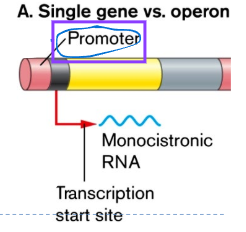
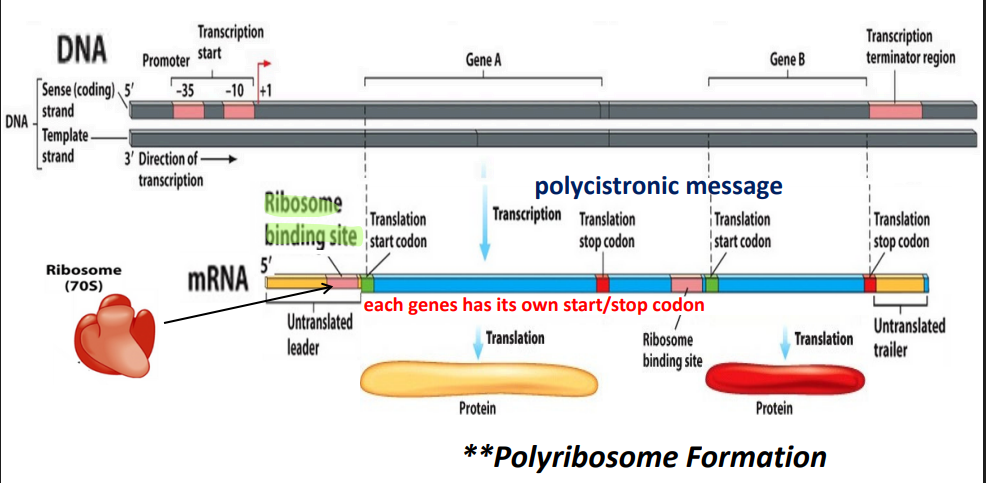
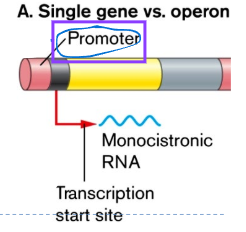
Cistron

gene

  • Monocistronic: one prmoter, one gene

  • Polycistronic: one promoter, multiple genes
18
New cards
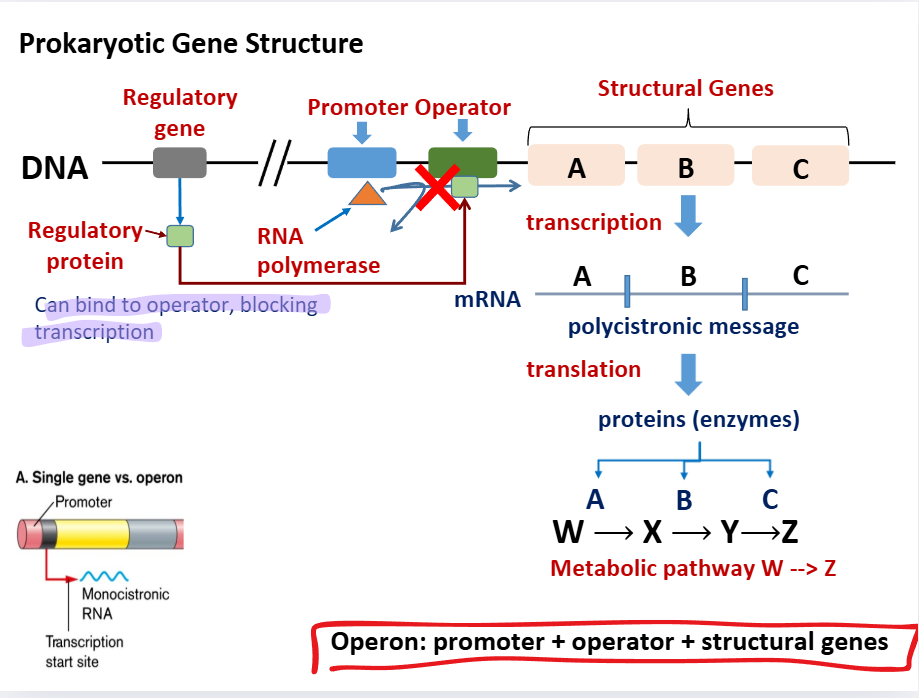
<p>Operon basic structure</p>

Operon basic structure

knowt flashcard image
19
New cards

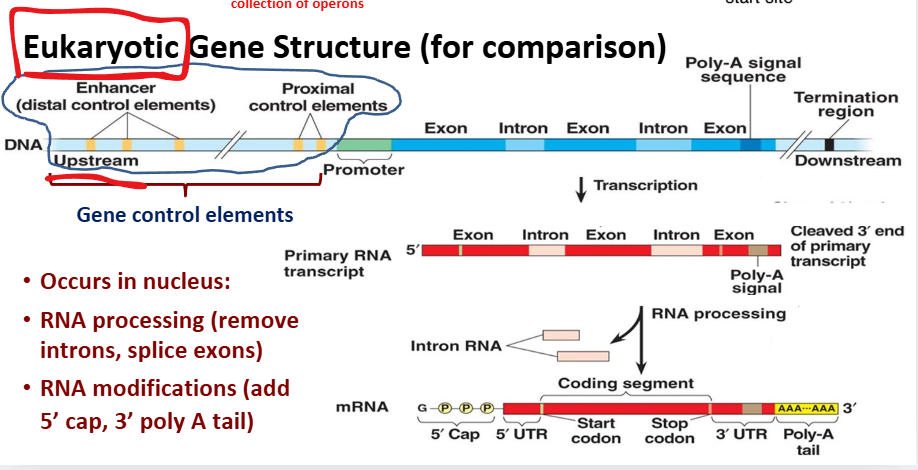
promoter

defines the start of the gene (common to prokaryotes and eukaryotes)
20
New cards
<p><span><strong><span>Eukaryotic Gene Structure (for comparison)</span></strong></span></p>

Eukaryotic Gene Structure (for comparison)

knowt flashcard image
21
New cards
<p><strong>Operon gene structure</strong></p>

Operon gene structure

Operon: promoter + operator + structural genes

  • Regulatory gene is upstream

  • Regulatory gene —→ regulatory protein —→ binds to operator and prevents transcription

  • If regulatory gene is inactive: structural genes —→ transcription into polycistronic message —→ translation into enzymes (proteins) which guide metabolic pathways
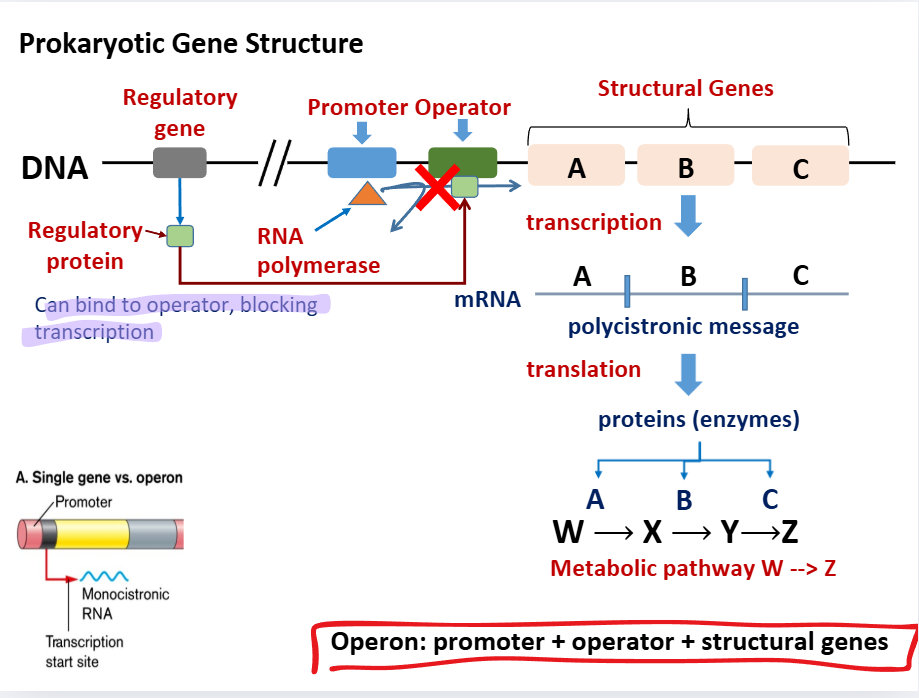
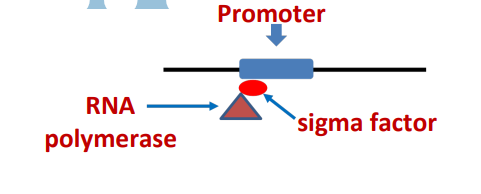
<p>Operon: promoter + operator + structural genes</p><ul><li><p><strong><u>Regulatory gene </u></strong>is <strong><u>upstream</u></strong></p></li><li><p><strong>Regulatory gene —→ regulatory protein —→ binds to operator and prevents transcription</strong></p></li><li><p><strong><u>If regulatory gene is inactive</u></strong>: <strong>structural genes</strong> —→ transcription into <strong>polycistronic message</strong> —→ translation into <strong>enzymes (proteins)</strong> which guide <span style="color: rgb(37, 232, 10);"><strong><u>metabolic pathways</u></strong></span></p></li></ul><p></p>
22
New cards
<p>Sigma factors</p>

Sigma factors

interacting w/different promoters; sigma factors guide RNA polymerase to the promoters
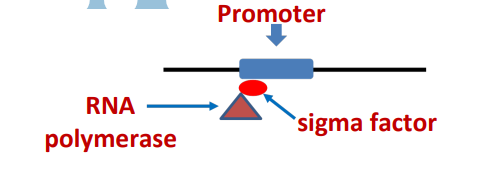
<p>interacting w/different promoters; sigma factors <strong><u>guide RNA polymerase to the promoters</u></strong></p>
23
New cards
<p>Regulon</p>

Regulon

controls multiple operons

  • collectively control operons common to particular metabolism via specific sigma factor
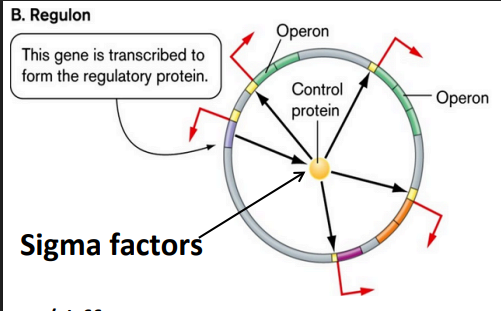
<p>controls <strong><u>multiple operons</u></strong></p><ul><li><p>collectively <strong><u>control operons common to particular metabolism</u></strong> via <strong><u>specific sigma factor</u></strong></p></li></ul><p></p>
24
New cards

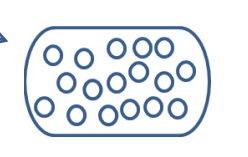
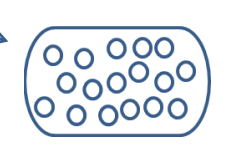
Plasmids

small, extra-chromosomal, circular DNA segments 2 – 25 kbp in size.

  • Plasmids NOT necessary for survival

  • Autonomous; possess an ori

  • Some can integrate into chromosome

  • Some are transferable

25
New cards

How do low copy number plasmids and high copy number plasmids affect the latter?

High copy number plasmids provide higher gene expression and protein yields, but can lead to a metabolic burden, protein aggregation, and lower cell growth. Conversely, low copy number plasmids are less of a burden and are better for expressing toxic proteins, studying genes at a more physiological level, or maintaining a more stable phenotype. 

26
New cards

R factor, catabolic plasmids, F factor

resistance to antibiotics, catabolic pathway, fertility (transfer of plasmids - conjugation)
27
New cards
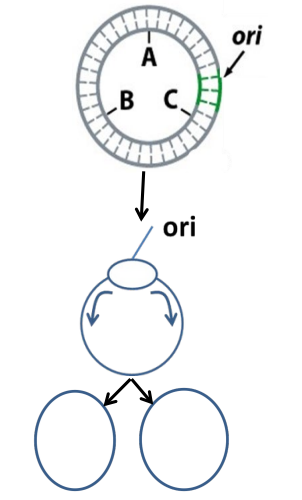
<p>Bidirectional replication (plasmids)</p>

Bidirectional replication (plasmids)

same as chromosomal replication
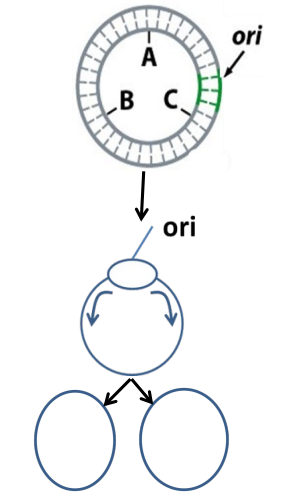
<p>same as chromosomal replication</p>
28
New cards
<p>Rolling circle replication</p>

Rolling circle replication

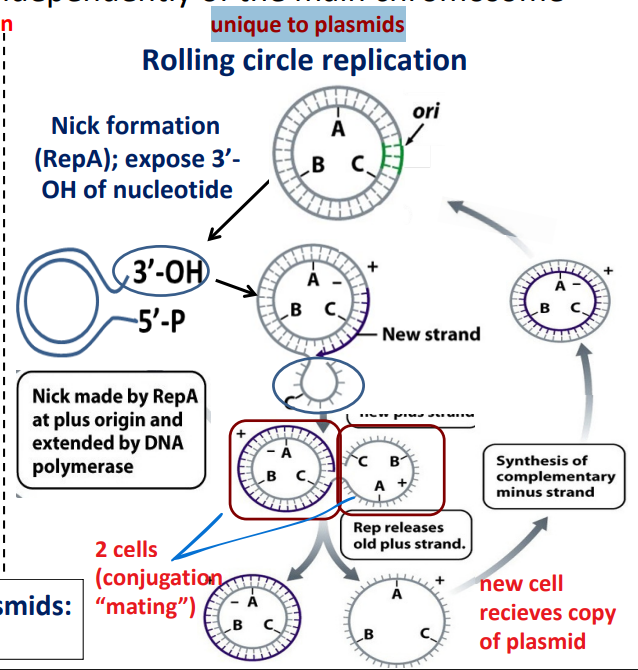
unique to plasmids

  • Nick formation (RepA); exposes 3’- OH of nucleotide

  • Nick made by RepA at ori extended by RNA polymerase

  • Rep releases old (+) strand and new cell recieves copy of plasmid

  • synthesis of complementary (-) strand for plasmid in new cell

<p>unique to plasmids</p><ul><li><p>Nick formation <strong><u>(RepA); exposes 3’- OH of nucleotide</u></strong></p></li><li><p><strong><u>Nick made by RepA at ori extended</u></strong> by RNA polymerase</p></li><li><p>Rep r<strong><u>eleases old (+) strand</u></strong> and <strong><u>new cell recieves copy</u></strong> of plasmid</p></li><li><p><strong><u>synthesis of complementary (-) strand</u></strong> for plasmid in new cell</p></li></ul><p></p>
29
New cards

Plasmid Inheritance

Plasmids do not carry essential* genes how are they maintained in the host cell?

  • Possess plasmid genes that benefit the host under certain conditions *antibiotic resistance (Selective pressure)

  • Integrate plasmid into the chromosome

  • High/Low copy # of plasmids

30
New cards
<p>High copy # plasmids</p>

High copy # plasmids

knowt flashcard image
31
New cards

Low copy # plasmids

  • possess a partitioning system (par proteins)

  • Par proteins - guide plasmid to opposite end (requires energy); serve to segregate and partition plasmid and its copy
32
New cards
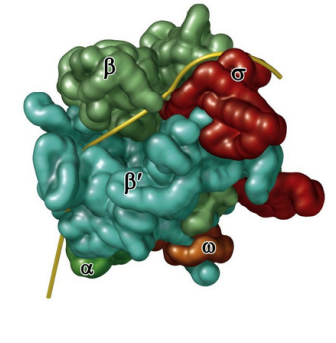
<p>Bacterial RNA Polymerase</p>

Bacterial RNA Polymerase

Bacterial RNA polymerase “holoenzyme”: a core polymerase that synthesizes mRNA : has 4 subunits: 2 alpha (α)subunits, 1 β, and 1 β’

  • Sigma factor guides RNA polymerase to the promoter, then unbinds from core polymerase
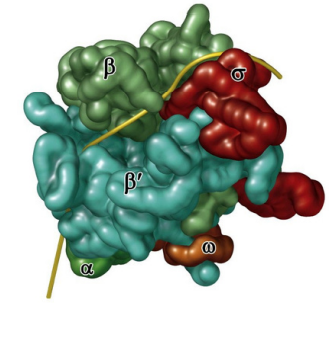
<p>Bacterial <strong><u>RNA polymerase “holoenzyme”:</u></strong> a core polymerase that synthesizes mRNA : has 4 subunits: <strong>2 alpha (α)subunits, 1 β, and 1 β’</strong></p><ul><li><p><strong><u>Sigma factor</u></strong> guides RNA polymerase to the promoter, then unbinds from core polymerase</p></li></ul><p></p>
33
New cards
<p>-35 and -10 bp</p>

-35 and -10 bp

Most sigma factors recognize promoter sequences at positions -35 bp, -10 bp upstream of transcription start.
<p>Most sigma factors <strong><u>recognize promoter sequences</u></strong> at positions <span style="color: yellow;"><strong><u>-35 bp, -10 bp</u></strong></span><strong><u> upstream of transcription start.</u></strong></p>
34
New cards

Consensus sequences are conserved sequences

rich in T, A bonds b/c it has 2 DB compared to 3 in G, C (less energy to break)
35
New cards
<p>σ70 sigma factor</p>

σ70 sigma factor

common for most bacterial genes
<p>common for most bacterial genes</p>
36
New cards
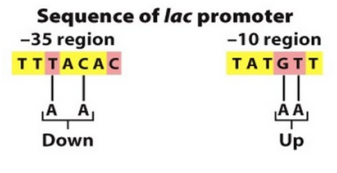
<p>Changes in promoter sequence:</p>

Changes in promoter sequence:

up (increase activity) or down (decrease activity)

<p>up (increase activity) or down (decrease activity)</p>
37
New cards

Promoter strength:

strong (high expression) v. weak (low expression)

  • strong vs weak binding (weak promoters are NOT BAD, they just code for less genes)

38
New cards
<p>Ribosome (70S)</p>

Ribosome (70S)

large subunit (50S) + small subunit (30S)

  • 30 S includes —→ 16 S - rRNA and proteins

<p>large subunit (50S) + small subunit (30S)</p><ul><li><p>30 S includes —→ 16 S - rRNA and proteins</p></li></ul><p></p>
39
New cards
<p>Shine-Delgarno sequence:</p>

Shine-Delgarno sequence:

ribosome binding site; binds to 16S ribosomal RNA of small (30S) ribosomal subunit;ribosome binding followed by translation of transcript toform polypeptide
<p><strong><u>ribosome binding site; binds to 16S ribosomal RNA of small (30S) ribosomal subunit</u></strong>;ribosome binding followed by translation of transcript toform polypeptide</p>

Explore top flashcards

Final Exam Crothers
Updated 725d ago
flashcards Flashcards (105)
List #32
Updated 1155d ago
flashcards Flashcards (37)
Ch.14: Water
Updated 979d ago
flashcards Flashcards (24)
Vocab U.6
Updated 1060d ago
flashcards Flashcards (20)
Lecture 19
Updated 22d ago
flashcards Flashcards (44)
Biology EOC
Updated 1049d ago
flashcards Flashcards (383)
Final Exam Crothers
Updated 725d ago
flashcards Flashcards (105)
List #32
Updated 1155d ago
flashcards Flashcards (37)
Ch.14: Water
Updated 979d ago
flashcards Flashcards (24)
Vocab U.6
Updated 1060d ago
flashcards Flashcards (20)
Lecture 19
Updated 22d ago
flashcards Flashcards (44)
Biology EOC
Updated 1049d ago
flashcards Flashcards (383)