Test 1 (1-2)
0.0(0)
 Studied by 1 person
 Call Kai
 Learn
Learn Practice Test
 Spaced Repetition
 Match
Match Flashcards
 Knowt Play
Card Sorting
1/107

Earn XP
Description and Tags
Last updated 5:31 AM on 9/7/25
Name | Mastery | Learn | Test | Matching | Spaced | Call with Kai |
|---|
No analytics yet
Send a link to your students to track their progress
108 Terms
1
New cards
gene
a region of DNA that specifies a particular protein or RNA
2
New cards
artificial selection
selective breeding of plants and animals for certain desired traits
3
New cards
self-fertilization
mating between gametes from the same individual
4
New cards
cross-fertilization
mating between gametes come from separate individuals
5
New cards
What are the advantages of using pea plants in Mendel’s breeding experiments?
obtain lots of offspring within a short period of time
6
New cards
discrete traits
clear-cut, distinct opposite traits such as yellow vs. purple flower colour
7
New cards
continuous traits
traits with intermediate phenotypes like height or skin colour
8
New cards
pure-breeding/true-breeding/inbred
individuals that carry specific parental characteristics that remain constant for generations because have been mated only to each other for many generations
9
New cards
antagonistic pairs
mating between individuals with dissimilar characteristics
10
New cards
hybrid
offpring of parents with antagonistic traits
11
New cards
reciprocal cross
reversed the characterisitics of the male and female parents
i.e. pollen from purple flower x egg from white flower
vs. pollen from white flower x egg from purple flower
i.e. pollen from purple flower x egg from white flower
vs. pollen from white flower x egg from purple flower
12
New cards
monohybrid cross
mating between **homozygous** individuals for one gene that have antagonistic traits (TT x tt)
13
New cards
What is the result of a cross between purebreds?
all offspring looking like one parent (dominant)
14
New cards
What is the phenotypic ratio resulting of a cross between a monohybrid individuals?
3:1
15
New cards
allele
alternative forms of a gene
16
New cards
monohybrid
indivual having 2 different alleles of a single gene
17
New cards
Mendel’s law of segregation
the two allleles of each gene separate during gamete formation, then unite at **random** at fertilization
18
New cards
product rule
the probablity of 2 or more independent events occuring together is the product of the probability that each event will occur by itself
19
New cards
sum rule
the probability of event 1 **or** event 2 occuring (mutually exclusive events) is the sum of their individual probabilities
20
New cards
How can you distinguish between a TT and Tt in plants?
self-fertilize and observe next generation
21
New cards
testcross
mating between individual with dominant phenotype (Y_) with recessive individual (yy) to find the **genotype** of the dominant individual
22
New cards
dihybrid
individual that is heterozygous for 2 genes (YyRr)
23
New cards
parental type
phenotype that looks like one of the parents
24
New cards
recombinant type
phenotype that does not resemble either of the parents
25
New cards
What is the phenotypic ratios for dihybrid crosses?
9:3:3:1
26
New cards
law on independent assortment
the alleles of 2 different genes gets sorted into gametes independently of each other
27
New cards
mutation
chance alteration of genetic sequence
28
New cards
wild-type allele (+)
an allele that is present in the population at a frequency higher than 1%
29
New cards
mutant allele
an allele that is present in the population at a frequency lower than 1%
30
New cards
Can a mutant allele become a wild-type allele?
yes - if it becomes common enough in the population (more than 1%)
31
New cards
monomorphic
a gene with only one common, wild-type allele present in the population (Agouti in mice)
32
New cards
polymorphic
a gene that has more than one common allele in the population (other alleles are very rare) (ABO blood type)
33
New cards
common variants
the high-frequency alleles of a polymorphic gene (HLA gene)
34
New cards
Human civilization is driven by
a) domestication in genetic process
b) cross-breeding experiments
c) Mendel’s genetics
a) domestication in genetic process
b) cross-breeding experiments
c) Mendel’s genetics
a
35
New cards
How can we tell species apart?
same genes, different possible alleles
individuals that are genetically close enough to breed and produce fertile offspring
individuals that are genetically close enough to breed and produce fertile offspring
36
New cards
There is a concrete definition for species. T/F
F
37
New cards
The genotype of an individual is the sole influencer of phenotypes. T/F
F - can also vary based on environmental factors (e.g. UV radiation and skin colour)
38
New cards
The parental (P) generation…
a) just refers to the furthest most generation in a pedigree/breeding experiment
b) must always be pure breeding
c) must always be pure breeding for all traits
d) all of the above
a) just refers to the furthest most generation in a pedigree/breeding experiment
b) must always be pure breeding
c) must always be pure breeding for all traits
d) all of the above
b
39
New cards
The parent generation…
a) just refers to the furthest most generation in a pedigree/breeding experiment
b) must always be pure breeding
c) must always be pure breeding for all traits
d) the generation prior to the offspring of interest
e) all of the above
a) just refers to the furthest most generation in a pedigree/breeding experiment
b) must always be pure breeding
c) must always be pure breeding for all traits
d) the generation prior to the offspring of interest
e) all of the above
d
40
New cards
Discrete units of inheritance are _____
a) genes
b) genotypes
c) phenotypes
d) alleles
a) genes
b) genotypes
c) phenotypes
d) alleles
d
41
New cards
Genes/alleles are always designated by _____ (differentiate from when we refer to protein product)
italics
42
New cards
different alleles differ in _____ _____, this can result in the amino acid sequence of the protein or the _____ of the protein being made
nucleotide sequence, amount
43
New cards
What is the genotypic ratio for a cross between monohybrids?
1:2:1
44
New cards
What is the phenotypic ratio of the cross between dihybrids?
9:3:3:1
45
New cards
What must you NOT assume iof the parental generation of a dihybrid?
do NOT assume that the parentals are homozygous dom/dom x rec/rec
* can also be GG ww x gg WW
* can also be GG ww x gg WW
46
New cards
When dihybrids (2 genes) are crossed and the alleles act in simple dominant/recessive manner, new phenotypic _____ appear (not present in previous generations
combinations
47
New cards
In a test cross, you always want to mate the individual with the unknown genotype with an indvidual that is ___ ___
homozygous recessive
48
New cards
incomplete dominance
heterozygote does not resemble either homozygous parents, phenotype is an intermediate between the two pure-bred parents
49
New cards
What is the phenotypic ratio of a cross between monohybrids, acting in an incomplete dominance manner?
1:2:1
50
New cards
Traits that act in an incomplete dominance manner often relate to _____ _____
gene dosage
51
New cards
codominant
both traits of the parents show up equally in the heterozygote’s phenotype
52
New cards
What is the phenotypic ratio of a cross between monohybrids, acting in an co-dominance manner?
1:2:1
53
New cards
In complete dominance, the recessive alleles are most often _____, while dominant alleles are usually _____
nonfunctional, functional
54
New cards
when both alleles specify a functional gene product, they are often _____ for traits analyzed at the molecular level
co-dominant
55
New cards
ABO blood type is an example of which mode of inheritance, specifically IA and IB?
co-dominance
56
New cards
An allele that is dominant will always be dominant in any case. T/F
F - dominance or recessive is always relative to a second allele (i.e. in ABO blood type, IA is dominant over i, but co-dominant with IB)
57
New cards
dominance series
alleles are listed in order from most dominant to most recessive
58
New cards
In the case of multiple alleles, how can you tell that they are the result of different alleles of the same gene and not multiple genes?
all test pairings of alleles will yield a 3:1 ratio in the F2 generation
59
New cards
pleiotropy
a single gene determining a number of distinct traits
60
New cards
syndrome
a group of problems that are usually seen together
61
New cards
recessive lethal allele
in homozygous, the recessive lethal alleles will cause death
62
New cards
What is the phenotypic ratio involving recessive lethal allele between 2 monohybrids?
2:1
63
New cards
Recessive lethal mutations are common in animals including humans, however they often remain hidden, except in rare cases of homozygosity often caused by _____ mating
consanguineous
64
New cards
Recessive alleles causing prenatal or early childhood lethality canbe passed on to subseuqent generations only by _____ carriers because affected homozygotes die before they can mate
heterozygous
65
New cards
What are the phenotypic classes of 2 genes interacting additively on one gene? (complete dominance)
1. both present (A_ B_)
2. one present (A_ bb)
3. the other present (aa B_)
4. neither present (aa bb)
66
New cards
A cross between 2 heterozygotes (that came from pure-bred parents) resulted in a phenotypic ratio of 9:3:3:1. However, there are new phenotypes that were not present in prior generations. What is the most likely explanation for this?
2 genes (A and B) acting on one phenotype but are assorting independently and operation in indepedent biochemical pathways
67
New cards
epistasis
a gene interation in which an allele of one gene masks the effects of another gene’s alleles
68
New cards
In epistasis, the allele that is doing the masking is _____ to the gene that is being mask, the _____ gene
epistatic, hypostatic
69
New cards
recessive epistasis
homozygosity for a recessive allele of one gene hides tthe effect of a second gene
70
New cards
What is the phenotypic ratio for recessive epistasis?
9:3:4
71
New cards
The yellow coat colour in Labrador retriever and the Bombay phenotype is an example of which mode of inheritance?
recessive epistasis
72
New cards
reciprocal recessive epistasis
dominant alleles of two genes acting together produce the trait (A_ B_), while the other 3 phenotypic classes (A_ bb, aa B_, aa bb) do not
* aa is epistasis to gene B
* bb is epistasis to gene A
* aa is epistasis to gene B
* bb is epistasis to gene A
73
New cards
dominant epistasis
epistasis in which the dominant allele of one gene hides the effects of another gene
74
New cards
What is/are the possible phenotypic ratio for dominant epistasis?
12:3:1 or 13:3
75
New cards
heterogenous trait
a mutation at any one of a number of genes can give rise to the same phenotype
76
New cards
Two deaf parents can have hearing offspring if the nother and father are homozygous for recessive mutions in:
a) the same gene
b) different genes
a) the same gene
b) different genes
b
77
New cards
What does complementation mean?
the original mutations affected two different genes, for both genes, the normal allele from one parent covered up for what the mutant allele fot eh same gene couldn’t provide (from the other parent)
* 2 deaf parents have mutations on different genes but their children have normal hearing
* this is because they have mutations on different genes and therefore the other parent’s allele “covered up” for the non-functional mutant allele (still making the protein needed for hearing)
* 2 deaf parents have mutations on different genes but their children have normal hearing
* this is because they have mutations on different genes and therefore the other parent’s allele “covered up” for the non-functional mutant allele (still making the protein needed for hearing)
78
New cards
penetrance
the proportion of individuals with a particular genotype who actually show the expected phenotype
* incomplete penetrance - ie. only 75% of people with the genotype for Retinoblastoma actually develop the disease
* incomplete penetrance - ie. only 75% of people with the genotype for Retinoblastoma actually develop the disease
79
New cards
Which of the following are used to describe penetrance?
a) complete/incomplete
b) variable/unvarying
a) complete/incomplete
b) variable/unvarying
a
80
New cards
Expressivity
the degree/intensity in which a particular genotype is expressed in a phenotype
81
New cards
Which of the following are used to describe expressivity?
a) complete/incomplete
b) variable/unvarying
a) complete/incomplete
b) variable/unvarying
b
82
New cards
modifier genes
unline the major genes that have the main effects on the phenotype, modifier genes have a subtle, secondary effect
* ie. tail size in mice T causes short tail but other modifier genes can influence the effect on how much this allele will affect the actual size of the tail
* ie. tail size in mice T causes short tail but other modifier genes can influence the effect on how much this allele will affect the actual size of the tail
83
New cards
temperature sensitive
the expressiblity of an allele is affected by temperature
84
New cards
conditional lethal allele
allele that only causes death only under certain conditions
85
New cards
permissive conditions
the conditions range where the conditional lethal allele does not cause death
86
New cards
restrictive conditions
the conditions where the conditional lethal allele will cause death
87
New cards
sex-limited traits
affect a structure or process that is found in only ONE sex (but not the other)
88
New cards
sex-influenced traits
show up in both sexes, but may differ between the sexes
89
New cards
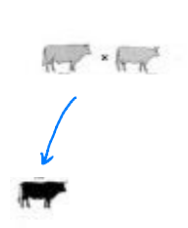
Propose 2 scenarios for type of inheritance for coat colour? What are the expected phenotypic ratios for each case?
complete dominance (3:1) or incomplete dominance (1:2:1)
90
New cards
If an offspring has a different phenotype than hte parents, the parents cannot be _____, they must be _____
pure-breeding, heterozygous
91
New cards
A pure-breeding white goat and a pure-breeding black goat are bred together several times and all offspring are grey. This result indicates:
a) complete dominance
b) codominance
c) incomplete dominance
d) two genes interacting
a) complete dominance
b) codominance
c) incomplete dominance
d) two genes interacting
c
92
New cards
Is colouring in zebras a result of codominance?
no - then there must exist zebras that are all black or all white
93
New cards
When establishing dominance series for a polymorphic gene, the crosses must be done with _____ individuals!
pure-breeding
94
New cards
Mutations is also known as _____ _____ in which there is a change in DNA sequence of a gene
chance alternations
95
New cards
The wild-type allele is always dominant, that’s why it’s the most common in the population. T/F
F
96
New cards
multifactorial inheritance/phenotype
a phenotype that arise from the action of more than 1 gene (polygenic) or frm interactions between genes and the environment
97
New cards
complementary gene action
two or more genes work in a process (biochemical pathway) to produce a particular trait
98
New cards
A phenotypic ratio of 9:7 indicates that there are _____ genes acting on the same phenotype
2 (modification of (9:3:3:1)
99
New cards
complementation testing is used for:
1)
2)
1)
2)
1) is 1 or 2 (or more) genes acting on the phenotype?
2) is the mutation on the same gene for both parents?
2) is the mutation on the same gene for both parents?
100
New cards
Rr Pp x Rr Pp involves 2 genes that act on one phenotype, this is an example of a dihybrid cross. T/F
F - dihybrid means that the they are heterozygotes for 2 genes that are acting on two different phenotypes
 Note
Note  Flashcards (20)