Lab Practical DNA and Gel Electrophoresis
 Studied by 1 person
 Call Kai
 Learn
Learn Practice Test
 Spaced Repetition
 Match
Match Flashcards
 Knowt Play
1/5

There's no tags or description
Looks like no tags are added yet.
Name | Mastery | Learn | Test | Matching | Spaced | Call with Kai |
|---|
No analytics yet
Send a link to your students to track their progress
6 Terms
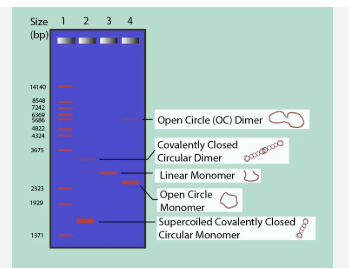
Understand how size, charge and shape can affect the movement of molecules through an agarose gel?
Size: smaller molecules move faster through the gel pores as the largest are first and the smallest usually the last ones
Charge: DNA is negatively charged so when placed in the buffer the molecules would move towards the positive end.
Shape: If its more irregulary shaped the molecule would have a harder time moving along the gel than linear shaped molecules as friction increases for them (diff migration patterns)
Know the basic structure of DNA and the names of the different nitrogenous bases
DNA is a double stranded helix with a backbone of a phosphorus group, a deoxyribose sugar, and a nitrogenous base (Adenine + Thymine and Guanine + Cytosine)
What is FH? What causes the disease? How is it inherited?
FH is familial hypercholesterolemia and what causes it is genetics of having abnormal high levels of cholesterol from birth. It is inherited by genetics with a mutation from LDLR, which is responsible for the production of proteins to clear the LDL cholesterol. (If one person has it they already carry the gene for it)
Understand how restriction enzymes work and how they can be used to help diagnose a genetic disease?
restriction enzymes are proteins that cuts DNA at a specific sequence of abt 6-8 pairs. The enzyme will find the rare occurance sequence in the DNA and cut it to make fragment of different sizes. The thick bands or fragment would be used to compare to one another showcasing if they have the same fragment as the disease carrier.
Be able to interpret gel electrophoresis results as related to FH
is the sample and the other ladders look similar they have the gene for FH or if identical then they have it.

Given graphical results of a DNA gel, be able to determine the size of an unknown DNA band?
compare its position to its known bands on the ladder so the size for the one pointing at the arrow is 600 bp
 Note
Note  Flashcards (32)