Outer Ear
 Call Kai
 Learn
Learn Practice Test
 Spaced Repetition
 Match
Match Flashcards
 Knowt Play
1/18

There's no tags or description
Looks like no tags are added yet.
Name | Mastery | Learn | Test | Matching | Spaced | Call with Kai |
|---|
No analytics yet
Send a link to your students to track their progress
19 Terms
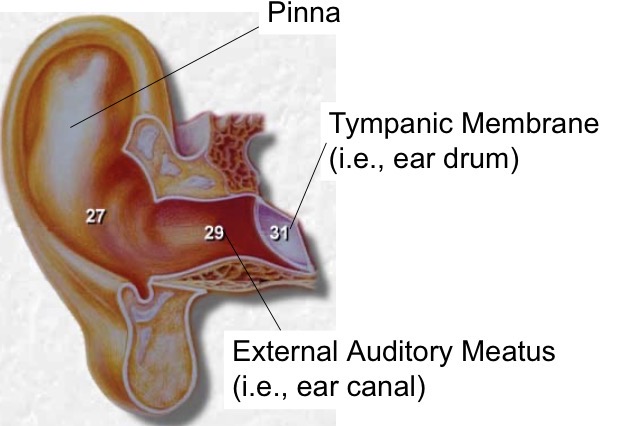
3 parts of the outer ear
Pinna (auricle)
Tympanic Membrane (ear drum)
External Auditory Meatus (ear canal)
Functions of the outer ear
Funnel sound into your ear
Some sound localization
Pinna (auricle) functions
Protects ear canal (external auditory meatus)
Small amplification of sounds in the range of its resonant frequency
Helps differentiate sounds that come from behind vs in front
Helps with localization of high frequency sounds
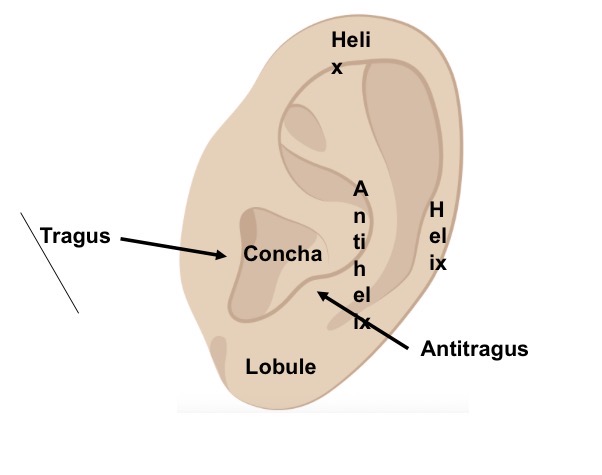
Pinna (auricle) anatomy
Helix and anti-helix
Concha
Tragus and anti-tragus
Lobule
Ear canal (external auditory meatus) functions
Produces cerumen (ear wax)
lubricates ear
Helps remove debris from ear canal
Antibacterial and anti fungal properties
Amplifies sounds in the range of its resonant frequency (2-4kHz)
Protects the tympanic membrane (ear drum) and middle ear
Ear drum (tympanic membrane)
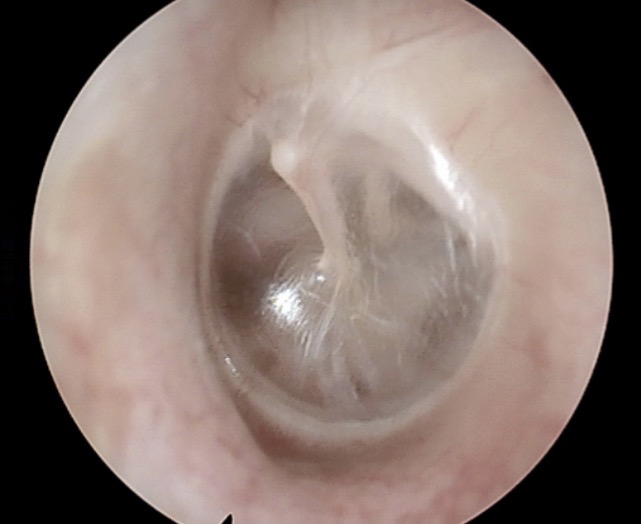
Cone shaped structure that completely closes off one end of the ear canal
Connects to the bones of the middle ear
Can be ruptured by things like cotton swabs or major pressure changes
Ear drum (tympanic membrane) function
Cone shape funnels the acoustic energy of the sound to its center for MECHANICAL TRANSMISSION to the middle ear
Sound localization
The process of determining where a sound is coming from in space in 3 dimensions
Binaural hearing
Having 2 ears
Sound shadows are most prominent at high frequencies
Since diffraction (sound waves wrapping around objects) occurs primarily for low-medium frequencies, sound shadows are most prominent for high frequencies
Two binaural acoustic cues for horizontalsound localization
1) Interaural level difference (ILD)
2) Interaural time differences (ITD)
Interaural level difference (ILD)
Most prominent at high frequencies due to greater sound shadow
Also greater head baffle - head acts as barrier and reflects/amplifies sound on the same side
Can be seen in head related transfer functions (HRTF)
Interaural time differences (ITD)
Most prominent at low frequencies
HRTFs (head related transfer functions)
The amplitude response curves of the head/torso/pinna
Often measured with acoustic dummies with microphones inside their ears
A monaural acoustic cue for sound localization: Pinna filtering
The pinna is asymmetrical, so it filters sound from high vs. low locations differently
This helps us judge the elevation of sounds
Several pathologies can affect outer ear function
Cerumen Impaction
Otitis Externa
Aural Atresia and Microtia
Cerumen Impaction
Ear wax can build up and block the ear canal, preventing sound from getting through
Can create hearing loss, but treatable
Otitis Externa
Infection of the ear canal (bacterial, fungal); also called swimmers’ ear
Accompanied by itching, swelling, pain, excretions; infection and symptoms are treated with ear drops
Can create hearing loss if severe and chronic
Aural Atresia and Microtia
Abnormal or absent pinna and/or ear canal can create a ~60-dB hearing loss
Middle ear transform is minimal due to lack of impedance matching – more on this next time!

