Physics test study - Unit 3 - Work, Energy, Power
 Studied by 1 person
 Call Kai
 Learn
Learn Practice Test
 Spaced Repetition
 Match
Match Flashcards
 Knowt Play
1/11

There's no tags or description
Looks like no tags are added yet.
Name | Mastery | Learn | Test | Matching | Spaced |
|---|
No study sessions yet.
12 Terms
Kinetic energy (definition, equation)
Kinetic: referring to motion
Energy: the ability to do work (work is the change in KE)
K = (1/2)mv²
Can kinetic energy be negative?
NO
Kinetic energy is a SCALAR quantity, with no direction, so it is always positive
Work (definition, equation)
> The energy transferred when a force acts on an object and causes it to move a certain distance
W = Fd
W = the change in KE = (1/2)mvf²-(1/2)mvi²
Can work be negative?
Yes
Work is neg (-) when force is applied in the OPPOSITE direction as motion
Work is pos (+) when force is applied in the SAME direction as motion
When does work cause an increase in energy in a system?
When work is positive (+), the system gains energy.
When work is negative (-), the system loses energy.
What is a joule?
Unit used for
work
K energy
U energy
and is = to 1 N acting upon 1 m
Work- Energy Theorem
the total work done by the sum of all forces on a particle equals the change in its kinetic energy:
Wnet=ΔKE
If positive(+) net work is done on an object, its kinetic energy increases (it speeds up).
If negative(-) net work is done, its kinetic energy decreases (it slows down).
Power (definition, equation)
The rate at which work is done, or energy is transferred
Pinst= W/Δt = ΔE/Δt
Pavg= Fv
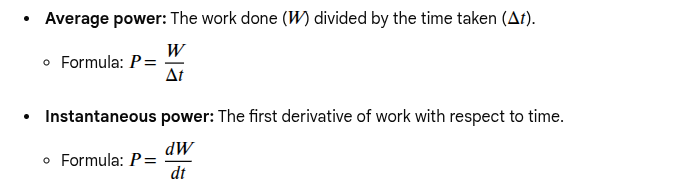
What unit is used for power in AP Physics I?
Watts (W)
1 Joule(J) / second(s)
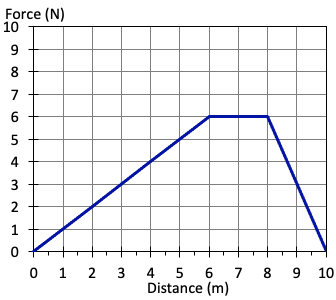
How do you find work in a graph?
Work = Fd
W = the area under a Force vs Displacement graph
Potential energy (definition, equations)
Stored energy an object possesses due to its position.
the amount of potential energy an object has is equal to the work done to give that object that energy (usually through moving it to some location)
ΔUgravitational=mgΔy
Uspring=(1/2)kΔx²
 Note
Note  Flashcards (47)