7 - Management of technology
 Call Kai
 Learn
Learn Practice Test
 Spaced Repetition
 Match
Match Flashcards
 Knowt Play
1/20

There's no tags or description
Looks like no tags are added yet.
Name | Mastery | Learn | Test | Matching | Spaced | Call with Kai |
|---|
No analytics yet
Send a link to your students to track their progress
21 Terms
Def Technology
system of professional knowledge (SW)
and instruments (HW)
for exploiting nature’s potentials
to satisfy the needs of the society
SW (Software/Knowledge): Intangible assets, expertise, "know-how," and processes
HW (Hardware/Instruments): Tangible assets, physical tools, machines, and equipment
powerful forces that are shaping today’s economic landscape quotation
Technology
globalisation
Philip Kotler
technology developpement : 3 different axis + name of concept
1) Application nature
a) Product technology (what)
b) process technology (how)
2) functional role (importance to the product)
c)core technology
d) complementary technology
e)peripheral technology
3) Competitive position
f) base technology
g) key (differentiation) t.
h) Pacing t.
explain the cube technology types
The cube is a strategic mapping tool. It allows a manager to visualize where a technology stands across three dimensions (Nature, Function, and Competition) to decide on investment and R&D strategy
3. Les 3 décisions stratégiques que permet le cube :
Le cube aide à répondre à ces questions :
Où investir ? On investit massivement dans les technologies qui sont [Product + Core + Key]. C'est là que se trouve votre profit.
Où réduire les coûts ? Si une technologie est [Process + Peripheral + Base], on ne dépense pas d'argent pour innover, on essaie juste de la payer le moins cher possible.
Que surveiller ? On surveille les technologies Pacing. Elles sont au fond du cube aujourd'hui, mais elles pourraient devenir les Key technologies de demain.
tech typology def terms application concept
Product technology :
(What) Defines the product itself (concept, design, application engineering).
Example: An electric car's battery system.
Process technology :
(How), How it is manufactured or delivered (manufacturing procedures, quality management, logistics). Example: The robotic assembly line.
tech typology def terms functional role concept
Core tech: Essential. The product cannot perform its basic function without it. (The engine of a car).
Complementary tech : Adds important additional functions in most cases. (Air conditioning).
Peripheral tech : Secondary or optional functions in some cases. (A heated cup holder).
tech typology def terms competitive position
Base technology :
commonly known and used
Key (differentitation) technology :
Mastered by a single firm or limited number of fimrs
Pacing technology :
under development, not used yet
def management of technology
MoT is a cross-functional activity that addresses how to develop, adapt, and exploit technological capabilities to accomplish the goals of an organization.
appearance graph technology life cycles
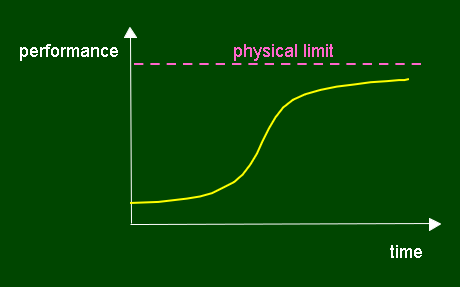
theory s-curve maturity
When a technology reaches its limit, performance flattens. To grow, a firm must jump to a new S-Curve (Discontinuous Innovation).
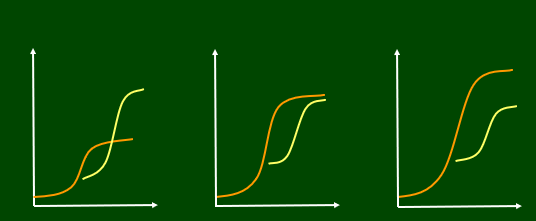
theory technological substition
The process where a new technology replaces an old one after a period of overlap.
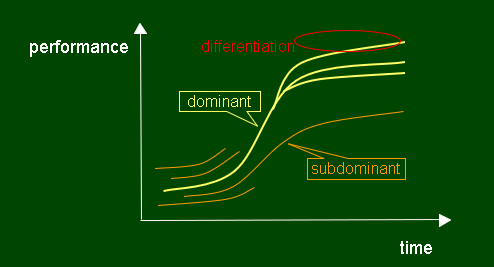
Dominant vs. Subdominant Designs
Dominant Design: The technological path that the majority of the industry follows because it is the most efficient or standardized (e.g., the modern touchscreen smartphone).
Subdominant Design: Alternative technologies that exist but failed to become the market standard. They usually survive only in "niche" markets.
Differentiation (The Red Circle): When everyone reaches the same performance ceiling, companies fight over small performance gains or specific features to stand out.
Types of Differentiation (How to Compete?)
Once a technology is mature, how do you win? two main levers:
Market-Based:
Different price categories: Playing on cost (low-cost vs. luxury).
Different ways of usage: Changing how the product is used (e.g., a watch becoming a health tracker).
Technology-Based:
Changing the technological concept entirely to jump onto a new S-Curve, thereby bypassing the limits of the current technology.
Technology life cycle - def
manager's priority changes as a technology grows up
graph
4 stages
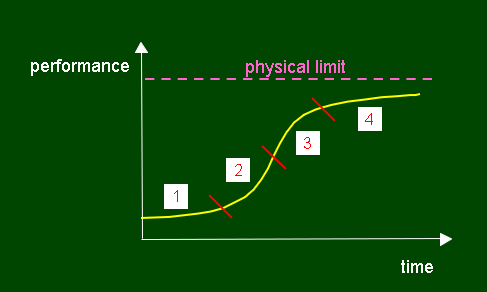
Technology life cycle - stage 1
Context: The technology is brand new. It's expensive and doesn't work perfectly yet.
Key traits: High risk, low growth, and lots of "optimism" but little practical use except in niche areas.
Management Focus: Survival and proving that the concept works
·Major uncertainties
·High level of investment with high risk to obtain marginal improvements in performance
·Low rate of growth
·High degree of optimism regarding the performance
·Underestimation of the period before it reaches the point of rapid growth
·Practical applications only in some special uses where earlier technologies are inadequate
Technology life cycle - stage 2
Context: The technology finally "works." Performance explodes.
Key traits: Quickness is more important than cost. You need to be fast to capture the market. Many new startups emerge.
Competitive Advantage: R&D expertise. If you have the best engineers, you win.
Source of competitive advantage : New technology in (new) products
Main determinant of business success :
research and development
·Emerging body of knowledge („critical mass”) à rapid performance growth („chain reaction”)
·Proliferation of different attempts to apply the new technology
·Rapid succession of new products with significantly higher performance
·Quickness is more important than cost reduction for competitive advantage
·Business success needs strong r&d expertise and technological orientation of the organization
·Emergence of new venture companies
Technology life cycle - stage 3
Context: A "Dominant Design" has emerged. The market is getting crowded.
Key traits: You can't just have "better tech" anymore; you need to specialize. Companies start targeting specific segments (e.g., "the premium version" vs. "the student version").
Competitive Advantage: Marketing. Branding and understanding the customer become the keys to success
Source of competitive advantage :
pructs for defined market segmnents
Main determinant of business success :
marketing
·Dominant technologies emerge
·Market segmentation: different products designed to meet the needs of individual market segments
·Product à technology differentiation (market-based, technology-based)
·Product lives lengthen
·Product cost becomes more important
Technology life cycle - stage '4
Context: The technology has reached its physical limit (like the Betz limit for wind or the speed of a silicon chip).
Key traits: Radical innovation is impossible. Competition is now purely on Price and Quality. Only a few "giant" companies survive (Industrial concentration).
Competitive Advantage: Cost reduction. Success depends on manufacturing efficiency and logistics
Source of competitive advantage :
lower price
Main determinant of business success :
production, quality management, cost accourting
·Physical limit is close à little scope for radical new products
·Increased competition for share in a saturated market
·Competition on price à reduced margin à need to reduce costs
·Emphasis on quality à longer in-service life à smaller replacement market
·Industrial concentration: emergence of a few dominant companies
Innovation schumpter 1934
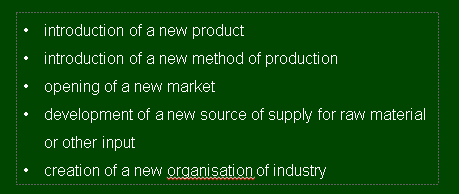
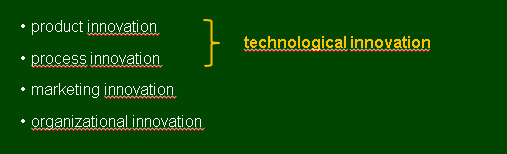
Innovation Oslo manual 3rd 2005
Oslo Manual 4th Ed (2018) change the definition of innovation
Back: It simplified the 4 previous categories into 2 main types:
Product Innovation (Goods or services).
Business Process Innovation (Production, distribution, marketing, organization).
disruptive innovation
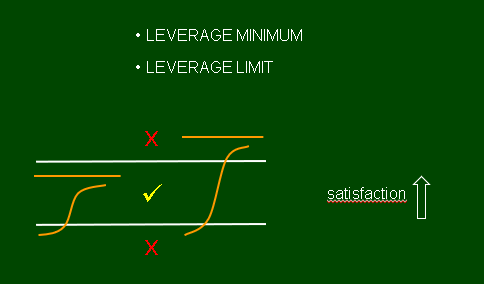
2. The Satisfaction Zone (The White Lines Diagram)
This is the most technical part of your slides. It defines the "window of opportunity" for a product:
The Minimum Leverage (Bottom Line): If your technology's performance is below this line, the customer is frustrated. The product is "not good enough" (X).
The Leverage Limit (Top Line): If your performance goes above this line, you are "Overserving" the market. The customer doesn't care about the extra speed or features anymore and won't pay extra for them (X).
The Success Zone (✓): This is the "Sweet Spot." The technology provides exactly what is needed at a price the customer is willing to pay.