Theory: autumn term
 Call Kai
 Learn
Learn Practice Test
 Spaced Repetition
 Match
Match Flashcards
 Knowt Play
1/81

There's no tags or description
Looks like no tags are added yet.
Name | Mastery | Learn | Test | Matching | Spaced | Call with Kai | Chat |
|---|
No analytics yet
Send a link to your students to track their progress
82 Terms
What is open source hardware?
Open to the public to see design of a physical object
What is open source software?
Source code available to everyone without price
What are digital systems based on?
Digital systems are based on discrete signals
What is an analogue system based on?
Analogue systems are based on continuous signals
What is an interface?
An interface is a point which two computer systems communicate
What is an IDE?
A software program written in an integrated development environment
What is a USB?
A USB is a universal serial bus, a serial communication protocol that establishes specifications for cable and connectors
Describe the advantages of USB-Cs:
Symmetric connectors which make it easier to connect
Provides more power than previous types of USB
Almost all modern protocols can run over USB-C, more versatile
What are the two types of port?
Hardware and software port
What is a hardware port?
A hardware port is a connection point between a computer and an external/internal hardware device
What is an internal port?
A connection point on a motherboard that attaches internal hardware inside the computer
What might the internal port connect?
Hard drives or optical drives (internal hardware)
What is an external port?
A physical connection point on the outside of a computer for peripheral devices
What is a software port?
A software port is a virtual point where network connections start and end
What is the software port managed by?
The software port is managed by the computer’s OS
What is a driver?
A driver is a program that enables the communication between an OS and a hardware component or software application
What is a bootloader?
The bootloader on Arduinos is a tiny piece of software that lets you upload the code you write to the Arduino itself
What does OS stand for?
Operating system
What does an OS do?
Manages memory
Schedules processors
Controls peripherals
Manages files
Provides a user interface
What are logic gates?
Fundamental building block of digital electronics that allow computers to transform 1s and 0s into more complex operations
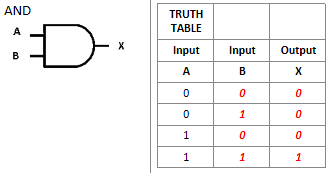
What is this logic gate?
AND logic gate
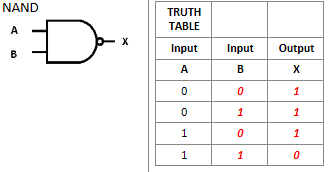
What is this logic gate?
NAND logic gate
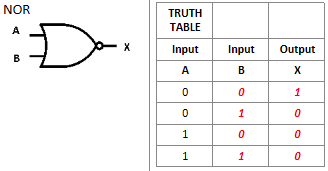
What is this logic gate?
NOR logic gate
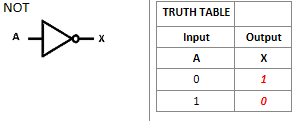
What is this logic gate?
NOT logic gate
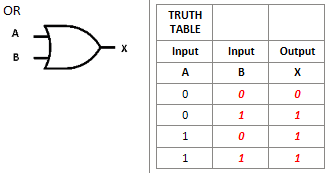
What is this logic gate?
OR logic gate
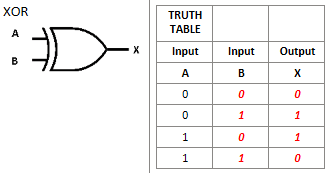
What is this logic gate? And when does it show 1?
XOR logic gate, shows 1 when ONLY one of the inputs is 1
What does a CPU stand for and do?
A CPU (central processing unit) executes programs
What is a RAM?
Random access memory holds data and instructions that the CPU is currently using
What are microprocessors used in?
Used in similar general purpose computer
What is in the central chip of a microprocessor?
Several peripheral chips for memory, input and output, timers, and interfaces
Why does a microprocessor use an OS?
A microprocessor uses an OS to manage multiple processes simultaneously
What is a microcontroller?
A tiny, single-purpose computer that does one thing well
What do microcontrollers do?
They run one specific program and are embedded inside other devices so they can control the actions of the product
Describe two advantages of a microcontroller:
They are low-power devices
Usually small and low cost
How do microcontrollers receive signals?
They have a dedicated input and output device
Give examples of high level code
Python, Java, C
What are advantages of high level languages?
Closer to natural language (than binary)
Easier to read and to write
Largely machine-independent: code can be run on various hardware architectures/OS with minimal editing
What is source code?
Source code are the instructions written in a high level language
What are the two types of low level languages?
Machine code and assembly language
What is machine code?
Machine code is the set of instructions that a CPU understands directly
What is assembly language?
Assembly language uses mnemonics which correspond to a machine code instruction for programmers
Which language uses mnemonics?
Assembly language
What is all programming ultimately converted to?
All programming is ultimately converted to machine code
What are the three types of translators?
Assemblers, compilers, interpreters
What does a compiler do?
A compiler takes the whole source code and translates it into machine code in one go → produces object code
What is an advantage of object code?
It can run unassisted at any time
What are the advantages of compilers?
A compiled program can be supplied as an executable file - a file that is ready to run
Compilers optimise code, taking up less memory space
What are disadvantages of compilers?
Source code must be re-compiled every time the programmer changes the program
Source code compiled on one platform will not run on another - machine code is specific
In which translator(s) is the source code compiled specific to one platform?
Compilers and assemblers
What is an interpreter?
An interpreter translates source code into machine code one instruction at a time, then executed immediately
Advantages of interpreters?
Instructions are executed as soon as they are translated
Errors can be quickly spotted
What happens when an error is spotted in an interpreter?
Once an error is found, the program stops running and the user is notified at which part of the program the interpretation has failed
Disadvantages of interpreters?
The processor has to wait for each instruction to be translated every time it is run
Interpreters do not produce an executable file that can be distributed
Source code has to be supplied each time (could be modified)
Do interpreters produce an executable file that can be distributed?
No
For which translator(s) does source code always have to be provided?
Interpreters
What do assemblers do?
Assemblers translate assembly language into machine code
What converts assembly language into machine code?
Assemblers
What is a difference between assemblers and the other two (compilers and interpreters)?
C and I generate many machine code instructions for each high-level instruction, while assemblers create one machine code instruction for each assembly instruction
What is serial communication?
Serial communication is the process of sending data one bit at a time over a communication channel
What is synchronised serial communication?
Synchronised serial communication is when the timing of each bit is synchronised by the clock oscillations
What is asynchronous serial communication?
Asynchronous communication is when files are broken up into many packets and reassembled at the receiving end (more common)
What is parallel communication?
Parallel communication describes several bits being sent at the same time, with several channels in parallel with each other
What is an advantage of parallel communication?
Parallel communication is faster than serial as many bits are sent over many channels at the same time
What is a disadvantage of parallel communication?
Parallel communication can be unreliable over long distances
Where is parallel communication mainly found?
On very short communication channels of printed circuit boards
What is a transducer?
Any device that converts one form of energy into another
What is a sensor (input transducer)?
Device which converts physical quantities (like temperature, light, or pressure) into electrical signals
What is an actuator (output transducer)?
Device which is converts electrical signals to physical movements
What movements can actuators cause?
Rotate, open, close, push, pull, etc
Name 4 examples of actuators:
Speakers
Solenoids
Relays
Motors
What is a speaker?
A diaphragm is vibrated to create sound waves
What is a solenoid?
A long coil of wire that acts as an electromagnet when an electric current passes through it
What can a solenoid control?
A solenoid can control plungers, or arms, which can control triggers or lock
What is a relay?
An electrically operated switch
What type of electrical signal does a relay use?
A small, low-power electrical signal
What does a relay control?
A much larger, separate high-power circuit
What is a motor?
A motor is an actuator: a type of output device that converts electrical signals from a processor into physical movement or action
What is a DAC?
A digital-analogue converter
What does the DAC do first?
The computer sends a stream of binary numbers to the DAC
After the DAC receives the binary numbers, what does it do?
The DAC reads each binary number and outputs a specific, proportional electrical voltage
What happens whilst the DAC converts the binary numbers?
As the binary values change very rapidly, the DAC creates a "stepped" electrical signal
How are the electrical steps modified as the last step of the DAC?
Electrical steps passed through an amplifier and output device, smoothing the stepped signal into a continuous audio wave