03 - Genes, genetic diseases and epigenetics
 Studied by 0 people
 Call Kai
 Learn
Learn Practice Test
 Spaced Repetition
 Match
Match Flashcards
 Knowt Play
1/76

There's no tags or description
Looks like no tags are added yet.
Name | Mastery | Learn | Test | Matching | Spaced | Call with Kai |
|---|
No analytics yet
Send a link to your students to track their progress
77 Terms
Genes
a specific sequence of nucleotides in DNA (or RNA), located on a chromosome. A gene is the functional unit of inheritance controlling the transmission and expression of traits by coding for a particular polypeptide
DNA and RNA are made up by sequences of
bases
DNA bases =
adenine (A),
thymine (T),
guanine (G)
cytosine (C)
RNA bases =
adenine (A),
cytosine (C),
uracil (U)
guanine (G)
Bases form specific pairs:
(A-T, G-C, A-U)
contain the information that codes for specific amino acids (20 different amino acids in the body
Nucleotide
DNA subunit, formed of one deoxyribose
molecule (sugar), one phosphate group, one base
codon
A group of 3 nucleotides is called a codon,
each codon codes for an
amino acid in a
corresponding protein
Polypeptide
chain of many amino acids
Protein
contains one or more polypeptides
Mutation
alteration of genetic information
Base pair substitution
wrong base replaces another
Frameshift mutation:
insertion or deletion of base-pairs of the DNA, thus
altering the amino acid sequence
Two different types of cells:
Gametes
Somatic cells
Gametes
sperm and egg cells)
23 chromosomes (haploid)
Somatic cells
cell that is not a gamete. Is diploid since it has 46
chromosomes arranged in 23 pairs
dna
the structure of dna is similar to a twisted ladder, with base pairs forming the rungs.
genes are composed of dna segments
coiled dna
the dna in each cell would be about 2m long if strecthed out. To fit inside the cell, the dna is tightly coiled
chromosome
one chromosome of every pair is from each parent
nucleus
each nucleus of a somatic cell contains 46 chromosomes arranged in 23 pairs
cells
a nuclesus resides in most human cells
Leading cause of intellectual disability and miscarriage
CHROMOSOMES’ ABNORMALITIES
59% of first-trimester spontaneous abortions have major
chromosome aberrations
chromosome abnormalities in live births
approximately 1 in 150 has a
major diagnosable chromosome
abnormality
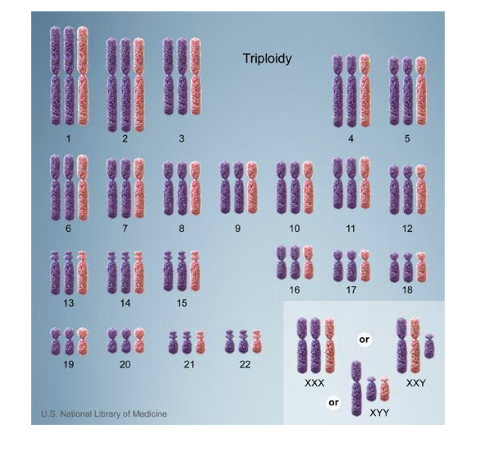
Polyploidy
condition in which the diploid
cells have more than two complete sets of
chromosomes
Aneuploidy
presence of an abnormal
number of chromosomes in a cell
triploidity
DOWN SYNDROME
Best-known example of aneuploidy is the trisomy of chromosome 21
1 in 800 live births
risomy 21 means that cells have
3 copies of chromosome 21 instead of two
Chromosome 21 - why is it imp
Chromosome 21 contains 200 to 300 different
genes = many different roles in the body!
down syndrome features - Iq
It usually ranges from 20 to 70 (intellectual disability).
down syndrome features - male/female findings
Virtually all males are sterile; some females can reproduce.
down syndrome features - face
Distinctive features include low nasal bridge, epicanthal folds, protruding tongue, low-set ears.
down syndrome features - musculo-skeletal system
Features include poor muscle tone (hypotonia) and short stature.
down syndrome features - systematic disorders
Features include congenital heart disease (one third to half of cases), reduced ability to fight respiratory tract infections, and increased susceptibility to leukemia-
overall reduced survival rate; by age 40 years usually develop symptoms similar to those of Alzheimer's disease.
down syndrome features - mortality
About 75% of fetuses with Down syndrome abort spontaneously or are stillborn; 20% of infants die before age 10 years; those who live beyond 10 years have life
expectancy of about 60 years.
down syndrome features - causative factors
97% of cases are caused by nondisjunction during formation of one of parent's gametes or during early embryonic development; 3% result from translocations; in 95% of cases, nondisjunction occurs when mother's egg cell is formed; the remainder involve paternal nondisjunction; 1% are mosaics-these have a large number of normal cells, and effects of trisomic cells are attenuated and symptoms are generally less severe.
turner syndrome
1 in 2000 – 2500 females
is on a spectrum so severity of syndrome can vary
Females with part of 1 X chromosome missing, or only 1 X chromosome (not pairedwith another X)
Have 45 chromosomes instead of 46 in certain cells
only seen in females cuz theres 2 x
Some cells might be normal and contain 46
chromosomes
If part or all of the second sex
chrosomosome is lost in most of cells,
individual will develop symptoms of
turner syndrome
turner syndrome features -iq
Individuals with this syndrome are not considered to be intellectually disabled, although the syndrome is associated with some impairment of spatial and
mathematical reasoning ability.
turner syndrome features - male/female findings
It is found only in females.
turner syndrome features - musculo skeletal system
Short stature is common; other features are characteristic webbing of neck, widely spaced nipples, and reduced carrying angle at elbow
turner syndrome features - systemic disorders
Features include coarctation (narrowing) of aorta, edema of feet in newborns; females are usually sterile and have gonadal streaks rather than ovaries; streaks are sometimes susceptible to cancer.
turner syndrome features - mortality
About 15-20% of spontaneous abortions with chromosome abnormatities have this karyotype, most common single-chromosome aberration; highly lethal during gestation, only about 0,5% of these conceptions survive to term.
turner syndrome features - causative factors
75% of cases inherit X chromosome from mother, thus caused by meiotic error in father; frequency is low compared with other sex chromosome aneuploidies (2: 5
000 newborn females); 50% have simple monosomy of X chromosome; the remainder have more complex abnormalities; combinations of 45.X cells with XX or XY cells common.
TURNER SYNDROME - Functions of the X chromosome Fertility
• Genes for reproduction are enriched on the X chromosome
• BMP15 gene: involved in folliculogenesis (development of ovulatory
follicles)
TURNER SYNDROME - Skeletal malformations
• Loss of SHOX gene normally present on X chromosome
• SHOX gene plays role in growth and maturation of the skeleton
when you lose can chromosomes what do you look at
you look at the traits and characteristics they impact and you can understand symptoms you will develope
EPIGENETIC MECHANISMS
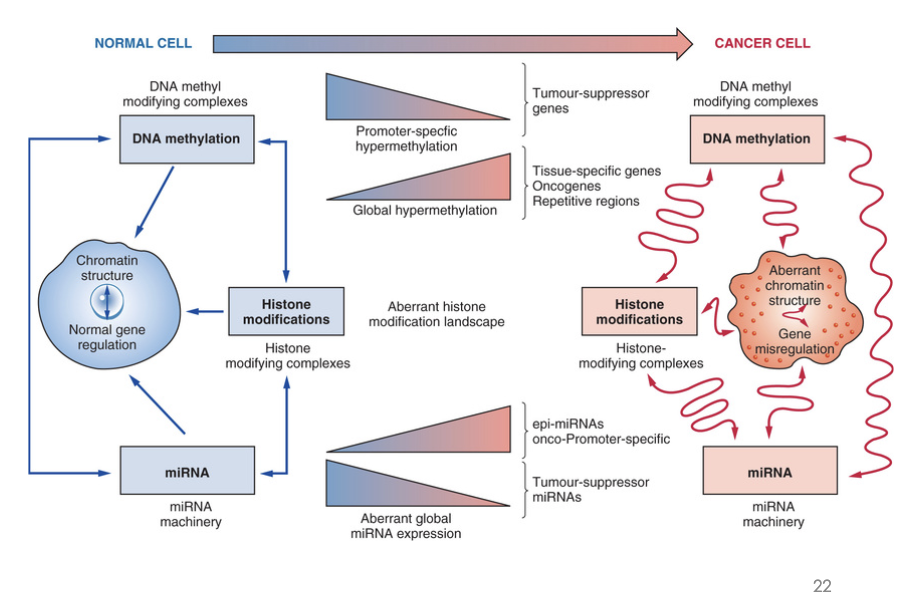
Biochemical changes that affect gene expression without altering the DNA sequence.
DNA methylation, Histone modifications, microRNA
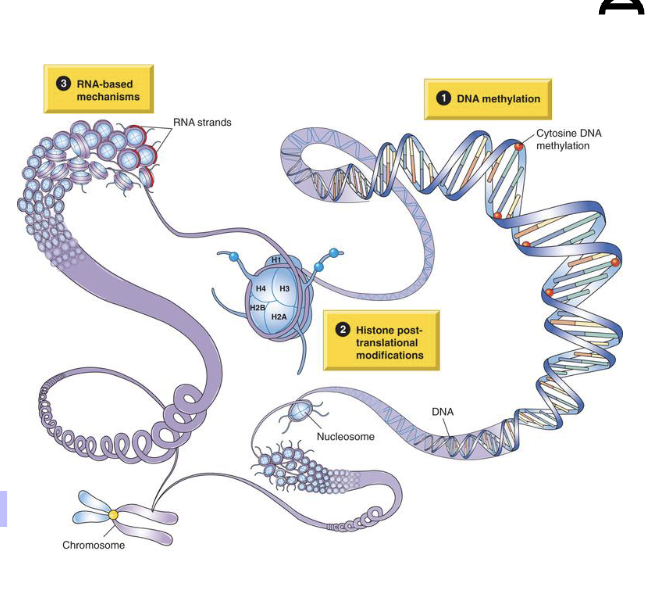
DNA methylation
methyl group is added to the DNA, which usually silences the gene
Attachment of a methyl group to a cytosine
Histone modifications
alteration of
the structure of chromatin, reducing
or elevating gene expression
microRNA
aberrant miRNA
expression which alters gene
expression at the post-transcriptional level
causes of EPIGENETIC MECHANISMS
• Environmental factors (diet, exposure to certain chemicals)
• Nutritional deprivation
• Transgenerational inheritance of epigenetic modifications
Dense DNA methylation:
insulate the genes, blocks the transcription factors
• Methylated gene is transcriptionally silent
Aberrant DNA methylation:
• Presence of dense methylation where it’s normally absent
• Absence of methylation where it is typically present
• Abnormal methylation is common in cancer: leads to misregulation of tumor-supressor genes and oncogenes
Oncogene
• Can potentially cause cancer
• Mutation/high expression level of normal genes implicated in:
• Cell growth
• Cell proliferation
• Inhibition of apoptosis
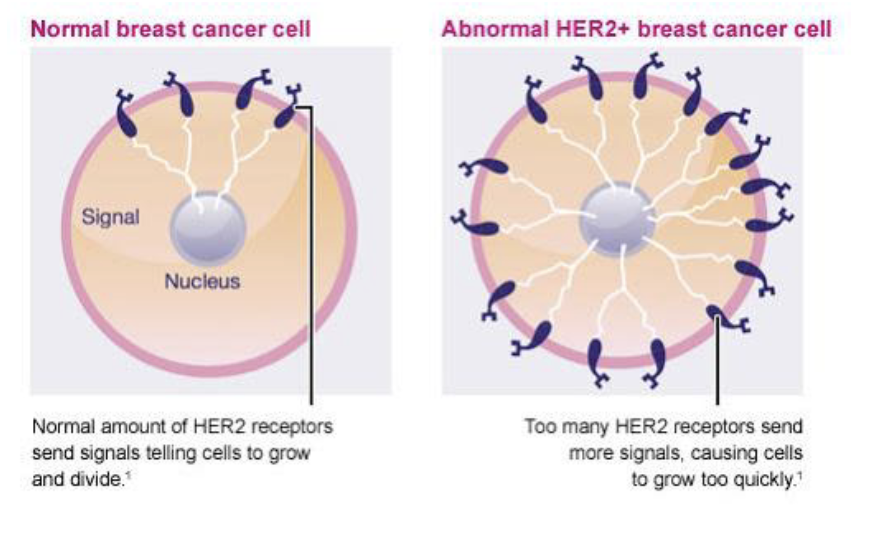
her2 receptors
used to measure agressive brest cancer
alot = more agressive
Tumor-supressor genes:
• Can potentially cause cancer
• Abnormal expression leads to loss or reduction of functions, which leads to cells growing abnormally
Tumor-supressor genes categoreis
Caretaker genes
Gatekeeper genes
Landscaper genes
Caretaker genes
stability of genome via
DNA repair
Gatekeeper genes
regulate cell growth by
inhibiting cell cycle or promoting apoptosis
Landscaper genes
regulate cell growth by
their action on the surrounding
environment/stroma
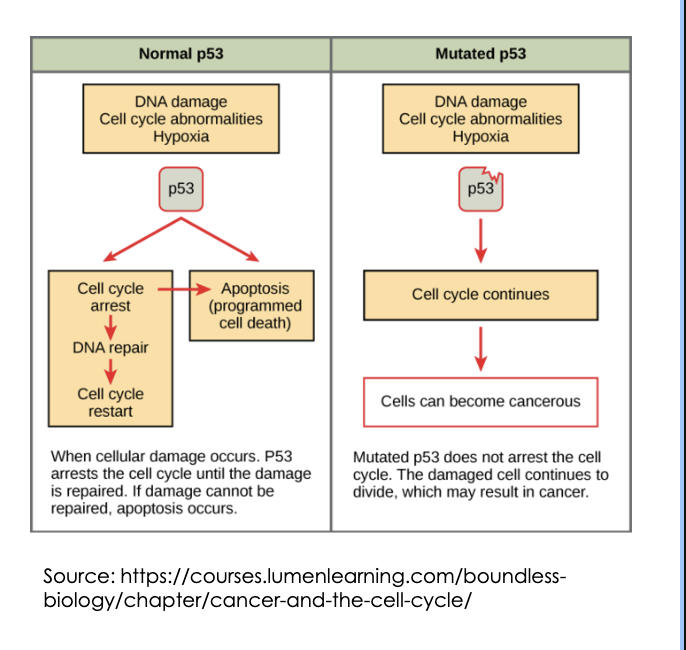
normal vs muatted p53 gene
tumor supressor genes
low level p53 = more cancerous
chromatin
DNA + histones
Histones facilitate the
compaction of
DNA in the nucleus
2 forms of chromatin
Euchromatin
Heterochromatin
Euchromatin
open state where all
genes are transcriptionally active
Heterochromatin
closed state in
which most or all nearby genes are
inactive
Histone modification
addition or deletion of
an acetyl group at the end of the histone
protein
Modification of histones can up or
downregulate nearby gene expression by:
Modifying the tightness of the interaction
between DNA and histones, making DNA
more or less accessible to transcription
factors
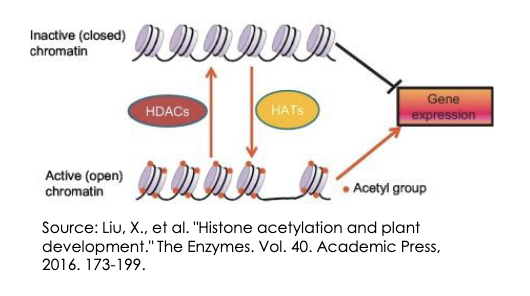
Hyperacetylation
disrupts the association
between histone and DNA, leading to
increased accessibility of DNA and increase
gene expression
Hypoacetylation
DNA is more tightly wrapped
around histones, decrease gene expression
HDACs =
histone deacetylases. Enzyme
that removes acetyl groups on histones
HATs =
histone acetyltransferase. Enzyme
that adds acetyl group on histones
RB1 gene
prevents excessive growth, inhibits cell cycle progression
BRCA1 gene
DNA repair
METHYLATION AND CANCER
 Note
Note  Flashcards (129)