Middle Ages
 Call Kai
 Learn
Learn Practice Test
 Spaced Repetition
 Match
Match Flashcards
 Knowt Play
1/38

There's no tags or description
Looks like no tags are added yet.
Name | Mastery | Learn | Test | Matching | Spaced | Call with Kai |
|---|
No analytics yet
Send a link to your students to track their progress
39 Terms
Manor
Large farming estate owned by kings
Surfs worked and had to pay taxes
People would hide in the manor when invaders arrived
Feudalism
Kings didn't Protect everyone
The Hierarchy
Land is passed down from father to son, women could have fief (land) as dowry
A fief is a word for the piece of land when given in a deal
Simony
-Concept where people would buy positions in the Church
-Families donated money so their second born sons could pursue a good job
Heretic
Speaks out above the church
Tithe
Christians (who were a part of the church;) paying tax
Secular
Referring to worldly power, rather than spiritual power
Ownership of land, politics, money, etc…
Nobles/Lords
3rd on the Hierarchy below the Pope/Church and the Monarch
Lived in Castles
Owned land
Peasants/Serfs
was difficult due to the hard work they had in their jobs
Could not leave without the lords permission
Rarely ate meat
Life span was short due to the negligence of society and not being able to have essential life things
Hierarchy of the Church
Pope
Cardinals
Archbishops
Bishops
Priests
Pope
the leader of the Church.
Cardinals
important church leaders who helped the Pope
Archbishops
in charge of large areas of the Church.
Bishops
led local areas and had power in their regions.
Priests
worked in villages and helped people with their faith.
Clovis
former King of the Franks. He was the first King to unite the Franks. He was a strong leader and warrior.
Charles Martel
Military leader and Ruler of Francia. He was a Frankish statesman known as the “Hammer.”
Charlemagne
He was Pepin the Short’s son
He spread Christian teachings throughout Europe and forced people to convert
Under his rule, the government divided into regions (controlled by Counts)
He started schools run by monks
Otto I
First emperor of the Holy Roman Empire
Gained support of the church
United the Holy Roman Empire (Germany & Italy)
Fredrick l
He is a powerful Holy Roman Empire.
He is known for the third crusade.
He was an emperor from 1155 till his death in 1190.
Vikings
from Scandinavia
boat people basically like pirates or north men
also attacked Charlemagne empire.
They raided many places world wide
Noblewomen
inherited an estate from her husband= landowner, send knights to war, educated by tutors, could defend land when their husband was away at war
Peasant women
endless labor, worked side by side with husbands/ family, Domestic duties, poor and powerless
Fall of Rome
Caused by invaders, the failing of economy
Downfall for cities and decentralized the governmen
Dark Ages
The time period following the fall of Rome in Europe
between the fall of the Roman Empire and the European Renaissance was a period of decline for Europe.
also called the Middle Ages because it falls in the middle of 2 important time periods: Classical Period (Greece & Rome) and the European Renaissance.
Treaty of Verdun
Division of Carolingian Empire
Concordat of Worms
a landmark treaty ending the initial Investiture Controversy
Only the church appoints the bishops
German princes regain power
Knights
wore armor to defend their land
Followed chivalry
To become one=1) be of noble class2) pass through training
Pepin III
The short
Won land in Rome and gave control to the Pope
Papal States
Carolingians
Inquisition
A period of prolonged and intensive questioning or investigation
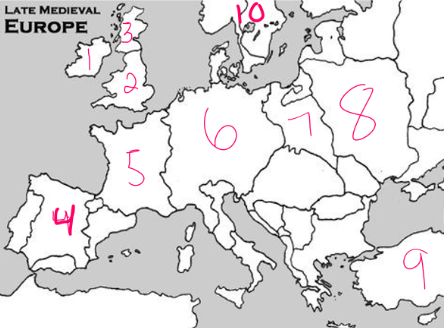
1
Ireland
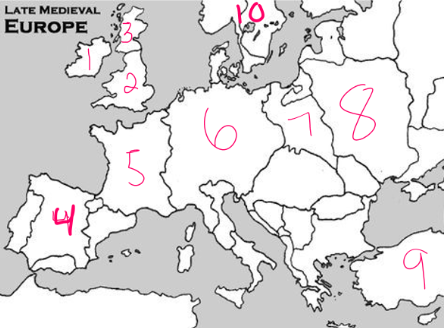
2
England
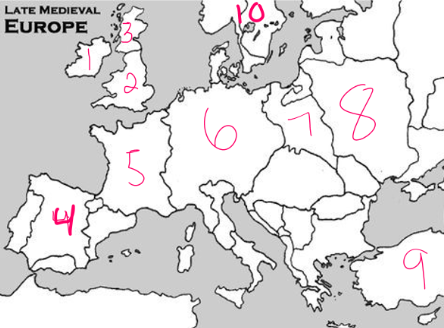
3
Scotland
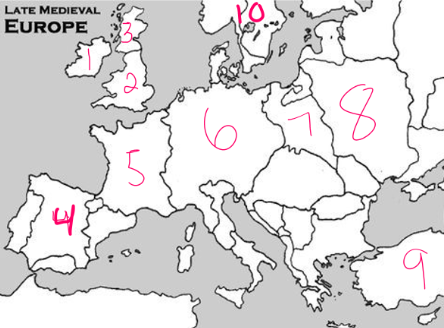
4
Spain
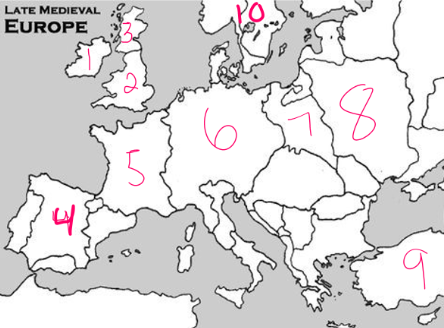
5
France
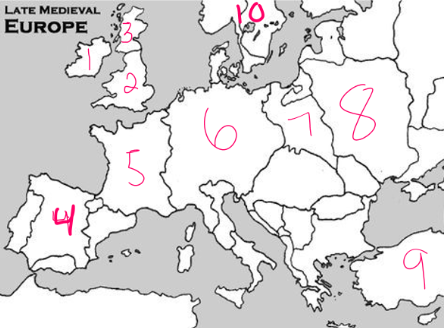
6
Holy Roman Empire
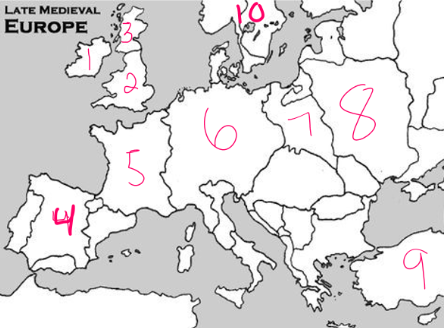
7
Poland
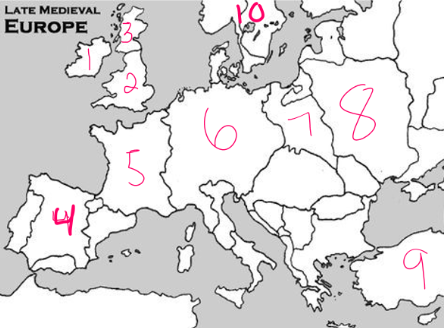
8
Russia
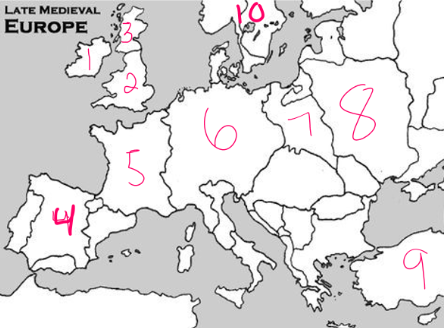
9
Byzantine Empire
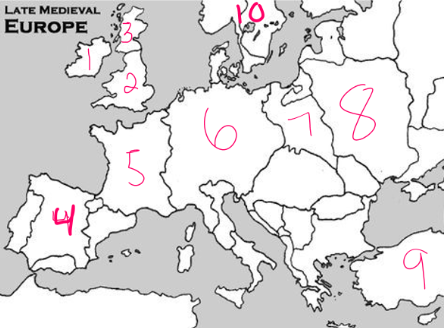
10
Scandinavia

