Bio Exam 2 - Professor Fischetti
 Call Kai
 Learn
Learn Practice Test
 Spaced Repetition
 Match
Match Flashcards
 Knowt Play
1/66

Earn XP
Description and Tags
gray and jessica combined sets yayyyy it worked
Name | Mastery | Learn | Test | Matching | Spaced | Call with Kai |
|---|
No analytics yet
Send a link to your students to track their progress
67 Terms
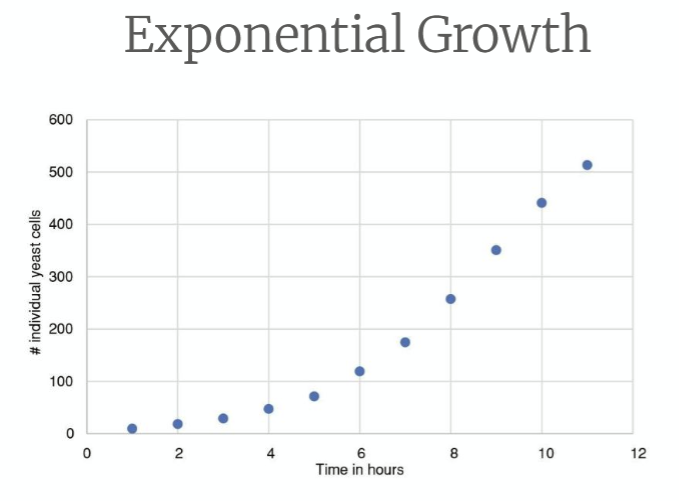
What is this curve?
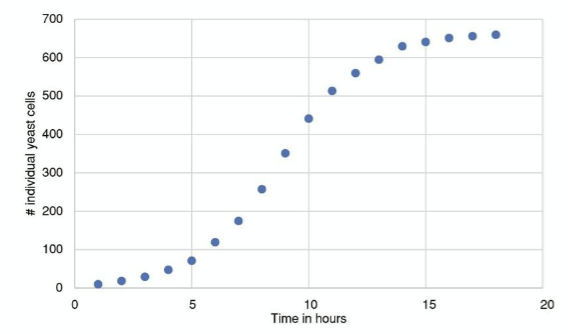
What curve is this?
What is happening when a graph flattens out?
It has reached Carrying Capacity/Steady State
What is it called when exponential growth eventually creates too many individuals for the environment to support?
Struggle for Existence
Morphological/Phenotypic Variation
Variation in the form of structure of the organism
Continuous Variation
Infinite number of possible measurements between extremes
Discontinuous Variation
Variation can be categorized (qualitative). Ex: eye color, hair color, height, rows of scales
How do you know which allele is dominant?
The trait expressed in the Heterozygote is the dominant allele’s trait.
If a population is evolving…
allele or genotype frequencies change from generation to generation
If a population is not evolving…
it is in Hardy-Weinberg Equilibrium
If calculated x2 is greater than critical x2, is the population evolving?
The population is evolving
Ontogeny
The change an individual experiences over a lifetime.
Mendel’s Laws
Segregation, Independent Assortment, Law of Dominance
Hardy-Weinberg Equilibrium
Genotype frequencies are due to random chance
HWE Assumption: No Natural Selection
All genotypes will have equal fitnesses (fixed)
Assortative Mating
Mating occurs between same phenotype or genotype
Disassortative Mating
Mating occurs between different phenotype or genotype
HWE Assumption: No Migration/Gene Flow
There must be no allele differences in HWE
HWE Assumption: No Mutation
There must be no variation in HWE
HWE Assumption: Mating is Random
Cannot has assortative or disassortative mating
Microevolution
chenges within populations
Macroevolution
occurs above the species level
Phylogenetic Trees (or Cladograms)
Nodes, Leaves, Branches
Node
implies a common ancestor for species on branches above the node
Leaves
equally related to their most closely shared node
Branch
Connection between nodes and/or leaves
Phenotypes
Physical (morphological, structural) attributes of an organism influenced by its genotype and environment.
Hardy-Weinberg Equilibrium
A principle that gives predictions for the null hypothesis regarding genetic variation.
Cryptic Variant
A variant that blends in with its environment.
Conspicuous Variant
A variant that stands out in its environment.
Carrying capacity
The maximum population size that an environment can sustain.
J Curve or Exponential Curve
A specific shape of a growth curve reflecting unlimited resources, resulting in population doubling.
Struggle for existence
The concept inferred by Darwin that populations produce more offspring than the environment can support.
Homozygous dominant genotype frequency
In Hardy-Weinberg equilibrium, the expected frequency if p = 0.6 is 0.36.
Expected number of heterozygous individuals
Using the HWE formula 2pq, the expected number of heterozygous individuals (Dd) in a population of 1,000 where p=0.6 and q=0.4 is 480.
Chi-square value conclusion
If the chi-square value is 0.0, the conclusion is that the population is not evolving.
Nonrandom mating
A violation of Hardy-Weinberg equilibrium that changes genotype frequencies but not necessarily allele frequencies.
Stabilizing selection
A mode of selection where the average phenotype is favored and extremes are selected against.
Heterozygote advantage
A phenomenon maintaining both alleles and preventing fixation due to their fitness differences.
Exponential growth
Population growth pattern that occurs in environments with abundant resources.
Fixation
When an allele’s frequency reaches 1.0 (100%) in a population due to strong selective pressure.
Directional selection
A mode of selection where a population shifts toward one extreme trait.
Standard deviation
A statistical measure that decreases as a population becomes more specialized for a specific environment.
Disruptive selection
A mode of selection where individuals with extreme traits survive better than those with average traits.
Genetic Drift
The effect of chance on a population’s allele and genotype frequencies.
Mutation
A chemical error during DNA replication leading to new traits.
Natural selection
The process where certain traits increase survival and reproduction rates.
Migration or gene flow
The movement of individuals or gametes between populations, introducing new alleles.
Allele A
An allele expected to decrease in frequency over time due to low fitness.
Sickle Cell Anemia
A genetic disorder where a deleterious recessive allele persists due to stabilizing selection.
Strength of selection (S)
Calculated as S = 1 - W, where W is the fitness of an individual or phenotype.
Gene
A basic unit of inheritance.
Allele
Different forms of the same gene.
Genotype
The combination of alleles found in an individual.
Mendel's Laws
The principles of segregation and independent assortment.
Gene Pool
The total number of copies of a gene within a population.
Frequency sum in population genetics
All allele frequencies in a population must add up to 1.
Darwin’s finches
An adaptive radiation of 14 species traced back approximately 5 million years.
Hardy-Weinberg Equilibrium
A principle to test whether a population is evolving.
Assortative mating
Mating that occurs between individuals of the same phenotype or genotype.
Disassortative mating
Mating that occurs between individuals of different phenotypes or genotypes.
Genetic bottleneck
Temporary reduction in population size due to environmental events that limits genetic diversity.
Microevolution
Small-scale changes within populations over time.
Macroevolution
Large-scale evolutionary changes occurring above the species level.
Phylogeny
The evolutionary history of an organism.
Phylogenetic trees
Diagrams that represent the evolutionary relationships between species based on shared traits.
Monophyletic group
A group that shares a common ancestor.

