AP Psychology Unit 4
2.0(1)
 Studied by 19 people
 Call Kai
 Learn
Learn Practice Test
 Spaced Repetition
 Match
Match Flashcards
 Knowt Play
Card Sorting
1/112

Earn XP
Description and Tags
Last updated 3:54 AM on 4/24/23
Name | Mastery | Learn | Test | Matching | Spaced | Call with Kai |
|---|
No analytics yet
Send a link to your students to track their progress
113 Terms
1
New cards
sensation
passive process of bringing information from the outside world into the body and brain (unconscious)
2
New cards
perception
the active process of selecting, organizing, and interpreting the information brought to the brain by senses (conscious)
3
New cards
bottom-up processing
analysis of the stimulus begins with the sensory receptors and works up to the level of the brain and mind (sensory)
4
New cards
top-down processing
the interpretation of incoming information based on prior knowledge, experiences, and expectations (perception)
-Ex: where's waldo
-Ex: where's waldo
5
New cards
selective attention
process of discriminating between what is and is not important is influence by motivation, past experience, culture, and biology
-basically ignoring the non important things
-basically ignoring the non important things
6
New cards
cocktail party effect
ability to tune into a single voice despite many conversations in a noisy room
7
New cards
inattentional blindness
the inability to see an object or a person while out attention is directed elsewhere
- Simons and Chabris
- Simons and Chabris
8
New cards
subliminal
below one's absolute threshold for conscious awareness
-unconscious awareness
-unconscious awareness
9
New cards
Change Blindness
failing to notice changes in environment when focused on something
10
New cards
Transduction
In sensations, it is the transformation of stimulus energy into neural impulses
11
New cards
Psychophysics
study of the relationship between physical characteristics of stimuli and our psychological experience with them
12
New cards
Gustav Fechner
early German psychologist credited with founding psychophysics
13
New cards
t
Sensory System Steps:
1) receive sensory information from our environment
2) Transform that information into energy impulses (transduction)
3) Deliver neural information to our brain
1) receive sensory information from our environment
2) Transform that information into energy impulses (transduction)
3) Deliver neural information to our brain
14
New cards
Threshold
the level of stimulation required to trigger a neural impulse
15
New cards
absolute threshold
the minimum stimulation needed to detect a particular stimulus 50 percent of the time
-Ex: see a flame 30 ft away
-Ex: see a flame 30 ft away
16
New cards
Subliminal threshold
stimuli below one's absolute threshold for conscious awareness (unconsciously aware)
17
New cards
difference threshold
the minimum amount of stimulus needed to produce a noticeable change (JND)
- the greater the intensity of the stimuli, the more significant the change needed to be perceived
-Ex: change in temp
- the greater the intensity of the stimuli, the more significant the change needed to be perceived
-Ex: change in temp
18
New cards
Weber's law
the principle that, to be perceived as different, two stimuli must differ by a constant minimum percentage (rather than a constant amount) (about 2%)
19
New cards
sensory adaptation (habituation)
over time, we lose sensitivity to a stimulus from repeated exposure
-does not work with vision because eyes constantly move
- Allows us to be attentive to new potentially dangerous situations
-does not work with vision because eyes constantly move
- Allows us to be attentive to new potentially dangerous situations
20
New cards
signal detection theory
how we detect stimuli (signal) amid stimulation noisea theory predicting how and when we detect the presence of a faint stimulus (signal) amid background stimulation (noise).
\
\- Assumes there is no single absolute threshold and that detection depends partly on a person's experience, expectations, motivation, and alertness.
\
\- Assumes there is no single absolute threshold and that detection depends partly on a person's experience, expectations, motivation, and alertness.
21
New cards
perceptual set
perceiving the world in ways that align with our mood, experience, and expectations
- hard to correct it once we have the wrong interpretation
-works with sight, taste, smell, and hearing though top-down processing
- hard to correct it once we have the wrong interpretation
-works with sight, taste, smell, and hearing though top-down processing
22
New cards
Context effects
experience, culture, and environmental factors can affect perception
23
New cards
Schema
a concept or framework that organizes and interprets information
- Basically, your expectations of the world, based on culture and environment
-guides perceptual set
- Basically, your expectations of the world, based on culture and environment
-guides perceptual set
24
New cards
t
-injures might hurt more when angry, and hurt less when happy
-motives can make us perceive a needed object as more or less attractive or accessible
-motives can make us perceive a needed object as more or less attractive or accessible
25
New cards
Wavelength (frequency)
The distance between two corresponding parts of a wave
- the longer it is, the less often it occurs affecting color perception
-affects color or pitch
- the longer it is, the less often it occurs affecting color perception
-affects color or pitch
26
New cards
Amplitude
Height of a wave
-affects brightness and loudness
-affects brightness and loudness
27
New cards
Negative after image
the image seen after a portion of the retina is exposed to an intense visual stimulus
- sensory receptors for certain colors get fatigued, allowing complementary colors to predominate the fatigued colors
- sensory receptors for certain colors get fatigued, allowing complementary colors to predominate the fatigued colors
28
New cards
cornea
The clear tissue that covers the front of the eye, which bends the light towards the eyeball
29
New cards
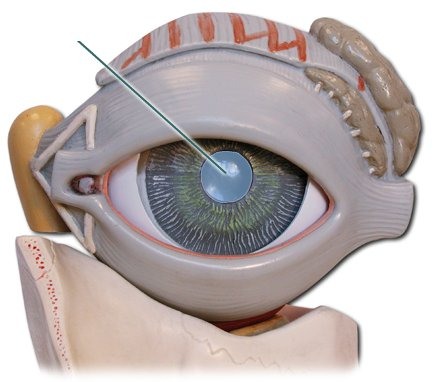
pupil
the opening of the center of the eye the appears black
30
New cards
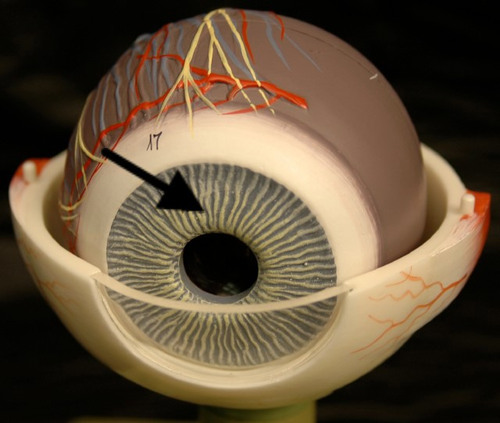
iris
colored muscle surrounding the pupil that controls the amount of light entering.
- opens and closes responding to environmental and internal conditions
- opens and closes responding to environmental and internal conditions
31
New cards
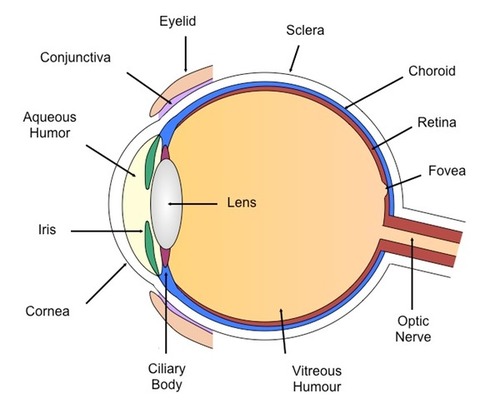
lens
curved transparent structure that adjust to focus images to the rear of the eye
32
New cards
vitreous humor
jellylike substance found behind the lens in the posterior cavity of the eye that maintains its shape
33
New cards
retina
the light-sensitive inner surface of the eye, containing the receptor rods and cones plus layers of neurons that begin the processing of visual information
-rear of the eye
- has visual accommodation
-rear of the eye
- has visual accommodation
34
New cards
visual accomodation
the focused image to the retina appears inverted
35
New cards
accomodation
process of lens changing shapes to focus near or far in the retina
36
New cards
rods
retinal receptors that detect black, white, and gray; necessary for peripheral and night vision
-20x more rods than cones
-20x more rods than cones
37
New cards
cones
photoreceptor cells for daylight and color visions
38
New cards
fovea
the central focal point in the retina, around which the eye's cones cluster
39
New cards
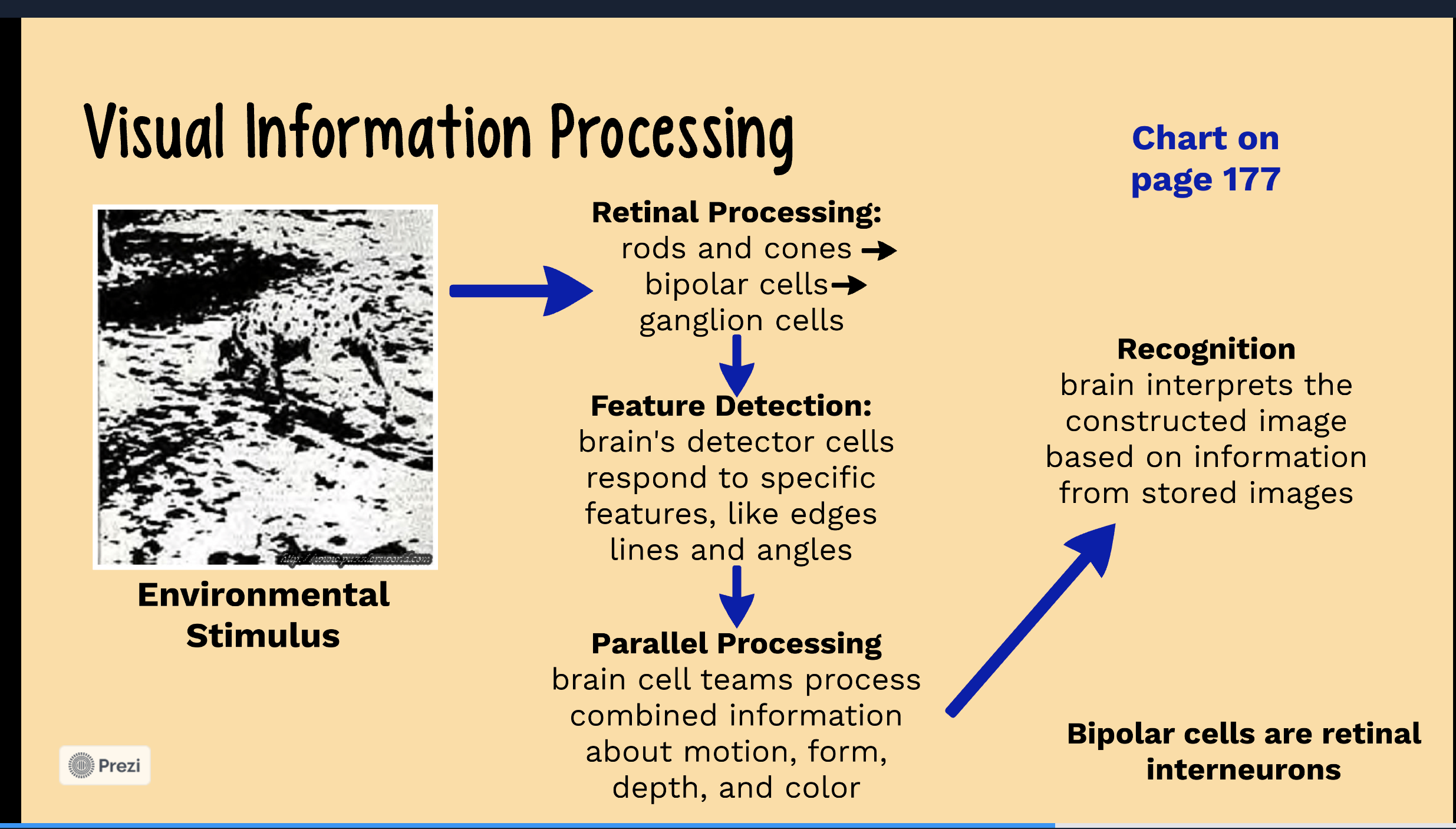
bipolar cells
eye neurons that receive information from the retinal cells and distribute information to the ganglion cells
40
New cards
ganglion cells
their axons form the optic nerve
41
New cards
optic nerve
the nerve that carries neural impulses from the eye to the occipital lobe
42
New cards
hue
color that is determined by wavelength of light
- Just color
- Just color
43
New cards
intensity
amount of energy of light or sound waves; perceived as brightness or loudness
44
New cards
blind spot
the point at which the optic nerve leaves the eye, creating a "blind" spot because no receptor cells are located there
45
New cards
feature detectors
nerve cells in the brain that respond to specific features of the stimulus, such as shape, angle, or movement in the visual cortex
46
New cards
parallel processing
the ability of the brain to do many things at once simultaneously
47
New cards
t
48
New cards
color vision
mental construction based on the wavelengths that an object reflects (rather than absorbs)
49
New cards
Trichromatic theory (young-helmholtz)
the theory that the retina contains three different color receptors—red, green, and blue—which, when stimulated in combination, can produce the perception of any color.
-when colors are equally active, we see white or grey
-when colors are equally active, we see white or grey
50
New cards
opponent-process theory
the theory that opposing retinal processes (red-green, yellow-blue, white-black) enable color vision.
-Ex: some cells are stimulated by green and blocked by red; others are stimulated by red and blocked by green
-opponent pairs can't travel together but can travel with other colors like greenish-blue
-focuses on color perception in the brain rather than the eyes
-Ex: some cells are stimulated by green and blocked by red; others are stimulated by red and blocked by green
-opponent pairs can't travel together but can travel with other colors like greenish-blue
-focuses on color perception in the brain rather than the eyes
51
New cards
color blindness
genetic condition of a recessive trait caused by deficiency of cones in fovea
52
New cards
David Hubel
Canadian neurophysiologist noted for his studies of the structure and function of the visual cortex; noble prize
-research of feature detectors
- their research of depriving kittens of their vision showed that there's a critical period during which the visual system develops in animals
-research of feature detectors
- their research of depriving kittens of their vision showed that there's a critical period during which the visual system develops in animals
53
New cards
Torsten Wiesel
neuropsychologist, made discoveries concerning feature detectors; Nobel Prize
- their research of depriving kittens of their vision showed that there's a critical period during which the visual system develops in animals
- their research of depriving kittens of their vision showed that there's a critical period during which the visual system develops in animals
54
New cards
Gestalt
an organized whole. Gestalt psychologists emphasized the whole image may exceed the sum of its parts.
-generally considered inborn tendencies
-generally considered inborn tendencies
55
New cards
figure-ground
seeing an object in front of a background
56
New cards
grouping principles
proximity, similarity, closure, and continuity
57
New cards
proximity
objects that are close to each other ; are perceived as belonging together
58
New cards
similarity
objects that are similar are perceived as belonging together
59
New cards
closure
tending to complete a form when it has gaps
60
New cards
continuity
following whatever direction we are lead
-Ex: smooth edges are more continuous than rigid edges
-Ex: smooth edges are more continuous than rigid edges
61
New cards
t
After distinguishing the figure from the ground, our brain uses grouping principles to form meaningful images
62
New cards
depth perception
the ability to see objects in three dimensions although the images that strike the retina are two-dimensional; allows us to judge distance
63
New cards
visual cliff
a laboratory device for testing depth perception in infants and young animals
64
New cards
binocular cues
depth cues that depend on the use of two eyes
65
New cards
retinal disparity
a binocular cue that is the difference between the images the eyes perceives because of their different positions
66
New cards
convergance
based on how much the eyes need to move when focusing on an object
- the more convergence that the eyes must use, the more the object is to the middle of the face
- Ex: putting a finger in the middle of your face and your eyes cross
- the more convergence that the eyes must use, the more the object is to the middle of the face
- Ex: putting a finger in the middle of your face and your eyes cross
67
New cards
monocular cues
depth cues available to either eye alone
- compares one object to the ones next to it
- compares one object to the ones next to it
68
New cards
relative size
if we assume two objects are similar in size, most people perceive the one that casts the smaller retinal image as farther away
69
New cards
interposition
if one object partially blocks our view of another, we perceive it as closer
70
New cards
relative clarity
hazy object seen as more distant
71
New cards
relative height
we perceive objects higher in our field of vision as farther away
72
New cards
relative motion
objects that move faster are perceived to be closer
73
New cards
motion parallax
a depth cue in which the relative movement of elements in a scene gives depth information when the observer moves relative to the scene
- faster = closer
-slower = farther
- faster = closer
-slower = farther
74
New cards
linear perspective
parallel lines appear to converge more when they are further
75
New cards
light and shadow
objects that appear dimmer are further
76
New cards
color consistency
Perception that the color of an object remains the e same even if the lighting conditions change
77
New cards
size consistency
Tendency for the brain to perceive objects as the same apparent size as the object moves further away
78
New cards
shape consistency
Tendency to see shapes as unchanging regardless of the angle you see it at
79
New cards
Ames illusion
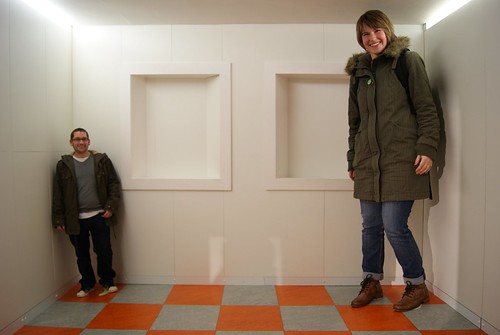
80
New cards
perceptual adaptation
Allows us to learn to deal with new perceptual experiences
81
New cards
Audition
Biological process of which our ears process sound waves
82
New cards
Sound waves
a longitudinal wave consisting of compressions and rarefactions, which travels through a medium
83
New cards
Pinna
Outer ear to catch sound waves
84
New cards
eardrum
Ear canal (auditory canal) > _______ > hammer > anvil > stirrups > cochlea
85
New cards
Cochlea
a coiled, bony, fluid-filled tube in the inner ear through which sound waves trigger nerve impulses
86
New cards
Organ of corti
Center part of the cochlea, containing hair cells, canals, and membranes
87
New cards
Cochlea implants
a device for converting sounds into electrical signals and stimulating the auditory nerve through electrodes threaded into the cochlea
88
New cards
Blind spot
the point at which the optic nerve leaves the eye, creating a "blind" spot because no receptor cells are located there
89
New cards
place theory
Herman vin Helmholtz stated that higher and lower tones excite specific areas of the cochlea's basilar membrane
90
New cards
Frequency theory
suggests that as pitch rises, the entire basilar membrane vibrates at that frequency
91
New cards
volley principle
The theory holding that groups of auditory nerve fibers fire neural impulses in rapid succession, creating volleys of impulses.
92
New cards
T
Ear rely on volume and timing to determine where the sound is coming from
-brain can't accurately locate sounds directly above, below, or front of us
-brain can't accurately locate sounds directly above, below, or front of us
93
New cards
skin
largest organ of the body, detects mechanical energy
94
New cards
Pressure and temperature sensing cells
Detect light touch, pressure, pain, cold, and warmth
95
New cards
pain
Serves as a warning system for damage and danger, helping us survive
96
New cards
nociceptors
Stimulates receptors, but can be reduced by drugs like aspirin
97
New cards
Fast pathways
registers localized pain and relays it to the cortex in a fraction of a second
- Ex: burning yourself
- Ex: burning yourself
98
New cards
Slow pathways
pain information travels through the limbic system, a detour that delays the arrival of information at the cerebral cortex by seconds
- Ex: aches
- Ex: aches
99
New cards
gate-control theory
the theory that the spinal cord contains a neurological "gate" that blocks pain signals or allows them to pass on to the brain. The "gate" is opened by the activity of pain signals traveling up small nerve fibers and is closed by activity in larger fibers or by information coming from the brain.
- fails to explain phantom and chronic pain
- fails to explain phantom and chronic pain
100
New cards
Large nerve fibers
close the pain gate
 Note
Note  Flashcards (97)