power and borders CASE STUDY- MALI
 Call Kai
 Learn
Learn Practice Test
 Spaced Repetition
 Match
Match Flashcards
 Knowt Play
1/6

There's no tags or description
Looks like no tags are added yet.
Name | Mastery | Learn | Test | Matching | Spaced | Call with Kai | Chat |
|---|
No analytics yet
Send a link to your students to track their progress
7 Terms
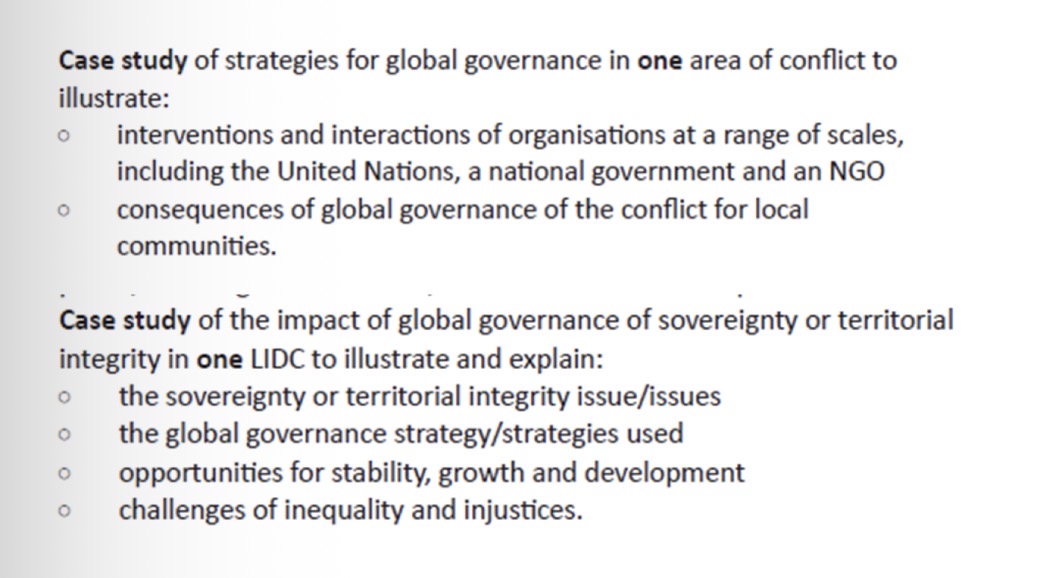
Interventions and interactions of organisations at a range of scales- UN, national government, NGOs
UN:
UN peacekeeping- conflict to peace, provide security
Guided by 3 basic principles: consent of the parties, impartiality, non use of force except in self defence+ defense of mandate
MINUSMA (United Nations Multidimensional Integrated Stabilization Mission in Mali) April 2013 : 12,000 military personnel, 1700 police. 2019-2020 budget US $1.14bil
AIMS: UN Security Council established UN MINUSMA 2013, ensure security, protect civilians + human rights, restoration of state authority, promoting co-operation between security forces. Operate in main population centres (Timbuktu/Bamako), aims to keep lines of communication between gov + army open, provide humanitarian assistance
SUCCESSES: brought stabilisation to Mali—> enabled peaceful 2013 election + 2015 peace agreement which support government. GDP per capita slowly growing, periods of peace bring more economic stability- $879 in 2020, $495 in 2015.
LIMITATIONS: overpowered by Jihadist groups in Northern Mali, MINUSMA focusing too much on central Mali not northern regions, UN accused by Malian gov + Taureg ‘rebels’ (MNLA) of impartiality- 2015 use of helicopters to kill Tuareg fighters to protect UN forces. ½ UN peacekeeping forces killed, conflict ongoing. MINUSMA pulled out of country, Mali became increasingly isolated following militaries most recent coup.
National government (Mali/France):
MALIAN GOVERNMENT: contributed to crisis, through neglect corruption, state weakness, military interference, human rights abuses. Ousted in a coup in 2012- chaos, MNLA (Tauregs) rebels claimed northern cities to liberate Azawad area. Gov asked for foreign military help 2013.
FRENCH GOVERNMENT: french military entered in 2013, 5000 troops sent, operations began against Islamists- Malian military regained control over northern Islamist cities. - Islamists groups trying to advance south towards Bamako like Jihadist groups linked to Al-Quaeda. Rise of these groups due to lack of sovereignty. Withdrew in 2022 due to military coups and demands for them to leave.
NGOs:
Ban of French NGOs after France announced it would freeze official development aid due to concerns over Mali’s collaboration with Russian Wagner group- French had concerns for human rights violations
CARE international: CARE has been helping drought, disaster, conflict affected communities since Sahel food crisis in 2012, CARE provides food and nutrition assistance, and raises awareness on safe water and hygiene. Improve food security.
World Education Mali: addressing educational barriers to literacy
Population services international: health projects, lower birth rate by giving contraceptive information, family planning advice
SUCCESSES: provided assistance to local communities, 120,000 helped with food insecurity, 36,000 water/sanitation help
LIMITATIONS: funding unreliable, difficult in areas where some armed bandits kidnap NGO workers and diplomats for ransom money.
Consequences of global governance of the conflict for local communities
Examples of global governance: UN, french forces, NGOs
Military intervention may exacerbate already existing inequalities and injustices. it may do this by:
increased number of civilian casualties- violent attacks by armed groups: 42% of population require humanitarian assistance 2023.
Displacement of population
Damage to housing+ infrastructure
Food insecurity, farmers are unable to grow crops
Disruption to education- 1600 schools closed
Escalation of human rights violations
MINUSMA mission to protect human rights and civilians, and rule of law in Mali (protect sovereignty) but overpowered by Jihadist groups in the North
Mali government linked with human rights abuses and corruption.
Military intervention by french- displace population, close schools, exacerbate poverty, food insecurity as farmers unable to grow crops
French airstrike targeted what they claimed was a gathering of "terrorists" near the village of Bounti. A UN investigation later concluded the strike hit a wedding celebration, killing at least 19 civilians
urban-rural divides (outside Bamako only a few cities have access to electricity, also 84% of population have access to basic water supplies)
French NGOs banned as France froze development, concerns to Mali’s association with Russian Wagner group- human rights abuses. Disrupted essential services like healthcare, food, water
World education Mali- address barriers to literacy
CARE- food and nutrition assistance
12,000 people helped with food insecurity
Sovereignty or territorial integrity issue(s)
Separatism:
Taureg group rebelled in 2012 (national movement for the liberation of Azawad- MNLA), started armed conflict with Mali gov, by April 2012 Tuaregs declared Azawad as independent state
Tauregs across different countries, not just in Mali- there was little regard for tribal lands when borders were decided
Bamako national government marginalised and neglected Tuaregs. Most recent military coup in 2012 caused by dissatisfaction with government for ineffective governance of the North
Terrorism+ extremist activity:
attacks on Malian and regional military forces and Un and French peacekeeping forces by Islamist groups
lack of sovereignty caused rise of Jihadist groups linked to Al-Quaeda.
Islamist groups worked together with Taureg to claim separatist state because Tauregs wanted northern areas, but then they fought against each other- conflicting political goals
Trafficking of people occurred across porous borders between Mali, Niger, Burkina Faso
Schools targeted- reduce access to education and increases vulnerability to sex exploitation, forced labour + recruitment of children to armed forces.
government inability to police country
Restrict movement of UN peacekeepers, NGO workers who can be kidnapped. UN MINUSMA peacekeepers overpowered by Jihadist groups in northern Mali
Global governance strategy(ies) used
UN stabilisation Mission- MINUSMA
Restoration of state authority/ rule of law
Protection of civilians/ human rights
Promoting co-operation between security forces
Malian government + regional organisations
national military government supported by ECOWAS (economic community of west African states)- regional body supporting peace processes and sanctions to influence political developments
French troops:
5000 troops, significant
IRC (international rescue committee) helping country recover
IRC started work in Mali in 2012
Providing emergency relief
Providing clean drinking water
Healthcare services
Children + parents provided with psychological support- heal from trauma
NGOs like CARE- reduce food insecurity
12,000 helped with food insecurity
World education Mali address barriers to education
Opportunities for stability, growth, development
Global governance strategies create opportunities to increase stability by:
preserving Malis territorial integrity, restoring sovereign state control + rule of law in centre and north
Ensuring peaceful, legal and democratic national elections- stability in Mali
Protecting civilians through improved security and reduction in terrorist activity
NGOs assist local communities, protect human rights, World Education Mali addresses educational barriers to literacy
UN Security Council established MINUSMA 2013- stablise Mali, provide security, reduce terrorist activity, support government in strengthening state apparatus, ensuring democratic elections (successful election in 2013 enabled) restoring territorial integrity
Achieve growth by:
strengthening governance of mining sector- gold is main export- for economic growth
Incorporating north into national economy by accelerating infrastructure projects such as rural electrification
Encouraging youth training schemes- provide skills for employment
Further development by tackling:
health- improving access to health facilities, reducing food insecurity, improving living conditions, disease protection
Education- increasing school enrolment, training teachers, reducing school attacks by terrorist groups
Poverty- helping subsistence farmers to become more resilient using sustainable techniques
Challenges to global governance strategies of sovereignty- inequality and injustices
Inequality:
globally, Mali is one of the poorest and least developed countries HDI 0.427- 184th
High level of income inequality and serious gender inequality
Inequalities between north- poorly funded and limited service provision
84% of population has access to basic water supply
Outside Bamako, only a few towns have regular electricity
Linguistic divisions between ethnic groups- challenge for peace, hinder peace making
Urban-rural contrasts, inequalities in infrastructure and access to services like health, electricity, water supply
Injustices:
government inability to protect citizens from human rights abuses- women and children subject to lots of domestic and agricultural work, child marriage, FGM
Government inability to police country+ provide security against extremist activity: people trafficking, rape, burning of schools, drug smuggling
People fleeing violence displaced internally or in neighbouring countries
Terrorism restricts the movement of UN peacekeepers and NGO workers as some are kidnapped, UN peacekeepers overpowered by Jihadist groups in northern Mali.
Poor access to education- especially for girls. Low adult literacy rate
High infant mortality, maternal mortality, adolescent birth rate.
Low life expectancy (58,9 yrs in 2018)