Lecture 7 -Transport Across Cell Membranes
 Studied by 1 person
 Call Kai
 Learn
Learn Practice Test
 Spaced Repetition
 Match
Match Flashcards
 Knowt Play
1/34

There's no tags or description
Looks like no tags are added yet.
Name | Mastery | Learn | Test | Matching | Spaced | Call with Kai |
|---|
No analytics yet
Send a link to your students to track their progress
35 Terms
Diffusion
Tendency by which molecules move from areas of high concentration to low concentration
At equilibrium in diffusion, molecules continue to move, but there is no __ _____
net flow
Amphipathic lipids are proteins are constantly moving ______ thus creating opportunities for compatible molecules to join or pass through the membrane
laterally
Membrane potential
voltage difference across the membrane generated by the differential distribution of ions
The diffusion of non-charged solutes is determined solely by its ______ ______
concentration gradient
the net drive force of the concentration gradient and membrane potential is called _____ _____
electrochemical gradient
The electrochemical gradient determines the direction of solute flow in ______ _____
passive transport
3 types of cell membrane transport
passive transport
active transport
vesicular transport
Difference between passive and active transport
passive transport: requires no energy input
active transport: energy input required
3 types of passive transport (diffusion)
simple diffusion
facilitated diffusion
osmosis
2 type of active transport
primary active transport (requires ATP directly)
secondary active transport (requires ATP indirectly)
3 types of vesicular transport
endocytosis
exocytosis
transcytosis
Characteristics for molecules to participate in simple diffusion across the cell membrane
small and non polar
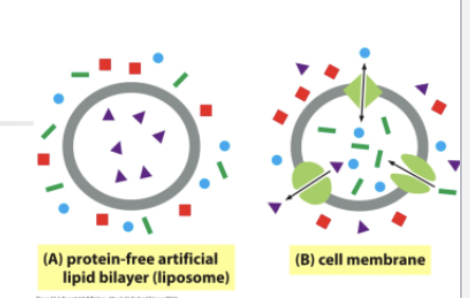
What allows ionic and polar molecules to get across cell membrane?
Membrane transport proteins
two types of membrane transport proteins
transporters (carriers): change conformation
channels: form tiny hydrophobic pores for diffusion
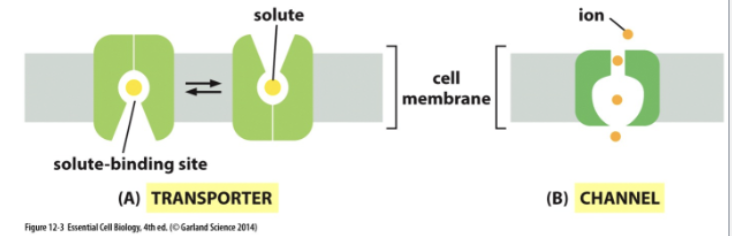
Draw the difference between a transporter and a channel
(see image)
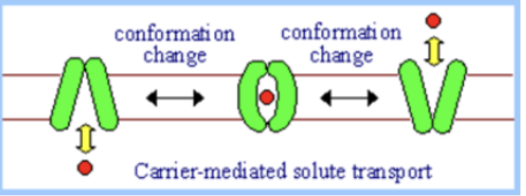
How many conformations must a transport (carrier) protein have
2
Are carrier proteins ever completely open?
No!
What determines the specificity of a carrier protein
carrier binding site
Is carrier-mediated transport active or passive
can be either
carrier proteins can either move ___ or __ specific molecules at a time
one or two
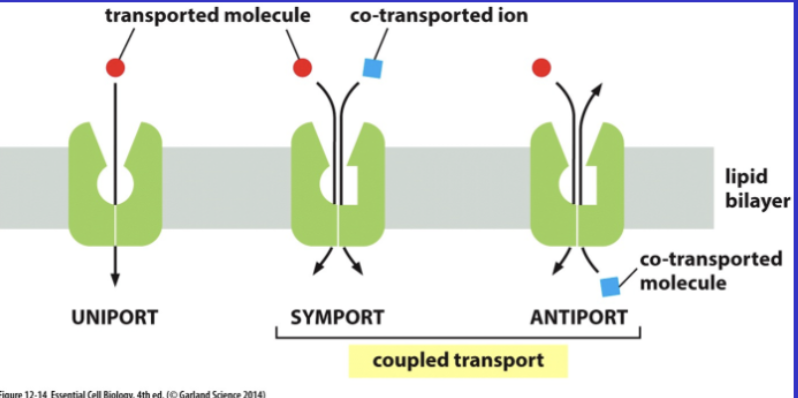
Two types of coupled transport in carrier proteins
symport: same direction
antiport: opposite direction
Active transport requires (2 things)
energy
transporter proteins (pumps)
Active transport is ________ (directionality)
unidirectional
2 types of active transport pumps
ATP driven
coupled pumps
ATP driven pumps
use energy from ATP hydrolysis
primary active transport
Coupled pumps
linked uphill transport of one solute to downhill of another
secondary active transport
The Na+/ K+ pump moves Na+ __ of the cell and K+ __ the cell (restores the concentration gradient)
out; inside
Chemical process of Na/K pump
3 Na+ binds inside the cell
pump catalyzed by ATP hydrolysis; pump is phosphorylated
conformational change occurs → 3 Na+ to the outside
2 K+ accepted from outside
Dephosphoylation triggers conformational change → 2 K+ expelled inside
What is osmosis
Passive diffusion of water through membranes
2 ways osmosis can occur
pass through membrane slowly via simple diffusion
transported through channel protein (aquaporins) via facilitated diffusion
Water transport is always ______
passive
What determines the specificity of an ion channel
diameter; shape
distribution of charged and polar amino acids that line the interior
Protein channels have a ____ ___ at its narrowest part
selectivity filter
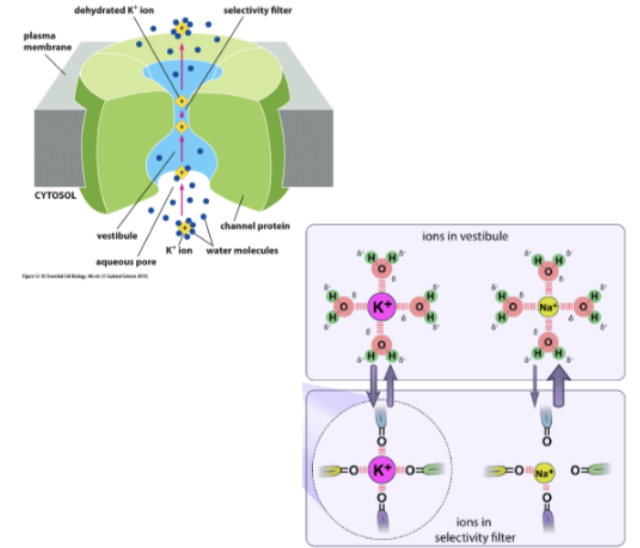
How does the selectivity filter work
water soluble ion enters selectivity filter
brings ion into contact with channel wall
only those with appropriate size and charge offer favorable energy to pass through in single file
 Note
Note  Flashcards (62)