Chapter 12: Nervous Tissue
 Studied by 2 people
 Call Kai
 Learn
Learn Practice Test
 Spaced Repetition
 Match
Match Flashcards
 Knowt Play
1/72

There's no tags or description
Looks like no tags are added yet.
Name | Mastery | Learn | Test | Matching | Spaced | Call with Kai |
|---|
No analytics yet
Send a link to your students to track their progress
73 Terms
List the components of the CNS vs. the PNS
CNS:
brain
spinal cord
PNS:
cranial nerves
spinal nerves
enteric plexuses (in small intestine)
sensory receptors (in skin)
Trace the organization of the nervous system
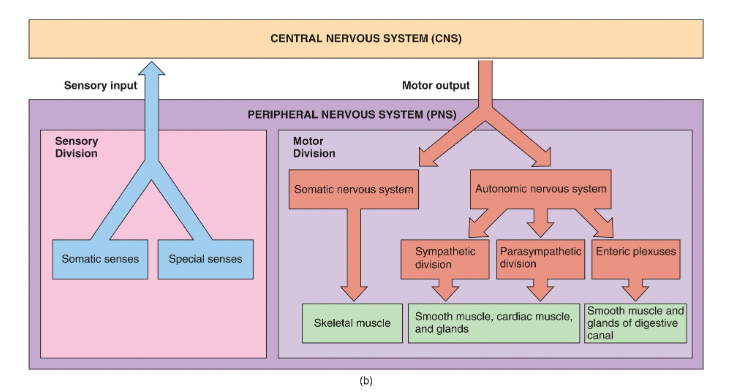
Describe the 3 major functions of the nervous system
SENSORY → detect changes thru sensory receptors
INTEGRATIVE → analyze incoming sensory info, store some aspects, & make decisions regarding appropriate behaviours
MOTOR → respond to stimuli via effectors
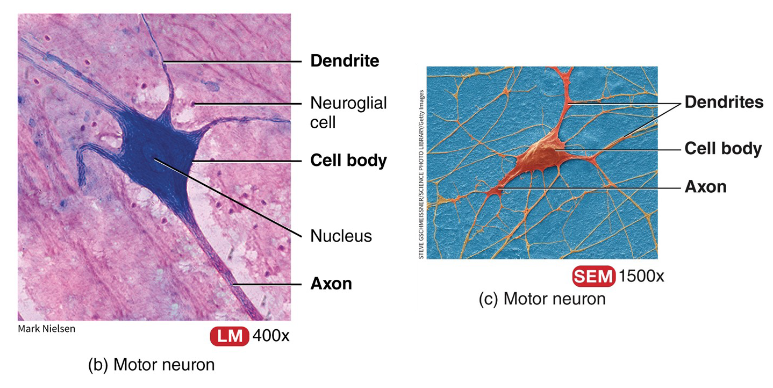
What are neurons?
electrically excitable cellular structures
nerve impulse = action potential
What is considered threshold potential?
-55mV
What is considered resting membrane potential?
voltage across cell membrane when inactive → -70mV
makes inside (-) relative to inside (more K+ inside, more Na+ outside)
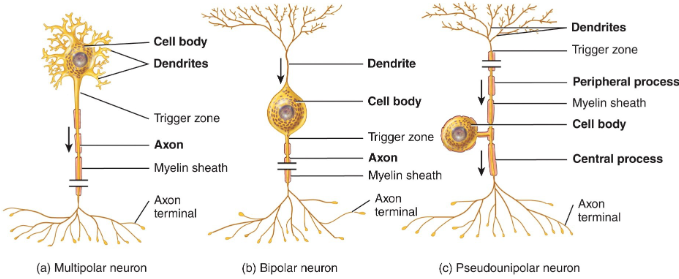
Identify the three classifications of a neuron
Multipolar neuron
Bipolar neuron (one dendrite)
Pseudounipolar neurons
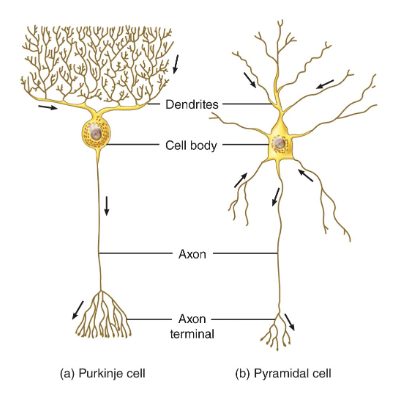
Differentiate the 2 types of dendrititc branching
Purkinje cell
Pyramidal cell
Describe the 3 functional classifications of neurons
Sensory/Afferent Neurons → conveys info to CNS
Interneurons/Association neurons → process sensory info & elicit motor response
Motor/Efferent neurons → conveys actions potential from the CNS
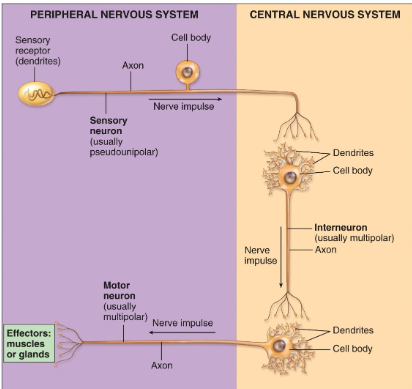
Which type of neuron are sensory, interneuron, & motor neurons usually?
sensory → pseudounipolar
interneuron → multipolar
motor neuron → multipolar
What are neuroglia?
NOT electrically excitable
make up about half the volume of the nervous system
can multiply & divide
6 kinds total (4 in CNS, 2 in PNS)
List and describe the function of the 4 neuroglia in the CNS
ASTROCYTES → support neurons by maintaining chemical environment (Ca2+ & K+)
OLIGODENDROCYTES→ produce myelin in CNS
MICROGLIA → participate in phagocytosis
EPENDYMAL CELLS → form & circulate CSF (cerebrospinal fluid)
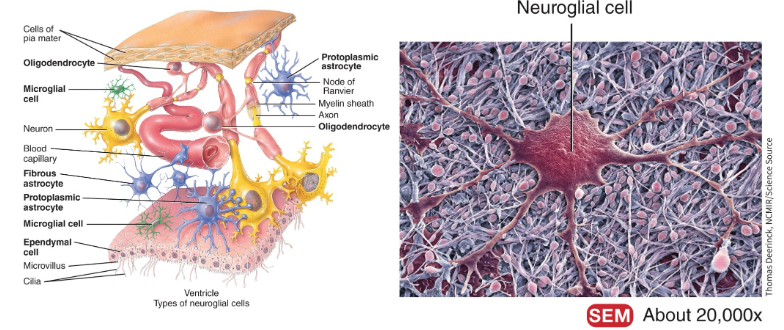
List and the describe the function of the 2 neuroglia in the PNS
SATELLITE CELLS → support neuroglia in PNS; in ganglia
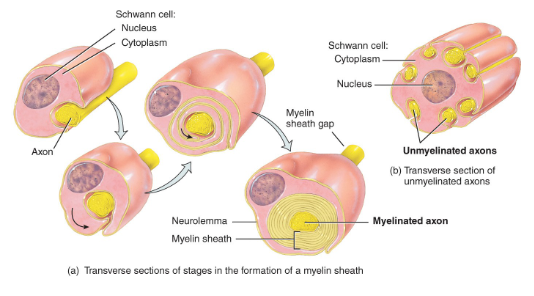
SCHWANN CELLS → produce myelin in PNS
What is myelin sheath?
multilayered lipid & protein covering around some axons that insulates them & increases the speed of nerve & impulse conduction
Excitable cells communicate w/ each other via ___ or ___
action potentials; graded potentials
What is the difference between action and graded potentials?
action potential → allow communication over short & long distances
graded potential → allow communication over short distances only
What does the production of an AP or GP depend upon?
the existence of a resting membrane potential & the existence of certain ion channels
List the 5 types of ion channels
Leak channels
Ligand-gated channels
Mechanically-gated channels
Voltage-gated
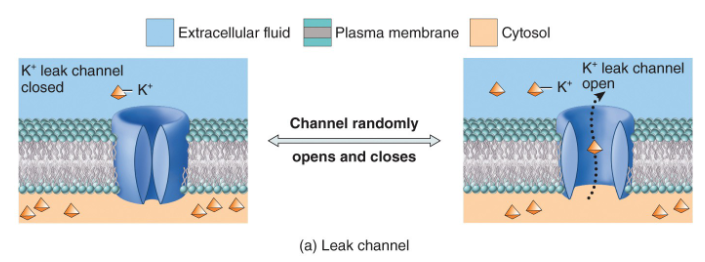
Describe leak channels
randomly alternate between open & closed
K+ channels = more numerous than Na+ channels
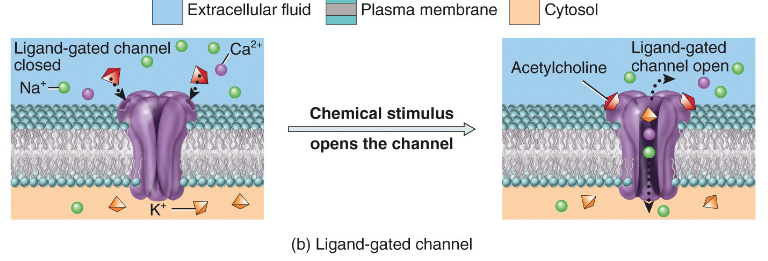
Describe ligand-gated channels
respond to chemical stimuli (ligand binds to receptor; e.g. acetylcholine)
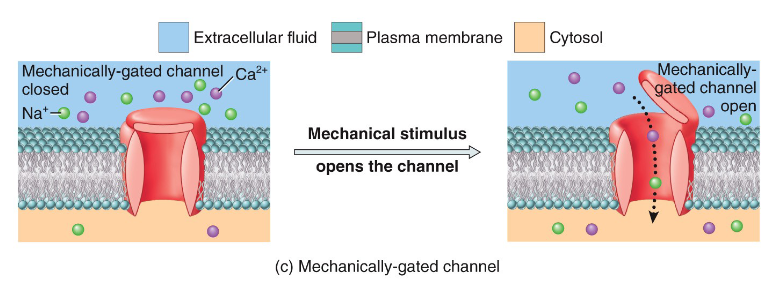
Describe mechanically-gated channels
respond to mechanical vibration or pressure stimuli
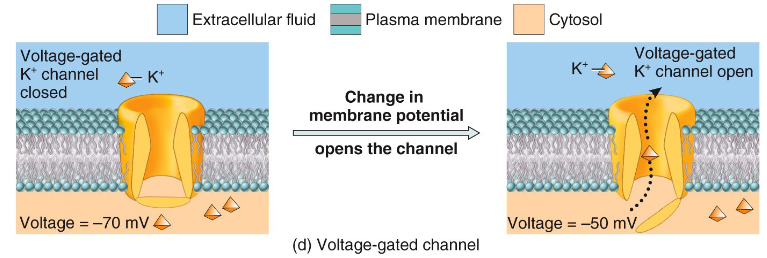
Describe voltage-gated channels
respond to direct changes in membrane potential
The membrane of a non-conducting neuron is postive outiside and negative inside. This is determined by:
unequal distribution of ions across the plasma membrane & the selective permeability of the neuron’s membrane to Na+ & K+
Most anions cannot leave the cell
Na+/K+ pumps
Contrast hyperpolarizing and depolarizing graded potential
hyperpolarizing graded potential → below RMB (-70mV); more polar = more (-)
depolarizing graded potential → above RMB; less polar = more (+)
A graded potential occurs in response to the ______
opening of a mechanically-gated or ligand-gated ion channel
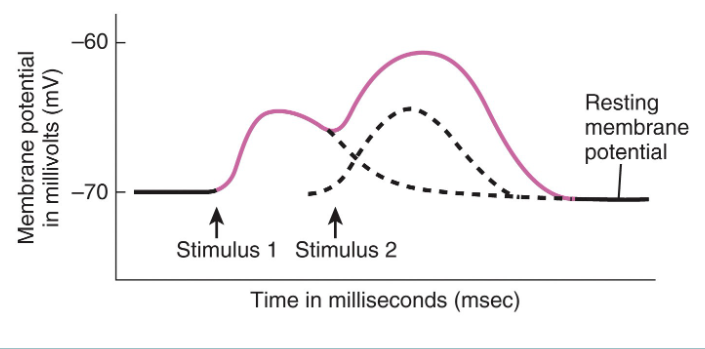
The amplitude of a graded potential depends on the _____. Graded potentials can be ___ to become larger in amplitude.
stimulus strength; added together
List and describe the 2 phases of action potentials
Depolarization → voltage-gated Na+ channel activation gates are open
Repolarization → voltage-gated K+ channels are open; Na+ channels are inactivating
(together = “absolute refractory period”)
Stimulus causes depolarization to ___
threshold
What occurs during relative refractory period?
voltage-gated K+ channels are still open; Na+ channels are in resting state
Action potentials can only occur if the membrane potential reaches ___
threshold
List the phases of changes in ion flow through voltage-gated hcnanels during the depolarizing and repolarizing phases of a nerve impulse
Resting state
Depolarizing phase
Repolarization phase begins
Repolarization phase continues
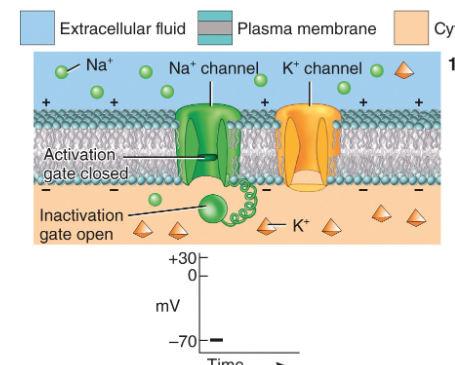
Describe what occurs during resting state
all voltage-gated Na+ & K+ channels are closed
axon plasma membrane is at resting membrane potential
small buildup of negative charges along inside surface of membrane & an equal buildup of positive charges along outside surface of membrane
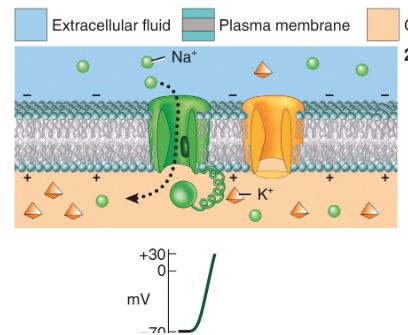
Desrcibe what occurs during the depolarizing phase
when membrane potential reaches threshold, the Na+ channel activation gates open
as Na+ ions move thru these channels into the neuron, a buildup of (+) charges forms along the inside surface of membrane
membrane becomes depolarizaed
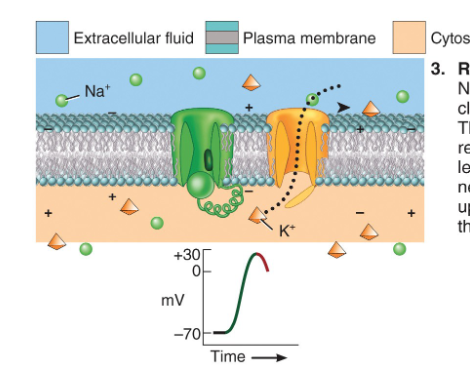
Describe what occurs during the repolarizing phase
Na+ channel inactivation gates close & K+ channels open
membrane becomes repolarized as some K+ ions leave the neuron
few (-) charges begin to build up along the inside surface of membrane
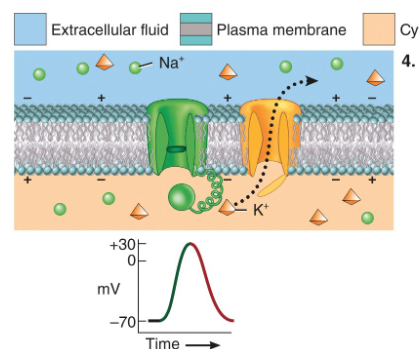
Describe what occurs when the repolarization phase continues
K+ outflow continues; as they leave the nuron, more (-) charges build up along inside surface of membrane
K+ outflow eventually restores RMP
Na+ channel activation gates close & inactivation gates open
return to resting state when K+ gates close
Compare the origin of graded potentials vs. action potentials
GP → mainly in dendrites & cell body
AP → at trigger zones and propagate along axon
Compare the types of channels for GP vs. AP
GP → ligand-gated or mechanically-gated ion channels
AP → voltage-gated channels for Na+ & K+
Compare the conduction of GP vs. AP
GP → decremental (not propagated) permit communication over short distances
AP → propagate & thus permit communication over long distances
Comapre the amplitude/size of GP vs. AP
GP → depending on strength of stimulus, varies from less than 1 mV to more than 50mV
AP → all or none; typically about 100mV
Compare the duration of GP vs. AP
GP → typically longer, ranging from several milliseconds to several minutes
AP → shorter, ranging from 0.5 to 2 msec
Compare polarity of GP vs. AP
GP → may be hyperpolarizing (inhibitory to generation of action potential) or depolaring (excitatory to generation of action)
AP → always consist of depolarizing phase followed by repolarizing phase & return to resting membrane potential
Compare the refractory periods of GP vs. AP
GP → NOT present; summation can occur
AP → present; summation cannot occur
Define propagation
action potentials must trabel from where they arise at the trigger zone to the axon terminals in order for communication to occur
AP do not die out; they keep their strength as they spread across the membrane of a neuron
Differentiate between continuous vs. saltatory conduction
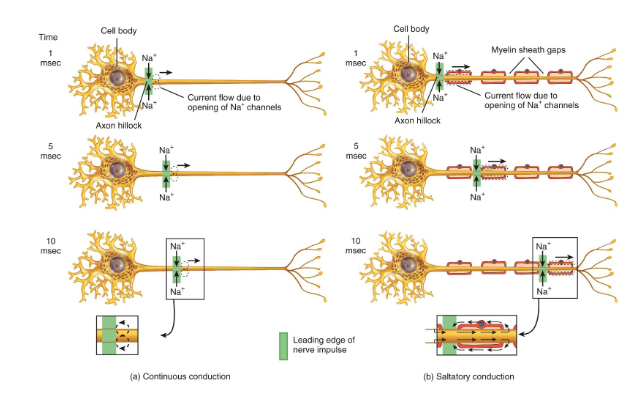
List the 3 factors that affect propogation speed
axon diameter → larger diamter axons propagate APs faster
amount of myelination → myelin increase speed of AP propagation
temperature → higher temperature inccreases speed of AP propagation
What is a synapse? What are the 2 types of synapse?
synapse → junction between neurons or between a neuron & an effector
electrical synapse → gap junctions connect cells & allow the transfer of info to synchronize the activity of a group of cells
chemical synapse → one-way transfer of info from a presynaptic neuron to a postsynaptic neuron
List the types of synapses between presynaptic & postsynaptic neurons
axodendritic synapse
axosomatic synapse
axo-axonal synapse
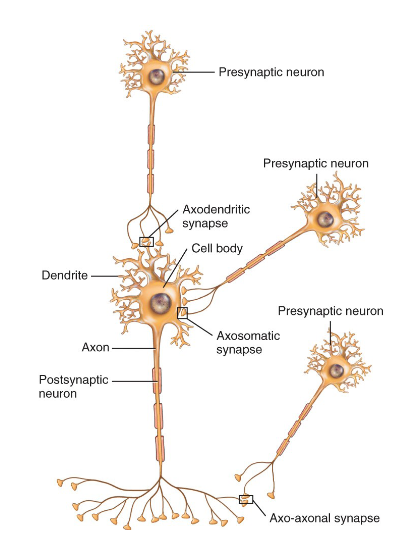
Contrast the 2 types of postsynaptic potentials
excitatory postsynaptic potentials
depolarizing postsynaptic potential
inhibitory postsynaptic potentials
hyperpolarizing postsynaptic potential
True or false: A postsynapic neuron CANNOT receive many signals at once
FALSE
Neurotransmitters at chemical synapses cause either an ___ or ____ graded potential
excitatory (EPSP); inhibitory (IPSP)
List the 2 structures of neurotransmitters (receptors)
ionotrophic receptors → contains neurotransmitter binding site & ion channel
metabotropic receptors → contains a neurotransmitter binding site & is coupled at a separate ion channel by a G protein
Neurotransmitters can be removed from the synaptic cleft by:
Diffusion
Enzymatic degradation
Uptake into cells
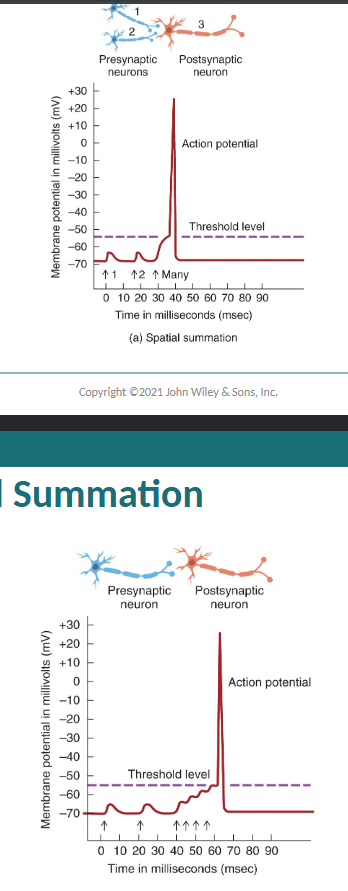
What is summation? What does it cause?
when several presynaptic end bulbs release their neurotransmitter at about the same time
generates a nerve impulse
may be spatial or temporal
Differentiate between spatial or temporal summation
spatial → AP at 40 msec
temporal → AP at around 60 msec
Describe the function of dendrites
dendrites receive stimuli through activation of ligand-gated or mechanically gated ion channels
in sensory neurons, produce generator/receptor potentials
in motor neurons & interneurons, produce excitatory & inhibitory postsynaptic potentials (EPSPs & IPSPs)
Describe the function of the cell body
cell body receives stimuli & produces EPSPs & IPSPs thru activation of ligand-gated ion channels
Describe the function of the “junction of axon hillock & initial segment of axon”
trigger zone in many neurons
integrates EPSPs & IPSPs
if sum is depolarization that reaches threshold, initiates a nerve impulse
Describe the function of an axon
propagates nerve impulses from initial segment (or from dendrites of sensory neurons) to axon terminals in self-regenerating manner
impulse amplitude does NOT change as it propagates along axon
Describe the function of axon terminals & synaptic end bulbs (or varicosities)
inflow of Ca+ caused by depolarizing phase of nerve impulse triggers exocytosis of neurotransmitter from synaptic vesicles
Where on the neuron are ligand-gated channels located?
plasma membrane of the dendrites
Where on the neuron are voltage gated Na+ & K+ channels located?
plasma membrane of the axon
Where on the neuron are voltage gated Ca2+ channels located
plasma membrane of the axon terminals & synaptic end bulbs
Are there any channels located on the cell body?
no
List the 6 major small molecule neurotransmitters
acetylcholine
amino acids
biogenic amines
ATP & other purines
nitric oxide
carbon monoxide
List & briefly describe the 4 major neuropeptides
SUBSTANCE P → found in sensory neurons, spinal cord pathways, & parts of brain associated w/ pain; enhances perception of pain
ENKECEPHALINS → inhibit pain impulses by suppressing release of substance P; may have role in memory & learning, control of body temp, sexual activity, & mental illness
ENDORPHINS → inhibit pain by blocking release of substance P; may have a role in memory & learning, sexual activity, & mental illness
DYNORPHINS → may be related to controlling pain & registering emotions
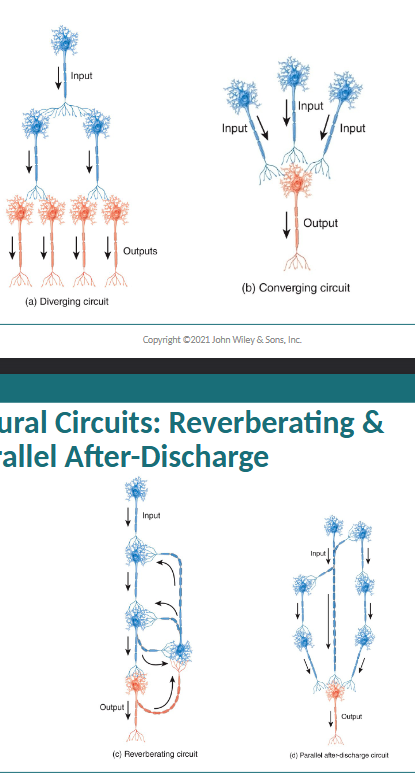
Define neural circuits
functional group of neurons that process specific types of info
List the 5 types of neural circuits
Simple series
Diverging
Converging
Reverberating
Parallel after-discharge
Define plasticity
the capability to change based on experience
define regenerate
the capability to replicate or repair
Although the nervous system exhibits ____, neurons have a limited ability to ____ themselves
plasticity; regenerate
In the CNS, there is little to no repair due to:
Inhibitory influences from neuroglia, particularly oligodendrocytes
Absence of growth-stimulating cues that were present during fetal development
Rapid formation of scar tissue
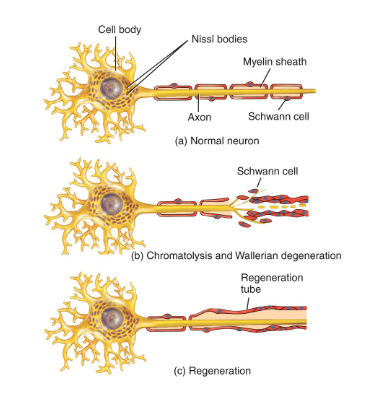
In the PNS, repair is possible if:
the cell body is intact
Schwann cells are functional
scar tissue formation does not occur too rapidly
The steps involved in the repair process of neurons in the PNS are:
Chromatolysis
Wallerian degeneration
Formation of a regeneration tube
 Note
Note  Flashcards (62)