Meteorology 1
 Studied by 0 people
 Call Kai
 Learn
Learn Practice Test
 Spaced Repetition
 Match
Match Flashcards
 Knowt Play
1/8

There's no tags or description
Looks like no tags are added yet.
Name | Mastery | Learn | Test | Matching | Spaced | Call with Kai |
|---|
No analytics yet
Send a link to your students to track their progress
9 Terms
Properties of the atmosphere
Composed primarily of
Nitrogen
Oxygen
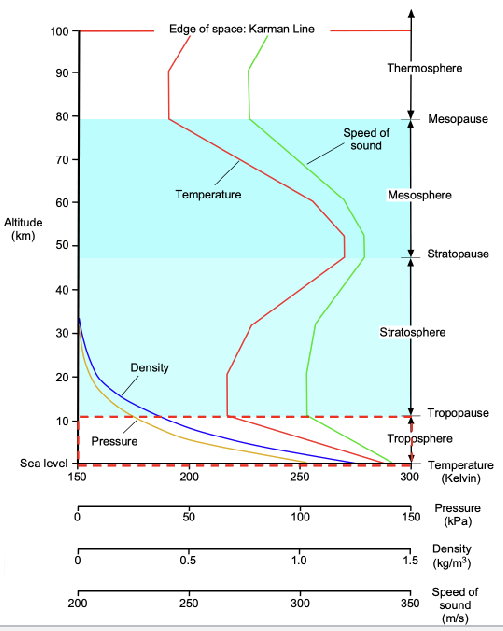
Divided into multiple layers
Weather mostly occurs in lowest layer - Troposphere
Troposphere varies in height from equator to poles
Average height over Europe ~35,000ft
Temperature
Measures kinetic energy of molecules
Density
Measures how much mass is in a unit volume
Pressure
The force applied to a unit area of a surface
Related by ideal gas equation of state: P= ρRT
P - Pressure (Pa)
ρ - Density (kgm-3)
R - 287Jkg-1K-1
T - Temperature (K)
International Standard Atmosphere (ISA)
At Sea Level
Temperature: 15°C
Pressure: 1013.25hPa
Density: 1.225kgm-3
Height of Troposphere: 12km (~40kft)
Within Troposphere
Temperature reduces by 6.5°C per kilometre of altitude (~2°C per 1000ft)
Pressure reduction is complex
At low altitudes approximately linear
~1hPa reduction for every 27ft of altitude
Density calculated from ideal gas law
Motion of the atmosphere
Solar heating drives global movement of air
Tropics get more concentrated heating leading to increased air temperature
Higher temperature air is lower density leading to it rising
Rising air spreads out toward the poles where it cools increasing density, so it falls
Coriolis “Force”
Not a real force, rather a pseudo force
An observer who is stationary in space sees the airflow travelling in a straight line, not acted on by any force
But an observer on the surface of the earth sees airflow is deflected to the right (in the norther hemisphere), which would require a force
Often useful to consider it as a real force
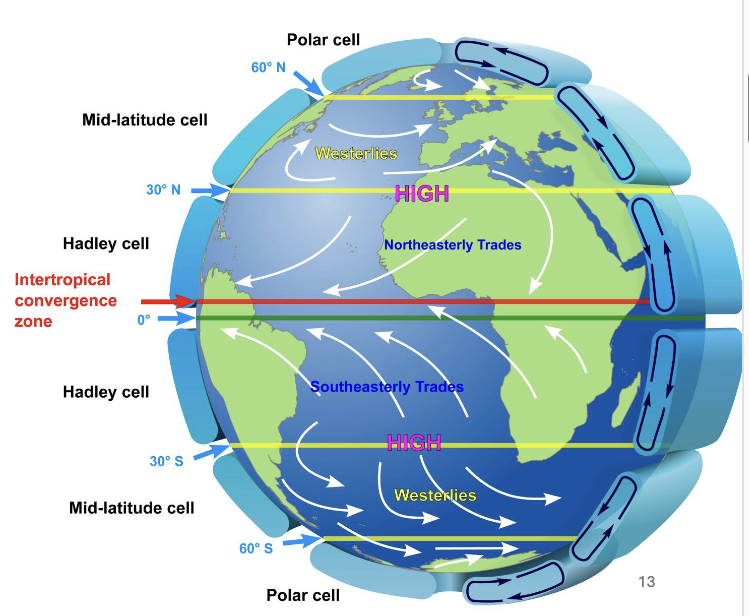
Atmospheric circulation
Coriolis force disturbs the equator to polar air flow
Generates a number of discrete cells
Hadley cell
0-30 degrees latitude
Ferrel/mid-latitude cell
30-60 degrees latitude
Polar cell
60-90 degrees latitude
Pressure systems
Atmosphere cells drive global weather patterns
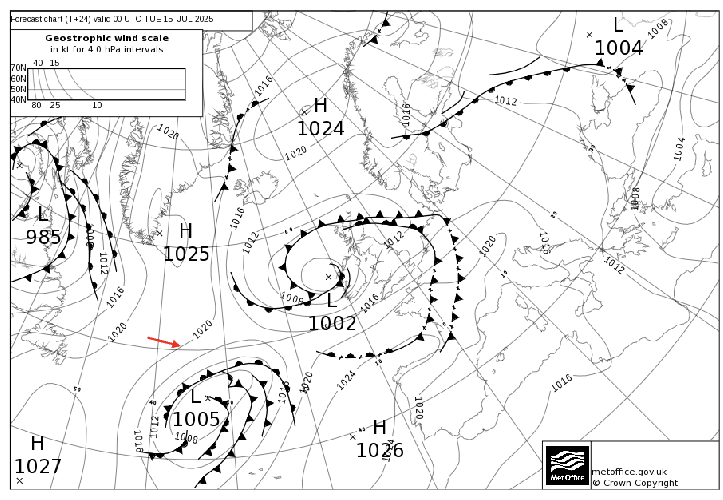
At local levels weather is driven by pressure systems
Characterised by distribution of sea level air pressure
Illustrated by isobars
Simple high pressure system
Air naturally wants to flow from high pressure to low pressure
Without Coriolis force
Air flows out radially
With Coriolis force
Air tends to follow circular path
In general airflow is parallel to the isobars
Geostrophic wind
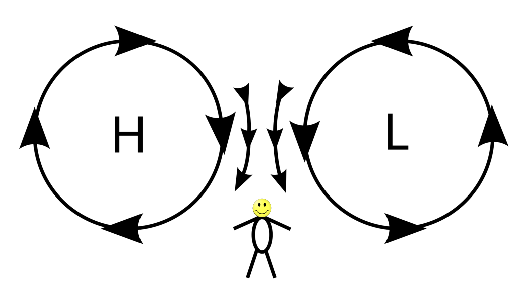
Buys Ballot Law
In norther hemisphere, standing with your back to the wind the Low pressure will be on your Left side. High pressure will be on your Right
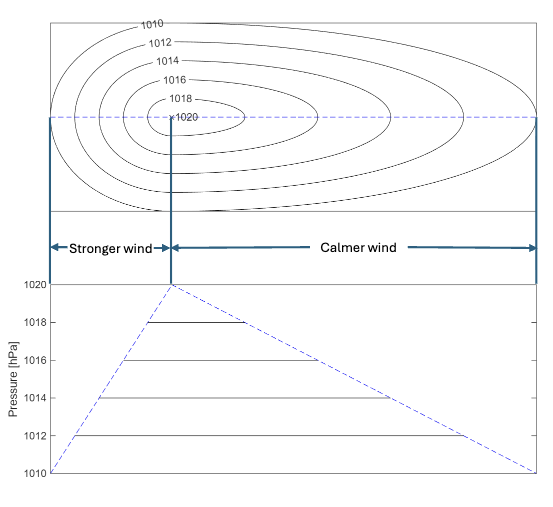
Pressure gradient
Spacing of isobars illustrates the pressure gradient
Close spacing = Steep gradient
Steep gradient = Stronger wind
Large spacing = Shallow gradient
Shallow gradient = Calmer wind
 Note
Note  Flashcards (355)