magnetism:moving charge
 Studied by 0 people
 Call Kai
 Learn
Learn Practice Test
 Spaced Repetition
 Match
Match Flashcards
 Knowt Play
1/9

There's no tags or description
Looks like no tags are added yet.
Name | Mastery | Learn | Test | Matching | Spaced | Call with Kai |
|---|
No analytics yet
Send a link to your students to track their progress
10 Terms
what will happen when a moving charge is in an magnetic uniform field? And electric uniform field?
-circular motion in magnetic field
-projectile motion in electric field
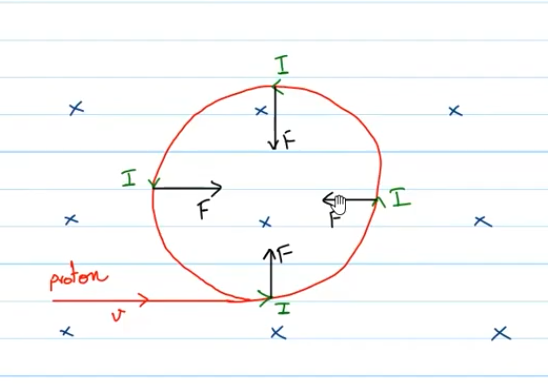
what will happen if the charged particle enters a)vertically & b)horizontally in the magnetic field?
-vertically
the field will cause the particle to move in circular motion as it is perpendicular to the field lines. There will be a magitude of force (pushing it out the field) but since its perpendicular to the velocity it doesnt effect it
-horizontally
there is no magnitude of force by field as it is parallel to the field lines so it will just move straight out
How will we find force produced by the moving charge in a magnetic field?
Since it moves in a circular motion MagneticF=CircularF
MagneticF will be F=bqv as it is for moving charge
How to find the radius of the circle motion made?
MagneticF=CircularF
Bqv=mv²/r, rearrange it
what is velocity selection and how is this done?
It is basically “selecting” the velocity of ur desire for a charge
Make a uniform cross field [Magnetic + Electric] and then pass a charged particle e.g proton with an unknown/known velocity into it
If magnetic field strong will move upwards in a circular motion, if electric field strong will move downwards in projectile motion. We want both the fields to equal each other and cancel each other out so that the proton undeflected passes through the fields
We do this by varying one field or the other to reach that equilibrium
![<p>It is basically “selecting” the velocity of ur desire for a charge</p><p></p><p>Make a uniform cross field [Magnetic + Electric] and then pass a charged particle e.g proton with an unknown/known velocity into it</p><p>If magnetic field strong will move upwards in a circular motion, if electric field strong will move downwards in projectile motion. We want both the fields to equal each other and cancel each other out so that the proton undeflected passes through the fields</p><p>We do this by varying one field or the other to reach that equilibrium</p>](https://knowt-user-attachments.s3.amazonaws.com/edd8bca5-e57c-4805-b1a5-5afcc6f2a192.png)
how will both these field be uniform?
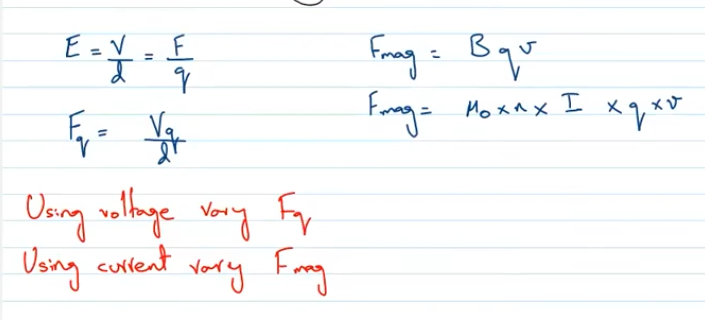
How can we vary the fields? Tell a way for both
B opened up specifically to μ₀nI as its kept in a solenoid
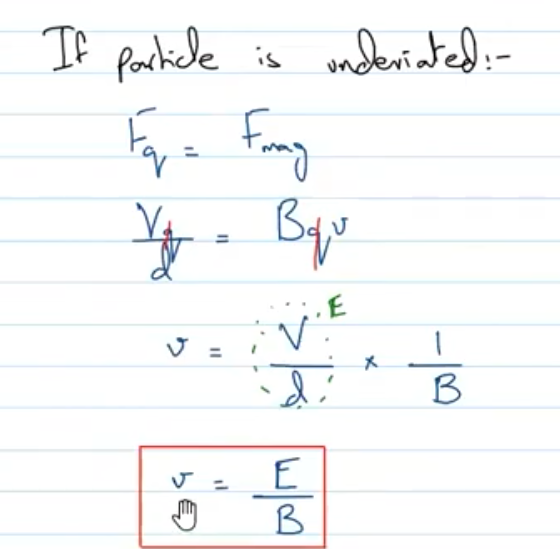
what does it mean if the particle passes through undeflected?
that “selected” velocity will equal to the ratio of electric field over magnetic field AND MagneticF=ElectricF
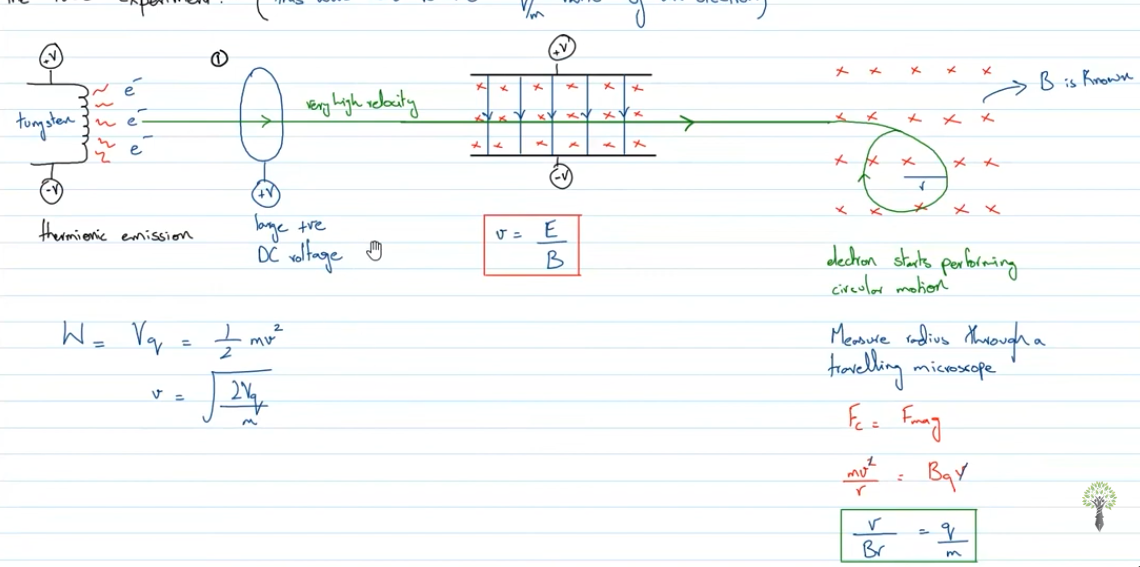
what was the fine tube experiment?
to find the charge/mass ratio of an electron
how was this done?
a wire has potential difference passed through it so that current goes through it as well causing the wire to be so hot it stary radiating electrons. This wire is of tungsten so that it doesn’t melt
then to find the velocity there are two ways as shown
after knowing the velocity this electron is passed through an magnetic field to finally find the charge/mass ratio
 Note
Note  Flashcards (56)