Honors Physics Unit 2
 Studied by 1 person
 Call Kai
 Learn
Learn Practice Test
 Spaced Repetition
 Match
Match Flashcards
 Knowt Play
1/35

There's no tags or description
Looks like no tags are added yet.
Name | Mastery | Learn | Test | Matching | Spaced | Call with Kai |
|---|
No analytics yet
Send a link to your students to track their progress
36 Terms
Force
an interaction between 2 object
Contact Forces
require objects to touch, ex; pushing someone on a swing
Field Forces
do not require objects to touch, ex; gravitational force (we don’t have to be touching the earth to feel its force)
Phrase for Naming a Force
The {name of force} that the {agent} exerts on the {object}
Gravitational Force
The attractive forces that objects exert on each other due to their masses (usually really small) ; earth mass (*10^ 24)
Weight =
gravitational force (weight is not synonymous with mass)
Tension Force
the force that a string/cable/cord/rope/etc exerts on an object
When is Tension Present?
whenever a rope is attached to an object and taut
Direction of Gravitational Force
force is always exerting downward on earth
Direction of Tension Force
parallel to rope, away from the object (The rope PULLS on the object) whatever direction the rope is pulling the object in
Spring/elastic Force
The force that a spring exerts on an object (only if spring is stretched or compressed (deformed)
Direction of the Spring/elastic Force
stretched springs pull, compressed springs push
Friction Force
inhibits 2 objects from sliding across one another
Static Friction
static if friction completely prevents the 2 surfaces from sliding across one another - i.e. they have the same velocity, whenever we have one object touching another and static friction is needed to keep the object(s) stationary
Kinetic Friction
if the 2 objects slide across one another - i.e. they have different velocities (surface isn’t frictionless)
Direction of Static Friction
parallel to the 2 surfaces in contact, in whichever direction needed to balance the forces ex: if you push to the right on a very heavy box but it doesn’t move, static friction is to the left to oppose your push
Direction of Kinetic Friction
opposite the velocity of the object - i.e. if a box slides to the right across the floor, kinetic friction is to the left
Air Resistance (Drag)
the force that air exerts to oppose motion of an object moving through it
Direction of Air Resistance
opposite the velocity of the object (sticking your hand out of a moving car feeling the air resistance)
Normal (applied) Force
the force that one object exerts on another by pushing on it, present anytime 2 objects are touching, perpendicular
Direction of Normal Force
perpendicular to the surfaces in contact, away from agent toward object
Vector
A quantity with magnitude and direction
what are vectors represented by
arrows
Vector Components
give the magnitude and direction of a vector according to 2 perpendicular axes
Finding Vector Components
Draw an x-y axis at the tail of the vector
Draw the x & y components- DONT FORGET ARROWS!!!
Use SOHCAHTOA to find the magnitude of the components
Weight =
Gravitational Force
The speed of a force=
Normal Force
Newton’s 2nd Law
Sigma Force (net force) =( mass)(acceleration)
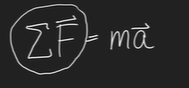
1 Newton =
1 kg * m/s²
Balanced Force Particle Model
Fn (normal force) = Fg (gravitational force) + Ty (vertical tension)
Unbalanced Force Particle Model
Tx (horizontal tension) - fk (kinetic force) =ma (mass)(acceleration)
Fg (gravitational force) =
mg (mass)(gravitational accel. aka 9.8m/s²)
standard acceleration due to Earth’s gravity
9.8m/s²
Equation for Kinetic Friction
(coefficient) of kinetic friction times the normal force

Equation for Static Friction
less than or equal to coefficient of static friction times the normal force
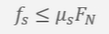
Coefficient of kinetic OR static friction
add small k or s depending on which friction