The MSM
 Studied by 0 people
 Call Kai
 Learn
Learn Practice Test
 Spaced Repetition
 Match
Match Flashcards
 Knowt Play
1/5

There's no tags or description
Looks like no tags are added yet.
Name | Mastery | Learn | Test | Matching | Spaced | Call with Kai |
|---|
No analytics yet
Send a link to your students to track their progress
6 Terms
Describe the MSM
Model should be attached
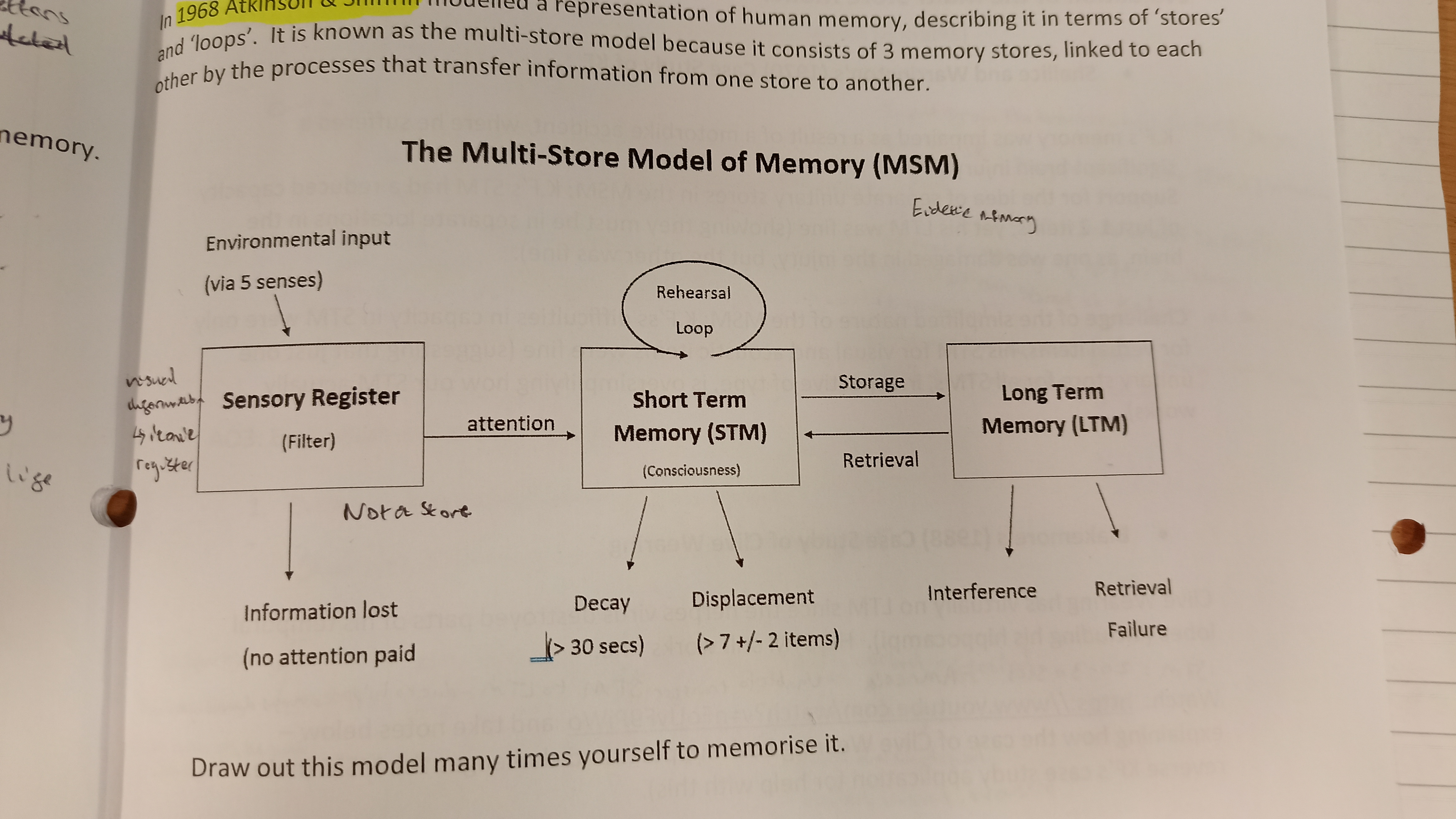
Who made the MSM?
Atkinson & Shiffrin (1968)
Describe the study of KF
KF’s memory had been impaired as a result of a motorbike accident.
Supports the idea of separate unitary stores in the MSM as his STM had a reduced capacity of just 1-2 items but his LTM was fine, indicating that there are separate stores for LTM and STM.
This study also challenges the MSM because the damage was only to verbal items and not acoustic or visual items. This suggests that the MSM oversimplifies memory by making singular stores for LTM and STM when there should be multiple for each type of memory.
Describe the Clive Wearing study
Clive Wearing had a severely damaged LTM as the herpes virus had destroyed parts of his temporal lobes, including hippocampi. His STM was entirely intact.
This condition gave Clive severe long term amnesia, his STM only lasted 20-30 seconds, and he was unable to transfer memories from the STM to the LTM.
This supports the MSM because it reinforces the idea that there are separate stores in the brain for both the STM and LTM as the damage was only done to one part of the brain and that only cause issues with one type of memory.
One of the challenges this presents is with the problem of oversimplifying the model of memory as Clive had no problems with procedural and semantic memories, suggesting that there are separate stores for those forms of LTMs that were not affected.
Describe the study of HM
HM suffered from epilepsy so he had a surgery to reduce seizures. It was done by removing HM’s hippocampus.
Seizures were less frequent
Kept some LTMs but was unable to form new ones.
STM intact
Procedural memory still functional - tested by HM continuing to improve at tracing out a star through a mirror.
Issues/Debates
Machine reductionism:
The MSM attempts to explain complex behaviour and human memory by simplifying memory down to a computer-like system. The problem with this is that memory has other factors that computers do not have, such as emotions or motivations. This limits the usefulness of the MSM as it is less valid because it doesn't take everything into account and is less reliable because it is worse at predicting outcomes.
 Note
Note  Flashcards (355)