AP Bio Unit 8
 Call Kai
 Learn
Learn Practice Test
 Spaced Repetition
 Match
Match Flashcards
 Knowt Play
1/28

There's no tags or description
Looks like no tags are added yet.
Name | Mastery | Learn | Test | Matching | Spaced | Call with Kai |
|---|
No analytics yet
Send a link to your students to track their progress
29 Terms
How do organisms respond to changes in their environment.
Organisms respond to changes in their environment through behavior (actions the organisms chooses or performs) and physiological mechanisms (are the internal process and functions that keep an organisms alive and maintain homeostasis. They describe how the body works on the inside, like how cells, organs, and systems respond to changes. Like the heart rate increase during exercise, the kidneys regulating water and salt balance, sweating cools the body, neurons send signals, and insulin lowers blood glucose)
And these responses are triggered by stimulus, which is an external or internal signal or combination of signals that causes a responses from on organism.
Signaling behaviors
These are actions or patterns of behavior that organisms use to send information to other individuals, allowing them to coordinate actives, attract mates, warn of danger, establish territory, or maintain social structure.
These behaviors evolve because they increase fitness by improving survival or reproductive success.
And this arises from the fact that organisms exchange information with one another in response to internal and external signals, and this communication (which is referred to as this term) between organisms can change behavior. And this ____ _____ produces changes in behaviors of other organisms, and it can lead to such things like differential reproductive success.
Remember _______ _____ exist because organism must communicate information that helps them survive and reproduce. These behaviors arise due to both internal and external signals that trigger the need to send a message.
The various mechanisms that Animals communicate through; Visual; Audible; Tactile; Electrical; Chemical signals;
Animals use various communication mechanisms which include:
_____: These are behaviors where animals use body movements, colors, patterns, or displays to send information that another organism can see. For example mating signals in a Peacock tail display.
_____: These are sound-based behaviors animals use to send information to others. These signals can travel long distances, work in the dark, and allow rapid communication. For example birds songs used to defend territory or identify themselves to other birds.
____: This is physical contact between organisms. These signals are especially important in social species, parent-offspring interactions, and cooperative behaviors. For example bees touch antenna to identify nestmates, or exchange information about food.
______: This communication occurs when animals use electrical fields, or electrical pulses to send information to other individuals. This is most common in aquatic species, because water conducts electricity well. These signals can be used for communication, navigation, mating, territorial displays, detecting predators or prey.
______ _______ This occurs when animals use chemical signals, often called pheromones, to send information to other individuals. These signals can travel long distances, last a long time, and work even when animals are not physically present. For example, ants release pheromones on the ground to mark a path to food, guide other ants, strengthen the trail as more ants follow.
All of these communication mechanisms listed are considered signaling behaviors, as a behavior is any action an organism performs in response to internal or external stimuli. Yet this communication behavior is triggered by both internal and external signals.
Communication mechanisms having multiple uses; Indicate dominance, find food, establish territory, ensure reproductive success
Communication mechanisms, through signaling behaviors have multiple uses including:
_________ _______: For example, a dominate wolf will raise it hackles, stand tail, hold its tail high, and stare directly at subordinate. These visual signals commute dominance without needing to fight.
____ ____: For example, Forager bees perform a waggle dance inside the hive to communicate the direction for food sources, the distance, and the quality of the nectar. Other bees interpret the dance and fly directly to the food, displaying the usage of a visual and tactical signal.
_______ _____: For example, many male birds singe loudly to claim a territory, want other males to stay out, and advertise territory quality for females.
______ ______ _______: For example, Peacocks fan out bright tail feather to signal health and fitness, and perform complex dances to impress females.
Response and communication impacting natural selection and evolution.
Response and communication act to impact evolution, as natural selection favors innate and learned behaviors that increases survival and reproduce success (fitness), such as cooperative behaviors that involve teamwork between organisms of the same species, which act to increases the fitness of individuals and increases the survival of the population.
(Remember innate behavior are genetically controlled and can occur without prior experience or training. And learned behaviors are developed as a result of experience.)
Signaling behaviors between interspecies
Organisms have acted to exchange information with another another, through signaling behaviors that occur with other species (yet remember most signaling behaviors happen interspecies)
Some species have evolved warning traits:
This is used used to do things like discourage predation, they can use aposematism (this is when an organisms uses bright colors or bold patterns to warn predators that it is toxic, dangerous, or bad-tasting), It can also be markings, behaviors, and/or chemicals.
For example: Coral snakes have a distinct red, yellow, and black banding that indicates the presence of venom to potential predators.
Or Skunk arching its back, raising its tail, turning its back, and stopping its feet before spraying.
Communication occurring between scent; A signaling behavior that is chemical signaling.
We see one example of signaling behaviors that organisms engaging in to communicate, specifically being chemical signaling in which mammals use scent markings to establish and identify territory, specifically:
Urine, Feces, or secretions from scent glands
Can contain pheromones
Can communicate social status and ownership
Can warn of competitors
Can be used to attract females
Endotherms
These are organisms that use thermal energy generated by metabolism to maintain homeostasis body temperatures (so basically organisms that make their own body heat using the internal metabolic process)
For example, Changes in heart rate (as a faster heart rate supports higher metabolic activity because More oxygen can be delivered to the cells) fat storage (as that fat is burned for energy and heat is a by-product) muscle contractions (shivering)
Ectotherms
These are organisms that lack efficient internal mechanisms to regulate and maintain body temperate, so they rely on behaviors to regulate temperatures.
Such as moving in and out of the sun or shade.
Due to the fact that these organisms don’t used internal metabolic process to generate body heat, they don’t need to burn nearly as much food energy, compared to ________ who burn huge amounts of calories to keep body temperature stable.
Metabolic rate
This is the amount of energy expended by an animals over a specific amount of time. (so is the speed at which an organism uses energy)
Moreover, a net gain in energy, means an organism takes in more energy than it uses for basic life processes, in the equation form it would be (Energy intake - Energy used for metabolism >). This would result in energy storage, growth or increases reproductive output
Remember ________ rate impacts this, as it is how fast an organism uses energy, and when it is a high rate more ATP is burned, so more food must be consumed just to keep up, this decreases this. This is why endotherms rarely have a large net gain, as they spend a huge amount of energy to maintain body temperature.
So when there is a low _______ rate, there is more net gain as less ATP is burned, food energy lasts longer, and more energy is left over. This is why ectotherms often have a large net gain, as they don’t burn energy to make heat.
Moreover, a net loss in energy, means an organism is burning more energy than it is taking in (Energy intake - Energy used for metabolism<). This would result in loss of mass, decreases in reproduction, and possible death.
Remember ________ rate impacts this, as it is how fast an organism uses energy, and when it is high rate more ATP is burned, so more food must be consumed just to keep up, it causes this to be a likelihood to increases.
So where there is a low _______ rate, there is less likely this would happen as less ATP is burned, food energy lasts longer, and more energy is left over. So the organisms is using energy slowly so it is less likely they would burn more then they are taking in. This is why ectotherms can go days, weeks, or months without eating.
Organisms and their Metabolic Rate
Endothermic organism have a high metabolic rate, this is due to the fact that they used metabolism to generate body heat, burn lots of ATP, require constant food intake, and maintain stable internal temperature. Therefore these organisms requires a lot of energy so they can maintain their internal homeostasis.
For Ectothermic organisms, they tend to have a low metabolic rate, this is due to that fact that they do not use metabolism to make heat, they rely on on the environment for body temperatures, and the burn very little ATP, therefore they can survive long period with food.
Remember Generally, the smaller the organism, the higher the metabolic rate. This is due to the fact that they have a large surface-area-to-volume ration, (so more surfaces are relative to their body mass). This allows heat to escape quickly through that surface, therefore they must burn energy rapidly to replace the lost heat, so they increase metabolism to stay warm.
Organisms using different Reproductive strategies in response to energy availability.
Organisms employ diverse reproductive strategies based on energy availability, including timing reproduction and investing in offspring to maximize their reproductive success in the face of resource constraint.
When energy resources are limited, animals may prioritize survival over reproduction, reducing or halting reproductive activity.
When energy resources are abundant, animals may allocate more energy to reproduce, and increase their reproductive output.
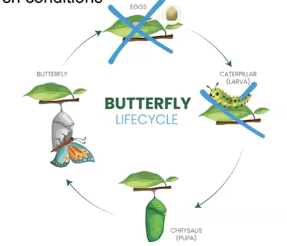
For example, many insects like some moths and butterflies, entire reproduce dipause (this is when an organism temporally stops or slows down reproduction to save energy during bad environmental conditions) during unfavorable seasons, such as winter, to survive harsh conditions.
The different systems that make up the ecological levels; Organisms; population; community; ecosystem; Biome; Biosphere
The different ecological levels of organizations (these are the different scales at which we study living things and how they interact with each other and the environment)
It starts with:
________: this is one individuals living thing
________: This is a group of the same species living in one area
________: This is all different species/ populations living together in one area and interact with each other.
_______: This is the community plus the nonliving environment (Abiotic factor) (so the community of organisms in an area and the abortion facts they interaction with, such as air, water, and soil.
______: This Is the large regions with similar climate and ecosystems, and vegetation, such as desert, forest, or grassland.
_______: This is all life one earth
Energy Flow; Nutrient cycling
This is the one-way movement of energy through an ecosystem, specifically from the sun, to producers, to consumers, and then to decomposers. (Specifically energy enters ecosystems primarily from the Sun, captured by producers — like plants, through photosynthesis. This energy then flows through food chains and webs as organism consume each other. At each trophic level, energy is lost as heat, making it flow unidirectional and not cyclical—This means energy moves in one direction and never comes back, while cyclical means it is a cycle where it gets rescued over and over again)
This is the process where important elements like carbon, nitrogen, and water are reused and recycled through living things and the environment. (Specifically nutrients, like carbon nitrogen, phosphorus, are essential elements that organisms need for growth and survival. These ______ are taken up by organism and then returned to the environment through process like decomposition and respiration)
The four primary biogeochemical cycles; Water cycle: Carbon cycle; Nitrogen cycle: Phosphorus cycle
The __________ cycles, are the natural processes that move essential nutrients (like water, carbon, nitrogen, and phosphorus) between living things and the earth’s air, water, and soil.
These include:
The ______ cycle: This _____ _____ is the continuous movement of water through Earth’s oceans, atmosphere, and Land, powered by the sun and driven by gravity. Water evaporates from oceans, lakes, rivers, and plants release water vapor through transpiration, sending moisture into the atmosphere. There, the vapor cools and condenses into clouds. When the droplets become heavy, they fall as precipitation such as rain or snow. Some of this water runs off into rivers and returns to the ocean, while some infiltrates the ground and becomes groundwater. Throughout this cycle, water changes between liquid, vapor, and ice, but the total amount of water on Earth stays nearly constant (This involves, transportation — evaporation of water from plants, this involves evaporation, this involved condensation — is when water vapor is in the air and cool down and changes into liquid water, and also precipitation)
The _______ cycle: This the the continuous movement of carbon between the atmosphere, living organisms, oceans, soil, and rocks. Plants take in carbon dioxide from the air during photosynthesis and use it to build organic molecules, which then move through food webs as animals eat plants and other animals. When organisms respire, they release carbon dioxide back into the atmosphere. After plants and animals die, decomposers break them down, returning carbon to the soil or releasing it as CO₂ or methane. Some carbon becomes stored long‑term in rocks, fossil fuels, or ocean sediments, and volcanic activity or human actions like burning fossil fuels release this stored carbon back into the air. This cycle helps regulate Earth’s climate by controlling atmospheric CO₂ levels. (These include photosynthesis, cellular respiration, decomposition — when decomposer, like bacteria and fungi and detritivores, that break down organic matter into nutrients, and they release carbon dioxide and they take in oxygen. And combustion, which is the process of burning a substance, while releases carbon dioxide)
The _______ cycle: this is the process that moves nitrogen between the atmosphere, soil, living organisms, and back again, allowing this essential element to become usable for life. Although nitrogen gas makes up most of the atmosphere, it is unusable to most organisms until certain bacteria convert it into ammonia through nitrogen fixation. Other bacteria then transform ammonia into nitrites and nitrates in a process called nitrification, and plants absorb these nitrates to build proteins and nucleic acids. When animals eat plants, nitrogen moves through the food chain, and after organisms die or release waste, decomposers return nitrogen to the soil as ammonia (ammonification). Finally, specialized bacteria convert nitrates back into nitrogen gas through denitrification, releasing it into the atmosphere and completing the cycle. This entire process ensures nitrogen is continuously recycled and available for all living things (
The _______ cycle: Is the movement of phosphorus through rocks, soil, water, and living organisms, and unlike other major cycles, it does not involve the atmosphere because phosphorus rarely becomes a gas. Phosphorus begins in rocks and is released as phosphate ions when rocks weather and break down. Plants absorb these phosphates from the soil, and the nutrient then moves through the food chain as animals eat plants and other animals. When organisms produce waste or die, decomposers return phosphorus to the soil or sediments. Over long periods, some phosphorus becomes trapped in ocean sediments and eventually forms new rock, restarting the cycle. Because phosphorus is essential for DNA, RNA, ATP, and cell membranes, this slow but steady recycling process is crucial for life. (These include stuff like weathering, absorption, and decomposition.)
Changes in energy availability directly impacting populations. Increased energy availability. Decreased Energy availability
Changes in energy availability in an environment directly impact population size, specifically
______ _____ _______: When energy resources are abundant, populations tend to grow. This is because individuals have more resources to support growth, reproduction, and survival.
______ _____ _______: When energy resources, becomes scare, population may decline. This can lead to reduction birth rates, increased death rates, and potentially a decreases in the overall population size.
Trophic Level Effects
These are the impacts that changes in one level of a food chain have on the other levels (This describe how a change in one level of a food chain causes triple effects through the other levels, either upward or downward)
Specifically, changes in energy availability at the top of the food web can cascade down, affecting populations at lower trophic levels. (So it moves from the top-down effects, which is called a trophic Cascade)
This tends to be a inverse relationship, when a higher trophic level changes, the level below usually changes in the opposite direction.
Photosynthetic organisms; Chemosynthetic organisms
These are organisms like plants and algae, use light energy from the sun to convert carbon dioxide and water into glucose, through photosynthesis, which contribute to primary productivity (is the rate at which producers, like plants and algae, make energy-rick food using photosynthesis)
These are organisms like certain bacteria, obtaining energy from chemical reaction, involving inorganic molecules in the absence of oxygen. (they oxidize — meaning loosing electron during a chemical reactions — inorganic compounds, like sulfur or ammonia, to obtain energy) (examples include bacteria found in deep-sea vents that use sulfur compounds as an energy source)(remember this is not the same as anaerobic respiration, as that is the breaking down glucose without oxygen, while this is making food, like glucose using chemical energy)
Heterotrophs; Carnivores; Herbivores; Omnivores; Decomposers; Scavengers
This is an organism that gets its energy by eating other organisms because it cannot make its own food (therefore it is not a photosynthetic organisms neither is a Chemosynthetic organisms). The types of these include:
_______-: Consumer other animals
________: Consumer plants
_______: Consume both plants and animals
__________: Break down dead organisms and release nutrients into the environment
_________: Consumer dead organic matter
What is a population comprised of
A population is comprised of organisms of the same species In a particular area.
And these individuals interact with one another and with the environment in complex ways. Individual within a population usually interbreed with one another more than interbreeding with individuals from other populations.
Populations responding to an environment
Populations response to environment in different ways, specifically:
The size of populations largely depends upon availability of resources, as when food is less available the population size decreases. This is because less food energy is available to support individuals. Reproduction rates decrease, an offspring survivability decreases
However, when food is readily available, the population size increases. As the reproduction rates increases, more food for offspring, and survival rates increases.
Moreover, different species have adaptations that aid in survival when energy availability changes. For example, the storage of fat during winter months, the losing of leaves or growing leaves when day length changes, and Migration in response to changes in food availability.
Formula to determine population growth
Rember Several factors can affect population which includes, the age at reproductive maturity, the number of offspring produces, the frequency of reproduction, and the survivorship of offspring to reproductive maturity.
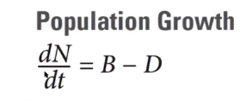
This is the equation that acts to predict that, specifically the limting factors, which includes (dN/dt) = B - D
Specifically:
dN = change in population size
dt = Change in time
B = birth rate
D = Death rate
(remember this one doesn’t take into account carrying capacity or density dependents, it just represents a simple linear population change— so it is not exponential or logistic)
Formula for exponential growth in reproduction
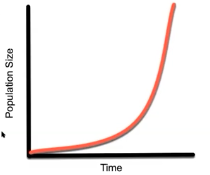
Reproduction without constraints results in this _______ growth of population, which refers to a sharp increase in the growth of a population. This occurs under ideal conditions, when resources are abundant. And the number of organisms added in each generation increases as the population gets large (this means more individuals are reproducing, and how long it takes to produce an offspring stays the same). Remember _________ growth is represented as a J-shaped curve.
And this type of growth is represented by the equation (dN/dt) = Rmax * N
Specifically:
dN = Change in population size
dt = Change in time
N = population size
Rmax = maximum per capital growth rate of population. (is the maximum possible pre-capital growth rate of a population under ideal conditions, so it represses the highest biological growth rate the species can achieve when resources are unlimited, there is not competition, no predators, preference condition)
Resource availability in an environment impacts population density
_______ ____ (this is the number of individuals living in a given area), or the referring to how close individuals within a population live near one another.
And resources availability impacts this as when abundance of food is available, the population can become dense, so it leads to a higher reproductive rate, and therefore space is more limited.
However, when food is limited, the density of a population may decrease, because it leads to lower reproductive rate, so individuals can spread out in a limited space.
Density-dependent factors
These are factors (abiotic or biotic) that limit population growth more strongly when the population becomes crowded (high density). So they get stronger as population size increases because individuals compete more intensely for limited resources.
So these include competition for resources, territoriality, diseases, and predation.
Density-independent factors
These are factors (abiotic or biotic) that limit population size regardless of how crowded the population is. So their impact does not increases or decrease based on population density, they impact large and small populations that same way.
These include natural disasters, like floods, forest firers, volcanic eruptions, and pollution.
Logistic-growth model; Carrying capacity; Formula to display this type of model
This is a model that describe how a population grows quickly at first, then slows down, and eventually levels of when it reaches the ______ _____ (K).
It is illustrated as an S-shaped curve, and when it levels of it reflect the maximum number of individuals an environment can sustain, and it is referred to this. (is the maximum number of individuals an environment can support over time without running out of resources)(remember both density-dependent and density-independent limting factors can cause a population to reach a ______-______)
Under certain conditions, a population can temporally exceeds the ______-______ however limting factors will always bring population size back down, and remember fluctuation in population size can naturally occur at or near _____-______.
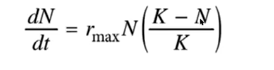
The formal that is used to represses this type of growth would be: (dN/dt) = RmaxN((K-N)/K))
Specifically:
dN = Change in population size
dt = change in time
N = population size
K = Carrying capacity
rmax = maximum per capital growth rate of population
How a community is structured; Species diversity; Species abundance; species evenness; Species composition; Species richness; species abundance
A ________ which refers to a group of different species living together in the same location and interacting with one another, are described based on species _______ and species ________:
Specifically:
Species _______: This is a measures of how many different species are in a community and how evenly the individuals are disturbed among those species.
It includes Species ________: which is the number of individuals of a particular species in an ecosystem
It includes species _______: which is how evenly individuals are distributed among the different species in a community.
Species ______: This is the list of which species are in a community and how many individuals of each species there are (this is made up of species _______ and species ________)
This is made up Species ________: which is the number of individuals of a particular species in an ecosystem
It includes species _______: which is the number of different species in an ecosystem
And communities are based on both of these.
Simpson’s Diversity index
This is how species diversity can be measured using this equations.
And it is therefore used to measure the biodiveristy (remrnes species diverys is the one that actually measures this because it includes species richness and species evenness so it gives a numerical measure of biodiversity)

