4.4 Variation and Evolution
 Call Kai
 Learn
Learn Practice Test
 Spaced Repetition
 Match
Match Flashcards
 Knowt Play
1/34

There's no tags or description
Looks like no tags are added yet.
Name | Mastery | Learn | Test | Matching | Spaced | Call with Kai |
|---|
No analytics yet
Send a link to your students to track their progress
35 Terms
Variation
The differences between organisms of the same species
Phenotype
The total appearance of an organism
Phenotypic variation between people include:
Discontinuous variation
Continuous variation
Discontinuous variation
Shows a limited number of phenotypes
It is normally controlled by one gene
The environment does not affect gene expression
Normally represented on bar charts
Heritable variation
Differences in phenotype due to genetic reasons
This type of variation can be inherited
Non-heritable variation
Differences in phenotype due to environmental reasons
This type of variation cannot be inherited
Continuous Variation
There is a gradation from one extreme to the other
Normally controlled by many genes
The phenotype is determined by the interaction of all the genes and the environment
A bell-shaped curve is obtained
Factors that affect populations of organisms (biotic)
predation
parasitism
disease
competition for resources
What is the major biotic factor affecting breeding success and survival
Competition
Therefore determining the density and growth rate of populations
Things that organisms may compete for
Resources such as sunlight, minerals and food
Nest sites or mates
Intra-specific competition
Competition between members of the same species
Some of the population may not survive or reproduce, so the growth of the population slows
If the resource is plentiful with no competition, then the population will increase
Inter-specific competition
Competition between members of different species
Contest competition
The winning competitor gains the resource
Scramble competition
Many individuals all compete for and gain some of the resource
Selection
The process by which organisms that are better adapted to their environment survive and breed, while those less well adapted fail to do so
Selective agencies
Environmental factors that can alter the frequency of alleles in a population, when they are limiting
Examples of selective agencies
Supply of food
Breeding sites
Climate
Human impact
Selection pressure
The effect of the selective agencies acting on the population through Natural Selection
Gene Pool
Total of all the alleles for all the genes in a population
A gene pool will remain stable under the following conditions:
The population is large
There is no selection pressure
Mating is random
No mutations occur
All genotypes are equally fertile
No emigration or immigration
Genetic drift
A change in the frequency of an allele by chance
The Hardy-Weinberg Principle
The frequency of alleles and genotypes within a population will remain constant from one generation to the next if certain conditions remain true
Hardy Weinberg conditions
The population is large
There is no selection for or against any phenotype
There is random mating throughout the population
There are no mutations
The population is isolated, i.e. there is no immigration or emigration
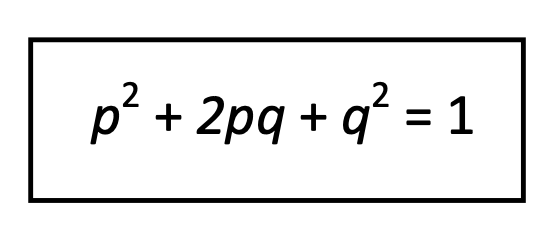
The Hardy Weinberg Equation
p = frequency of the dominant allele
q = frequency of the recessive allele
p + q = 1
p2 = frequency of homozygous dominant (AA)
2pq = frequency of heterozygote (Aa)
q2 = frequency of homozygous recessive (aa)
Charles Darwin and Alfred Russel Wallace's theory of evolution states that…
Existing species have arisen through the modification of ancestral species by natural selection
The theory of evolution is based on the following observations:
In any population, there is variation
Individuals within a population have the potential to produce large numbers of offspring, yet the number of adults tends to stay the same from one generation to the next
From these observations, two deductions can be made…
There is a struggle for survival (competition) with only the ‘fittest’ phenotypes surviving
The individuals who survive reproduce and pass on to their offspring alleles for the phenotypes that enable them to succeed, changing the allele frequency
Speciation
The process by which new species are formed
Speciation can occur due to:
Genetic drift in isolated populations
The founder effect of disproportionate allele frequencies in small populations
Natural Selection
Isolating mechanism for allopatric speciation
Geographical isolation
Isolating mechanism for sympatric speciation
Reproductive isolation
Allopatric speciation
Occurs as the result of two populations becoming geographically isolated
Deme
A group of individuals within a population who breed with one another
Sympatric Speciation
Occurs when organisms inhabiting the same area become reproductively isolated into two groups for reasons other than geographical barriers
The reasons for reproductive isolation include:
Behavioural isolation
Gametic isolation
Seasonal isolation

